
Divine Feminine Across Mystical Traditions: Ibn Arabi, Ameer Khusro, Bhakti, and the Indic Idea of Shakti

By Ghulam Rasool Dehlvi, New Age Islam
06 April 2026
Main Points:
· This article highlights parallels between Sheikh-e-Akbar Ibn al-Arabi’s conception of divine feminine and Ameer Khusro’s bridal mysticism with a passing reference to India’s mystical traditions like Radha and Meerabai in Bhakti mysticism, showing India’s shared devotional culture.
· 722nd Urs Begins at Nizamuddin Dargah: The annual Urs of Hazrat Ameer Khusro begins in the sacred courtyard of his spiritual master/murshid Hazrat Nizamuddin Auliya, symbolizing the eternal bond between disciple and spiritual master.
· Khusro’s Divine Feminine Symbolism: Khusro’s poetry presents the soul as a bride longing for the Beloved, using feminine imagery to express surrender, humility, and divine love.
· His Urs serves as a living symbol of composite Indian mysticism, interfaith harmony, and peaceful spiritual coexistence, teaching love, tenderness, and receptivity in a polarized age.
At a time when religious discourse is increasingly framed through rigid dogmas and civilizational binaries, the shared mystical heritage of India offers a profoundly different grammar—one rooted not in exclusion, but in love, receptivity, sacred beauty, and spiritual complementarity. Few themes illuminate this shared inheritance more deeply than the idea of the Divine Feminine, a motif that flows through Islamic mysticism, Bhakti poetry, and the Indic understanding of Shakti.
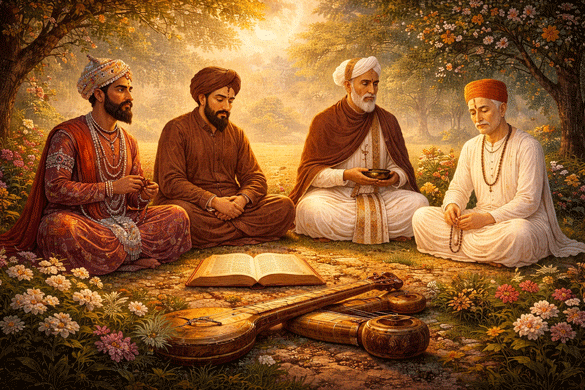
In Islamic metaphysics, one of the most profound articulations of this theme comes from Muhyi al-Din Ibn Arabi, the great Andalusian Sufi philosopher. His reflections on the earth as mother, receptacle, and repository of divine treasures offer a theology of femininity that transcends social gender categories. The earth, in his thought, is patient, receptive, and firm—simultaneously nurturing and powerful. Humanity emerges from her, returns to her, and rises again from her. In this sense, the maternal becomes a cosmic sign of divine creativity itself.
Ibn Arabi’s cosmology is remarkable for the way it binds together earth, maternity, receptivity, and divine creativity. In one striking meditation, he describes the earth as the most powerful of bodies because she gives forth all benefits from her very dhāt—her essence. She is patient, receptive, firm, and the repository of divine treasures. The earth, he says, is the mother from whom humanity emerges, to whom it returns, and from whom it will rise again. This is not merely poetic description; it is a metaphysical statement. The maternal and the earthy become signs of divine generosity, power, and permanence.
What is especially striking is that Ibn Arabi does not oppose these maternal qualities to divine majesty. Rather, he interweaves receptivity with strength, fertility with permanence, and softness with ontological power. This synthesis challenges the habitual separation of so-called masculine and feminine virtues. The Divine Feminine in his thought is not secondary; it is central to the unfolding of creation.
This metaphysical insight finds a uniquely Indian poetic embodiment in Hazrat Ameer Khusro Dehlavi, whose mystical songs transform feminine symbolism into the emotional language of longing. In Khusro, the soul becomes the bride yearning for the Divine Beloved, a trope that resonates deeply within both Persian Sufi and Indian devotional traditions. The famous “Chhap Tilak Sab Chheeni” is more than a love lyric; it is the drama of the soul emptied of ego and opened to grace.
Khusro’s genius lies in his ability to translate abstract metaphysics into lived spiritual experience. Where Ibn Arabi philosophizes the receptive nature of being, Khusro sings it. The feminine in his verse is the station of surrender, the sacred vulnerability through which the heart receives faiz—the overflowing grace of the Beloved.
This is where the Indian civilizational context becomes especially significant. The motif of the soul as bride is equally central to Bhakti traditions, from Meerabai’s unconditional and eternal love for Shri Krishna to Andal’s bridal mysticism and the Vaishnava poetry of Radha’s longing for Krishna. Here too, the devotee assumes a feminine posture before the Divine—not as biological identity, but as a symbol of complete surrender and ecstatic love.
The parallels are striking. In Sufism, the seeker becomes the bride of the Beloved. In Bhakti, the bhakta becomes Radha-like in longing. In both, femininity symbolizes receptivity, intimacy, and the transcendence of ego. This shared symbolism reveals an extraordinary civilizational dialogue between Islamic and Indic spiritualities.
The Indic concept of Shakti deepens this comparison further. In Hindu philosophical traditions, Shakti is the primordial creative energy of the cosmos—the dynamic power through which the Divine manifests the universe. She is not merely “female” in a biological sense; she is the principle of becoming, creation, movement, and transformation.
Here one finds a profound resonance with Ibn Arabi’s cosmology of the earth and Khusro’s bridal mysticism. The receptive earth, the longing soul, and the cosmic energy of manifestation all point toward a shared sacred intuition: the feminine is not marginal to spirituality; it is foundational to the very possibility of divine encounter.
This convergence has important implications for contemporary India. At a time when identity politics often hardens religious boundaries, the shared symbolism of the Divine Feminine offers a deeply rooted language of coexistence. It reminds us that beneath doctrinal differences lies a common mystical anthropology—one in which the highest human state is not domination, but surrender; not conquest, but receptivity; not ideological certainty, but love.
The Sufi khanqah and the Bhakti mandir have historically nurtured this sensibility. At the dargah of Hazrat Nizamuddin Auliya, Khusro’s songs continue to be sung by people across faiths, just as Bhakti poetry continues to dissolve boundaries of caste, sect, and creed. Both traditions affirm that the heart becomes truly human only when it learns the feminine virtues of tenderness, patience, and openness.
In today’s fractured world, this civilizational wisdom is urgently relevant. The Divine Feminine—whether in Ibn Arabi’s earth symbolism, Khusro’s bride, Bhakti’s Radha, or the cosmic Shakti—invites us to rethink power itself. True power is not domination but creativity; not rigidity but the capacity to nurture life and meaning.
For New Age Islam’s readers, this shared mystical grammar is also a reminder of India’s deeper spiritual unity. The bridges between Sufism and Bhakti are not modern inventions; they are part of the subcontinent’s lived sacred history. The feminine soul longing for the Beloved, the mother earth concealing divine treasures, and the cosmic energy animating existence all speak a common language of transcendence.
In the final analysis, the Divine Feminine across civilizations is less a doctrine than a way of seeing reality itself—as relational, fertile, compassionate, and open to grace. Ibn Arabi offers its metaphysics, Khusro its music, Bhakti its devotion, and Shakti its cosmic force. Together, they offer India and the world a spiritual vision capable of healing our age: strength rooted in tenderness, identity softened by love, and transcendence revealed through the receptive heart.
Hazrat Ameer Khusro’s enduring genius lies in translating this metaphysical truth into song, poetry, and love. Ibn Arabi gives us the ontology; Khusro gives us the music. One explains why the feminine is sacred, the other makes us feel it. And perhaps this is the deepest lesson both masters offer: the way to the Divine is through a heart strong enough to be tender, and tender enough to receive the Infinite.
…
Contributing author at New Age Islam, Ghulam Rasool Dehlvi is writer and scholar of Indian Sufism, interfaith ethics, and the spiritual history of Islam in South Asia. His latest book is "Ishq Sufiyana: Untold Stories of Divine Love".
New Age Islam, Islam Online, Islamic Website, African Muslim News, Arab World News, South Asia News, Indian Muslim News, World Muslim News, Women in Islam, Islamic Feminism, Arab Women, Women In Arab, Islamophobia in America, Muslim Women in West, Islam Women and Feminism