
Beyond the Binary: Krishna, Buddha, Ashoka and Akbar ' India's Spiritual, Political and Ethical Archetypes

By Ghulam Rasool Dehlvi, New Age Islam
06 March 2026
Nations, like individuals, pass through moments of moral uncertainty. In such times, history becomes a mirror. But the danger lies in treating that mirror as a battlefield — forcing civilizational and spiritual icons—such as Krishna and Buddha — into rivalry instead of allowing them to speak to one another….
In a recent conversation with this writer on a previous article on this platform, an intriguing comment was made by Mr Sumit Paul, regular columnist for New Age Islam, and a researcher in comparative religions. Let me first quote his verbatim words:
“Ram or Krishna didn't exist. Mahabharat, Ramayan etc. are all myths. Even if you apply Mythical Symbolism to understand the whole caboodle, you may be aware that in the post-Mahabharat religious literature of Hindus and even in Mahabharat, Krishna was held responsible for the bloodshed at such a large scale. Pandavas got disillusioned after the Battle of Kurukshetra. In fact, Pandavas were finer and much better humans than that manipulative Krishna who instigated Arjun and his brothers to fight and eliminate Kauravas by reciting a specious shlok, Yada Yada Hi Dharmasya Glanirbhavati Bharat (Chapter 4, shlok 7-8). To be precise, Pandavas were tricked into going to battle by the shrewd and bellicose Krishna. That fallaciously motivating shlok was used by the killers of M K Gandhi to justify their reprehensible deed. Approximately 3500 years ago, Krishna used his misleading shlokas to egg a reluctant Arjun on to kill Kauravas, his brethren, however evil they may have been. Krishna's example cannot and shouldn't be emulated in these bloody times. Directly or indirectly, putative Krishna's acts justify Jihad/ Crusade or Dharm Yuddh (religious war). These are oxymoronic myths. How can a war be religious? It can only be sanguinary and nothing else. The bloodied mankind doesn't require war-monger 'prophets' and 'gods' but an evolved soul like the Buddha who said so movingly and poignantly, "Passivity at any price. Suffer dishonour and disgrace but never resort to arms. Be bullied, be outraged, be killed but do not kill."
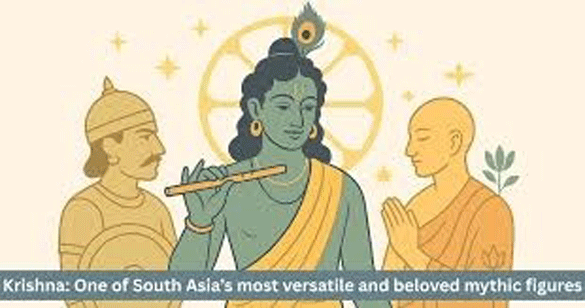
This observation needs a reasoned rebuttal. The assertion that Krishna was a manipulative instigator of violence, and that his message justifies religious war, reflects a selective and historically compressed reading of the Indic tradition. It also constructs a false moral opposition between Krishna and the Buddha — as though one represents bloodshed and the other pure peace. Let us examine this more carefully.
Myth, History and Meaning
Whether one believes Krishna and Rama to be historical figures or mythic archetypes is secondary to their civilizational role. Myths are not falsehoods; they are symbolic narratives through which cultures wrestle with moral dilemmas. To dismiss them as “non-existent” is to overlook their philosophical depth.
The Mahabharata itself is not a simplistic glorification of war. It is a tragedy — a meditation on the catastrophic cost of moral failure. The desolation after Kurukshetra, including the disillusionment of the Pandavas, is central to the epic’s moral warning.
Was Krishna Responsible for Bloodshed?
This writer does believe that the Bhagavad Gita is a greater manual of Jihad than even the Qur’an and Shri Krishna—much before Muhammad (pbuh) in Arabia—was in fact a Prophet of Islam in India who waged a war to uphold justice and righteousness. However, it is inaccurate to portray Krishna as the architect of violence. The war in the Mahabharata emerges after prolonged injustice, humiliation and failed negotiations. Krishna is repeatedly shown as attempting peace before war becomes inevitable. This is precisely what Prophet Muhammad did before he was forced to engage in the battles of Badr, Khandaq, Hunayn or other Ghazwas. The battlefield discourse in the Bhagavad Gita or even in Qur’an does not celebrate killing; it addresses a paralysis in the face of duty.
The famous verse in Srimad Bhagavad Gita, “Yada Yada Hi Dharmasya…” (4:7–8), speaks of restoring moral order when it collapses. It does not endorse perpetual warfare; it frames action within the context of justice and cosmic balance. To reduce this to a slogan for violence is a distortion — much like misusing any sacred text to justify extremism. The criminal misuse of scripture, whether in the assassination of Mahatma Gandhi or elsewhere, indicts the perpetrator, not the text.
The Question of “Religious War”
Sumit Saheb rightly asks: how can war be religious? Indeed, history shows that labelling war as sacred often masks political ambition. Yet the Mahabharata does not romanticize war as holy conquest. It portrays war as a last resort in the defense of justice when dialogue collapses.
Krishna’s teaching in the Gita emphasizes:
Acting without hatred
Detachment from personal gain
Responsibility toward social order
It is a philosophical treatise on ethical action under tragic circumstances — not a manual for crusade or jihad.
Buddha and the Ethics of Non-Violence
Gautama Buddha represents the highest articulation of non-violence and inner transformation. His emphasis on compassion and renunciation is indispensable for any civilization. However, even Buddhist history shows the complexity of political life. Absolute passivity in the face of systemic injustice raises difficult moral questions. Can society survive if all refuse to resist aggression? The tension between non-violence and responsibility is not easily resolved.
Krishna and Buddha address different ethical situations:
Buddha speaks primarily to the individual seeker.
Krishna addresses a ruler and warrior trapped in a collapse of public order.
Both grapple with suffering; they differ in context, not in moral seriousness.
A False Binary
To frame Krishna as a “war-monger” and Buddha as the sole voice of moral evolution oversimplifies Indian thought. The Mahabharata does not glorify bloodshed; it mourns it. The Gita does not celebrate killing; it demands introspection before action.
The real danger lies not in Krishna’s verses but in selective interpretation. Any tradition — Hindu, Muslim, Christian or otherwise — can be weaponized when stripped of ethical nuance.
What Does Humanity Need Today?
Humanity certainly does not need violence masquerading as piety. But neither does it need moral passivity in the face of injustice. The challenge is to balance compassion with responsibility, restraint with courage. Krishna’s central teaching is not “go to war.” It is:
Act without ego.
Stand for justice.
Do not act out of hatred.
At the same time, Buddha’s central teaching is:
Conquer anger with compassion.
Master the self.
These are not mutually exclusive insights. A mature civilization draws from both — resisting injustice while guarding the heart against cruelty.
To reduce Krishna to a manipulator and Buddha to passive surrender is to misunderstand both. Indian civilization’s depth lies precisely in its ability to hold these tensions — action and renunciation, power and compassion — in creative dialogue.
The true enemy is not mythic symbolism. It is a simplistic reading. And in that struggle, intellectual honesty is our first moral duty.
The Revolution Within
Gautama Buddha stands for the quiet revolution of the inner world. His renunciation of power and privilege was not weakness but strength — a declaration that real change begins with the conquest of desire, ego and anger. He offered a path where compassion replaces revenge and mindfulness replaces reaction. In a climate of growing polarization, Buddha’s insistence that hatred cannot end hatred feels almost prophetic.
Duty in the Midst of Conflict
Krishna, particularly in the Bhagavad Gita, presents a different moral landscape. Life is not always a forest of meditation; sometimes it is Kurukshetra — a field of unavoidable moral struggle.
Krishna’s message is not the glorification of war but the sanctification of responsibility. When injustice threatens social balance, withdrawal is not virtue; ethical action becomes duty. Yet even in action, detachment from ego remains central. Thus, where Buddha emphasizes restraint, Krishna emphasizes righteous engagement. Both are necessary in different contexts.
The Conversion of Power
History offers rulers as well as sages. Ashoka is perhaps the most dramatic example of moral transformation in political history. The devastation of the Kalinga War shook him profoundly. His embrace of Dhamma was not symbolic — it altered the language of governance, prioritizing welfare, tolerance and moral instruction over conquest. Ashoka demonstrates that repentance is not weakness; it is the highest form of strength. A state that learns from its violence can redefine its destiny.
The Architecture of Pluralism
Centuries later, Akbar confronted a different challenge — how to govern a religiously diverse society without succumbing to sectarian dominance. His principle of Sulh-i-Kul (peace with all) attempted to institutionalize coexistence. By engaging scholars of multiple faiths and incorporating diverse communities into administration, he acknowledged that India’s unity could not be built on exclusion.
Akbar’s experiments were not flawless, but they carried an enduring insight: political stability in India requires cultural respect.
A False Choice!
To place Buddha against Krishna, or Ashoka against Akbar, is to misunderstand the layered genius of Indian civilization. These figures do not cancel one another; they complete one another.
Buddha teaches self-mastery.
Krishna teaches moral responsibility.
Ashoka teaches repentance and ethical governance.
Akbar teaches sulh-e-kul (peace and reconciliation with all), pluralism and inclusive statecraft.
Each addresses a different dimension of human and collective life — the soul, duty, power and society.
The Way Forward!
India today does not suffer from a lack of heritage. It suffers from selective memory. When one tradition is amplified and others diminished, balance is lost. The real challenge is integration — drawing from multiple moral reservoirs without turning them into ideological weapons.
The future does not lie in choosing between contemplation and action, or between strength and tolerance. It lies in harmonizing them. If compassion guides power, if duty is tempered by humility, and if governance respects diversity, then India’s past will not remain a museum of greatness. It will become a living ethical resource.
History does not demand imitation; it demands understanding. And perhaps the truest homage to Buddha, Krishna, Ashoka and Akbar is not an argument over their superiority, but sincere effort to embody the virtues they represent. Only then can our civilization move from nostalgia to renewal.
…
Contributing author at New Age Islam, Ghulam Rasool Dehlvi is writer and scholar of Indian Sufism, interfaith ethics, and the spiritual history of Islam in South Asia. His latest book is "Ishq Sufiyana: Untold Stories of Divine Love".
New Age Islam, Islam Online, Islamic Website, African Muslim News, Arab World News, South Asia News, Indian Muslim News, World Muslim News, Women in Islam, Islamic Feminism, Arab Women, Women In Arab, Islamophobia in America, Muslim Women in West, Islam Women and Feminism