
Are Jews And Muslims At A Perpetual War? Lessons from The Life and Work of Sheikha Maryam Kabeer And Her Journey from Judaism To Sufism

By Ghulam Rasool Dehlvi, New Age Islam
03 March 2026
Main Points:
· In moments of intense geopolitical conflict—especially in the wake of tensions involving Israel and Iran—it is easy for observers to fall into sweeping generalizations. A dangerous narrative resurfaces: that Jews and Muslims are locked in an eternal religious struggle. But is this perception grounded in theological reality, or is it shaped by political circumstances and historical wounds?
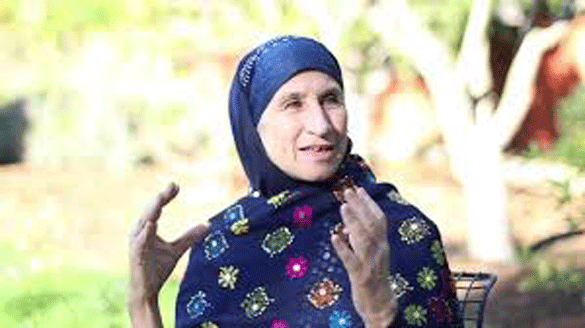
· The life of Sheikha Maryam Kabeer Faye offers a powerful counterexample to the myth of perpetual war. Born into a Jewish family in Hollywood, California, she embarked on a lifelong spiritual search that ultimately led her to Islam—specifically to the inner path of Sufism. But her journey is not one of rejection or rupture, but of continuity, deepening, and fulfilment.
· For her, Judaism and Islam are not alien to one another. Both trace their lineage to Prophet Abraham (pbuh), who embodies surrender (Islam) and covenantal faith (Judaism). Both affirm uncompromising monotheism, moral accountability, prayer, charity, and reverence for revelation. The Qur'an itself acknowledges the Children of Israel as recipients of divine guidance, while Jewish tradition recognizes Abraham as a model of faithful obedience.
· Theologically, there is no divine commandment requiring Jews and Muslims to be in perpetual hostility. The concept of eternal war arises not from scripture, but from political struggles, territorial disputes, and modern nationalism. To confuse state conflict with religious destiny is to misunderstand both history and theology.
· In her acclaimed memoir, A Journey Through Ten Thousand Veils, Sheikha Maryam recounts how, as a young girl, she received a scroll bearing the words: “Seek and the Truth Shall Make You Free.” That message ignited a quest that took her across continents—from India and Nepal to Christian monasteries in Europe—before she embraced Islam under the guidance of a Sufi master.
· Her conversion was not a repudiation of her Jewish upbringing, but the culmination of her spiritual seeking. Through Sufism, she came to understand the metaphor of “veils”—the layers of ego, fear, prejudice, and illusion that obscure our perception of unity. Among the most powerful of these veils is the illusion that human beings are fundamentally divided by religious identity. For her, the spiritual path revealed something deeper: that all lives are interconnected, united at their source in the One Loving Creator.
…
“Unite in the Light…...Seek and the Truth shall make you free.”
“The journey is the removal of veils.”
“All lives are interconnected.”
“Surrender is the key to transformation.”
“We are guided by Divine Love.”
Short and widely cited excerpts, representative lines and themes drawn from the book “A Journey Through Ten Thousand Veils” by Sheikha Maryam Kabeer Faye
The world today is at a war. It watches a major conflict which unfolded between Israel-America and Iran, with escalating attacks, counter-strikes, and rising fear across the Middle East. Iran’s Supreme Leader—long a symbol of fierce resistance against imperialism and opposition to Israel and the West—was killed in a targeted strike, underscoring how deeply intertwined politics, ideology, and power struggles have become in this conflict.
In an age marked by political tension and religious misunderstanding, a painful question often arises: Are Jews and Muslims destined to remain in perpetual conflict? History, media narratives, and modern geopolitics sometimes create the impression that hostility between the two communities is inevitable.
In this fraught geopolitical moment, a pressing question emerges not only for policymakers but for spiritual seekers: Are Jews and Muslims destined to remain in permanent conflict? Or is this belief a misunderstanding of deeper spiritual reality?
The life of Sheikha Maryam Kabeer Faye offers a powerful counter-narrative. Born into a Jewish family and later embracing Islam, her journey challenges the assumption that religious identities must stand in opposition. Instead, her story reveals continuity, fulfilment, and unity at the deepest spiritual level.
First, it is essential to separate political/military conflict from religious destiny. The current Iran–Israel war is driven by geopolitical aims, security perceptions, regional influence, and historical grievances—not by any religious injunction that Jews and Muslims must fight forever. Political alliances, nuclear tensions, and territorial strategic decisions lie at the heart of this struggle, rather than religious doctrine. Moreover, within communities affected by this war—such as Iranian diaspora populations in places like Los Angeles—even Jews and Muslims have historically lived in harmony, shared culture and heritage, and worked together for peace, despite political tensions.
Shared Roots Rather Than Eternal Division
Islam and Judaism both trace their spiritual heritage back to Prophet Abraham (peace be upon him)—a figure revered as a father of monotheistic faiths. This shared foundation suggests not division, but a common spiritual origin.
In her memoir and spiritual teaching, Sheikha Maryam Kabeer Faye describes how her own journey led her to penetrate the myth that conflict between the followers of monotheistic faiths is inevitable. Born into a liberal Jewish family, she traveled the world seeking truth, and in the process embraced Islam under the guidance of Sufi masters. Along the way, she realized that all lives are interconnected in the Presence of the One Loving Creator, and that human divisions—race, culture, religion—are veils that obscure a deeper unity.
As a young girl, Maryam Kabeer Faye was inspired by a simple yet transformative message: “Seek and the Truth Shall Make You Free.” That call led her across continents—from India and Nepal to Christian monasteries in Europe—and ultimately to Islam. Her acceptance of Islam did not represent a rejection of her Jewish heritage; rather, it was the culmination of her lifelong search for Divine truth.
Her book A Journey Through Ten Thousand Veils confronts stereotypes about religion, identity, and spiritual destiny. It shows that the spiritual path, especially through Sufism, dissolves barriers between souls and reveals a shared human quest for meaning and Divine connection.
The Myth of Eternal Hostility
One reason the question of perpetual war persists is because conflict is so visible in public life, while spiritual unity is quieter and less reported. Wars involving Muslim–majority nations and Israel are often portrayed in the media as ‘religious confrontations,’ but deeper study shows that many historical periods saw peaceful Muslim–Jewish coexistence long before modern nation-states existed; and current conflicts involve state interests, geopolitical power balances, and historical territorial disputes more than religious doctrine about eternal war. In academic explorations of the Israel–Iran conflict, scholars from different traditions have pointed to universal Abrahamic values—justice, compassion, peace—as foundations for dialogue and reconciliation. These shared ethical points suggest more common ground than division. From this emerge these perspectives:
Conflict arises from misunderstanding and fear, not divine design: Sheikha Maryam’s life and work illustrate how deep spiritual inquiry dissolves fear of ‘the other.’ Her surrender to Truth led her to honor the sacred unity beneath all religious labels.
Religious identity is not inherently oppositional: Judaism and Islam, at their spiritual cores, teach submission to the One God, moral responsibility, and care for humanity. These shared ethical foundations can provide fertile ground for reconciliation.
Unity precedes peace, not vice versa: Rather than seeing religious conflict as inevitable, spiritual seekers see it as a challenge to transcend ego, cultivate compassion, and recognize shared humanity—especially in times of war.
Politics Is Not Theology
Modern conflicts in the Middle East are often framed in religious language, but their roots are primarily geopolitical. The rivalry between states, concerns about security, regional influence, nuclear capability, and historical grievances are political matters. They do not represent an eternal theological mandate.
Throughout history, Jews and Muslims have experienced long periods of coexistence—most notably in medieval Andalusia and various parts of the Ottoman world—where intellectual, commercial, and cultural collaboration flourished. While no civilization was free from tension, the narrative of uninterrupted hostility is historically inaccurate. To claim that Jews and Muslims are meant to fight forever ignores centuries of shared life, scholarship, and spiritual exchange.
The Sufi Perspective on Unity
Sufism, the inner dimension of Islam, emphasizes the purification of the heart and the recognition of divine unity (tawhid). From a Sufi perspective, conflict emerges when the ego dominates perception—when identity hardens into exclusion and fear replaces compassion. Thus, Sheikha Maryam’s journey illustrates this transformative insight. Her life embodies bridge-building rather than boundary-drawing. By traversing traditions and cultures, she demonstrates that spiritual truth transcends inherited divisions. Her message challenges Muslims and Jews alike to move beyond reactive narratives and rediscover their shared ethical foundations: justice, mercy, remembrance of God, and service to humanity.
Beyond Perpetual War
Are Jews and Muslims meant to be at perpetual war? History and spirituality both suggest otherwise. Conflict, though tragically real, is not destiny. It is the result of human decisions—political, social, and psychological—not divine decree.
The life and work of Sheikha Maryam Kabeer Faye remind us that beneath the surface of division lies a deeper current of unity. Her journey from Judaism to Sufism is not a story of opposition, but of convergence—of discovering that the path to God ultimately calls humanity toward reconciliation rather than rupture.
In a world overshadowed by suspicion and strife, her example invites both communities to look beyond the noise of politics and remember their shared origin in the One God who is, above all, the Source of peace.
Lessons for Today’s World
Amid the Iran–Israel conflict, several key insights can guide thoughtful engagement: Political wars should not be mistaken for spiritual wars. Most violence in history—including wars involving Muslim and Jewish identities—is rooted in political power and historical grievances, not divine judgment. Human solidarity exists even in conflict zones. Shared sheltering experiences and interfaith coexistence show that ordinary people—Muslims, Jews, Christians—can support each other in crisis. Spiritual frameworks like Sufism remind us of unity. Sheikha Maryam’s journey across faith traditions highlights inner connectedness that surpasses external division. Peace begins with inner transformation. True harmony arises when individuals recognize the shared spiritual pulse within all souls.
A Higher Horizon of Peace
Conflict is a product of circumstance and choice—not an eternal spiritual mandate. Sheikha Maryam’s journey reminds us that beneath political storms lies a deeper ocean of Divine unity. When individuals respond to the call to seek truth sincerely, they move beyond inherited divisions toward a shared horizon of peace. In a fractured world, her story stands as a testimony that unity is not naïve idealism—it is a spiritual reality waiting to be recognized.
The current Middle East conflict may seem to confirm a narrative of religious hostility, but a deeper look—both spiritually and historically—reveals that this is not the destiny of Jews, Muslims, or humanity at large. The teachings and life of Sheikha Maryam Kabeer Faye remind us that conflict is a human condition born of fear and separation, not a divine mandate for perpetual war. When seekers turn inward and walk the path of unity, they discover that beneath the surface of political strife lies a shared human and spiritual reality that calls all souls toward peace, compassion, and mutual respect. In short, in this age of polarization, her life offers several important lessons:
Religious identity need not produce antagonism. Spiritual depth often reveals unexpected continuities between traditions.
Conflict between states is not equivalent to enmity between faiths. Political disputes do not define eternal religious relationships.
Unity begins within. Removing the “veils” of prejudice and inherited suspicion allows for a more truthful perception of the other.
Shared moral commitments provide a basis for peace. Both Judaism and Islam call for compassion, justice, and accountability before God.
…
Contributing author at New Age Islam, Ghulam Rasool Dehlvi is writer and scholar of Indian Sufism, interfaith ethics, and the spiritual history of Islam in South Asia. His latest book is "Ishq Sufiyana: Untold Stories of Divine Love".
New Age Islam, Islam Online, Islamic Website, African Muslim News, Arab World News, South Asia News, Indian Muslim News, World Muslim News, Women in Islam, Islamic Feminism, Arab Women, Women In Arab, Islamophobia in America, Muslim Women in West, Islam Women and Feminism