
'Fatima is Fatima' Fatima as the Divine Feminine and the Durga of Islam

By Ghulam Rasool Dehlvi, New Age Islam
23 February 2026
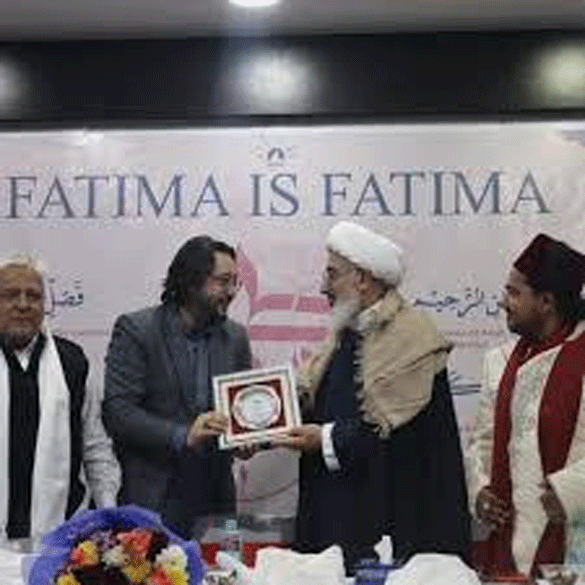
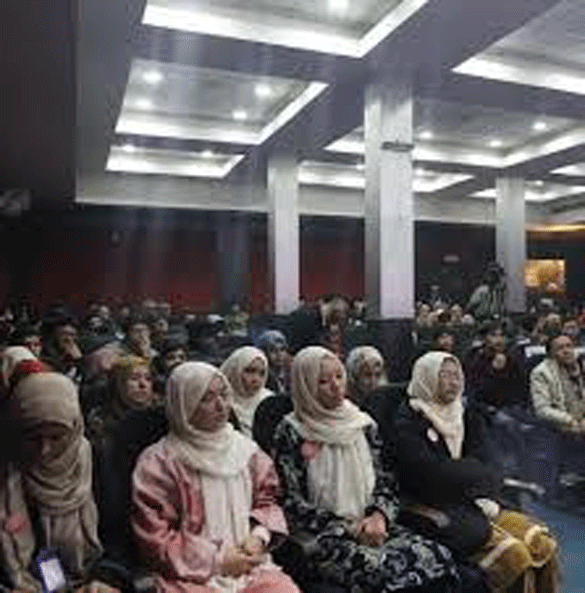
This is an abridged version of an address delivered by the author at the annual event-cum-seminar— “Fatima Is Fatima” —organised by All Kargil (Ladakh) Students' Association Delhi (AKSAD) at Ghalib Institute, Delhi. The event commemorated the birth anniversary of Bibi Fatima Zahra (s.a.), the revered daughter of Prophet Muhammad (pbuh), and centred on the theme “Women: The Pillar for Social Upliftment.” Held under the female wing of AKSAD, the seminar featured distinguished scholars and community leaders who reflected on the moral, social, and spiritual legacy of Lady Fatima Zahra (s.a.). The author participated as a speaker in his capacity as an Islamic researcher and as the author of the book “Ishq Sufiyana: Untold Stories of Divine Love”. Among the notable speakers were Ayatollah Dr. Abdul Majid Hakeem Elahi, representative of the Supreme Leader of Iran; Haji Haneefa Jan, Member of Parliament from the Union Territory of Ladakh; and Sheikh Mirza Amini Sahab, among others.
Established in 1997, AKSAD has been actively working for the educational and social welfare of students from the Kargil district of Ladakh. The organisation recently concluded the “Late Hajiya Fatima Sports Fest 2026,” along with several cultural and religious initiatives aimed at community development and youth engagement
Main Points:
· The third day of Ramazan marks the demise of the most beloved daughter of Prophet Muhammad (pbuh), deeply honoured and revered as a radiant embodiment of sacred feminine strength within Islam.
· To remember and invoke the moral energy of Fatima al-Zahra today is, for many believers, to return to Islam’s ethical centre. It is to affirm that faith stands with the oppressed, that dignity outweighs power, and that spiritual authority flows from integrity rather than force.
· Just as Durga is worshipped as divine feminine in Hindu theology, Bibi Fatima (s.a.) is an embodiment of divine feminine but revered as fully human figure in Islam, as the Islamic belief in Tawhid (absolute oneness of God) does not allow any human to share divinity. The comparison must remain metaphorical, not doctrinal.
· While Durga symbolizes cosmic power expressed through mythic battle, Fatima represents moral and spiritual strength expressed through patience, truth, and principled resistance. Both represent standing against injustice — but in distinct theological frameworks. Both traditions elevate the feminine as a force of resilience, wisdom, and protection. These figures challenge the idea that religion is purely patriarchal and affirm that women embody sacred moral authority.
· Fatima as “the Durga of Islam” is a concept which can serve as a symbolic bridge in Hindu-Muslim dialogue — if handled carefully. The goal is mutual respect and shared ethical understanding, not theological blurring or equivalence.
· In an era when discussions on women’s empowerment often oscillate between cultural polarities, the seminar “Fatima is Fatima” reaffirmed that within the Islamic spiritual tradition itself lies a profound and empowering model—embodied in the person of Lady Fatima Zahra (s.a.), whose life continues to illuminate pathways of faith, resilience and social responsibility.
…
A Careful Comparative Reflection
The third day of Ramazan marked the demise of the most beloved daughter of Prophet Muhammad (pbuh) whom I deeply honour and revere as the Shakti or “Durga of Islam”. To me, to remember and invoke Fatima’s divine feminine energy today is to reclaim Islam’s moral center. It is to affirm that faith stands with the oppressed, that dignity outweighs power, and that spiritual authority flows from integrity rather than force. In an age where religious symbols are often politicized, Fatima al-Zahra (S.A) reminds us that the truest revolution begins within the conscience. She is not a goddess. She is not a mythic warrior. She is something perhaps more radical: a human being whose faith made her fearless before injustice at a very young age. And in that fearless dignity lies her enduring light.
In interreligious and inter-community conversations, symbolic language often tries to build bridges where history has built walls. One such phrase that occasionally appears is “Fatima al-Zahra — the Durga of Islam.” It is a striking comparison. It evokes strength, courage, and sacred feminine power. But it also demands theological care. At the heart of this reflection stand two deeply revered figures: (1) Fatima al-Zahra — the daughter of Prophet Muhammad (pbuh) is revered in Islam for her purity, patience, moral courage, and steadfast defense of justice. On the other hand, Durga — the powerful Hindu goddess symbolizes shakti (divine feminine energy), protection of righteousness, and the defeat of evil.
In times when religion is either reduced to ritual formalism or weaponized for sectarian rivalry, it becomes necessary to return to personalities who embody faith not as domination, but as dignity. Among such towering figures in Islamic history stands Fatima al-Zahra — not merely as the beloved daughter of the holy Prophet, but as a moral force whose strength was quiet, principled, and transformative. So, Syeda-e-Kainaat Fatima al-Zahra’s greatness does not lie in political authority or military leadership. It lies in her moral clarity, her courage in the face of injustice, and her unwavering commitment to truth. In a society still negotiating tribal loyalties and emerging state structures, she represented an ethical conscience that could not be silenced by power.
Strength in Two Theological Worlds
In Hindu theology, Durga is divine. She is worshipped as the embodiment of cosmic power, the feminine force that restores balance when evil prevails. In Islam, Fatima is not divine and never worshipped. Islamic theology rests firmly on Tawhid — the absolute oneness of God. No human being, however exalted, shares in divinity. Fatima’s greatness lies not in supernatural power, but in moral integrity.
Yet within their distinct theological frameworks, both figures represent resistance to injustice and the protection of truth. While Durga’s strength is expressed through mythic battle, Bibi Fatima’s strength was expressed through moral courage.
After the passing of the Prophet (pbuh), Fatima emerged as a voice of conscience. Her sermon in Madinah remains one of the earliest examples of a Muslim woman articulating theological and political principles in public space. She spoke not as a ruler, but as a guardian of prophetic ethics.
The Feminine as Moral Power
Both traditions, in different ways, recognize that strength is not exclusively masculine. The Shakti or Durga symbolizes the cosmic power that defeats oppression. Compatibly, Fatima symbolizes the spiritual power that confronts injustice through dignity and steadfastness.
In a world where religion is often portrayed as patriarchal, these figures challenge that narrative. They show that the feminine, in sacred traditions, is not weakness — it is resilience, wisdom, and moral authority.
However, it is important not to collapse differences. Maa Durga is a deity within a rich mythological and theological universe. However, Bibi Fatima (s.a) is a historical figure rooted in seventh-century Arabia, whose authority flows from character and faith, not divine status.
A Bridge, Not a Blurring!
To call Bibi Fatima “the Durga of Islam” can be meaningful only if understood metaphorically — as a way of recognizing parallel ideals of strength and protection within different faiths. It should never imply theological equivalence. It is important to bear in mind that inter-community respect does not require doctrinal confusion. It requires clarity alongside appreciation.
By reflecting on these two figures carefully, we are reminded of something deeper: religions, despite their differences, often elevate women as symbols of courage, sacrifice, and resistance against injustice.
Why This Comparison Matters Today!
In an age fractured by religious identities, comparative reflection can either inflame tension or inspire mutual respect. When handled with care, it can illuminate shared ethical aspirations without erasing real theological boundaries.
Syeda Fatima al-Zahra (s.a) remains, for the truth-seeking Muslims, a model of steadfast faith and moral courage. Maa Durga remains, for Hindus, a manifestation of divine power and righteous protection. Different theologies. Different narratives. Yet both point toward a common human longing: that truth must stand firm against injustice. And perhaps that shared longing is where genuine dialogue begins.
“Fatima is Fatima”—An Archetype of Resistance to Reclaim Consciousness
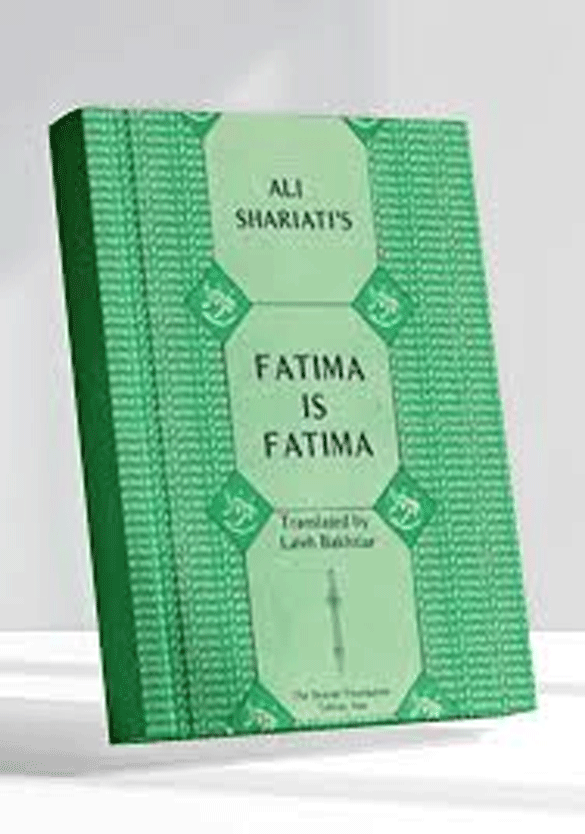
In the turbulent intellectual climate of pre-revolutionary Iran, when Muslim societies were grappling with colonialism, authoritarian modernism, and an identity crisis, Ali Shariati delivered a lecture that would later be published in 1971 as “Fatemeh is Fatemeh”.
Central to Shariati’s discourse is the conviction that Islam, properly understood, is a force of liberation. His Fatima stands in stark contrast to both Western capitalist consumer culture and static religious conservatism. Instead, Fatima embodies an Islam that resists imperialism, confronts injustice, and dignifies women as active participants in history.
Shariati thus constructs a new archetype of Fatima: the revolutionary Muslim woman — intellectually aware, politically conscious, morally courageous, and spiritually centered.
Shariati was not interested in repeating devotional narratives. He explicitly warned his audience that what he was offering was not merely an analytical description of Fatima’s personality, but a reinterpretation requiring the scrutiny of enlightened minds. His Fatima is not confined to the domestic sphere; she is elevated into history as a conscious, morally defiant, and socially engaged figure.
Thus, the book “Fatemeh is Fatemeh” emerged in the years leading up to the Iranian Revolution, a time marked by political repression and the search for an indigenous revolutionary identity. For many young Muslim women, two dominant models appeared inadequate: (1) The Westernized, consumerist model of femininity detached from spiritual roots, and (2) The traditional, passive role that excluded women from sociopolitical struggle.
Shariati’s movement “Fatemeh is Fatemeh” rejected both. It sought to construct an Islamic archetype of womanhood that was intellectually alive, spiritually grounded, and politically engaged. In Shariati’s portrayal, Fatima al-Zahra is not merely “the daughter of the Prophet.” She is an independent historical force.
One of the most powerful episodes Shariati highlights is the confiscation of Fadak — a piece of land associated with Fatima. For him, the issue is not about property but about principle. Shariati sees: Even when deprived of her claim, Fatima does not retreat into silence. Her persistence embodies the Qur’anic ethic of standing firm against wrongdoing. For Shariati, this moment transforms her from a historical personality into a paradigm of revolutionary consciousness. Fadak is confiscated — but Fatima does not surrender her moral voice.
Shariati thus constructs a new archetype: the revolutionary Muslim woman — intellectually aware, politically conscious, morally courageous, and spiritually centered. In reclaiming that archetype of Fatima, Shariati was not merely revisiting the past. He was proposing a future — one in which faith and freedom, spirituality and struggle, are not opposites but companions on the same path.
…
URL: https://newageislam.com/interfaith-dialogue/fatima-is-fatima-divine-feminine-durga-of-islam/d/138968
New Age Islam, Islam Online, Islamic Website, African Muslim News, Arab World News, South Asia News, Indian Muslim News, World Muslim News, Women in Islam, Islamic Feminism, Arab Women, Women In Arab, Islamophobia in America, Muslim Women in West, Islam Women and Feminism