
Promoting Shared Interests and National Harmony

By Dr. Zafar Darik Qasmi, New Age Islam
27 June 2026
Abstract:
Preserving India's long-standing tradition of peaceful coexistence, mutual respect and cultural diversity is essential for building a strong and united society. Justice, equality and respect for human dignity are the true foundations of social stability and national progress. Growing religious hatred, intolerance and social division pose serious threats to national unity and lasting peace. The challenges facing the Muslim community, particularly sectarian divisions and the decline of intellectual and educational development, also require thoughtful attention. A return to the universal teachings of Islam, which promote peace, justice, freedom of belief, tolerance and cooperation, can help strengthen both the Muslim community and society as a whole. Religious scholars, political leaders and civil society should respond wisely to contemporary challenges through dialogue, education and constructive engagement. Shared human values, inclusive thinking and mutual respect are essential for creating a harmonious, prosperous and peaceful society where people of all faiths and backgrounds can live together with dignity, security and confidence.
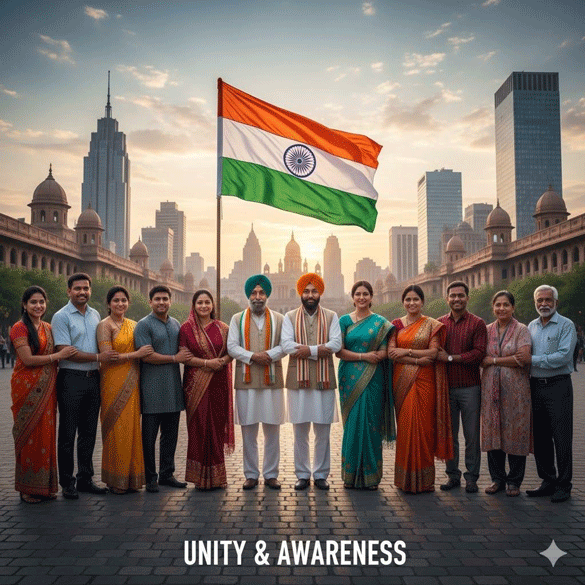
Main Points:
• National harmony depends on justice, equality, mutual respect and the protection of human rights.
• Religious hatred, discrimination and social division weaken peace, unity and the strength of a nation.
• Muslims should rise above sectarian differences and present the true message of Islam through knowledge, wisdom and good character.
• Religious and community leaders must address modern challenges with education, dialogue, research and responsible leadership.
• Shared human values, peaceful coexistence and cooperation among all communities are the keys to a stable, inclusive and prosperous society.
—-
India is one of the world's oldest and most respected civilizations. Throughout its long history, people of different religions, cultures and communities have lived together with mutual respect and understanding. They have honoured each other's beliefs, protected religious traditions and appreciated social customs. These values have strengthened the country's shared culture and spirit of brotherhood. Such harmony is a unique feature of Indian society and has earned it admiration across the world.
Unfortunately, these noble traditions are now facing serious challenges. Attempts are being made to weaken social unity and create divisions among communities. Extremist and hate-driven groups are trying to damage the peaceful character of the country. Their confidence often grows when influential people openly or indirectly support their actions. As a result, efforts to disturb peace and public order have become more frequent.
One recent example is the insult directed at the Prophet Muhammad (peace be upon him). A woman recently made offensive remarks against him, causing deep pain to millions of Muslims. Such behaviour is completely unacceptable and should be condemned. Similar incidents have occurred many times in recent years. Likewise, attacks on places of worship and actions motivated by religious hatred threaten the peace and unity of the nation.
Those who spread hatred and those who encourage them must realise that they are putting India's centuries-old tradition of harmony at risk. A country known for its diversity and coexistence should never allow discrimination, prejudice and religious hostility to replace mutual trust and respect. Political leaders, social organisations and responsible citizens must reject divisive agendas and work together to preserve the values that have united India for generations.
The lessons of history clearly show that strong and successful societies are built upon justice, equality and respect for human rights. Whenever injustice, corruption and social unrest spread, they are often fuelled by hatred, prejudice and narrow-minded thinking. Therefore, governments, political leaders and ordinary citizens all share the responsibility of creating a balanced and peaceful society where every individual feels respected and secure. No action should be taken that humiliates or marginalises any community or religious group. Only in such an atmosphere can a healthy, stable and progressive society flourish.
A government that follows discrimination instead of fairness can never become a true example of justice or humanity. Today, many parts of the world are witnessing growing intolerance, religious hatred and social tension. Behind these problems are forces that benefit from conflict and division rather than peace and cooperation. At such a difficult time, humanity needs guidance based on justice, compassion and mutual respect so that people may live with dignity and security.
At the same time, false accusations against Islam and increasing hostility towards Muslims have become common in many places. Although there is overwhelming evidence of Islam's authenticity and its moral teachings, Muslims have not always presented its true message effectively. As a result, misunderstandings and doubts continue to grow. One important reason is that many Muslims have become more attached to sectarian identities than to the universal teachings of Islam. In some cases, sectarian differences have been treated as the only path to salvation, weakening unity within the Muslim community.
This attitude has also affected education, intellectual growth and research. The Muslim world has suffered a decline in scholarship and critical thinking because too much energy has been spent on internal disagreements instead of constructive learning. It is therefore essential to rise above narrow divisions and return to the original spirit of Islam. Its teachings should be explained with wisdom, balance and sincerity so that people can understand their true purpose. Islam promotes peace, justice, equality, freedom of belief, tolerance, mutual cooperation, respect for human dignity and moral responsibility. These principles provide a strong foundation for building a peaceful and harmonious society for all.
Religious and community leaders must also understand the demands of the modern age and respond wisely to changing social realities. In a diverse society, it is essential to understand contemporary challenges, strengthen constructive relations with people of different faiths and cultures, and present Islamic teachings with knowledge, wisdom and confidence. Important discussions on these issues should reach the wider public so that society may benefit from informed and balanced guidance.
One of Islam's greatest strengths is its tradition of ijtihad, which allows scholars to address new situations in the light of the Qur'an and the Sunnah. This valuable principle should be used responsibly to provide practical solutions for modern problems. At the same time, Muslim scholars and intellectuals should contribute through research, education and thoughtful scholarship, helping people to understand Islam's universal message.
The world today needs a social and international vision that is broad, inclusive and capable of embracing diversity. Such a vision should promote knowledge, wisdom, justice and mutual understanding while encouraging people of different beliefs to live together peacefully. A truly civilised society is one in which every individual and every community enjoys the freedom to practise its faith and cooperate with others on the basis of respect, dialogue and shared values. This is the path that leads to lasting peace, social harmony and genuine human progress.
The challenges before us cannot be overcome through emotion or reaction alone. They require careful thinking, sound knowledge and thoughtful planning. History teaches us that successful societies respond to difficulties with patience, wisdom and long-term vision rather than haste. We must therefore strengthen our educational, social, economic, cultural and intellectual institutions while firmly rejecting hatred, violence and divisive propaganda. By promoting shared interests, common values and mutual respect, India can preserve its unique tradition of unity in diversity and build a stronger, more peaceful and more prosperous future for all its citizens.
—
Dr Zafar Darik Qasmi is an Islamic scholar, author and regular columnist for New Age Islam.
URL: https://newageislam.com/interfaith-dialogue/promoting-shared-interests-national-harmony/d/140572
New Age Islam, Islam Online, Islamic Website, African Muslim News, Arab World News, South Asia News, Indian Muslim News, World Muslim News, Women in Islam, Islamic Feminism, Arab Women, Women In Arab, Islamophobia in America, Muslim Women in West, Islam Women and Feminism