
Introduction to the Religious Texts of Hindus and Parsis

By Dr. Zafar Darik Qasmi, New Age Islam
03 April 2026
In the Light of the Views of Maulana Abdul Haq Haqqani
Abstract:
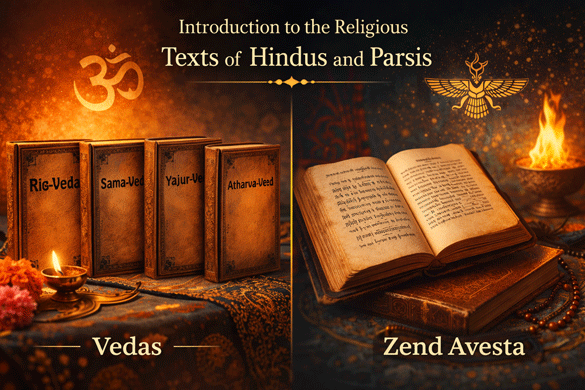
This article introduces the religious texts of Hindus and Parsis in a simple way. It explains that every religion has sacred books which guide people in their beliefs and daily life. Hindus consider many of their texts divine, especially the Vedas, though scholars differ on this issue. Maulana Haqqani argues that the Vedas were written by different sages, so they may not be purely divine. However, Hindus still deeply respect them. The article also highlights that Islamic openness encourages respect for other religions and their beliefs. In the case of Parsis, their main sacred book is the Zend Avesta, which they believe is divine and contains guidance revealed to their prophets.
Main Points:
· Every religion has sacred books that guide beliefs, worship practices, and moral life in society.
· Hindu texts are divided into Shruti considered divine and Smriti regarded as human composed literature.
· Maulana Haqqani argues Vedas were written by different sages therefore cannot be fully divine revelation.
· Despite differences Islamic openness encourages Muslims to respect and acknowledge beliefs of other religions peacefully.
· Parsis believe Zend Avesta is divine and texts contain teachings of prophets and ancient rulers.
—
There are many civilisations, religions, and belief systems in the world. Every religion has its own customs, traditions, and sacred books. People of each religion follow these teachings to shape their way of life. They worship according to them and try to do good in society. In other words, every community values the teachings of its religion and considers them true and important.
If we look at Hindus, we find that they also consider their religious books to be divine. According to their traditions, their religion is called Vedic Dharma or Sanatan Dharma.
A key question arises here: are the Vedic texts truly divine, or are they written by humans? This is an important issue. A detailed discussion can be found in the author’s book “Muslim Scholars’ Study of Hinduism.” However, a few important points are mentioned here.
Hindu scholars divide their religious literature into two parts: Shruti and Smriti. Shruti texts are considered divine, while Smriti texts are regarded as non-divine.
It is important to note that many Hindu scholars, especially those linked with Arya Samaj, clearly believe that the Vedas are divine. However, some Hindu scholars do not agree, though they are fewer in number.
Now, let us look at the opinion of Maulana Haqqani about the Vedas. In the introduction to his commentary, he writes that Hindus claim their books are divine, although they are not mentioned in detail in the Qur’an. Since Muslims are required to believe in divine books, it becomes necessary to study such claims.
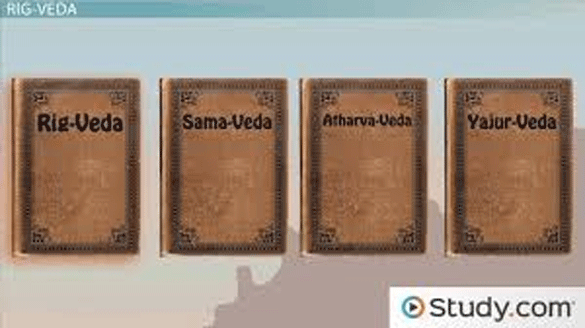
He explains that Hindus believe the four Vedas—Rig Veda, Yajur Veda, Sama Veda, and Atharva Veda—came from the mouth of Brahma. They are considered to belong to a very ancient time. Other texts, such as the six Shastras and the eighteen Puranas, are said to be derived from them.
However, texts like the Mahabharata, Gita, Yoga Vasistha, and Ramayana are accepted by Hindus themselves as the works of scholars. These books include teachings taken from the Vedas as well as historical stories passed down and written by learned people. Therefore, according to Maulana Haqqani, these cannot be considered divine books. Still, they are respected and valued by the people of India.
Maulana Haqqani strongly argues that the Vedas are not divine. He supports his view by quoting Hindu scholars themselves. For example, a well-known group called Tat Bodhini Sabha of Bareilly stated that the idea that the Vedas came from Brahma is not reliable. They explained that the Vedas were composed by different sages at different times, and the names of these sages are found in the texts.
If even Hindu scholars accept that the Vedas were written by multiple authors, then how can they be considered divine revelation? However, it is also true that Hindus deeply respect and believe in these texts.
The author adds that Islamic openness and tolerance suggest that if Hindus consider some of their books divine, Muslims should acknowledge their belief, even if some teachings differ from Islam. In the author’s view, the religious heritage of Hindus can be considered divine.
Islamic openness and broad-mindedness suggest that if Hindus regard some of their books as divine, Muslims should acknowledge their belief, even if certain teachings differ from Islamic teachings. In this regard, my view is that the religious texts of Hindus are also divine. For a detailed discussion, readers may refer to the book “Muslim Scholars’ Study of Hinduism.”
Religious Literature of Parsis
It is well known that almost all religions claim to have a system of guidance for human life. They believe their teachings provide the right way to live a good and moral life.
Similarly, the Parsi religion also has its own sacred texts. Their main religious book is known as the Zend Avesta.
Maulana Haqqani writes that Parsis (also called fire-worshippers or Magians) claim that divine revelation came to their prophets. They consider texts like the Zend Avesta to be the word of God.
They also have other books, among which Dastur is well known. This book contains several sections or letters attributed to different figures, including early prophets and kings such as Zoroaster, Jamshid, Faridun, and others.
Some of these sections are very short, only one or two pages. It is said that during the time of Khusro Parvez, these texts were translated from the Pahlavi language into Dari. Certain phrases and markings were also added, and each section begins with translations similar to “In the name of God” and “I seek refuge in God.”
—-
Dr. Zafar Darik Qasmi is an Islamic Scholar, Author and Regular Columnist for New Age Islam.
New Age Islam, Islam Online, Islamic Website, African Muslim News, Arab World News, South Asia News, Indian Muslim News, World Muslim News, Women in Islam, Islamic Feminism, Arab Women, Women In Arab, Islamophobia in America, Muslim Women in West, Islam Women and Feminism