
As A Muslim, How I Was Treated by Jews In My Life
By Ghulam Rasool Dehlvi, New Age Islam
15 May 2026
‘On that day, the sun shall rise in the west and all people seeing will believe it.’
(Hadith—prophetic tradition)
While this writer was exploring Sufi mysticism in San Francisco (USA), one day I ended up in a retreat at Khankah SAM founded by Murshid Samuel Lewis (1896–1971), an American mystic, horticultural scientist, and the founder of what became the Sufi Ruhaniat International now. A disciple of Indian Sufi mystic Hazrat Inayat Khan in the Chishtia Sufi lineage, he is also known as Sufi Sam or Sufi Ahmed Murad Chisti in the United States.
Murshid Sam was born to Jewish parents. His father Jacob Lewis was a vice president of the Levi Strauss jean manufacturing company. His mother was Harriett Rosenthal, the daughter of Lenore Rothschild of the international banking family (In The Garden with Murshid Sam). What fascinated me was Murshid Sam’s Jewish background as a Sufi practitioner and mentor. Despite these roots, he devoted his life to cultivating a spiritual path rooted in Sufism, interfaith harmony, meditation, sacred music, and universal mysticism.
On that day, I was more astonished to find this letter written by Murshid Sam to Dr. Seyyed Hussein Nasr, the then chair of Center for Religious Studies, Harvard, University. My eyes were dazzled by this correspondence:
Dear Prof. Nasr
As-Salaam Aleikum!
…..This is clearly indicated by kashf and let us say Mushahida. And certainly Allah, to whom be all praise, is quite willing to approve of the Hadith: “In that day will the sun rise in the west and all men seeing, will believe.”
Love and blessings.
Sufi Ahmed Murad Chisti
1088 Fulton Street
San Francisco, CA
25 August, 1963
For me, this is not merely a historical document. It represents a profound spiritual bridge between East and West, Judaism and Islam, Sufism and universal spirituality. A Jewish-born American mystic writing in the language of Islamic metaphysics and prophetic symbolism to one of the foremost Iranian Muslim philosophers of the modern age embodied a remarkable civilisational Jewish-Muslim dialogue rarely acknowledged in contemporary discourse.
Later, Pir Shabda Kahn — Murshid Sam’s close disciple and our very own spiritual mentor and the current Spiritual Director of Sufi Ruhaniat International — elucidated it. He offered an illuminating interpretation of the Prophetic tradition referenced in Murshid Sam’s correspondence and explained to this writer something to the following effect:
“This corroborates what Hazrat Inayat Khan once said:
The message of love, unity and harmony that was carried forward from the East to the West will have to be brought back from the West to the East.”
Those words remained deeply etched in my mind. They encapsulated not only the mission of universal Sufism in the modern world, but also the possibility of renewed spiritual understanding between Muslims and Jews beyond the limitations of politics and historical conflict.
My encounters with such spiritually inclined Jewish seekers and Sufi mystics profoundly transformed my perspective on Jewish-Muslim mystical relations. They reminded me that beneath political divisions lies a deeper Abrahamic spiritual heritage rooted in divine love, remembrance of God, compassion, inner purification, and the unity of humanity.
At a time when public discourse on Muslims and Jews is increasingly shaped by political polarisation, suspicion, and inherited hostility, personal experiences often reveal a far more humane and spiritually meaningful reality.
Speaking from my own encounters with Jewish individuals and families over the years — particularly during my interactions with Jewish friends living in San Francisco, New York, Pennsylvania and other spiritually inclined seekers in the United States and Europe — I have experienced kindness, intellectual openness, hospitality, and sincere human warmth that deserve honest acknowledgement.
As Muslims, we often speak — rightly — about the suffering, displacement, and pain of Palestinians. Their attachment to their homeland, memories, grief, and aspirations for justice are deeply human and morally undeniable. Yet, an honest and balanced engagement with the Palestine–Israel issue also requires acknowledging the profound spiritual and historical attachment many Jews feel toward Jerusalem and the Holy Land.
For many Jews, Jerusalem is not merely a political symbol. It represents centuries of prayer, exile, longing, memory, and sacred history. The Biblical verse often recited in Jewish tradition expresses this attachment powerfully:
“If I forget thee, O Jerusalem, let my right hand forget her cunning.
If I do not remember thee, let my tongue cleave to the roof of my mouth.”
— Psalm 137:5–6
Through conversations with Jewish friends and spiritual seekers, I realised that beneath political disagreements often lies a deeply emotional and spiritual world shaped by historical trauma, displacement, persecution, memory, and longing. One may disagree with state policies or political actions while still acknowledging the humanity and sincerity of ordinary people.
Among the most fascinating dimensions of these encounters was my interaction with spiritually inclined Jews influenced by mystical traditions that resonated deeply with Sufism. These interactions profoundly transformed my understanding of Jewish-Muslim spiritual relations and the historical connections between Jewish mysticism and Islamic spirituality.
Pir Shabda Kahn, Spiritual Director of Ruhaniat International
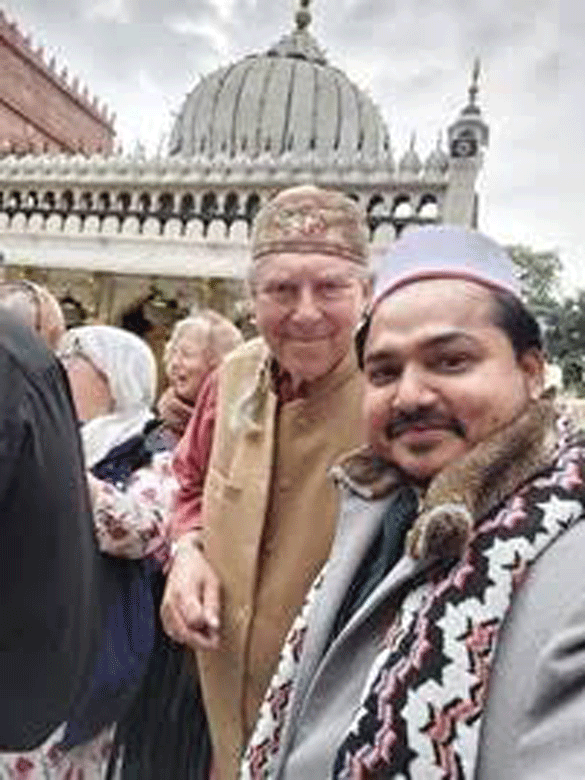
A major influence on my spiritual journey was Pir Shabda Kahn, the Spiritual Director of Ruhaniat International, who was born in Queens, USA. He was the first to initiate me into the Universal Sufi Silsila—the Inayatiyya-Chishtiyya Order, a Sufi tradition now well established in the West. Through his teachings, I encountered a more universal and inclusive understanding of Sufism rooted in harmony among religions, spiritual refinement, sacred music, meditation, and compassionate service to humanity. His work reinforced my understanding that the mystical dimensions of Judaism and Islam have historically shared profound ethical and spiritual affinities.
My perspective on Jewish-Muslim mystical relations was also enriched through my engagement with Boris Engelson, the Geneva-based journalist whose ancestors were survivors of the Holocaust. Conversations surrounding memory, suffering, exile, spirituality, and historical trauma opened for me a more empathetic understanding of Jewish historical consciousness. These reflections reminded me that behind political debates often lie generations of inherited pain, resilience, spiritual searching, and longing for dignity and belonging.
Jonathan Granoff, New Jersey
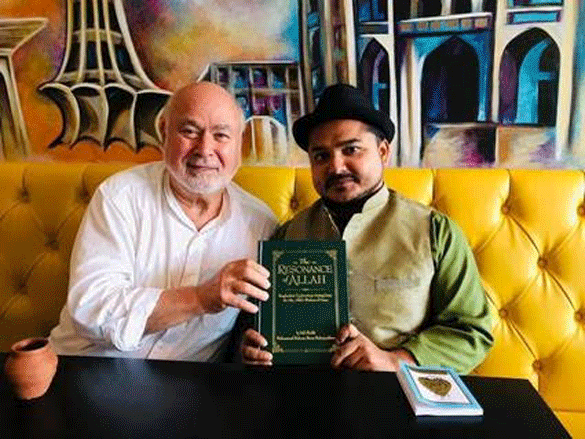
Particularly influential in shaping my perspective was Jonathan Granoff, a close disciple of the Tamil-speaking Sufi saint Bawa Muhaiyaddeen, who is buried in Philadelphia. His spiritual association with the Bawa Muhaiyaddeen Fellowship reflected a remarkable bridge between Jewish and Sufi spiritual worlds. What touched me personally was not only his universal spiritual outlook and emphasis on compassion, peace-building, and inner purification, but also his thoughtful engagement with my literary work. He actually inspired me to write a book on divine love and graciously hosted me at his home in New Jersey for about a month.
Later, back in India when I authored my debut book Ishq Sufiyana: Untold Stories of Divine Love, he wrote a spiritually enriching prologue to. His reflections strengthened my conviction that sincere mystical seekers across faith traditions often speak a common language of divine love and human unity.
Sheikha Maryam, Philadelphia
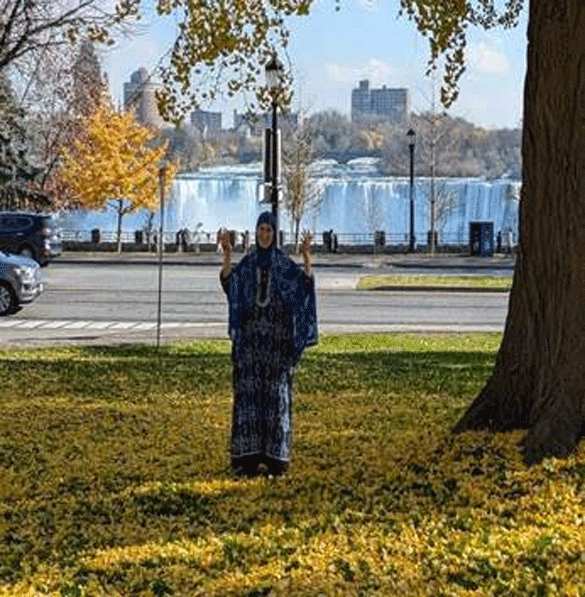
Equally inspiring was Sheikha Maryam, who was born into a liberal Jewish family in Hollywood, California, and later embraced mystical Islam and Sufism at Baitul Maqdis in Palestine. Her spiritual journey reflected a profound quest for divine love, inward purification, and universal compassion — values deeply shared by both Islamic Sufism and Jewish mystical traditions. Her life itself remains a symbol of how spirituality can transcend inherited boundaries and bring hearts closer through shared devotion to God. I cannot express my delight and gratitude for her generosity to this writer who was hosted at her heavenly home in Philadelphia for a month or more. “Unite in the Light” is her life and mission. “Home is where a Heart is” is her home for me.
Eisa Ibn Maryam, my spiritual brother in America
I was also deeply moved by the humanitarian and interfaith efforts of her son, Eisa Ibn Maryam, who currently serves as a chaplain and actively engages in grassroots social work across the United States and abroad among people of different faith traditions. His commitment to compassionate service, healing, and interfaith solidarity reflects the ethical spirit at the heart of both authentic Sufism and prophetic spirituality.
These encounters remind me that the historical relationship between Islam and Judaism is not always framed through political conflict; it also includes centuries of intellectual exchange, mystical dialogue, ethical philosophy, and shared spiritual vocabulary.
I was particularly struck by discussions around forms of what scholars sometimes describe as “Jewish Sufism” — especially the medieval mystical traditions influenced by Islamic spirituality in Muslim Spain and Egypt.
Figures such as Abraham Maimonides, the son of Maimonides, openly admired aspects of Sufi discipline, meditation, asceticism, remembrance of God, and ethical self-purification. Learning about these shared mystical currents deepened my appreciation for the spiritual bridges that historically connected Muslims and Jews.
What touched me personally in all these encounters was not merely intellectual dialogue, but human conduct. I was treated not as an outsider or enemy, but with dignity and respect as a fellow believer in God. I encountered Jews who were curious about Islam, respectful toward the Prophet Muhammad (peace be upon him), and genuinely interested in interfaith understanding. Many conversations extended into spirituality, ethics, mysticism, and the shared Abrahamic roots of Islam and Judaism.
These experiences reminded me that religious traditions are often far more compassionate at the human level than political rhetoric allows us to imagine. Hatred usually grows from distance, ignorance, propaganda, and inherited fears. Genuine interaction often softens rigid assumptions on all sides.
As Muslims, our ethical responsibility is not only to stand for justice, but also to uphold fairness, honesty, and compassion even toward those with whom we disagree politically. The Qur’an itself instructs believers:
“Do not let the hatred of a people lead you away from justice. Be just; that is nearer to righteousness.”
— Qur’an 5:8
Today, when social media increasingly rewards outrage, simplification, and dehumanisation, these encounters become even more important. Listening to one another’s pain does not weaken one’s moral position; rather, it deepens moral credibility and spiritual maturity.
My experiences with Jewish friends — especially those engaged in mystical and spiritually contemplative traditions — did not erase the political complexities or tragedies of the Palestine–Israel conflict. But they taught me an important spiritual lesson. Before people become symbols of conflict, they are human beings carrying memories, fears, hopes, prayers, wounds, and spiritual longings much like ourselves.
Perhaps genuine peace can begin only when people learn to recognise one another not merely through the lens of politics, but through the deeper language of shared humanity, shared spirituality, and shared devotion to the One God.
La ilaha illallah!
“Shema Yisrael, Adonai Eloheinu, Adonai Echad”
“Hear, O Israel: the Lord our God, the Lord is One.”
— Deuteronomy 6:4
URL: https://newageislam.com/interfaith-dialogue/as-muslim-how-i-treated-by-jews-in-my-life/d/140028
New Age Islam, Islam Online, Islamic Website, African Muslim News, Arab World News, South Asia News, Indian Muslim News, World Muslim News, Women in Islam, Islamic Feminism, Arab Women, Women In Arab, Islamophobia in America, Muslim Women in West, Islam Women and Feminism