
“Allah Does Not Forbid You”: Reclaiming a Quranic Ethic of Justice and Coexistence
By New Age Islam Special Correspondent
02 June 2026
One of the most vital Quranic verses for understanding how Islam relates to people of other faiths is found in Surah Al-Mumtahanah:
“Allah does not forbid you from those who do not fight you because of religion and do not expel you from your homes — from being righteous toward them and acting justly toward them. Indeed, Allah loves those who act justly.” (Quran 60:8)
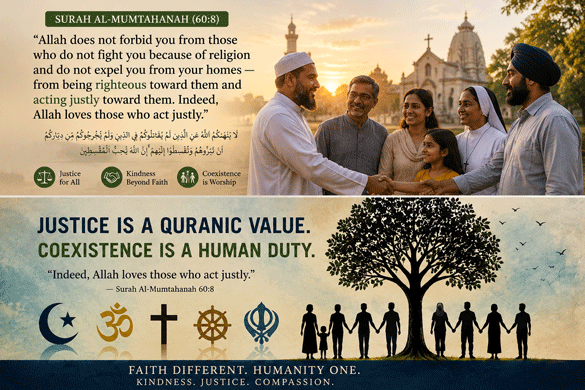
Major Points:
· Surah Al-Mumtahanah 60:8 remains one of the Quran’s most direct statements on coexistence and how to engage ethically with people of other faiths.
· Even though it was revealed during a period of intense political conflict and communal pain, it refused to generalise hatred. Instead, it established a profound principle: people who live in peace deserve kindness and justice, regardless of their religious background.
· In our current era, this message is more relevant than ever.
· For Muslims in pluralistic societies, it provides the theological groundwork for democratic living and interfaith respect. For scholars fighting extremism, it offers a powerful correction to interpretations that focus solely on conflict.
· And for societies struggling with polarisation, it offers a vision rooted in shared humanity.
One of the most vital Quranic verses for understanding how Islam relates to people of other faiths is found in Surah Al-Mumtahanah:
She that is to be examined (60:8)
لَّا يَنْهَىٰكُمُ ٱللَّهُ عَنِ ٱلَّذِينَ لَمْ يُقَـٰتِلُوكُمْ فِى ٱلدِّينِ وَلَمْ يُخْرِجُوكُم مِّن دِيَـٰرِكُمْ أَن تَبَرُّوهُمْ وَتُقْسِطُوٓا۟ إِلَيْهِمْ ۚ إِنَّ ٱللَّهَ يُحِبُّ ٱلْمُقْسِطِينَ
https://quran.com/60/8
“Allah does not forbid you from those who do not fight you because of religion and do not expel you from your homes — from being righteous toward them and acting justly toward them. Indeed, Allah loves those who act justly.” (Quran 60:8)
In modern discourse, this verse has become a cornerstone for discussions regarding pluralism, coexistence, citizenship, secular democracy, minority rights, and interfaith dialogue. In an era increasingly fractured by religious nationalism, sectarianism, and digital polarisation, these words offer a moral and spiritual compass grounded in justice, compassion, and human dignity.
For many moderate Muslim scholars, Surah Al-Mumtahanah 60:8 is far from a marginal teaching. It serves as a foundational ethical principle that dictates how Muslims should engage with peaceful members of other faiths. The verse rejects the idea of permanent hostility toward non-Muslims, proposing instead that relationships be built on a bedrock of justice and kindness. Furthermore, it directly challenges extremist narratives that attempt to split the world into rigid, warring camps of believers and enemies.
Today, this verse is especially poignant in countries like India, where Muslims live as a minority within a vast, diverse tapestry of society. It provides a theological basis for democratic coexistence, social cooperation, constitutional morality, and peaceful citizenship.
Understanding the Historical Context
To truly grasp the weight of this verse, one must look at the historical circumstances surrounding its revelation.
Surah Al-Mumtahanah was revealed during a time of intense conflict between the early Muslim community in Madinah and the Quraysh leadership in Makkah. At that time, Muslims were facing severe persecution, including torture, economic boycotts, and being driven from their homes. Many had lost their families, their livelihoods, and their tribal protections simply because of their faith.
Yet, despite these harrowing experiences, the Quran did not command Muslims to hate all non-Muslims indiscriminately. Instead, it drew a careful line between hostile aggressors and peaceful individuals.
The verses immediately surrounding 60:8 make this distinction crystal clear. Verse 60:9 states that Allah forbids Muslims from forming alliances with those who fought them because of their religion, expelled them from their homes, or aided in such aggression. Therefore, the Quran’s primary concern is not religious identity itself, but rather oppression and violence.
This distinction is vital.
The Quran does not divide humanity based solely on religious labels. Rather, it categorises people by their actions: between oppressors and non-oppressors, aggressors and peaceful people, the unjust and the just.
Many modern scholars argue that extremist interpretations strip away this historical and moral context, presenting Islam as being in a state of permanent hostility toward all outsiders. Surah Al-Mumtahanah stands as a direct challenge to such narrow readings.
The Meaning of “Birr” and “Justice”
The verse relies on two profound Arabic concepts: “tabarruhum” and “tuqsitu ilayhim.”
The word “birr” implies deep goodness, kindness, moral excellence, and compassionate behavior. It is the same word used in the Quran to describe the utmost righteousness one owes to their parents. This goes beyond mere tolerance; it calls for active goodness and ethical excellence.
The second term refers to justice and fairness.
Consequently, the Quran is not simply telling Muslims to avoid harming peaceful non-Muslims; it is instructing them to treat them with genuine goodness and equity.
This shifts the entire framework of how Muslims engage with society. The verse encourages the building of ethical connections across religious lines, promoting cooperation, fairness, compassion, and mutual respect. It rejects hatred as a default setting.
Classical scholars like Imam Al-Tabari and Imam Al-Qurtubi interpreted this verse as an encouragement for Muslims to maintain healthy, positive relations with peaceful non-Muslims—including neighbours, relatives, business partners, and fellow citizens. Modern scholars take this further, arguing that the verse provides the theological groundwork for pluralistic citizenship in contemporary societies.
The Moderate Interpretations in Contemporary Times
Today, moderate Muslim scholars frequently turn to this verse when addressing the need for interfaith harmony and coexistence.
The Egyptian scholar Sheikh Yusuf al-Qaradawi argued that the fundamental relationship between Islam and non-Muslims is one of peace, unless aggression occurs. He emphasised that the Quran explicitly permits kindness and cooperation with all peaceful communities.
In India, the scholar Wahiduddin Khan frequently cited this verse to argue that Muslims should prioritise peace-building, dialogue, and constructive engagement with the wider world. He believed that in modern societies, Islam's mission should be one of moral persuasion and coexistence rather than confrontation.
Similarly, Moroccan scholar Abdullah Bin Bayyah has emphasised that Islamic law must prioritise peace, stability, and coexistence within multicultural societies. To him, Quranic ethics cannot be reduced to conflict-driven readings that ignore their historical context.
Many progressive Muslim thinkers also see this verse as proof that the Quran recognises moral goodness regardless of religious identity. They argue that justice and compassion are universal values, not the exclusive property of any one faith. This perspective is particularly significant in democratic societies where people of diverse faiths live together as equal citizens.
The Indian Context
In the context of India, Surah Al-Mumtahanah 60:8 carries immense weight.
Indian Islam has historically evolved within a deeply multicultural environment, shaped by centuries of interaction between Muslims, Hindus, Christians, Sikhs, Jains, Buddhists, and many others. Much of India’s Islamic heritage was not built in isolation, but through a long history of coexistence and cultural exchange.
Sufi traditions in India have long been defined by a deep sense of compassion, service, and a shared sense of humanity. Many Sufi saints managed to draw followers from all walks of life, regardless of their religious background, simply by living out their moral values and maintaining an inclusive spirit.
The Quranic ethics found in Surah Al-Mumtahanah echo this very same Indian Islamic experience. In a modern India where communal tensions can often dominate political conversations, this verse offers a much-needed alternative moral vocabulary. It serves as a reminder that peaceful coexistence isn't a sign of weakness or a forced compromise; rather, it is a Quranic principle firmly rooted in the concept of justice.
This verse also serves as a direct challenge to communal politics that attempt to paint different religious communities as permanent enemies. For Indian Muslims, it provides a theological foundation for participating fully in democratic life—whether through interfaith dialogue, civil society work, educational cooperation, or simple neighbourhood solidarity. Essentially, it gives religious legitimacy to the idea of constitutional citizenship.
At the same time, this verse is about protecting dignity and justice; it does not ask Muslims to sit silently in the face of oppression. The Quran makes a clear distinction between living peacefully alongside others and submitting to injustice. It encourages Muslims to stand up against wrongdoing while maintaining an ethical, respectful conduct toward those who seek peace.
Moving Beyond Mere Tolerance
One of the most profound aspects of this verse is how it moves the conversation past "mere tolerance". Tolerance can sometimes feel like a reluctant acceptance of something one dislikes. The Quranic language used here, however, is far more proactive and positive. It calls for goodness, fairness, and active moral engagement.
This distinction is vital today, as societies worldwide struggle with intense polarisation. All too often, religious communities coexist physically while remaining emotionally hostile toward one another. The Quranic framework asks for something deeper: for Muslims to actively embody ethical excellence.
We see this verse in action when a Muslim doctor treats patients of all faiths with equal care. We see it when a Muslim teacher supports students from diverse backgrounds, when a Muslim citizen defends the rights of minorities, or when an activist stands up against mob violence and hate speech. In this light, coexistence is transformed into a spiritual act.
Countering Extremist Narratives
Extremist groups often attempt to frame Islam almost exclusively through the lens of conflict. They tend to cherry-pick verses revealed during wartime while ignoring those that emphasise justice and peace. Surah Al-Mumtahanah (60:8) is a crucial tool in countering these ideological distortions.
The verse explicitly rejects the idea of blanket hostility toward all non-Muslims, establishing ethical treatment as the standard relationship with peaceful people. Many contemporary scholars argue that extremist movements strip verses of their historical context, turning specific wartime instructions into a permanent, universal theology. This creates a "siege mentality," making Muslims feel as though they are in an endless, inevitable conflict with the rest of the world.
However, the Quran clearly distinguishes between aggression and peaceful coexistence. Understanding this difference is essential to preventing radicalisation, especially among young people who may encounter decontextualised or inflammatory religious content online. In an age of digital media, where short clips and emotionally charged propaganda can easily strip away a text's broader ethical framework, moderate interpretations of Surah Al-Mumtahanah help restore balance by reconnecting people to the Quran’s larger moral vision.
Interfaith Relations and Human Dignity
The verse also opens significant doors for interfaith engagement. While extremists often dismiss interfaith work as a religious compromise, Surah Al-Mumtahanah provides clear Quranic backing for respectful relations with peaceful communities.
This does not mean Muslims are asked to erase their theological identities. Islam remains a distinct faith with its own unique beliefs and practices. However, having disagreements does not justify hatred or injustice. The Quran repeatedly acknowledges that religious diversity is an inherent part of the human experience. As another verse famously states: “For each among you We have prescribed a law and a method. If Allah had willed, He would have made you one community.” (Quran 5:48)
This isn't suggesting that all religions are the same, but rather that human diversity is a part of God’s creation. Consequently, many scholars argue that Muslims should approach religious diversity with ethical confidence rather than fear. In a country like India, where communities live side-by-side, this kind of interfaith trust is the bedrock of social peace—from shared festivals and neighborhood life to workplaces and public spaces.
Justice as a Divine Value
The verse concludes with a powerful truth: “Indeed, Allah loves those who act justly.”
Here, justice is elevated from a mere social necessity to a profound spiritual value loved by God. This is deeply significant. The Quran doesn't say that Allah only loves Muslims; it says He loves those who act justly. This turns justice into a universal ethical principle.
Modern Muslim thinkers frequently point out that the moral credibility of Islam depends not just on rituals, but on how one conducts themselves ethically. While prayer, fasting, and pilgrimage are essential acts of worship, justice toward one's fellow human beings remains at the very heart of Quranic spirituality.
This perspective is incredibly relevant when discussing minority rights, communal violence, and democratic responsibility. A society cannot claim moral greatness if it practices injustice against its most vulnerable members. Ultimately, the Quranic emphasis on justice places a responsibility on Muslims to uphold a universal standard: one cannot demand justice for their own community while denying it to others.
Relevance in a Polarised World
Today, we are seeing a sharp rise in religious nationalism, Islamophobia, sectarianism, and identity politics. Across much of the globe, communities are increasingly defining themselves by who they oppose. Even social media algorithms seem designed to fuel this, rewarding outrage, suspicion, and fear.
In this heavy climate, Surah Al-Mumtahanah 60:8 offers a perspective that is radically humane. The verse serves as a reminder that peaceful coexistence and a strong religious identity are not mutually exclusive; you don’t need to harbor hatred to protect your faith.
This is especially vital for Muslim minorities living in democratic nations. Fear-based narratives often push these communities toward isolation or reactionary mindsets, yet the Quran encourages ethical engagement instead of withdrawal. This message isn't just for minorities, either. Justice and coexistence are responsibilities for majority communities as well; they are the bedrock of any stable society. History shows us time and again that societies built on exclusion and hate eventually end up hurting everyone, including those in power.
Citizenship and Constitutional Morality
Many contemporary Muslim scholars link this verse to the concept of constitutional citizenship. In the modern nation-state, people belong to a shared political community regardless of their faith. True equal citizenship relies on mutual respect, legal fairness, and civic cooperation. Surah Al-Mumtahanah supports this because it grounds human relationships in justice rather than religious animosity.
Many Indian Muslim intellectuals argue that constitutional morality and Quranic ethics are perfectly compatible. Defending secular democracy, minority rights, and the rule of law doesn't go against Islamic teachings; in fact, these values echo the Quranic commitment to justice and human dignity. This becomes incredibly important during times of communal tension, as the verse calls on Muslims to respond with ethical discipline rather than collective anger. It also challenges believers to build alliances for justice that cross religious lines.
The Prophetic Example
The life of the Prophet Muhammad provides essential context for this verse. He maintained treaties and worked alongside various non-Muslim communities. He accepted protection from non-Muslims when necessary, engaged in trade partnerships, and insisted on justice even when dealing with opponents.
A prime example is the Constitution of Madinah, which established a pluralistic political framework among Muslims, Jews, and other tribes. It allowed different religious groups to keep their identities while sharing civic duties. We also see his respectful treatment of visiting Christian delegations, such as the Christians of Najran. These historical moments reinforce the idea that coexistence and justice are deeply woven into the Islamic tradition.
Reclaiming Ethical Islam
One of the biggest struggles facing Muslim societies today is the battle over interpretation. Will Islam be defined by anger and exclusion, or by justice, mercy, and ethical responsibility?
Surah Al-Mumtahanah 60:8 sits at the heart of this debate. Moderate scholars argue that the future credibility of Islam depends on reclaiming its ethical foundations. The Quran consistently emphasises compassion, patience, wisdom, and human dignity—principles that must guide how Muslims engage with the modern world.
This doesn't mean turning a blind eye to political realities or ignoring the suffering of Muslims globally. The Quran recognises oppression and allows for resistance against injustice, but that resistance itself must remain ethically grounded. The verse provides a sense of balance: it doesn't demand passivity, nor does it call for hatred. Instead, it creates a moral framework where justice is the ultimate standard.
Conclusion
Surah Al-Mumtahanah 60:8 remains one of the Quran’s most direct statements on coexistence and how to engage ethically with people of other faiths. Even though it was revealed during a period of intense political conflict and communal pain, it refused to generalise hatred. Instead, it established a profound principle: people who live in peace deserve kindness and justice, regardless of their religious background.
In our current era, this message is more relevant than ever. For Muslims in pluralistic societies, it provides the theological groundwork for democratic living and interfaith respect. For scholars fighting extremism, it offers a powerful correction to interpretations that focus solely on conflict. And for societies struggling with polarisation, it offers a vision rooted in shared humanity.
The verse reminds us that faith should never be used as a weapon of cruelty. Religion is meant to elevate our moral conduct, not destroy it. Ultimately, Surah Al-Mumtahanah teaches us that justice isn't just a political necessity—it is a spiritual obligation. In a fractured world searching for direction, that message may be our most important guide.
------
New Age Islam, Islam Online, Islamic Website, African Muslim News, Arab World News, South Asia News, Indian Muslim News, World Muslim News, Women in Islam, Islamic Feminism, Arab Women, Women In Arab, Islamophobia in America, Muslim Women in West, Islam Women and Feminism