
Indian Press On Crusade For Afghan Women And Pakistan In The Throes Of Turmoil: New Age Islam's Selection, 31 October 2020
By New Age Islam Edit
Desk
31 October
2020
• Crusade For Afghan Women
By Hiranmay Karlekar
• You Cannot Kill An Idea With Another Idea.
But You Can Always Kill A Human Being With An Idea
By Tabish Khair
• Interesting Times Ahead In Pak
By Markandey Katju
• The Troika Of India-US Pacts Should Not Be
Over-Hyped, Pakistan Tells Why
By Manoj Joshi
-----
Crusade For Afghan Women
By Hiranmay Karlekar
31 October
2020
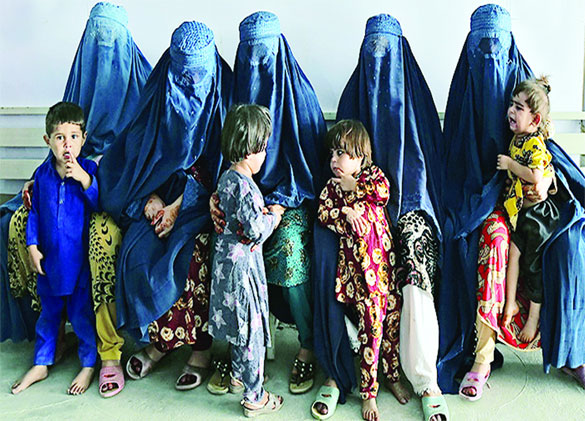
They
should not be left at the mercy of the Taliban and civil societies in all
democracies should ensure that they have equal rights and freedom
-----
As the
world is pre-occupied with dealing with the COVID-19 pandemic, and individual
countries solve their respective specific problems, such as India with its
confrontation with China, the fate of Afghan women has received little
attention. No Government seems to be bothered by the fact that a political
order in Afghanistan, shaped according to the Taliban’s dictates, may once
again relegate them to virtual house arrest and deprive them of almost all
freedoms, including the economic activity of their choice, and independent
access to healthcare — as they were during the Taliban rule from 1994 to 2001.
In a report
titled The Taliban’s War on Women: A Health and Human Rights Crisis in
Afghanistan, Physicians for Human Rights, a respected human rights organisation
based in the United States, presented a nightmarish picture of the condition of
Afghan women under Taliban rule. It wrote: “The Taliban was the first faction
laying claim to power in Afghanistan, which had targetted women for extreme
repression and punished them brutally for infractions. To our knowledge, no
other regime in the world had methodically and violently forced half of its
population into virtual house arrest, prohibiting them on the pain of physical
punishment, from showing their faces, seeking medical care without a male
escort or attending school.
“It is
difficult to find another Government or would-be Government that has created
such poverty by arbitrarily depriving half the population under its control of
jobs, schooling, mobility and healthcare. Such restrictions are literally
life-threatening to the women and their children.”
Lt-Gen
Kamal Matinuddin (Retd) of the Pakistan Army wrote in Taliban Phenomenon:
Afghanistan 1994-97, “Girls are being denied education, women have been
prevented from working. If they leave their house, they have to be covered from
head to foot with a veil (burqa); besides being veiled, women have to be
accompanied by a male relative when they venture out on the streets.
Shopkeepers have been directed not to sell goods to unveiled women. Rickshaw
drivers are not to pick up women passengers unless they are fully covered.
Women caught violating these rules are imprisoned, as are the shopkeepers and
rickshaw-drivers.”
Things
began to change after the Taliban were booted out of power in 2001 by US-led
coalition forces. As George R Allen and Wanda Felbab-Brown state in their
paper, Fate of Women’s Rights in Afghanistan, which is a part of Brookings
Institution’s 19A: Gender Equality Series, “The post-Taliban constitution in
2004 gave Afghan women all kinds of rights, and the post-Taliban political
dispensation brought social and economic growth that significantly improved
their socio-economic condition.” They further state that against fewer than 10
in 2003, the percentage of girls enrolled in primary schools rose to 33 in
2017. Registered female enrolment in secondary schools rose from six to 39 per
cent in the same period. Three-and-a-half million Afghan girls were in school
with 1,00,00 studying in universities. They further say, “By 2020, 21 per cent
of Afghan civil servants were women (compared with almost none during the
Taliban years), 16 per cent of them in senior management levels; and 27 per
cent of Afghan members of Parliament were women.”
These gains
are no doubt unevenly distributed. The beneficiaries have mainly been urban
women. According to Allen and Felbab-Brown, in rural Afghanistan, where 76 per
cent of Afghanistan’s women live, life has not changed much from the Taliban
era, their formal legal empowerment notwithstanding. This goes particularly for
Pashtun areas besides others where rural minority ethnic groups live. They have
to get permission from men in their families to access health care, attend
school and work. Many Afghan men are deeply conservative. Typically, families
allow their girls to have a primary or secondary education — usually up to
puberty — and then arrange their marriage. Even if the male guardian of a young
woman permits her to attend a university, she may not be allowed to work after
graduation. Also, rural women have to bear much of the brunt of the devastating
conflict between the Taliban and Government forces and local militia. Loss of
husbands, brothers and fathers to the fighting causes severe psychological
trauma and fundamentally jeopardises their economic survival and ability to go
about everyday life.
As a
result, attitudes differ. While women in rural areas want peace — many of them
even on the Taliban’s terms — urban
women generally want the Government not to give in and accept a political order
in which the Taliban can implement their retrograde gender and social agenda.
Hence, the question: Are the Taliban prepared to moderate their stance and, if
so, to what extent?
Borhan
Osman and Anand Gopal write in Afghan Views on a Future State; (With an
introduction by Barnett Rubin: NYU/Centre on International Cooperation), “a
number of interviewees emphasised that Taliban redlines lie not with female
education as such, but rather with co-ed or wholly secular education, which
accords with views voiced even by Mullah Omar.” They said they did not object
to women working or to the education of women in their country. However, what
they objected to and prevented by force was if this work or education breached
Islamic Shari’a. Nowadays, there were scores of schools, especially for girls
in the area under the Islamic Emirate, and women performed jobs such as
“teaching of girls and medicine for women.”
They further said, “We encourage this and we call for it on condition
that hospitals for females are segregated from hospitals for males, and on
condition that the work conditions are in harmony with Islamic Shari’a, not to
satisfy instincts, whims and lust. We do not care if the West or the world
complain about us in this respect. All we want is to establish Islamic Shari’a
in Afghanistan; we do not care who is satisfied and who is not satisfied.
“Similarly,
several interviewees presently active in the movement said that an Islamic
State should not only allow women to go to school, but it must encourage them; indeed,
the State should use its resources toward this end. The condition for such
education is that girls should observe the proper hijab and that there should
be full segregation. There appears to be little change on the view of women’s
right to work, however. Most interviewees accepted the need of women in the
sectors of health and education, and in any Government department dealing with
women and children. Beyond that, there appears to be little enthusiasm for the
idea of women holding public office or working in businesses not dealing with
females or children.”
What all
this adds up to is a far cry from what Afghan women — at least those in urban
areas — enjoy in terms of opportunities, rights and freedoms. Women in rural
areas doubtless lag behind. They, however, legally have the right to the
opportunities available in the cities and, a great deal of their distress will
disappear when peace returns — a goal that seems distant but should not be
abandoned. Besides, the most important question is whether what the Taliban
means what they say or are peddling falsehoods aimed at persuading the
Americans to take a less stringent line with them.
In an
article titled The false inclusivity of the Taliban’s emirate
(www.aljazeera.com), Mehdi J Hakimi writes, “Notwithstanding repeated claims
that they support women’s rights, for instance, the Taliban has continued to
attack girls’ schools. Also, women and young people, while comprising most of
the country’s population, are conspicuously missing from the Taliban’s negotiating
team. Moreover, despite Afghanistan’s rich pluralism and cultural mosaic, there
is extremely little ethnic, religious, linguistic, cultural and professional
diversity within their ranks. This absence…tells us, through calibrated action
rather than hollow rhetoric, who is actually welcome in the Taliban’s emirate.”
Referring
to the “blatant inconsistency between the Taliban’s mantra of inclusion and
praxis of exclusion, this early in the intra-Afghan talks,” and their reneging
on their “counter-terrorism pledges to the United States by continuing to
operate closely with al-Qaeda,” Hakimi
concludes by writing that the Islamic emirate’s recurring duplicity “must serve
as a reminder of the perils of hastily taking a leap of faith towards the
Taliban. A lasting peace, after all, is possible only through a genuinely
inclusive process — not through one masquerading as such.”
Clearly,
there is no guarantee that the Taliban will implement even their currently
professed stand on the opportunities and freedoms they would grant women —
which themselves fall far short of what Afghan women enjoy now — when they are
in power. Afghan women are in peril. Civil societies in all democracies must
press on their Governments not to abandon them.
-----
Hiranmay Karlekar is Consultant Editor, The
Pioneer, and an author
https://www.dailypioneer.com/2020/columnists/crusade-for-afghan-women.html
-----
You Cannot Kill An Idea With Another Idea. But
You Can Always Kill A Human Being With An Idea
By Tabish Khair
October 30,
2020
You cannot
kill an idea with another idea. But you can always kill a human being with an
idea.
Let us talk
of two ideas that often come to blows with one another: The idea of freedom of
expression and the idea of the sacredness of your religious symbol. Someone
makes cartoons of this religious symbol — in this case, the prophet of Islam,
Mohammad. A dedicated teacher in Paris shows these cartoons to his students in
good faith. He believes it is necessary for the sake of the first idea, that of
freedom of expression. I have no problem with that. Neither do all the Muslims
I know.
But there
are some Muslims, some custodians of the religious symbol in France, who get
outraged. They post intemperate things on social media. They later claim that
it was simply protest and criticism, not a provocation to violence. But they do
end up provoking an angry, confused young man, who beheads the teacher that had
shown the cartoons to his students, and is dutifully shot down by police
officers.
Two bodies.
Two deaths. Death is a physical matter. So is suffering: Even mental
afflictions have physical consequences. All pain is felt in the body. The body
that is not immortal.
The two
ideas do not die. Their conflict does not die. They have no body that can be
beheaded or shot. They cannot be threatened, imprisoned, abused, tortured,
killed. All this can only happen to the bodies that espouse either, and more,
of the ideas. It does not matter whether the ideas are good or bad, or, as is
often the case, both good-bad. What matters is that ideas do not have a body.
Hence,
these two ideas continue to be at loggerheads. France believes constitutionally
in secularism and freedom of expression and inevitably feels the need to
buttress these ideas. Its president makes a strong speech reiterating such
values. The fact that elections are just a year away adds urgency to the
speech. Some French towns project the cartoons on buildings. Some Muslim
countries, where the rulers use the idea of sacredness rather than freedom of
expression to rule, decide to boycott French goods. These are countries whose
autocratic governments do not trust freedom of expression in any field. The
lines are drawn.
I am told
that, in retaliation, the French government is considering asking
school-teachers to show the cartoons in class. Schools are closed right now.
But they will open soon. Will they be instructed to show the cartoons to all
their students? What do teachers think of this proposal?
I call a
couple of teachers I know in France. They are French-French. This means that
they are White and Catholic. But they teach in schools where many students are
from immigrant and Muslim backgrounds. Both these teachers believe in freedom
of expression. Just as strongly as I do. But both say that this proposal, and
all such proposals, leave them feeling uneasy.
“Why?” I
ask them.
They cannot
pinpoint the reasons for their unease. Then one says: “How do I get across to
students who feel that I am just insulting their culture? I am sure they won’t
say anything to me, but I might lose them forever. They will just bracket away
everything I could teach them. I will fail as a teacher.”
Then the
other one says: “And what happens if they listen to me and go out and get into
the wrong crowd, or into fights? What happens if they, or I, become vulnerable
to violence by extremists on their side or my side?”
I can hear
what they are trying to express. I know why they cannot express it. Because we
have a huge vocabulary for ideas, religious or secular, in all languages. But
we have so few words to utter the body. The body that eats and touches, laughs
and weeps, hears and sees, believes and doubts. The body that is always
different from other bodies in its looks and attire and movements and hopes and
fears — and, hence, needs full freedom to be what it is. The body that shares
mortality with other bodies. The body that can be beheaded, or shot. The body
that can be manipulated by ideas — religious or secular — to make itself
vulnerable. That precarious body.
Even as I
write all this down, I hear more: Arabs beaten up, people knifed in a church in
Nice. Bodies.
How does
one ensure that this body, the body that suffers and dies, has the freedom to
live as it wants? After all, that is why people like me believe in freedom of
expression. It is not the idea that matters, but its necessity for the body to
live. The body needs to be able to express itself without retribution. But, say
those who object to absolute freedom of expression, what if the body expresses
hatred for others, hatred that can induce some angry, confused man, on the
other side this time, to take a gun and shoot down Muslims?
Yes, that
danger is always there. It exists on all sides. There are laws to prevent it.
But note: It is a danger to the body. Finally, this idea or that can be used to
threaten, imprison, abuse, torture, kill the body. Do not fight for this idea
or that idea, if it is at the cost of the body. Stand by the body. Let it be
free to live, and not suffer.
https://indianexpress.com/article/opinion/columns/france-knife-attack-muslim-terrorism-6909088/
----
Pakistan Is In The Throes Of Turmoil Right Now
By Markandey Katju
31 October
2020
The
hostility between the US and China is steadily increasing and this is bound to
have an effect on the ruling Pakistani establishment
Pakistan is
in the throes of turmoil right now. However, despite all the rallies and hue
and cry created by the People’s Democratic Movement (PDM), it is unlikely to be
of much consequence. For the uninitiated, the PDM was formed in September by
the leader of the Jamiat Ulema-e-Islam, Fazal-ur-Rehman, but constitutes 11
parties, representing nearly the entire political spectrum of Pakistan.
Significantly, the PDM has brought together the two mainstream but rival
parties, the Pakistan People’s Party (PPP) led by Bilawal Bhutto and the
Pakistan Muslim League (PML) led by the exiled former Prime Minister Nawaz
Sharif, but currently headed by his daughter Maryam.
No doubt
Pakistan is facing a severe economic crisis because of which people are
suffering. Prices of essential commodities like food and medicines have gone
through the roof and there is mounting unemployment. However, despite these,
the people of Pakistan are unlikely to give much support to the PDM as it is an
unholy alliance of corrupt leaders. While Nawaz Sharif was mentioned in the
Panama Papers, his daughter Maryam has been accused of having four huge flats
in England by Prime Minister Imran Khan. Then there is Bilawal whose mother
Benazir allegedly took huge amounts of money abroad and Maulana Fazal-ur-Rehman,
the Rasputin of Pakistan and a rank opportunist, to name a few. These
politicians have no real love for the people of Pakistan but are a disgruntled,
motley lot having nothing in common. In fact earlier, for years they had been
at each other’s throats but now they have united because they are out of power
and not enjoying the loaves of office.
As
anticipated, Nawaz Sharif’s attack from London in his online speech in the PDM
rally in Gujranwala against General Bajwa and some other top military brass —
probably thinking that this would divide the Pakistani Generals and provoke
some to stage a coup against the Army chief — did not have any effect. An army,
by its very nature, is different from a mob. It is a highly-disciplined
organisation, with a hierarchy and chain of command. Each person on a lower
rank unquestioningly carries out the orders of his superior. The army chief is
at the top of this hierarchy and the corps commanders, even if they sometimes
disagree with him, will ultimately carry out his orders. They know that breach
of this discipline destroys an army, and therefore themselves. So there will be
no coup in the Pakistan Army, whatever Nawaz Sharif may think. The Pakistan
Army officers are fiercely protective of their Generals, both serving and
retired, and will not tolerate their humiliation, because they know if this
happens one day they, too, may meet a similar fate. In fact, it is probably
because Nawaz Sharif started hounding General Musharraf that the Pakistan Army
turned on him.
The essence
of a State is its military and bureaucratic establishment. In Pakistan, the
army is the real power, though it prefers to shield and screen itself behind
the veneer of a civil Government, as that gives it power without
responsibility. Imran Khan is clever enough to realise this, and as long as he
keeps the army happy (which he is doing with great alacrity) he is safe. To
think that a mob can fight and disperse an army, even if a hundred times
smaller in number, is unrealistic and silly. It reminds one of Vendemiaire in
Paris in October 1795, when 4,000 troops under Brigadier General Napoleon
Bonaparte dispersed a mob numerically 10 times larger by “a whiff of
grapeshot.” So all the PDM’s horses and all the PDM’s men cannot have any
effect on the Pakistan ruling establishment, however many rallies they may
hold. However, there is one factor which can have an effect, and it is this
which needs to be considered.
Earlier,
Pakistan was pro-US and was closely tied to it, economically and militarily.
But now it has also become close to China, which has emerged as the second
superpower in the world. China has closer proximity to Pakistan and has hugely
invested in it. The China–Pakistan Economic Corridor has forged a strong link
between the two countries. The Chinese are taking away huge amounts of raw
materials from Balochistan. Gwadar Port has been given on a 40-year lease to
China and Pakistani markets are full of cheap Chinese goods. So Pakistan, which
earlier had only one master, now has two. It is well-known that the hostility
between these two, the US and China, is steadily increasing, and this is bound
to have an effect on the ruling Pakistani establishment, which may well be torn
apart, one part siding with the US and the other with China.
Mere discontent
among the Pakistani people, over rising prices, unemployment and so on, by
itself is unlikely to cause an overthrow of the rulers. But if coupled with,
and supported by one of the two masters mentioned above (which may feel
threatened by the other’s ascendancy), this may well happen in the long run,
caused by a fissure in Pakistan’s ruling establishment. Interesting times are
ahead in our neighbouring nation.
----
Markandey Katju is former Judge of the Supreme
Court of India
https://www.dailypioneer.com/2020/columnists/interesting-times-ahead-in-pak.html
----
The Troika Of India-US Pacts Should Not Be
Over-Hyped. Pakistan Tells Why
By Manoj Joshi
30 October,
2020
On Tuesday,
October 27, India and the US signed the Basic Exchange Cooperation Agreement (BECA)
on the occasion of the third ‘2+2’ in-person meet held between the Indian and
US foreign and defence ministers in New Delhi. The agreement gives India access
to classified US geospatial and GIS data.
India-US
defence ties predate the strategic congruence that became evident after the
Jaswant Singh-Strobe Talbott dialogue in the late 1990s, followed by President
Clinton’s visit to India in 2000. In fact, they go back to efforts to develop
defence technology ties during Rajiv Gandhi’s tenure between 1984-1989.
GSOMIA (a
military information agreement) was the first of the foundational agreements to
be signed in 2002 during the visit of
Defence Minister George Fernandes to Washington DC. It essentially guaranteed
that the two countries would protect
any classified information or technology
that they shared. It was aimed at promoting interoperability and laid the
foundation for future US arms sales to the country.
There was a
long stretch thereafter when the two countries continued to discuss various
other foundational agreements, but nothing came through in the UPA years. It was only after the government of Prime
Minister Narendra Modi came to power in 2014 and the US had an unusually
talented and sensitive Defence Secretary, Ashton Carter, that the two sides
were able to work out the LEMOA (logistics exchange agreement) signed in August
2016 during Carter’s visit. It was the second agreement to be signed and
required a great deal of negotiation since its implications went beyond the
Indo-US plane. It provides the framework for sharing military logistics, for
example for refuelling and replenishment of stores for ships or aircraft
transiting through an Indian/US facility. The third agreement, COMCASA (communications
security agreement) was signed during the inaugural ‘2+2’ meeting in September
2018. This is an India-specific version of the Communication and Information
Security Memorandum of Agreement (CISMOA).
COMCASA enables the US to supply India with its proprietary encrypted
communications equipment and systems, allowing secure peacetime and wartime
communications between high-level military leaders on both sides. Further, it
also enables Indian aircraft and ships with the US-made equipment to communicate
with each other and with the US seamlessly. Because of the lack of this
agreement, India had operated the US-made C-17s, C-130s and P-8I’s with
commercially available systems for nearly half a decade.
The BECA
facilitates the provision of targeting and navigation information from US
systems. As is well known, for example, that the GPS, which was developed by
the Pentagon, has a classified section which is far more accurate than the one
available for use by US in our cars. But in addition, missiles and systems
require geomagnetic and gravity data if they want pinpoint accuracy. But, of
course, having the data by itself doesn’t guarantee accuracy; your missile
navigation systems must also be able to use this highly accurate data.
In
themselves the agreements are fairly routine and should not be over-hyped. They
are really about building trust and setting the trajectory for future
relations. They are not the end, but the means to get there.
As of
now, all of them would enable
cooperation and exchange in a range of sensitive area, but they do not obligate the two countries to provide or service a particular
requirement.
Also, it
needs to be pointed out that in all the agreements except LEMOA, the traffic is
really one way, i.e. from the US to India. To clarify further, our asymmetry
ensures that the technology that needs to be protected and the service that is
expected, will come from the US, whether it is military technology, encryption
systems, or GIS data.
However,
India being a resident Indian Ocean power, is important from the LEMOA point of
view. Indeed, India has to worry that by synchronising its systems with those
of the US, it will enable Washington to
enter its decision-making loop, something that no sovereign country would like,
especially since we do not have an identity of views relating to Pakistan,
Afghanistan, Iran and have different perspectives on some important Indian
Ocean issues. Even in the case of China,
there are differences that would prevent whole-hearted cooperation.
These
foundational agreements are a product of the American bureaucratic culture.
They have scores of commitments around the world and their bureaucracy is particular in ensuring that
they all fall into a legal framework.
This is
what the Pakistanis realised too late. Islamabad thought that the bilateral
defence agreement they had signed with the US in 1959 would compel Washington to aid them in war
with India, but the pact was merely an Executive Agreement, not a treaty
approved by the US Senate. Indeed, the US could have come to their aid in 1971
using that agreement with a much more friendly Administration in Washington,
but it didn’t.
So, we need
to be clear that the US is not obliged to provide us any technology that we
want under GSOMIA, neither will it have any obligation to provide us geospatial
data in every circumstance. Certainly, it is unlikely to assist India in any
venture relating to Pakistan. In the case of China, this administration may be
obliging, but that may not necessarily be true of succeeding administrations in
the US. At the end of the day, the reality is that the US is the giver and
India the receiver.
Likewise,
of course, India may not necessarily provide logistics facilitation to US
vessels, were they to be involved in a war against, say for the sake of
discussion, Iran. But as this author’s Ph.D. supervisor once said, agreements
are a scrap of paper, unless they are backed by a mutuality of interest at the
given time.
What these
agreements do is to provide a trajectory which may lead somewhere, in this
case, a India-US military alliance. But we’re not there as yet. As the Pakistan
case reveals, that even as formal allies, assistance does not automatically
kick in.
Also read:
The 3 foundational agreements with US and what they mean for India’s military
growth
However, it
is undeniable that there is a lot of room for cooperation even short of a
formal alliance. During the Raisina Dialogue in March 2016, the then chief of
the US Pacific Command, Admiral Harry Harris had called on the two countries to
be more ambitious, and perhaps undertake coordinated patrols in the South China
Sea. But here we need to enter the caveat that Indo-US defence cooperation
remains confined to the region under the responsibility of the US Indo-Pacific
Command which ends in India’s western shores. But India’s primary naval
challenge is in the western and north-western Indian Ocean. Just how these
agreements can be finessed to serve our ends there remains to be seen.
-----
Manoj Joshi is a Distinguished Fellow at the
Observer Research Foundation. Views are personal.
https://theprint.in/opinion/the-troika-of-india-us-pacts-should-not-be-over-hyped-pakistan-tells-why/533948/
-----
URL: https://newageislam.com/indian-press/indian-press-crusade-afghan-women/d/123327
New
Age Islam, Islam Online, Islamic Website, African Muslim News, Arab World News, South Asia News, Indian Muslim News, World Muslim News, Women in Islam, Islamic Feminism, Arab Women, Women In Arab, Islamophobia in America, Muslim Women in West, Islam Women and Feminism