
The Throne We Built for Ourselves: Selfishness, Idolatry, and Human Liberation

V.A. Mohamad Ashrof, New Age Islam
26 February 2026
Among the most consequential crises of human civilization is one that wears no uniform and carries no weapon, yet governs more human behaviour than any law or army ever devised. It is the silent, gradual, and often invisible process by which the human ego—its desires, its prejudices, its thirst for dominance, and its insatiable hunger for validation—displaces the authority of Truth and assumes for itself the throne of the Absolute. This paper asks a deceptively simple question: How does a selfish interest become a god?
The question is not metaphorical. It is clinical, hermeneutical, and urgent. In the Quranic tradition, the phenomenon is diagnosed with striking precision:
“Have you seen the one who has taken as his god his own desire (hawa) and whom God has led astray due to knowledge and has set a seal upon his hearing and his heart and put over his vision a veil?” (Quran 45:23)
This verse offers a framework of extraordinary psychological depth. It does not describe the worshiper of stone idols or the practitioner of ancient rites. It describes the person who, despite possessing knowledge—perhaps immense knowledge—has allowed the unregulated desire of the self to function as the ultimate arbiter of truth, the final authority on justice, the supreme judge of right and wrong. In doing so, they have not merely committed a moral lapse; they have enacted a theological inversion. The self has become the sacred.
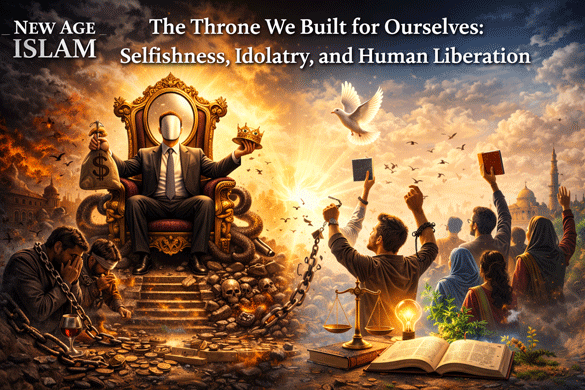
This paper employs a humanistic and liberatory hermeneutical approach to map the architecture, mechanisms, and manifestations of this inversion. It is humanistic because it centres the dignity and moral capacity of the human being. It is liberatory because its ultimate aim is the emancipation of the human spirit from the most intimate of all tyrannies: the tyranny of the ego over the conscience. And it is hermeneutical because it insists that sacred texts must be read not as instruments of social control, but as diagnostic and therapeutic guides for human liberation.
The Lexicon of Self-Deification
To understand how selfish interests, ascend to divine status, we must engage carefully with the conceptual vocabulary of the interior struggle. The Arabic term hawa—translated variously as 'desire,' 'caprice,' or 'whim'—carries within its etymology a devastating double meaning. It refers not only to impulse and craving but also to falling, to the act of plunging downward. To follow hawa is to undergo a gravitational collapse of the soul: a descent from the height of moral accountability to the depths of impulsive gratification.
This is not a description of ordinary human desire, which in moderate form is integral to life and flourishing. It is a description of desire unregulated by any external or objective standard—desire that has broken free of the gravitational pull of justice and truth. As Maulana Wahiduddin Khan observed, 'mindless yielding to desire will lead to disaster... try to steer your life in a rational manner. Don't give it over to your desires' (Khan 2009). When hawa is given absolute authority, it does not merely satisfy the self; it reorganizes the self's entire relationship with reality. What serves the desire is 'true'; what obstructs it is 'false.' Epistemology has been colonized by appetite.
The Quran describes the self—the nafs—as existing in various moral states. The nafs ammara bi al-su' (the soul that incites to evil) is the condition in which self-deification is most operative. Here, the ego does not merely inform decision-making; it tyrannizes it. The liberatory task of the human being is the journey toward the nafs lawwama (the self-reproaching soul)—the state of conscience that maintains the capacity for internal critique. This self-reproaching consciousness is the site where what we shall call 'internal iconoclasm' becomes possible.
The Epistemology of the Seal and the Veil
One of the most profound dimensions of Quran 45:23 is its epistemological claim. Self-deification does not merely corrupt morality; it corrupts the capacity to perceive reality. The verse describes the deified ego as producing a 'seal upon the hearing and the heart and a veil over the vision.' This is not physical incapacity but cognitive and moral blindness—what in contemporary psychological terms we would call motivated reasoning, confirmation bias, or 'wilful ignorance raised to the status of virtue.'
The verse carries an additional, counterintuitive dimension: the person is led astray 'due to knowledge'—'ala 'ilm. Self-deification is not a problem of ignorance. The deified ego is not merely uneducated; it may be supremely educated. The problem is not a shortage of data but a corruption of the telos—the ultimate purpose—of knowledge. When knowledge is no longer oriented toward justice ('adl) and truth (haqq), it becomes a sophisticated instrument in the service of the ego. The PhD in service of tribalism, the theologian in service of misogyny, the economist in service of predatory profit—all illustrate the knowledge paradox of 45:23.
As Fazlur Rahman noted in his landmark study of Quranic ethics, the Quran's primary objective is the establishment of a 'moral-social order that is viable and just' (Rahman 1980). Self-deification is the most fundamental threat to this order precisely because it abolishes the objective foundation upon which any shared moral order must rest. If each individual or collective has deified their own interests, then there is no shared truth left to appeal to. There is only power.
The Typology of Psychological Idols
Three recurring forms of internal idolatry emerge from the Quranic and humanistic traditions. The first is the idol of Kibr—grandiosity—the deep-seated belief in one's inherent superiority. In the Quranic narrative, the fall of Iblis was precipitated not by atheism but by narcissism: the refusal to acknowledge the dignity of Adam because of an obsession with his own created identity. When we deify our race, our class, our intellect, or our credentials, we replicate Iblis's error. We serve the idol of superiority by diminishing others to maintain our own perceived elevation.
The second is the idol of Asabiyyah—blind tribalism. This is the Group Ego: the deification of 'our side.' When loyalty to the tribe supersedes loyalty to truth, when we excuse the crimes of our group and ignore the suffering of others, the group's power has become our god. The Quranic mandate in 4:135—to stand as witnesses to justice even against oneself and one's kin—is the most direct counter-measure to this form of collective idolatry.
The third is the idol of Wahm—delusional certainty. This is the deification of one's own opinions, the refusal to accept any evidence that disrupts a preferred narrative. When ideological obsession replaces moral accountability, the individual ceases to seek truth and begins to seek victory. As Asma Barlas demonstrates, this form of idolatry is particularly insidious because it dresses itself in the language of conviction, faith, and principle (Barlas 2002). It looks like righteousness while serving only the ego's need to dominate.
The Consumerist Altar
If the first axis of analysis has been psychological, the second must be structural. Self-deification is never merely a private phenomenon; it has its external temples, its institutional altars, its social liturgies. And in the modern era, the most architecturally grand of these is the temple of consumer capitalism.
Walter Benjamin's provocative claim that 'capitalism is a religion' is not rhetorical flourish; it is diagnostic precision (Benjamin 1996). Consumer capitalism institutionalizes hawa. For the first time in human history, the unregulated satisfaction of desire has been organized as an economic virtue—as the very engine of prosperity and social good. Where the Quranic ethic of kifayah (sufficiency) and zuhd (detachment) counsels the subordination of appetite to justice, the market logic of infinite growth counsels the exact opposite: that more desire, perpetually stimulated and promptly satisfied, is the foundation of civilization.
In this system, as Zygmunt Bauman argues in Liquid Modernity, 'the consumer is defined by their capacity to consume, and any interruption to this consumption is experienced as a violation of fundamental identity' (Bauman 2000). This is the hallmark of a deified interest: it becomes an absolute right that overrides the rights of workers who produced the goods, the environments that provided the materials, and the generations who will inherit the consequences. The mechanism of 45:23 is fully operative: the hearing is sealed to the cries of the exploited; the vision is veiled to the ecological destruction; the heart is hardened to shared human vulnerability.
The Algorithmic High Priest
The digital revolution has introduced a new and extraordinarily potent mechanism for self-deification. If consumer capitalism institutionalizes hawa at the level of material appetite, digital social media platforms institutionalize it at the level of identity, opinion, and ego-validation.
In classical Islamic ethics, riya' is the performance of virtue for the sake of human approval rather than truth. It is called 'the minor shirk'—minor idolatry—because it involves substituting the approval of people for orientation toward the Divine. In the digital age, riya' has been democratized, intensified, and given algorithmic infrastructure. As Shoshana Zuboff demonstrates in The Age of Surveillance Capitalism, our most intimate experiences are mined to create 'behavioural futures' that feed pre-existing biases (Zuboff 2019). The platform presents us not with reality but with a mirror of our own desires, confirming our prejudices, amplifying our tribal loyalties, and making the self's reflection appear to be the world.
This is the technological fulfilment of the Quranic 'seal upon the heart.' The algorithm functions as a modern deity that knows our hawa better than we know it ourselves—and relentlessly serves it, bypassing the faculty of aql (reasoned intellect) to speak directly to the nafs ammara. Every echo chamber, every 'cancel' of a dissenting voice, every digital mob that enforces ideological purity—these are acts of worship at the altar of the deified self. And because these acts occur within the social fabric of 'community' and 'shared values,' they carry a legitimacy that naked individual selfishness rarely enjoys.
The Political Theology of the Collective Ego
The most dangerous scaling of self-deification is the collective—the nation, the party, the sect. Carl Schmitt observed that 'all significant concepts of the modern theory of the state are secularized theological concepts' (Schmitt 1985). The 'National Interest' is the most pervasive modern euphemism for the deified group ego. When a state declares that its interests justify the suspension of human rights, the bombing of civilians, or the systematic exploitation of weaker nations, it has enacted a political theology in which the nation's hawa is sovereign law.
The Pharaonic archetype in the Quran illuminates this dynamic. Pharaoh's crime was not merely unbelief; it was the proclamation 'I am your most exalted lord' (79:24)—the absolutization of state power, the sacralisation of the regime's interest. He divided his people into sects (28:4), manipulating identity-based conflict to maintain dominance. A liberatory hermeneutic recognizes contemporary 'Pharaohs' in any political system—democratic or autocratic—where the survival of the elite becomes the non-negotiable truth to which all other moral claims must yield.
The Quranic counter-theology is radical. Q.4:135 demands: 'Be persistently standing firm in justice, witnesses for God, even if it be against yourselves or parents and relatives.' Verse 5:8 extends this: 'Do not let the hatred of a people prevent you from being just.' These verses constitute a liberatory political theology that refuses to grant any collectivity—however beloved, however powerful—the status of the Absolute. As Martha Nussbaum has argued, the 'politics of narcissism' that sacrifices universal justice for group validation is ultimately self-destructive, eroding the very foundations of democratic life (Nussbaum 2018).
Patriarchy as Theological Self-Deification
Among the most intimate and persistent forms of self-deification is the gendered ego—the mechanism by which male desires for control, authority, and validation are elevated to the status of divine mandate. A liberatory hermeneutic must confront what Amina Wadud identifies as the 'functional deification of the male': the treatment of male experience as the universal and sacred norm from which all deviation must justify itself (Wadud 2006).
The deification mechanism here is identical to that described in 45:23, simply operating in the domestic sphere. The man's psychological need for dominance—his hawa for authority—is not named as such; it is renamed as 'God-given hierarchy,' 'natural order,' or 'divine protection.' When an interpreter bends a sacred text to justify the subjugation of a woman, he is not following God; he is following his own unregulated nafs and draping it in the robes of the Divine. As Fatima Mernissi documented, many misogynistic interpretations in Islamic history arose from specific historical male interests seeking to maintain power during times of social transition (Mernissi 1991).
Khaled Abou El Fadl makes the point with precision: when men claim an absolute right to command women, 'they are committing a form of shirk by usurping a prerogative that belongs only to the Divine' (Abou El Fadl 2001). The deified male ego forecloses genuine dialogue—it seals the hearing to the woman's testimony about her own experience and veils the vision to her spiritual autonomy. A truly liberatory reading of the Quran recovers the horizontal model of Q.9:71—'The believing men and believing women are protectors (awliya') of one another'—replacing the vertical relationship of sultah (dominance) with wilayah (reciprocal partnership and care).
The Idol of Certainty and the Violence of Dogma
Perhaps the most sophisticated refuge of the deified ego is the intellect itself. When an individual or a community confuses their interpretation of the Divine with the Divine Itself, when the map is worshipped in place of the territory, they have committed what we may call intellectual shirk—the deification of the human mind's partial grasp of a truth that infinitely exceeds it.
Quran 23:71 provides the ontological antidote: 'And if the Truth (Haqq) had followed their desires (ahwa'ahum), the heavens and the earth and whoever is in them would have been ruined.' This verse asserts the independence of Truth from human preference. The cosmos is not structured around our ideologies; our ideologies must submit to the structure of the cosmos. When we attempt to bend truth to serve our desire for intellectual supremacy, our sectarian pride, or our cultural comfort, we invite precisely this ruin.
Hans-Georg Gadamer identified the refusal to recognize the 'horizon' of one's own understanding as the death of genuine dialogue (Gadamer 1989). The deified intellect does not seek truth; it seeks confirmation. It does not engage the Other; it silences or excommunicates the Other. This is the 'seal upon the heart' of the ideologue: they may possess enormous quantities of information, but they have become epistemically impermeable. The liberatory response to this is ijtihad—not merely as a legal tool but as a spiritual discipline of internal iconoclasm: the willingness to break the idols of inherited certainty when they obstruct the universal mandates of justice and compassion.
Internal Iconoclasm and the Jihad of the Soul
The historical narrative of Islam begins with the physical clearing of the Ka'ba—the smashing of the idols that had accumulated in the sacred house. A liberatory hermeneutic understands this event not as a past historical moment but as a perpetual interior mandate. The true 'clearing of the temple' is the clearing of the inner house of worship—the dismantling of the psychological, ideological, and relational idols that have usurped the place of the Absolute.
This is the Jihad al-Nafs—the struggle against the self. In a humanistic framework, this is emphatically not an act of self-hatred or morbid self-abnegation. It is, as Amina Wadud argues, the prerequisite for any authentic commitment to external social justice: without dismantling the 'inner Pharaoh,' we will replicate systems of oppression in new guises, perpetually projecting our unexamined desires onto the architecture of the world (Wadud 2006). Liberation begins in the interior.
The transitional goal is described in the Quranic typology of the self: the movement from the nafs ammara bi al-su' (the self that incites to evil) through the nafs lawwama (the self-reproaching conscience) to the nafs mutma'innah (the soul at peace). The soul at peace is not passive or indifferent; it is at peace precisely because it has been freed from the compulsive service of the deified ego. It has recognized, in the words of Martin Buber's formulation, that genuine existence is not 'I-It'—the treating of others as instruments of the self—but 'I-Thou': the encounter with the sacred dignity of the other (Buber 1970).
Rahmah as Counter-Worship
If hawa is the gravitational force that pulls the soul into the orbit of the self, Rahmah—compassion, mercy—is the counter-gravitational force that orients the soul toward the Other. In the Quranic worldview, Rahmah is not a sentimental feeling but an ontological reality: the most fundamental characteristic of the Divine (al-Rahman, al-Rahim). To embody Rahmah is to participate in the most basic structure of Being.
In a world governed by the deified ego, compassion is not merely a virtue; it is a political act. It is the assertion that the Other has a claim on us that exceeds our own desire. Gustavo Gutiérrez's 'preferential option for the poor'—the insistence that genuine theism requires structural accountability to the marginalized—resonates powerfully with the Quranic concept of the Mustad'afin: the vulnerable whose rights become the measure of any community's faithfulness to divine justice (Gutierrez 1971). To be accountable to the poor, the displaced, the silenced, and the exploited is to worship something beyond the self. It is, in the most precise sense, the dethronement of the ego-god.
The Practice of Radical Accountability
The practical roadmap out of self-deification converges on the rigorous practice of Quran 4:135: 'Be persistently standing firm in justice, witnesses for God, even if it be against yourselves or parents and relatives.' This 'against-myself hermeneutic' is the most demanding spiritual discipline imaginable. It requires that the individual submit their most cherished identities—their nationality, their religious sect, their gender privilege, their intellectual self-image—to the scrutiny of justice.
In practical terms, this requires what the tradition calls Muhasabah (self-accounting): a regular, rigorous audit of one's own motivations. In every arena of human conflict—personal, political, intellectual—the liberatory question must be asked: 'Am I defending this position because it is true, or because it protects my ego? Am I outraged because a principle was violated, or because my sense of entitlement was challenged? Whose suffering am I eliding in order to maintain my current level of comfort?' These are not comfortable questions. They are the iconoclast's chisel applied to the most intimate of idols.
This accountability must be scaled outward to collective identities. Asma Barlas argues that the dismantling of patriarchal and tribal hierarchies requires precisely this 'extra-tribal morality': the willingness of a community to witness against itself (Barlas 2002). A nation that cannot critique its own history, a religious community that cannot admit its interpretive violence, a political movement that cannot name its own capacity for oppression—these are communities living under the seal and the veil of 45:23, sophisticated in their knowledge but enslaved in their moral vision.
The Khalifah as Antithesis of the Ego-God
The theological culmination of this inquiry is the concept of Khalifah—steward. Where the deified ego seeks to own, to dominate, and to possess, the Khalifah recognizes that life, intelligence, power, and the planet itself are Amanah: sacred trusts held in service of a purpose that transcends the self. The Khalifah does not stand at the centre of the universe; they stand accountable to it. Their hawa does not command; it is commanded.
This model has urgent ecological dimensions. The Earth, the Quran insists, is held in trust. Quran 30:41 identifies ecological destruction as the direct consequence of 'what the hands of people have earned'—the extractive logic of a deified ego that recognizes no boundary. As Seyyed Hossein Nasr argues, the environmental crisis is primarily a spiritual crisis: the consequence of a civilization that has elevated the human being to a god-like status, claiming absolute rights over the creation that were never ours to claim (Nasr 1968). The liberatory response is the Khalifah model: not dominion but stewardship; not possession but care; not exploitation but reciprocity.
The Quranic testimony of faith begins with a negation: La ilaha—there is no god. Before any positive affirmation, there is a clearing of the field, a radical refusal of false absolutes. In a humanistic framework, this La is an interior act of liberation as much as it is a theological statement. It is the declaration that no desire, no tribal loyalty, no gendered entitlement, no ideological certainty, no national interest—has the right to claim the authority of the Absolute. The internal idol is refused. The temple is cleared.
This paper has traced the pathways by which selfish interests assume divine status. It has shown that the mechanism described in Quran 45:23—the sealing of the heart, the veiling of the vision—is not an ancient curiosity but the operating logic of modernity's deepest crises. The consumerist altar that deifies appetite, the algorithmic mirror that worships the reflected self, the nationalist temple that sacralises group interest, the patriarchal hierarchy that elevates male desire to divine mandate, the ideological certainty that refuses the humility of partial knowledge—all of these are manifestations of the same psychological and theological inversion: the creature attempting to occupy the position of the Creator.
The liberatory hermeneutic this paper has employed is not pessimistic about the human person. On the contrary, its humanism rests on the conviction that the capacity for internal iconoclasm is as fundamental to human nature as the capacity for self-deification. The nafs is not condemned to worship itself; it has the freedom—and the mandate—to seek something larger. And that seeking, when it is genuine, when it is accountable to justice and compassionate toward the Other, is what the tradition has always meant by worship.
True faith, in this humanistic reading, is not a set of ritual performances or doctrinal formulae. It is a praxis of accountability: the constant, disciplined refusal to let the self's interests function as the measure of truth. It is the courage to stand against oneself when the demands of justice require it. It is the mercy to see the humanity of those one despises. It is the intellectual humility to remain a seeker of truth rather than a possessor of it. It is the ecological responsibility to hold the planet as trust rather than property.
When the selfish interest is dethroned from the position it has illegitimately occupied, something remarkable occurs. The human being does not diminish; they expand. They discover that they are not the isolated, competitive units that the deified ego required them to be. They discover relationship, solidarity, and the kind of peace—Sakina—that cannot be manufactured by any amount of desire-satisfaction. They discover that 'the service of God' is not the burden of submission to an external power but the liberation of the self from its most intimate prison.
The veil is lifted. The seal is broken. And the world appears, perhaps for the first time, as it has always been: a community of beings held together by a Truth that none of us possesses but all of us are called to serve. That calling—humble, accountable, compassionate, and just—is the only honest answer to the question with which we began. How do our selfish interests become God? They ascend through our abdication of the hard work of justice. And they are dethroned, every single time, when we remember what we are: not the centre of the universe, but its grateful, responsible, and morally accountable stewards.
Bibliography
Abou El Fadl, Khaled. Speaking in God's Name: Islamic Law, Authority and Women. Oxford: Oneworld Publications, 2001.
Barlas, Asma. 'Believing Women' in Islam: Unreading Patriarchal Interpretations of the Quran. Austin: University of Texas Press, 2002.
Bauman, Zygmunt. Liquid Modernity. Cambridge: Polity Press, 2000.
Benjamin, Walter. “Capitalism as Religion.” Selected Writings, Volume 1: 1913–1926. Cambridge: Harvard University Press, 1996.
Buber, Martin. I and Thou. Edinburgh: T&T Clark, 1937 (English trans. 1970).
Gadamer, Hans-Georg. Truth and Method. New York: Crossroad Publishing, 1960 (English trans. 1989).
Gutierrez, Gustavo. A Theology of Liberation: History, Politics, and Salvation. Maryknoll, NY: Orbis Books, 1971.
Khan, Maulana Wahiduddin. The Prophet of Peace: Teachings of the Prophet Muhammad. New Delhi: Penguin Books, 2009.
Mernissi, Fatima. The Veil and the Male Elite: A Feminist Interpretation of Women's Rights in Islam. Reading, MA: Addison-Wesley, 1991.
Nasr, Seyyed Hossein. Man and Nature: The Spiritual Crisis of Modern Man. Chicago: ABC International Group, 1968.
Nussbaum, Martha. The Monarchy of Fear: A Philosopher Looks at Our Political Crisis. New York: Simon & Schuster, 2018.
Rahman, Fazlur. Major Themes of the Quran. Chicago: Bibliotheca Islamica, 1980.
Schmitt, Carl. Political Theology: Four Chapters on the Concept of Sovereignty. Cambridge, MA: MIT Press, 1922 (English trans. 1985).
Wadud, Amina. Inside the Gender Jihad: Women's Reform in Islam. Oxford: Oneworld Publications, 2006.
Zuboff, Shoshana. The Age of Surveillance Capitalism: The Fight for a Human Future at the New Frontier of Power. New York: PublicAffairs, 2019.
…
V.A. Mohamad Ashrof is an independent Indian scholar specializing in Islamic humanism. With a deep commitment to advancing Quranic hermeneutics that prioritize human well-being, peace, and progress, his work aims to foster a just society, encourage critical thinking, and promote inclusive discourse and peaceful coexistence. He is dedicated to creating pathways for meaningful social change and intellectual growth through his scholarship.
New Age Islam, Islam Online, Islamic Website, African Muslim News, Arab World News, South Asia News, Indian Muslim News, World Muslim News, Women in Islam, Islamic Feminism, Arab Women, Women In Arab, Islamophobia in America, Muslim Women in West, Islam Women and Feminism