
The Life and Legacy of Mahmoud Mohamed Taha: Rethinking Islam In the Modern World
By New Age Islam special correspondent
24 April 2026
Subheading:
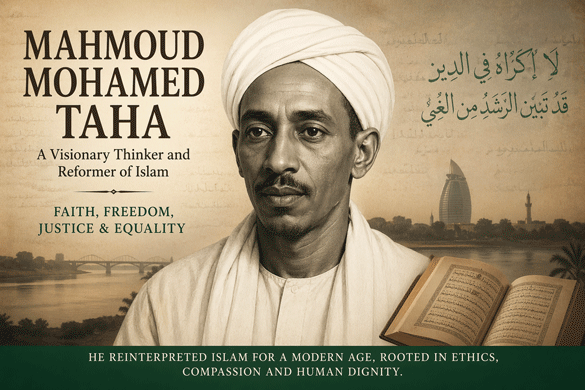
Throughout the sprawling and intricate story of Islamic thought, certain individuals stand out, challenging long-held traditions and striving to reinterpret religion in the context of an ever-evolving world. Mahmoud Mohamed Taha, a Sudanese thinker, is one such figure whose ideas continue to spark debate and hold profound relevance. Reflecting on his life and work, I am struck by his intellectual bravery, his unique approach to Islamic law, and his vision of a fair society—offering valuable lessons not only for Sudan but also for countries like India, where Muslims coexist as minorities within a democratic society.
Major Points:
I see that Mahmoud Mohamed Taha's life and ideas offer a valuable lens for understanding the challenges facing Muslims today. His emphasis on ethical values, his reinterpretation of Islamic law, and his dedication to justice make him a figure of lasting importance.
For Indian Muslims, his thought provides both inspiration and a challenge. It invites us to reconsider our approach to religion, engage more deeply with modernity, and build a future that is both faithful and forward-looking.
At its heart, Taha's thought revolves around ethics. He believed that the purpose of religion isn't to enforce strict rules but to foster moral values, such as compassion, justice, and equality.
Throughout the sprawling and intricate story of Islamic thought, certain individuals stand out, challenging long-held traditions and striving to reinterpret religion in the context of an ever-evolving world. Mahmoud Mohamed Taha, a Sudanese thinker, is one such figure whose ideas continue to spark debate and hold profound relevance. Reflecting on his life and work, I am struck by his intellectual bravery, his unique approach to Islamic law, and his vision of a fair society—offering valuable lessons not only for Sudan but also for countries like India, where Muslims coexist as minorities within a democratic society.
Taha's existence was more than scholarly pursuits; it embodied struggle, resistance, and ultimate sacrifice. He stands as a symbol of what it truly means to rethink religion in the face of modernity, regardless of the personal cost.
Early Life and Intellectual Formation
Mahmoud Mohamed Taha was born in 1909 in Sudan, during a period when the country was under Anglo-Egyptian rule. His early life was moulded by colonial realities, social hierarchies, and the quest for identity within a shifting political scene. Unlike many traditional scholars, Taha trained as an engineer, which instilled in him a rational and analytical approach to problem-solving.
However, his intellectual explorations went beyond technical education. He developed a deep interest in religion, politics, and social reform. He founded the Republican Brotherhood. a movement that sought to reinterpret Islam in a manner consistent with modern values, such as equality, freedom, and justice.
What truly distinguishes Taha's early life is his refusal to blindly accept established ideas. He firmly believed that Islam, as a living tradition, must adapt and grow. This conviction would later underpin his reformist thinking.
A Radical Idea: Two Levels of Islam
At the core of Taha's thought resides a daring and provocative notion: that the Quran holds two distinct messages. In his view, the earlier Meccan verses represent the universal, ethical, and spiritual bedrock of Islam, while the later Medinan verses were specific to their context, addressing the political and social realities of the Prophet's era.
This differentiation allowed Taha to assert that Islamic law, as traditionally understood, wasn't intended to remain fixed in its historical form. Instead, he believed that Muslims should return to the Meccan message, which emphasises equality, freedom, and individual responsibility.
For Taha, this wasn't a rejection of Islam but a deeper engagement with it. He regarded the Meccan verses as representing the "second message of Islam", a message yet to be fully realised in history.
This idea directly challenged the conventional framework of Islamic jurisprudence, which prioritises the Medinan verses in matters of law and governance. By reversing this hierarchy, Taha paved the way for a fresh perspective on Sharia—one that is flexible, ethical, and adaptable to modern conditions.
Reforming Islamic Law in the Modern Age
Taha's approach to Islamic law was revolutionary. He contended that many aspects of classical Sharia, including punishments and gender roles, were shaped by historical circumstances and shouldn't be rigidly applied in the modern world.
For example, he questioned the implementation of hudud punishments, arguing that they were appropriate for a specific time and society but not for a modern state that values human rights and dignity. Similarly, he championed gender equality, emphasising that the ethical principles of Islam support equal rights for both men and women.
What distinguishes Taha's reform is that it doesn't rely on external frameworks, such as Western liberalism. Instead, it is rooted within the Quran itself. He sought to extract modern values from Islamic sources, rather than imposing them from outside.
This internal reform approach holds particular importance because it addresses a key tension faced by many Muslims today: how to remain faithful to religious traditions while also embracing modern ideas of democracy, human rights, and social justice.
Conflict with the State and Religious Establishment
Taha's ideas were met with resistance. In fact, they sparked strong opposition from both the religious establishment and the political authorities in Sudan. His reinterpretation of Islamic law was deemed heretical by many scholars, while his emphasis on freedom and equality was viewed as a threat by the state.
The conflict escalated during the rule of Jaafar Nimeiry, who introduced Islamic laws in Sudan in the 1980s. Taha openly opposed these laws, arguing that they were a distortion of Islam and an attempt to use religion for political control.
In 1985, Taha was arrested, tried for apostasy, and executed. His death sent shockwaves around the world and transformed him into a symbol of intellectual resistance. He paid the ultimate price for his beliefs, but his ideas lived on.
Instead, they continue to fuel debates about the future of Islam and the possibility of reform.
The Ethical Core of Taha's Vision
At its heart, Taha's thought revolves around ethics. He believed that the purpose of religion isn't to enforce strict rules but to foster moral values, such as compassion, justice, and equality.
This ethical focus is particularly relevant in today's world, where religion is often wielded as a tool for exclusion and control. Taha reminds us that the true essence of Islam lies in its commitment to human dignity.
He also stressed individual responsibility. For Taha, faith isn't simply about adhering to rules; it's about making conscious moral choices. This perspective shifts the focus from external authority to internal conscience.
In many respects, Taha's vision mirrors wider trends in contemporary religious thought, which increasingly emphasises personal spirituality and ethical conduct.
Relevance for Indian Muslims
Reflecting on Taha's ideas, I'm struck by their potential relevance for Indian Muslims. India, a diverse and democratic nation, sees Muslims living as a minority, navigating intricate social and political landscapes.
Within this context, Taha's focus on ethical Islam and constitutional principles becomes particularly pertinent. His approach offers a means of harmonising religious identity with democratic citizenship.
For instance, his views on gender equality can enrich ongoing discussions about women's rights within Indian Muslim communities. His critique of rigid legalism may foster a more adaptable and context-aware approach to Islamic law.
Furthermore, his concentration on education and intellectual pursuit strongly resonates with the challenges many Indian Muslims face today. We need to move beyond defensive reactions and proactively engage with modern knowledge systems.
Taha's life also serves as a reminder of the importance of courage. Reform is never simple, often encountering resistance. However, without such efforts, societies risk stagnation.
Challenges and Criticisms
A discussion of Taha would be incomplete without acknowledging the criticisms levelled against his ideas. Many scholars contend that his distinction between Meccan and Medinan verses is overly simplistic and lacks robust historical support.
Others worry that his approach weakens the traditional structure of Islamic jurisprudence, creating ambiguity regarding religious authority.
These criticisms are crucial because they underscore the difficulty of reform. Altering long-held traditions isn't merely an intellectual hurdle; it's also a social and political one.
Yet, even critics often admit that Taha raised crucial questions about the relationship between Islam and modernity. Whether one agrees with his conclusions, his work compels us to examine these matters more profoundly.
A Continuing Conversation
Taha's legacy isn't a closed book; it's an ongoing dialogue. His ideas continue to be debated in academic circles, among reformist thinkers, and within Muslim communities globally.
In an era defined by rapid change, questions about religion's role in public life are growing more pressing. Taha's work presents one potential framework for addressing these questions.
For me, his willingness to think outside the box stands out. He didn't settle for easy answers and wasn't afraid to challenge accepted narratives. This intellectual independence might be his greatest contribution.
Conclusion: Why Taha Matters Today
Concluding this reflection, I see that Mahmoud Mohamed Taha's life and ideas offer a valuable lens for understanding the challenges facing Muslims today. His emphasis on ethical values, his reinterpretation of Islamic law, and his dedication to justice make him a figure of lasting importance.
For Indian Muslims, his thought provides both inspiration and a challenge. It invites us to reconsider our approach to religion, engage more deeply with modernity, and build a future that is both faithful and forward-looking.
Taha's life reminds us that reform encompasses not just ideas, but also action, courage, and sacrifice. In a world where religion is often seen as a source of division, his vision offers a path toward unity, dignity, and hope.
Ultimately, engaging with Taha isn't about agreeing with him on every detail. It's about seriously considering the questions he posed—and finding our own answers in light of our own realities.
…
New Age Islam, Islam Online, Islamic Website, African Muslim News, Arab World News, South Asia News, Indian Muslim News, World Muslim News, Women in Islam, Islamic Feminism, Arab Women, Women In Arab, Islamophobia in America, Muslim Women in West, Islam Women and Feminism