
The Quranic Verse 5:51 Must Be Interpreted In Light Of Its Exhortation To Seeking Its Best Meaning To Avoid Any Distortion Of Its Message On Inter-Faith Relations

By Muhammad Yunus, New Age Islam
(Co-author (Jointly with Ashfaque Ullah Syed), Essential Message of Islam, Amana Publications, USA, 2009)
4 October 2025
This article allows the Qur’an to unilaterally proclaim its role as promoter of inter-faith peace and harmony exploding the need for any deeply scholastic analysis of the verse 5:51 featured in Mohamad Ashrof’s just posted article, The Illegitimate Alliance: A Quranic Analysis of Quran 5:51, which draws on the works of some fifteen of the most eminent contemporary scholars of Islam and citations to make this point.
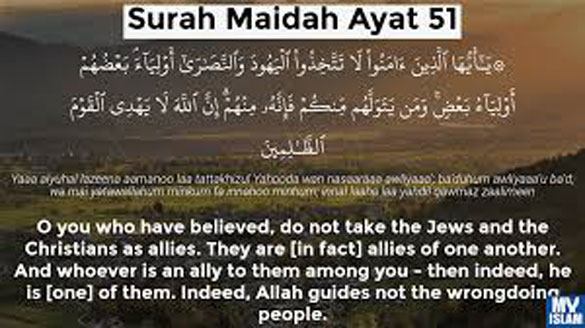
The verses 5:51, 5:55/56 listed below are often cited out of historical context to imply that for all times, the Muslims should not take the Jews and Christians as their friends or allies. But the Qur’an testifies that these verses came down in the wake of mounting hostilities from the Christians and Jews:
“You who believe, do not take the Jews and Christians for your allies (Awliya’)*: they are but the allies (Awliya’)* of one another, and any of you who allies with them, becomes, one of them. Indeed God does not guide the unjust people” (5:51). *[The word is the plural form of Wali, which connotes a ‘protector’, ‘friend’ or guardian as fitting the text.]
“Your only ally (Wali) is God, and His Messenger, and those who believe: those who keep up prayer, and give charity, and bow down (in prayer) (5:55). Therefore, whoso allies with God and His Messenger and (with) those who believe, (belong to) the party of God, and will be victorious (5:56). (Therefore) you who believe, do not take as your allies those, who take your religion for a joke and a sport, be they among those whom the Book was revealed before you, or among the disbelievers; but heed God, if you are (truly) faithful (5:57). When you call to prayer, they take it as mockery and amusement. This is because, they are a people who do not use their reason” (5:58).
Given that the Qur’an enjoins seeking its best meaning (39:18, 39:55), these verses must be read in conjunction with the reconciling passage 60:8/60:9 dating from the late Medinite period - reiterated below for reading them side by side:
“God does not forbid you to be virtuous and just to those who did not fight you over religion, nor drove you from your homelands. Indeed, God loves the just (60:8). God only forbids you to befriend those who fought against you over religion, and expelled you from your homelands, and backed (others) in your expulsion; and whoever befriends them – it is they who are unjust” (60:9).
In its concluding phase, the Qur’an allows Muslim men to marry Christian and Jewish women (5:5) and thus make them their awliya or allies. (9:71).
Thus, any generalization of the noted Qur’anic verses to foment hatred against contemporary Christians and Jews virtually distorts the message of the Qur’an and contradicts its role as promoter of inter-faith peace and harmony. To some critics however, this may sound apologetic, as it contradicts the ground reality of the present day Muslim world, where anti-Semitic sentiments run high in the wake of Israel’s continued forceful occupation of Palestine lands. Karen Armstrong. one the most reputed Islamic scholar of this era clarifies this in her following remark:
“Anti-Semitism is a Christian vice. Hatred of the Jews became marked in the Muslim world after the creation of the state of Israel in 1948. It is significant that Muslims were compelled to import anti-Jewish myths from Europe and translate into Arabic such virulently anti-Semitic texts as the Protocols of the elders of Zion, because they had no such tradition of their own. Because of this new hostility towards the Jewish people, some Muslims now quote the passages in the Qur’an that refer to Muhammad’s struggle with the three rebellious Jewish tribes to justify their prejudice. By taking these verses out of context, they have distorted both the message of the Qur’an and the attitude of the Prophet, who himself felt no such hatred of Judaism.” Re: Karen Armstrong, Islam, A short history, New York, 2002, p. 21/22
While there may be no dearth of purportedly ‘Islamic narratives’ originating from different eras and regions of Islam’s ever expanding landscape to project its hostility to the Christians and Jews, but these sources are products of history and politically motivated. Besides in its15-century long interaction with the others, Islam has seen armed conflicts, wars, occupations, expulsion and gory episodes and injustices on all sides. This has inevitably impacted the ‘so called’ Islamic historical narratives left by historians and scholars. While it will be impossible to make a summary of such narratives and to ascertain their authenticity, the Qur’an and only the Qur’an is preserved verbatim and remains by far the most reliable historical source on Islam’s doctrine on Inter-faith peace and harmony - which barring political confrontations with the Jewish tribes of Medina in course of the revelation remained cordial and respectful on personal and ideological basis which explains the flourishing of Jewish communities in the Islamic world.
Another compelling piece of evidence from the era of Caliph Umar is the Terms of surrender of Jerusalem, reported by Thomas Arnold:
“In the name of God, the Merciful, the Compassionate! This is the security which Umar, the servant of God, the commander of the faithful, grants to the people of Elia. He grants to all, whether sick or sound, security for their lives, their possessions, their churches and their crosses, and for all that concerns their religion. Their churches shall not be changed into dwelling places, nor destroyed, neither shall they nor their appurtenances be in any way diminished, nor the crosses of the inhabitants nor aught of their possessions, nor shall any constraint be put upon them in the matter of their faith, nor shall any one of them be harmed.” Thomas W. Arnold, Preaching of Islam, 2nd revised edition, 1913, reprinted Delhi 1990, p. 56
Bottom Line: The Qur’an’s own testimony provides a self-sufficient and historically consistent guide. While later scholastic interpretations add layers of commentary, they should not be allowed to obscure the Qur’an’s primary message: Read in its own historical unfolding, the Qur’an emerges as a coherent and intelligible guide—contrary to the claim of some jurists that it is accessible only through layers of scholastic exegesis.
-----
Muhammad Yunus, a Chemical Engineering graduate from Indian Institute of Technology, and a retired corporate executive has been engaged in an in-depth study of the Qur’an since early 90’s, focusing on its core message. He has co-authored the referred exegetic work, which received the approval of al-Azhar al-Sharif, Cairo in 2002, and following restructuring and refinement was endorsed and authenticated by Dr. Khaled Abou El Fadl of UCLA, and published by Amana Publications, Maryland, USA, 2009.
New Age Islam, Islam Online, Islamic Website, African Muslim News, Arab World News, South Asia News, Indian Muslim News, World Muslim News, Women in Islam, Islamic Feminism, Arab Women, Women In Arab, Islamophobia in America, Muslim Women in West, Islam Women and Feminism