
Rohingya Refugees - Life Ahead At Bhasan Char In Bangladesh Looks Dubious Due To the Question on the Sustainability of the Island

By
Priyanjoli Ghosh
December
14, 2020
One of the
most persecuted minorities across the globe — the Rohingyas have yet again
become victims due to the massive relocation plans of Bangladesh. On Dec. 4,
2020, seven Bangladeshi Naval ships departed for Bhasan Char Island, from
Chittagong Patenga, carrying around 1600 Rohingya refugees. Rohingyas are being
sent to the island, as a part of Sheikh Hasina’s initiative to declutter camps
in Bangladesh’s Cox’s Bazar. This article investigates the plight of the
Rohingyas with respect to the ongoing relocation and their way ahead.
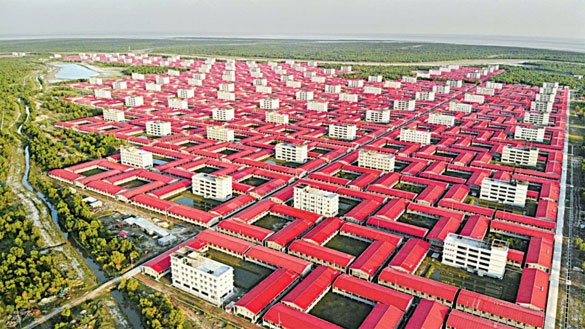
Satellite image of Bhasan Char. Source: Google Earth
-------
The Rohingyas — ethnically belonging to
Myanmar, were forced to flee their homes and take asylum in Bangladesh due to
the discriminating policies of the Myanmar government. This inadvertent influx
of Rohingyas since the 2017 brutal military crackdown in the Rakhine state of
Myanmar have become a stumbling block for Bangladesh. According to the United
Nations Children’s Fund (UNICEF), as of September 2019, around 1,295,000 people
were estimated to be in need of humanitarian assistance, of which Cox’s Bazar
District sheltered around 855,000 Rohingyas. In 2018 Bangladesh and Myanmar
signed a deal to repatriate these refugees. However, not a single Rohingya
reportedly returned to Rakhine because of the hostile conditions that has
ripped the region. It was in March 2019 that Bangladesh announced that it will
no longer accept the Rohingya refugees fleeing from Myanmar.
Relocation:
A Home Away From Home
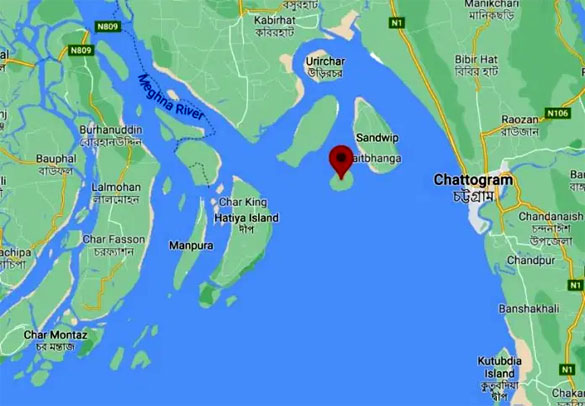
Source: Google Maps
------
Bhasan Char
is an island in Bangladesh’s Hatiya Upazila. Located in the Bay of Bengal, the
island surfaced in 2006 from the sediment deposited by the river. The island
which is on the mouth of Meghna River is flood prone. Sediment is carried away
from the Himalayas to the Bay of Bengal by the tributaries of Ganges,
Brahmaputra and Meghna Rivers, every year. The banks break during the rainy
season when the river overflows, leading to wiping out of large pieces of land.
The
government of Bangladesh has reportedly built hospitals, shelters, towers,
administrative buildings, healthcare clinics and mosques in the island. The
construction and installation started in March 2017 when a helipad was built in
the island. Subsequently, roads and tracks were constructed. By August 2018,
building blocks and flood embankments were seen to be constructed. As per the
relocation plan, there would be 1440 buildings to house around 1 lakh refugees.
Several
reports on the ongoing relocation process to Bhasan Char postulates contrasting
stories. While some reports claim refugees, who are voluntarily willing to
relocate have been moved to the island; some claims that refugees have been
forced to go to the Bhasan Char and a few other state that they had to register
themselves to be relocated. According to few other reports, the Rohingyas are
not allowed to leave the island unless they agree to move to Myanmar. There
also seems to be a confusion over the list that might have been published.
For the
Rohingyas, relocation to the Bhasan Char island seems to be an opportunity for
a better living. They are contented to receive the infrastructures laid out in
Bhasan Char as compared to the clamped camps, lack of sanitation facilities and
education in Cox’s Bazar. To them, it means a place of habitation with
preferable facilities, contrary to what they faced in Cox’s Bazar and Rakhine.
The
government of Bangladesh will reportedly provide the refugees with ration
supplies for the next six months until they start to earn their livelihoods.
Mizanur Rahman, additional secretary for the Office of the Refugee Relief and
Repatriation Commissioner, which oversees the camps, said authorities are
showing videos featuring finished housing blocks, which he said are solid
compared to the fragile bamboo shelters in the existing camps.
However,
what the Rohingyas fail to understand is that, residing in Bhasan Char would be
more controlled and stringent as compared to what they faced in Cox Bazar. The
island, which is several miles away from the mainland is certain to face few
challenges in receiving aids from time to time. The UN has also expressed
concerns over the relocation and continues to seek access to the Bhasan Char to
carry out feasibility and humanitarian studies.
Life at
Bhasan Char — A Grinding Reality Ahead
The life of
Rohingyas, following mass influx from Myanmar in 2017- still raises a series of
concerns in humanitarian terms. As they move forward to seek refuge with better
amenities, it would be difficult to ascertain their return to their homeland,
i.e., Rakhine in Myanmar. The Bangladesh government will have to struggle to
provide basic amenities to them due to socio-political and economic conditions.
Nevertheless, it has been trying to dispense aids to them on humanitarian
premise over the years.
There is a
desperate obligation to provide a dignified life to the Rohingyas. However, as
we take a closer look into the current plight of these refugees, a prospect for
a better life in Myanmar or Bangladesh seems unlikely. The Rohingyas are
plausibly going to be more dependent on the aids received by international
organizations and the Bangladeshi government. Life ahead in Bhasan Char looks
dubious due to the question on the sustainability of the island. Additionally,
they are also certainly going to face challenges on security grounds, due to continued
antipathy from locals of the place they are seeking refuge in. The Rohingya
crisis cannot be resolved efficiently unless Myanmar, Bangladesh and various
international organizations under the aegis of the UN work collaboratively on
the issue. Furthermore, there is a need for Myanmar to take an upper hand on
accepting its people regardless of the Rohingyas’ ethnic differences.
Rehabilitation to their homeland, i.e Myanmar should be seen as a more feasible
option as compared to relocation to some untenable remote island.
------
The
views and opinions expressed in this article are those of the author.
Priyanjoli
Ghosh works as an Analyst, focusing on geopolitical events. She holds a
master’s degree in International Studies from Christ University, Bangalore. She
has previously written for the Journal of Indo-Pacific Affairs, which is one of
the professional journals of the U.S Air Force; National Maritime Foundation,
an independent think-tank supported by the Ministry of Defence, India; and The
Geopolitics.
Original
Headline: Plight of the Rohingya Refugees: Cox’s Bazar to Bhasan Char in
Bangladesh
Source: The Geo Politics
New Age Islam, Islam Online, Islamic Website, African Muslim News, Arab World News, South Asia News, Indian Muslim News, World Muslim News, Women in Islam, Islamic Feminism, Arab Women, Women In Arab, Islamophobia in America, Muslim Women in West, Islam Women and Feminism