
India has Turned A Blind Right Eye To Hindutva Violence, But It Can Be A Threat To State Itself

By Praveen
Swami
17 April 2022
Little gaggles of schoolchildren, out on lunch break, gawked as 17-year-old Jesse Washington was hung from a tree, and his ears, fingers and genitals hacked off. The crowd, the Waco Times-Herald recorded in 1916, chatted and laughed as the African-American teenager’s body was doused in oil, then lowered and raised over a bonfire, timed to make his death slow. A well-dressed woman applauded when “a way was cleared so that she could see the writhing, naked form of the fast-dying Black.”
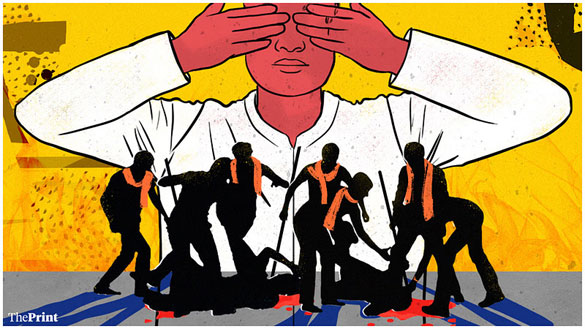
Illustration by Manisha Yadav | ThePrint
-----
Fred
Gildersleeve, a local photographer usually called out for weddings and parades,
documented the slaughter, and later sold his pictures as ¢10 postcards.
Washington’s teeth, gathered up from the street, went for $5 each.
In large
parts of India today, that celebratory culture of killing—recorded on
cellphones and circulated through social media—is becoming dangerously
commonplace. In the lanes of small towns and in villages, real power is held by
ideologically driven gangsters, not the institutions of the State. The point,
like in America, isn’t to torment a powerless minority: it is to tie the
majority into a new ideological order by a bond of blood.
The Rise
Of Everyday Terrorism
Festive
young revellers celebrated Ram Navami in Jharkhand’s Koderma district, singing
and dancing in the streets as police watched: “Muslims are motherf*****s,” the
words of their chant ran. The language of the cause leaves nothing to the
imagination. Airline executive-turned-ashram head Anupam Mishra, popular as
Bajrang Muni, threatens to rape Muslim women, while his supporters cheer.
Sadhvi Saraswati calls on Hindus to stockpile arms, and demanded public hanging
for eating beef; Deependra Singh aka Yati Narsinghanand seeks genocide.
Last week’s
Ram Navami riots, spread out across eight states, have underlined fears about
the accelerating tempo of hate politics across India. There’s little evidence,
it needs to be said, that riots have accelerated through Prime Minister
Narendra Modi’s time in office. Levels of communal riots, and the deaths that
resulted, fell from 2008 to 2011, then grew again until 2016. From 2017 to
2020, the last year for which statistics are available, the number of riots has
grown back to near 2008 levels.
Yet,
something new is happening: street gangs, loosely organised around religious
preachers or local leaders, are building the Hindu-nationalist state with
low-grade, everyday terrorism. These gangs police what we eat, how we dress,
our relationships, our words.
The beating
of a Muslim man for travelling with a Hindu woman; attacks on Muslim street
vendors; the ban on Muslim shopkeepers from trading on temple premises, this
week’s murder in Delhi of a Hindu man accused of cow slaughter: the government
doesn’t maintain statistics on beatings, lynchings and threats, but they’ve
been taking place with depressing regularity.
A New
Kind Of Nationalism
Edward
Anderson has argued that these violent networks form part of a system of what
he calls Neo-Hindutva: “idiosyncratic expressions of Hindu nationalism which
operate outside of the institutional and ideological framework of the Sangh
Parivar.” The Gau Raksha groups which have proliferated across northern India,
the Hindu Yuva Vahini, the Hindu Janjagruti Samiti, the Shri Ram Sene and other
militant groups are building the Hindutva state, on the streets.
Fieldwork
conducted by the ethnographer Satendra Kumar shows the membership of these
groups is driven by a massive cohort of unemployed or semi-employed youth,
seeking agency and dignity through religiosity. Institutions like the Kavad
Yatra or local Jagrans serve as stepping stones to membership of Gau Raksha
groups and other Hindutva vigilante organisations.
In this
world, Kumar notes, the masculinity-seeking of the young, small-time
criminality, and grinding economic insecurity collide with an ostentatious
religiosity. This intellectual ecosystem is built around pop-Hindutva, like the
songs of Haryana singer Upendra Rana, not the austere culture of the Rashtriya
Swayamsevak Singh (RSS) branch.
Fascist
Italy, scholar Matteo Millan has shown, was built ground-up by squadristi
action-groups notionally loyal to Il Duce, Benito Mussolini, in whose name they
“spread terror through the whole countryside.” The squadristi, not dissimilar
to the Neo-Hindutva gangs exercising power across swathes of India, were
“insubordinate and violent, but they were Fascism’s, and the Duce’s, therefore
indispensable.”
To the
Neo-Hindutva gang members, violence isn’t a means to an end. Rather, it is the
end in itself. Everyone loves a good lynching.
The Building
Blocks Of Hate
Little is
new, it is true, in either the hate-polemic or the killing: The communal riot
is a depressingly familiar feature of India’s political and social life. The
painstaking work of scholars Violette Graff and Juliette Galonnier reminds us
that from 1961 onwards, India regularly saw communal violence which claimed
hundreds of lives. Every riot since Partition has seen women subjected to
sexual violence.
Ajay
Verghese and Roberto Foa have demonstrated that brutal Hindu-Muslim clashes
existed even in the precolonial era, leaving behind cultural anxieties and
wounds embedded in popular culture, which could be easily exhumed and used for
political mobilisation.
From the
1980s, prime minister Indira Gandhi, her legitimacy battered by the Emergency
and a moribund economy, successfully developed an institutional riot system.
Large-scale communal violence was engineered, beginning in Moradabad in 1980,
which went on for more than three months and killed, as per official record,
around 400 people in a single police-led massacre.
Instead of
cracking down on the Uttar Pradesh Police, prime minister Gandhi asserted that
the Hindu “religion and traditions” were under attack.
Through
1983, there was further slaughter, in Aligarh, Allahabad, Godhra, Bihar Sharif,
Nalanda, Hyderabad, Vadodara, Pune and Meerut, culminating in a massive pogrom
in Assam’s Nellie. The Congress emerged as the protector of Hindus.
Long before
Bharatiya Janata Party (BJP) leader
Parvesh Verma told Hindus that Shaheen Bagh protesters were plotting to “enter
your houses, rape your sisters and daughters, kill them”, these fears had
embedded themselves in Indian society. Now, Neo-Hindutva has weaponised them
for its war.
The Potential
For Terrorism
“I sent
some three lakh letters, distributed 20,000 maps of Akhand Bharat on 26
January, but these Brahmins and traders have never done anything and neither
will they do,” the Hindutva leader B.L. Sharma ‘Prem’ lamented. “It is not that
physical power is the only way to make a difference, but it will awaken people
mentally,” Sharma concluded. “I believe that you have to light a fire in
society, at least a spark.”
Earlier
phases of communal violence sundered Hindus and Muslims, set in place a cycle
of hatred, entrenched backwardness and, as the decades wore on, enabled a
murderous jihadist sunrise. They did not, however, undermine the State’s
control of society, or the authority of its institutions. This time around,
Neo-Hindutva aspires to build a new society, in which it will be the arbiter of
how we live, or who we love.
Failure to
build a Hindutva state could engender more violence—not less. Even though
prosecutors have been unable to secure convictions against the suspected Hindu
nationalist perpetrators of the 2007 Samjhauta Express bombings—mainly due to early
investigative negligence—the case demonstrated the lethal potential of
Neo-Hindutva groups.
Bomb-makers
Ramchandra Kalsangra, Sandeep Dange and Ramesh Venkatrao Mahalkar, alleged to
have staged the bombing, remain fugitives. Two convictions were secured
terrorists in the network who bombed the Ajmer Sharif shrine, making clear the
linkages between the group and the Samjhauta attack.
From 2003,
hardliners disenchanted with the RSS began drifting away from democratic
politics to a new cult of the bomb. In August 2004, 18 people were injured in
the bombings of mosques at Purna and Jalna, in Maharashtra. In the summer of
2006, Bajrang Dal members Naresh Kondwar and Himanshu Phanse were killed while
making bombs in Nanded. In June 2008, Hindu Janajagruti Samiti operatives were
arrested for the bombing of the Gadkari Rangayatan theatre in Thane. Later, in
October, Bajrang Dal-linked Rajiv Mishra and Bhupinder Singh were killed while
making a bomb in Kanpur.
Former
Maharashtra director-general of police KP Raghuvanshi said in an interview that
the Nanded incident could have “frightening repercussions”.
Lyndon B.
Johnson, the deeply racist United States president who ended up dismantling
American apartheid, acted because he understood the dangers of a divided, angry
nation. Singapore responded to communal riots by enforcing housing integration.
Even though these societies have deep problems, the prospect of full-scale
communal warfare has diminished, through concerted State action.
The rule of
caste-driven tyrannies in swathes of India ensured the absence of modern state
structures that could deliver services and ensure law. The backwardness of
Bihar, as well as parts of Uttar Pradesh and Madhya Pradesh, is in no small
part the consequence of the fact that gangsters ruled, not the government. Now,
we’re in danger that a Hindu-nationalist order is rising in place of the State.
But we are
turning our blind Right eye to the crisis that lies ahead.
-----
Praveen Swami is National Security Editor, ThePrint. He tweets @praveenswami. Views are personal.
(Edited
by Prashant)
Source: The
Print
URL: https://www.newageislam.com/current-affairs/india-hindutva-violence-threat-/d/126808
New Age Islam, Islam Online, Islamic
Website, African Muslim News, Arab World News, South Asia News, Indian Muslim News, World Muslim News, Women in Islam, Islamic Feminism, Arab Women, Women In Arab, Islamophobia in America, Muslim Women in West, Islam Women and Feminism