
THE NOWHERE PEOPLE: The Story of the Struggle of Post-1965 Pakistani Refugees in Rajasthan
A New Age Islam Exclusive
By Pak Visthapit Sangh, Yoginder Sikand & Hindu
Singh Sodha
28 Aug 2010
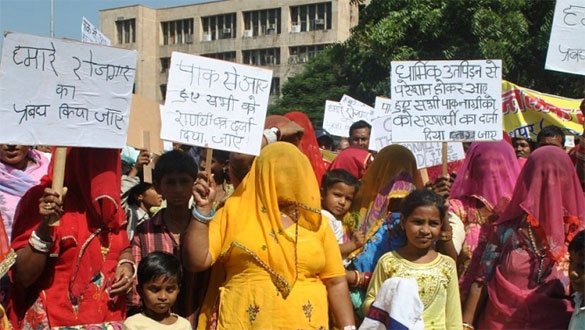
Photograph: Kind courtesy UJAS
----
Introduction
The issue of refugees has become a burning one for the
entire South Asian region. Over the past five decades and more, the
subcontinent has been caught in a spiral of tensions due to ongoing national,
regional, ethnic, religious, linguistic and economic conflicts. Difficulties in
accepting and properly handling cultural heterogeneity are a principal cause of
persecution of minority groups, and this lies behind the refugee problem in
many cases.
Of all the South Asian countries, India hosts the largest
number of refugees. India is a big country, having borders with Pakistan (2912
kms.), Bangladesh (4053 kms.), Burma (1463 kms.), China (3,380 kms.), Nepal
(1,690 kms.) and Bhutan (1463 kms.). Hence there is considerable possibility
for refugees to take shelter in India by crossing the international frontiers.
The Partition of India in 1947 created a massive refugee
problem. Millions of people were forced to flee across the newly-created border
that divided India and Pakistan. In the years that followed, numerous minority
groups from neighbouring countries who faced different forms of persecution
migrated to India. Many also came for economic reasons. Yet, despite the
relatively large number of refugees living in India, the country still does not
have a precise refugee policy and nor is it a signatory to United Nations
Convention on Refugees of 1951 and its Protocol for Refugees of 1967.
*
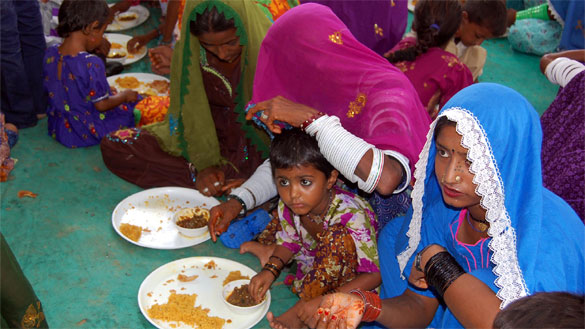
Migrants in a makeshift camp in Jodhpur
-----
Post-1965 Pakistani Refugees in Rajasthan
Of the various refugee groups presently residing in India,
one of the most neglected are refugees from Pakistan's Sindh province who
shifted to India in waves in 1965 and after. They are Hindus and belong to
various castes. It was to highlight their plight and struggle for their
citizenship rights and rehabilitation that the Pak Visthapit Sangh (PVS) was
established in 1999.
Most of these refugees are from Thar Parkar district in
Sindh. Others are from other neighbouring districts of Sindh, such as Umarkot,
Mirpur Khas and Hyderabad, as well as from Rahimyar Khan and Bahwalpur in
southern Punjab. These refugees are different from the Sindhi Hindu refugees
who shifted to India in the wake of the Partition in 1947, who are mainly
Sindhi-speaking and are ethnic Sindhis. The refugees from Thar Parkar have
their own language, Dhatki, and distinct cultural identity, sharing much in
common with people living across the border in India. The other recent refugees
from Sindh include Marwari-speaking and Gujarati-speaking communities who
traditionally engaged in seasonal migration to engage in agricultural labour in
the fields in Sindh. Many of these are landless Dalits and Tribals.
Thar Parkar is an arid area, part of the sprawling Thar
desert that covers large parts of Rajasthan and Sindh. It borders Kutch in
Gujarat in the south and Barmer in Rajasthan in the west. There is evidence of
human settlement in Thar Parkar from the period of the Indus Valley
Civilisation. One of the earliest references to the area points to it being
under the rule of the Parmars in the sixth century. It was then ruled by the
Sumras, who were replaced by the Sodha Rajputs, followed by the Kalhoros and
then Talpur Baluchis. The British annexed the territory in 1843 and
incorporated it into the Sindh province.
Thar Parkar has a mixed Hindu-Muslim population. The Muslims
include Rajputs, Baluchis, Syeds and Lohanas. The Hindu castes include
Meghwals, Bhils, Sansis, Jogis, Odhs, Rajputs, Brahmins, Malis, Rabaris,
Sonars, Jats, Nais, Darzis and several others.
*
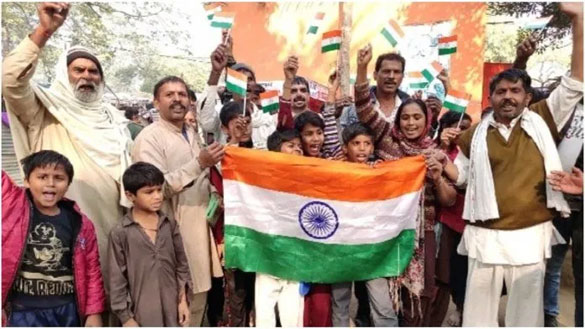
Representational image, via Twitter/ Pakistani Hindu
refugees staying across India cheer for Citizenship Bill
----
In the wake of the Partition of India, the region of Thar
Parkar saw little violence or movement of refugees. The denizens of this area,
Hindus and Muslims, had lived in peaceful coexistence for centuries. However, a
quarter century after the formation of Pakistan witnessed the creation of a
massive refugee crisis in Thar Parkar. The first wave of massive migration to
India from Thar Parkar occurred in the wake of the India-Pakistan war of 1965,
when some 10,000 people from the area crossed over to India. Then, in the
course of the 1971 war between India and Pakistan, India occupied a large part
of Thar Parkar, as a result of which some 90,000 Hindus of the area shifted to
India and decided not to return.
Under the 1972 Shimla agreement, India agreed to give back
this territory when Pakistan agreed to receive 90,000 of its nationals, mainly
Hindus from Thar Parkar, who had taken shelter in India during the war. India
gave back the land but Pakistan did not show any interest in accepting these
people, most of whom had sought shelter in western Rajasthan and few of whom
wanted to return to Pakistan.
Migration to India of Hindus from Thar Parkar and other
parts of southern Sindh was further exacerbated in later years owing to
religious persecution and discrimination. This migration continues even today.
These refugees are from various caste groups. Those who suffered the most,
however, are the Scheduled Tribes and Castes. They are largely illiterate,
extremely poor and are the original inhabitants of the Thar desert. In Pakistan
they worked mainly as landless labourers in the fields of landlords. In India
they continue to live in penury.
*
Pakistani Hindu refugees in Rajasthan
----
Refugees in the Camps
In the wake of the 1971 war, the refugees from Thar Parkar
and neighbouring parts of southern Sindh were confined in 24 refugee camps in
Barmer district of Rajasthan that were established by the Government of India.
The refugees were forced to remain restricted within the camps. Being used to
living freely on vast expanses, the refugee camps confined movement and proved
distressful to those who were housed there. Moreover, there were strict rules
pertaining to the refugees' stay. They had to give attendance daily and were
refused permission to visit their relatives anywhere. There were limited tents,
which were assigned to joint families. At times one tent housed more than two
or three families. Ration cards were issued to the head of the families who
lived in these tents. These camps continued to function till 1978.
In 1977 the Janata government came into power at the Centre
as well as in Rajasthan state. In 1978 the Government of India granted Indian
citizenship to the refugees living in the camps, including both those who had
arrived in 1965 and 1971. It authorized the District Magistrates in Gujarat and
Rajasthan to do so on the basis of Citizenship Act of 1955. Immediately after
the completion of the citizenship process the Government of
Rajasthan, in collaboration with the Government of India,
declared a rehabilitation package for the refugees of 1971.
Most of the 1965 refugees had been allocated villages
inhabited by Muslims who migrated to Pakistan during 1965 war. The declared
rehabilitation package for the 1971 migrants included land and a total of 90
million rupees cash from the Centre. According to the rehabilitation package,
each family was supposed to be allocated either 25 bighas of land in the canal
area or 75 bighas of barren land in the desert. However, in reality refugee
families received only a part of their total allocated land due to administrative
corruption and ignorance. The rest of the land was included in the National
Desert Park or occupied by the local people. In several cases, due to fear the
migrants could not protest.
*
The influx of Hindu refugees from southern Pakistan did not stop
after 1971. It continued in the years that followed due to religious
persecution, insecurity, deterioration of law and order situation, rising
religious fundamentalism, forced religious conversion, repeated bouts of
martial law and so on. The influx declined between 1972 and 1989 but still
continues. Many Hindus living in Pakistan wish to shift to India, but often
this is impossible for them.
In 1947, many rich Sindhi Hindus migrated to India. In
addition, many feudal and 'upper' caste Hindus from Thar Parkar shifted to
India between 1965 and 1989. The recent refugees are mostly Scheduled Tribes
and Castes, almost wholly illiterate and extremely poor. Most of them cross
over from the Attari check post in Punjab with valid documents. Prior to this,
many of them used to simply cross the porous border between Sindh and
Rajasthan, which was later fenced in the early 1990s.
The influx of refugees suddenly increased in the wake of the
demolition of the Babri Masjid in Ayodhya in 1992 and the consequent massive
wave of attacks on Muslims in
India. The reaction in Pakistan was so violent that many
Hindus in the south of the country started migrating to India. In addition to
those from Thar Parkar, many of them are actually of Rajasthani and, to a
lesser extent, Gujarati origin. They used to cross over from Rajasthan and
Gujarat to work in the fields of landlords in Sindh and southern Punjab. This
seasonal migration continued till the mid-1960s, after which, because of the
fencing of the frontier between Pakistan and India, they could not return to
their homes in India.
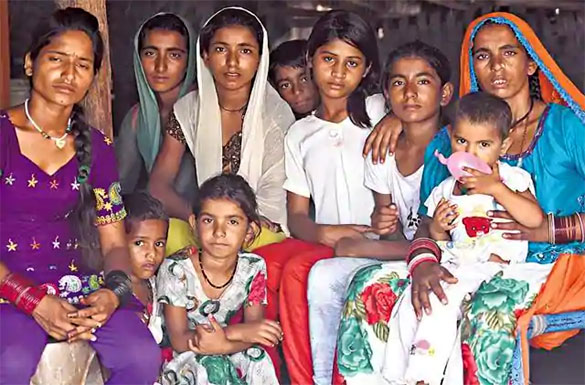
Pakistan refugees in a camp in Jodhpur, Rajasthan.(Aishwarya Kandpal / HT Photo )
------
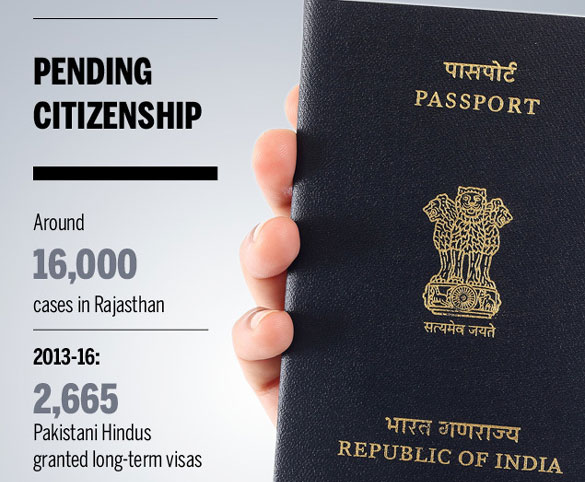
The following table provides details about the
approximate number of Pakistani refugees who crossed over to India from 1965
onwards:
Year
1965
Number of Refugees
From Pakistan
8,000
Mostly Granted Citizenship
1971
90,000
Mostly Granted
Citizenship
Post 1992
17,000 and still
continuing
Remarks
Roughly 3000 still
awaiting citizenship. In 2005-6 some 13,000 received citizenship
------
Most of the migrants who have come to India from southern
Sindh after 1965 have settled in Rajasthan. This is because most of them have
relatives in the state, particularly in the border districts of Barmer,
Bikaner, Jaisalmer and Sri Ganganagar. They have to regularly apply for the
renewal of their visas, and this is very often denied. Those migrants who have
not received Indian citizenship have to face many problems. They are not
allowed to travel to the border districts, which is where most of them have
relatives. The Indian High Commission in Islamabad refuses to give visas to
Pakistani nationals to travel to these districts. To circumvent this rule, some
people from Pakistan, including those who are residing in India without Indian
citizenship, earlier used to take visas for other places but travel to the
border districts. This was before they received Indian citizenship.
Technically, this is illegal. They used to keep their identities hidden. They
were not legally allowed to work in India but they often did so in order to
sustain themselves, as agricultural workers and daily-wage earners. They were
highly exploited by security personnel as well as local people since they had
no rights to claim. Before recently receiving Indian citizenship, in part as a
result of the efforts of PVS, many of them had already spent the minimum period
of five years in India that was earlier required for becoming eligible for
Indian citizenship, although this involved the complex procedure of constantly
having their visas extended, which was often not granted. Those who had spent
five years in India could technically apply for Indian citizenship under the
Indian Citizenship Act of 1955 (Section 5(1)(A) for people of Indian origin,
5(1)(C) for people married to and staying together with Indian nationals for
more than five years together, 5(1)(D) for people whose parents received Indian
citizenship and 5(1)(E) for major children. But this was not easy task as most
of the refugees were illiterate and poor.
*
The Origins of PVS
PVS is a loosely-structured community-based organisation,
which came into being in 1999 after consultation with leaders and individuals
belonging to the Pakistan migrant community. It is based in Jodhpur, and its
volunteers live in different parts of western Rajasthan. Most of its activists
are of Pakistan migrant background, mostly from Thar Parkar. Some of them were
born in Pakistan and shifted to India after 1971.
PVS has been working mainly with the migrant community,
highlighting their problems relating to citizenship and rehabilitation.
However, the need was recently felt to widen the focus of its work to include
other communities living in the districts in Rajasthan that border Pakistan,
both Hindus and Muslims. This would include promoting communal harmony and
shared religious and cultural traditions and highlighting the various
problems faced by these people living in a harsh desert
terrain. Another major issue is that of promoting cross-border peace
initiatives with people living across the frontier in Pakistan. Consequently,
to promote these objectives, the Seemant Lok Sangathan ('Border Peoples'
Union') (SLS) was formed in 2005.
*
PVS began with the aim of highlighting the problems of the
post-1965 Pakistani migrants living in scattered pockets mainly in Rajasthan
and Gujarat. Prior to this, these migrants lacked any effective platform for
highlighting their grievances and having their problems addressed. They were
sharply divided on the basis of caste and lacked a sense of unity. The fact
that they lived in towns, villages and settlements spread over different parts
of Rajasthan and Gujarat made coordinated action for highlighting their
concerns difficult. PVS sought to bring them together on a common platform to
seek to secure their basic human rights. It sought to promote a sense of
identity among the migrants transcending that of caste and region, based on
their common concerns and issues.
PVS began its journey by a series of meetings with migrants
living in different parts of Bikaner, Jaisalmer, Barmer and Jodhpur in
Rajasthan to understand and document their problems and grievances. Thereafter,
in July 1998, it organised a demonstration before the Rajasthan State Assembly
in Jaipur, bringing together some 600 migrants. A memorandum and charter of
demands was submitted to the then Chief Minister of the state, Bhairon Singh
Shekawat, demanding immediate resolution of the problems of the migrants.
Shortly after, the PVS submitted another memorandum to the then Indian Home
Minister, L.K. Advani, in Jaisalmer in the presence of the Rajasthan Chief
Minister. Thereafter, PVS activists continued visiting migrant settlements and
recording the problems of the migrant community. In August 1999, PVS organised
a demonstration before the office of the Colonisation Commissioner to highlight
the severe loopholes in the rehabilitation policy announced by the Government
for a section of the migrants. This was followed by block-level meetings in the
four districts of Jodhpur, Jaisalmer, Barmer and Bikaner, where most of the
refugees live.
Critique of
Rehabilitation Policy of the Government
One of the first efforts of the PVS was to initiate a study
of the rehabilitation policy for the refugees from Pakistan residing in western
Rajasthan which was announced by the government in 1978. In 2000 PVS conducted
base line survey almost all the villages where migrants from Pakistan live. The
survey highlighted the fact that while the refugees who came to India in 1965
and 1971 have officially received some sort of rehabilitation package from the
government, this is not the case for those who came to India after 1971. The
latter have not received any rehabilitation benefit whatsoever.
The following table provides details about the Government's
rehabilitation policy for the 1971 refugees:
Name of the Programme
Number of rehabilitated families Amount given to the families as loan (in Rs.)
Krishi Yojana
1. a. Barmer 4033
b. Jaisalmer 507
c. Jalore 51 4591 1,37,93,750
Indira Gandhi Canal
Area 3166 1,66,80,350
Ekal Yojana 231 9,22,500
Laghu Yojana 235 19,60,000
Old Age Pension 156
Total 8379 3,33,56,600
The following table shows the places where most of the
refugees
in Rajasthan who
came to India in 1971 were rehabilitated:
District Name of Block where Refugees Inhabilitated No. of Villages Inhabited
Barmer Shiv 80
Chohtan 86
Ramsar 53
Bikaner Kolayat 20
Pugal 27
Jaisalmer Rural Areas 28 Villages
Urban areas 3 Bhil Bastis (Not rehabilitated)
Jodhpur Urban Outskirts 6 Dalit and Tribal Bastis (Not rehabilitated)
The PVS survey highlighted the loopholes in the
rehabilitation package for the 1965 and 1971 migrants and demanded proper
rehabilitation for post-1971 refugees, many of whom are very poor Scheduled
Castes and Tribals, who eke a miserable existence as daily-wage earners. The
survey found that according to the available secondary data, based on ration
cards issued to heads of families, land was allotted to 4,033 people in Barmer
district, 3,166 in Bikaner in the command area of the Indira Gandhi Canal, 507 in
Jaisalmer and 51 in Jalore. However, the implementation of the policy was
deeply flawed and numerous families did not receive any land at all. Some of
the land was included in the National Desert Park or had been taken over by
locals. Many refugees did not receive the land that had been allocated to them.
In almost all cases, the land distributed was undeveloped, uncultivable, and of
poor grade in both the canal area and the arid zone. Further, for each murabba
of land the state government charged an additional sum of Rs. 30,000 to be paid
in instalments over 20 years against 18 per cent interest, which was
unaffordable for many migrants. In some cases there was opposition from local
people to refugees acquiring land. In one case that PVS discovered that in
Vedihar in Kutch, Gujarat, five hundred locals attacked the refugees and one
person was killed as the refugees sought to take possession of the land that
had been awarded to them.
*
Mobilising the
Refugees for their Rights
The work of PVS is mainly in the form of people's
mobilisation to have their issues highlighted and addressed. For this it has
organised numerous demonstrations as well as meetings with bureaucrats,
politicians and media personnel. It has also organised several public hearings,
where the migrants have spoken about their problems relating to citizenship and
rehabilitation before the media and government officials.
On 24 November 2001, PVS organized its first public hearing
at Bikaner where 3,166 refugees had been rehabilitated in 40 settlements.
Around 600 refugees, from some 40 settlements in Bikaner, attended the event,
as did refugees from Jodhpur, Jaisalmer, Barmer and Sri Ganganagar. The public
hearing was chaired by the then Additional Chief Secretary, R.K.Nair and was
also attended by other senior government officials, such as the District
Magistrates and Superintendents of Police of Bikaner, Ganganagar, Hanumangarh
and Churu districts. Similar public hearings were held at other places in
western Rajasthan thereafter.
Following the public hearing in Bikaner, the government of
Rajasthan formed a cell within the Colonization Department of Bikaner to deal
specifically with the problems relating to rehabilitation of the refugees from
Pakistan. The chairman of the cell is the District Commissioner and other
members include the District Magistrate, Additional Commissioner, Assistant
Commissioner of the Colonization Department, Bikaner and Hindu Singh Sodha,
convenor of PVS. Thereafter, the Chief Minister of Rajasthan formed a
state-level review committee formed to look into the problems of the refugees
from Pakistan, and included the convenor of the PVS as a representative. The
first meeting of the Review Committee was held in Jodhpur on 19 Sept 2001.
Apart from members of the committee, it was attended by District Magistrates
and Superintendents of Police of Jodhpur, Barmer, Jaisalmer, Pali and Jalore.
The PVS representative gave suggestions about the modalities and the procedures
to be followed by the committee and also briefed the members of the committee
about the severity of the problems faced by the migrants.
Yet, the problems relating to rehabilitation of the migrants
from Pakistan continue and PVS has been consistently highlighting these in its
public meetings and interaction with government officials. These include:
1. The lack of any
rehabilitation package for the post-1971 refugees, including those who have
recently shifted to India.
Most of these migrants are extremely poor and belong to
various Dalit communities.
2. Loopholes in the existing package for the 1965 and 1971
refugees relating to land allotment
. In many cases refugees have been granted arid or waste
lands, which are uncultivable. Some migrants were actually given much less land
than what had been officially allotted. Some migrants who married Indian
nationals did not receive any rehabilitation. To add to this, much of the land
allotted has now come under the Desert National Park. Some people been allotted
land but the land has not been actually acquired. In some cases, the allotted
land is officially declared as 'irrigated' but it is actually largely or
totally arid, but yet the owners are forced to pay instalments as owners of
'irrigated' land. Numerous families have been allotted some land for cultivation
but nothing for building their homes. The land allotted has been on the basis
of possession of a single ration card, which has meant that large families have
received land which is totally inadequate for proper sustenance. Numerous
migrants have seen their land being taken over by others but, due to illiteracy
and poverty and lack of access to influential people, have been unable to
prevent this. The cost if litigation is simply too heavy for them to bear.
3. Problems relating to livelihood. Many of the migrants,
particularly those from Dalit communities, are extremely poor and eke out a
miserable existence as daily-wage labourers, being highly exploited. They live
in small hovels and have no access to even basic amenities. Several of their
womenfolk do embroidery work for local middlemen, for which they receive but a
pittance. Many migrant families have yet to gain access to various services
provided by the government, including Below Poverty Line cards, credit,
education, pension and ration cards.
4. Problems in access to water.
Several migrant settlements, particularly those located in
the desert, face an acute water crisis. Some of these settlements are around
ten kilometres from the nearest water-point.
5. Problems relating to caste certificates.
A large proportion of the post-1971 migrants are from
various Scheduled Tribes and Castes. They face considerable problems in
acquiring Scheduled Tribe and Caste certificates.
6. Problems of migrants who have not received Indian
citizenship.
These migrants are denied access to all forms of state
provision, although many of them are very poor.
Case Studies
Bhairon Singh, Uttam Singh and Swaroop Singh are brothers who migrated to India following the 1971 war between Pakistan and India. Although their joint family consisted of a large number individual families, it was allotted only a single ration card. This was in the name of Bhau Singh, the brothers' father. The land allotment made on the basis of the ration card was therefore made only in the name of Bhau Singh. Consequently, the three brothers are left with very little land after the equal division of the land. The single ration card system followed for the purposes of rehabilitation is a serious problem as this has left many families without enough land to sustain them.
Fatima
is a Meghwal (Dalit) woman and is around 80 years old. She
is a widow, has two sons and lives with the younger one. Her husband was
allotted a piece of land under the 1978 rehabilitation package but after his
death her elder son has taken claim of it. She is now left without any land.
She works as an agricultural labourer in the field of a landowner. Her job is
to chop bajra once it is ripe and earns only a pittance.
Bijal
was allotted land under the 1978 rehabilitation package.
After his death, his wife Sita, was not able to claim it as another party
occupied it illegally. A letter of complaint was presented but so far no action
has been taken. Illegal occupation of the allotted land is a major problem
which gets aggravated in the circumstances where the aggrieved is poor. The
costs of litigation have to be borne by the hapless, poverty-stricken migrants,
which, in many cases, they cannot afford.
Madhu Dan
had been allotted 75 bighas of land in 1979. After his death
it was discovered by his family that that the land already belonged to another
person, Jiya Putri Malna. A court case was filed but after 17 years, in 1995,
the case was decided in favour of Malna. Madhu Dan's son is now without any
land. This is again a case of negligence on the part of the administration which
did not verify whether the land to be allotted was owned by the government or a
private individual.
*
Sada Ram
came to India in 1971. He settled in Pugal, along with his
three brothers. The entire family was allotted 25 bighas of land in the name of
Sada Ram, of which 10 bigha s are un-irrigated. Over the years the family has
expanded and now consists of 27 people. The amount of land is too small to
support such a large family. Hence, Sada Ram's two brothers are landless and do
not even have a plot of land for their homes.
*
Maha Singh Sodha
came to India in 1965 and settled in Gohad ka Tala, Barmer.
In 1968 he received a ration card and was initially allotted 75 bighas of land.
But because he did not have Indian citizenship then the allotment was cancelled.
In 2005 he received Indian citizenship but was officially awarded only 15
bighas of land.
*
Some 200 families from Pakistan in Kapran (Chotan, Barmer)
received 75
bighas each in 1966. In 1970, the land that was allotted to
30 families was re-allotted to local people. This created a conflict. The
refugees took the case to the court. In 1988 the Rajasthan Revenue Board
decided in favour of the locals but the refugees managed to secure a stay
order. In 1999 the Board decided in favour of the refugees but the
administration intervened and called for a re-inviestigation. In 2000 the High
Court decided in favour of the refugees. The matter was then taken to the
Supreme Court in 2004, which decided in favour of the refugees.
*
25 families from Thar Parkar who had stayed in the Harsani
refugee camp were each allotted 75
bigha s of land in Fatehgarh, Jaisalmer. On paper this was
irrigated land but actually they were uncultivable sand dunes. In 1986 the
families applied for transfer of this land. It was only in 2001 that some 18
families managed to have the land transferred afer paying roughly Rs.26,000
each. However, some influential locals opposed this and did not allow them to
cultivate the land. These locals claimed the land was theirs, but this was not
true. Yet, even now the refugees cannot cultivate the land, because of which
they are forced to live in desparate poverty and earn their livelihood through
manual labour.
*
Jujhardan Charan
came to India and settled in Dhansar. He was allotted 75
bigha s of land in 1978 in Shiv in Barmer. However, he did not actually receive
the land. In 1980 the Government informed him that the land he had been
allotted was now part of the Desert National Park, which could not be
cultivated. Because of this he now is forced to work as an agricultural
labourer. There are numerous other cases like this.
*
Satram Suthar
, a Pakistani refugee, was allotted 75 bigha s of land in
1978. However, this land was lost when the fence came up along the
India-Pakistan border. Satram asked for a plot of land in a different place but
his appeals continue unheard, forcing him to work as an agricultural labourer.
Numerous refugees who have settled along the border face the same problem.
*
Gamer Singh
, who lives in a village in Kolayat, Bikaner, was allotted
25 bigha s of land in 1978. In 1981 most of his land came under a nursery,
canal and, later, a new road as well. Yet, he did not receive any compensation.
*
Mansukh
, a Pakistani refugee, was given 25 bigha s land in Shiv, in
Barmer. However, since the land was assumed under the Desert National Park the
Government allotted him some other land in exchange. However, this new plot of
land was already in someone elses name so he received nothing.
*
Parbhu Dan Charan
received 25 bighas of land in Bikaner. He cultivated this
for 25 years. However, 17 bighas of this land wwere forcibly taken over by
local people. The Revenue Court ruled in favour of Parbhu Dan but the locals
refused to vacate the land.
Parbhu Dan is now deceased and his wife Tara Devi is now
left with only 8
bighas of unirrigated land.
*
Amsingh Sodha
came to India in 1971 and settled in Dhansa village in
Jalore. He married an Indian citizen and received a ration card. However, he
did not receive any land allotment on the grounds that his wife was an Indian
national. Allotment was not given to single individuals like Amsingh, but only
to those who had come to India with their families. There are several cases
like Amsingh's.
*
Mobta Ram Bheel
, from Malia, Jaisalmer, came to India in 1965. He was
allotted 75 bigha s of land. In 1969 he crossed the border into Pakistan in
search of employment. Prior to this he had taken a loan of Rs. 986. He died in
Pakistan, and his son Luna Ram, now 63 years old, returned to India in 2004. He
repaid his father's loan but the land is still not in his name.
PVS's Struggle for Indian Citizenship for the Refugees
Another major issue that PVS has consistently highlighted is
that of the problems involved in procuring Indian citizenship for Pakistani
refugees. Citizenship is essential in order to access rights. In the absence of
citizenship, thousands of refugees in Rajasthan, and, in lesser numbers, in
Gujarat, are unable to stake their claim to even the most basic human rights.
Since its inception the PVS has been struggling to make the
procedure for the acquiring of Indian citizenship by the refugees from Pakistan
simpler, faster and less expensive.
Through demonstrations, public awareness campaigns and
lobbying with political parties and bureaucrats it has succeeded in
facilitating the granting of Indian citizenship to a large number of Pakistani
refugees. However, still a number of recent migrants, roughly three thousand,
are still unable to procure Indian citizenship, although they do not wish to
return to Pakistan. PVS continues with its efforts to pressurise the government
to modify its policies to make it easier for the migrants to apply for Indian
citizenship.
In its interaction with political leaders and senior
bureaucrats PVS has consistently pointed out the extreme difficulty that
migrants from Pakistan face in applying for Indian citizenship. Several
refugees from Pakistan have stayed in India for more than five years, which
earlier made them eligible for citizenship under various sections of the Indian
Citizenship Act of 1955. However, now the minimum period of residence in India
has been extended to seven years, which means that it is much more difficult
for the refugees to acquire Indian citizenship. This difficulty is exacerbated
by the fact that many of the refugees are illiterate and poor. Moreover,
following the signing of the Assam Accord in 1986, the Government India
withdrew the power vested with the District Magistrates to grant citizenship
and transferred it to the Ministry of Home Affairs in New Delhi. Applying for
citizenship in Delhi is an expensive affair and involves arduous travel. In
order to apply for citizenship one needs a regular passport with a valid visa
and regular extension of Foreigners Registration Office's report, which is next
to impossible for many poor refugees from Pakistan, who move from one district
to other in search odd jobs to regularize their documents. Their desperate
poverty means that many of them simply cannot afford the fee required for applying
for citizenship. Being thus left without Indian citizenship, they cannot avail
of any government-provided service. Their children cannot attend government
schools, thus reinforcing the vicious circle of poverty and illiteracy in which
they are trapped.
*
In 1999 the then Home Minister during his visit to Jaisalmer
orally instructed District Magistrate to initiate the process of granting
citizenship to the refugees from Pakistan
who came to India in the wake of the 1965 and 1971
India$B!#%s(BPakistan wars. The PVS kept up with its demand of making the
process of applying for Indian citizenship simpler and affordable, insisting on
this in its meetings with senior politicians and bureaucrats. On this front the
PVS has secured some success.
In 2001, fter a PVS delegation met with Mr. Ashok Gehlot,
the then Chief Minister of Rajasthan, the Government of Rajasthan decided to
set up a Review Committee to look into the concerns of the Pakistan migrants.
It was headed by the Additional Chief Secretary (Home). Other members were the
Revenue Secretary, the Rehabilitation Secretary, the Divisional Commissioner of
Jodhpur, the Deputy Secretary (Home) and the representative of PVS. It
recommended, on the advice of the PVS, that the Central Government accept
applications for citizenship from Pakistan nationals on receipt of a simple
affidavit renouncing Pakistani citizenship. This would also save them the
financial burden of paying a substantial sum of money to the Embassy of
Pakistan in the form of fees for passport renewal and renunciation of Pakistani
nationality. In 2002, on the advice of the PVS, the Review Committee
recommended the setting up of cells in Jodhpur, Jaisalmer and Barmer to
facilitate the processing of applications for Indian citizenship submitted by Pakistani
refugees. These were constituted under the chairmanship of the local district
magistrate, and included a representative from PVS. The Review Committee also
sent a formal letter endorsed by the Chief Minister of Rajasthan to the
Ministry of Home Affairs, Government of India, to grant citizenship to migrants
from Pakistan who had been residing in Rajasthan for more than five years.
Most of the migrants have relatives living in the border
districts of Rajasthan and Gujarat. In addition, a large number of Pakistani
nationals in Thar Parkar and other parts of southern Sindh, both Hindus and
Muslims, have relatives living in these districts. However, Pakistani nationals
are not allowed to visit these districts, and this rule applies to those
Pakistani citizens who are now in India and wish to apply for Indian
citizenship. This is a major problem for the migrants, an issue that the PVS
has been highlighting. As a result of our pressure, the Review Committee, in
its third meeting in 2002, recommended that the existing order issued by the
Union Home Ministry stating that
Pakistani nationals resident in India for five years be
allowed to visit the border districts. However, this has yet to be approved of
by the Government of India.
On 6th January 2004, the Government of India decided to
grant citizenship to Pakistani refugees of 1965 and 1971 presently living in
Barmer and Jaisalmer district through 'citizenship camps'. The Government
declaration excluded refugees who came to India with valid passports and documents
after 1971 and had stayed in India for more than five years. On 14th Jan 2004,
PVS activists met Ms. Vasundhara Raje, Chief Minister of Rajasthan, and pointed
out that the present proposal of granting citizenship would benefit only a
small number of the refugees of the 1965 and 1971 India$B!#%s(BPakistan
conflict. On the other hand, thousands of migrants who came to India through
valid documents would be denied citizenship. The Chief Minister contacted Arun
Jaitley, the then Minister of Legal Affairs, and stressed that she agreed with
the stance of PVS and requested that the Central Government take necessary
measures to solve the problem. She also advised that minor children of refugees
be granted citizenship against a simple application by their parents. After
considerable lobbying, PVS representatives were finally able to make a
breakthrough. Subsequently, on February 28 the Government of India declared
that all eligible Pakistani refugees in Rajasthan and Gujarat could apply for
Indian citizenship.
Till 2004, Pakistani refugees who sought Indian citizenship
had to apply to the concerned government authorities in New Delhi, a process
that involved great costs and considerable effort, something that was beyond
the capacity of most of the applicants. PVS contacted the Chief Minister of
Rajasthan, who wrote a letter to the Minister of Legal Affairs, Government of
India, proposing that the power to grant citizenship to Pakistani refugees in
Rajasthan be delegated to District Magistrates. Later, PVS activists met the
State minister for Ministry of Home Affairs, who agreed on inclusion of
refugees who had traveled from Pakistan with valid documents in the upcoming
citizenship process and to the waiving off of the renewal, renunciation and
penalty payments mandatory in the process of applying for nationality on the
grounds of the desperate economic conditions of a large number of Pakistani
refugees.
As a result of the efforts of PVS, including meetings with
political leaders and bureaucrats and public demonstrations, on 28th February
2004 the Ministry of Home Affairs, Government of India, formally declared the
delegation of power of granting Indian citizenship to Pakistani migrants to the
District Magistrates of Rajasthan and Gujarat to grant citizenship to the refugees
from Pakistan who were residing in the concerned districts. This made it easier
for the Pakistani migrants to apply for citizenship, as most of them were
residing in Rajasthan and, in lesser numbers, in Gujarat. This power was
initially delegated for a period of one year. However, the implementation of
the order was delayed by several months.
On 27th March 2004, the Review Committee on Pakistani
migrants held a meeting in Jaipur. There, the convenor of PVS suggested the
formation of a permanent cell to resolve the problems of migrants, including
the continued delay in the process of processing applications for Indian
citizenship. PVS representatives met with the Principal Secretary of the
Government of Rajasthan and the Chief Minister of the state, Ms. Vasudhara
Raje, requesting that the Government order relating to the provision of
citizenship be put into effect as soon as possible. After meeting the PVS
convenor, the Rajasthan Chief Minister announced the formation of a permanent
cell to look into the problems of Pakistani migrants in Rajasthan, in
particular those related to citizenship and rehabilitation. The cell was
constituted under the chairmanship of Additional Chief Secretary (Home),
Government of Rajasthan, the Revenue Secretary, the Deputy Secretary (Home),
the Rehabilitation Secretary, the Divisional Commissioners of Bikaner and
Jodhpur and the representative of PVS. Two sub-committees were also constituted
under the chairmanship of the Divisional Commissioners of Bikaner and Jodhpur.
The members included all the Divisional Magistrates of the districts and the
representative of PVS.
In the meanwhile, a new problem emerged. The Government
suddenly hiked the fees payable by those applying for Indian citizenship,
making it quite out of the reach of most of the Pakistani migrants in
Rajasthan, a sizeable majority of who are very poor. Under the new citizenship
fees structure it would take a minimum 50,000 Rupees for a family to get Indian
citizenship. According to the new rules, under Section 5 (1) A of the Indian
Citizenship Act, in which previously there was no payment required, a fee of
Rs. 5000 was introduced. The fee under Section 5 (1) C was increased from Rs.
500 to Rs. 10,000 and that under Section 5 (1) D from Rs. 100 to Rs. 3000. In
the wake of this new development, the PVS convenor held a press conference in
Jaipur in October 2004, where he protested against the new fee structure. He
met with the Chief Minister of Rajasthan and requested her appeal to the Centre
to revert to the old fee structure. On 26th October 2004, the Chief Minister
sent a representation to the Centre in which she suggested that the old fee
structure be continued. The convenor of PVS also met with Shiv Raj Patil,
Minister of Home Affairs, Government of India in this regard. As a result of
the intense lobbying of PVS, the Government was forced to revert to the earlier
fee structure.
Finally, on 22nd December 2004, the Additional Chief
Secretary, Government of Rajasthan, notified the District Magistrates to
initiate the process of granting citizenship to Pakistani migrants residing in
their districts. Following this, 'citizenship camps' were organised by the
government between 4th January and 28th February 2005 in all the districts of
Rajasthan where the migrants are residing. PVS volunteers worked in these camps
to assist the refugees and the officials. By 28th February more than 13,000
Pakistani migrants received Indian citizenship through the citizenship camps.
This number proved false the Government's earlier claim that there were only
1600 Pakistani nationals living in Rajasthan. But it was a major achievement
for PVS.
However, many refugees were unable to acquire Indian
citizenship. Many applicants simply could not afford the fees required for
applying for citizenship. A large number of them did not apply for citizenship
for their children. In some cases, applicants' children could not be granted
citizenship because their gender was wrongly mentioned in their passports. Some
orphaned children could not apply for citizenship as, according to the rules,
they were eligible for citizenship only of their parents had also applied and
received citizenship. Several could not apply for citizenship because they had
not stayed in India for the minimum required period of five years. Many
migrants had crossed into India by walking across the border without necessary
documents and were, therefore, not eligible for applying for citizenship. Some
migrants belonging to nomadic communities were unable to secure citizenship
because they had not resided in any one particular place in India for a period
of five years, their caste occupations and poverty forcing them to constantly
travel. The process of providing Indian citizenship through the camps was
further complicated by the fact that the District Magistrates lacked proper
information regarding the Pakistani refugees residing in their districts. Yet,
the District Magistrates actively worked with the PVS to provide citizenship to
the applicants.
The process of granting citizenship through 'citizenship
camps' lasted only for two months. This was wholly inadequate for granting
citizenship to all the applicants. Further, the fact that the migration of
Hindus from Pakistan is still continuing means that the process of providing
citizenship has to be continued. Consequently, PVS felt that the need for
delegation of the power to provide Indian citizenship to District Magistrates
for an indefinite period, in place of the one year period that the Government
had allowed for. Accordingly, PVS submitted several memorandums containing this
demand.
On 3 March, 2005, due, in part, to the continuous efforts of
PVS, the Additional Secretary, Ministry of Home Affairs, Government of India,
declared the extension by one year the order of the Government of India that
delegated to the District Magistrates the power to grant Indian citizenship to
Pakistani migrants in Rajasthan and Gujarat. It was the landmark development
and a significant victory for PVS. However, PVS keeps up with its demand for
the permanent delegation of this power to district magistrates in Rajasthan
since most Pakistani migrants reside here and migration will probably continue
due to various reasons. On 28th February, 2006, the extension period of the
order was further renewed by another one year due to the insistence of PVS.
PVS continues to demand that:
1. 1. The hike in
the fee for applying for Pakistani refugees in Rajasthan applying for Indian
citizenship be rescinded
2. The period of seven years residence in India needed for
application for citizenship to be considered be reduced to the earlier period
of five years.
3. The power to grant citizenship continue to be vested with
District Magistrates.
Citizenship Camps
in Rajasthan in January and February 2005
District Barmer Bikaner Jaisalmer Sri Ganganagar Jodhpur Jalot Others
Date of Commencement
of the Process 11th January 2005 17th January 2005 4th Jan 2005 8th Jan 2005 9th Jan 2005 18th Feb 2005
Places Shiv District
HQ District HQ District
HQ Sursager District
HQ Bali Pali
Places Shiv District
HQ District HQ District HQ Sursagar District HQ Bali
(Pali)
Chohtan Kahjuwalla Raisingh Nagar Housing
Board Sanchore Jaipur
Barmer Vijay Nagar Barkatullah
Stadium Ajmer
Anup Garh Hanuman Garh
Gharsana Kota
Bundi
Sirohi
Number of People Who Received Citizenship
District Jodhpur Sri
Ganganagar Barner Jaipur Jaisalmer Bikaner
No. Of Beneficiaries 5315 2084 1261 525 495 389
District Jalore Pali Kota Budi Ajmer Hanuman
Garhi
No. Of Beneficiaries 386 236 123 86 87 42
District Sirohi Bhilwara Udaipur Rest Total
No. Of Beneficiaries 38 28 210 23 11327
*
Public Hearings to Highlight Refugees' Problems
In 2006, PVS organised a number of public hearings in
different places in western Rajasthan as well as in Bhuj (Gujarat). These were
attended by migrants as well as senior bureaucrats, government officials and
journalists. The aim of the public hearings was to highlight the problems of
the migrants (relating mainly to citizenship, rehabilitation and pathetic
living conditions) and to exert pressure on the administration to seek to
resolve them. They also served as a means for the administration to apprise the
refugees about various government schemes for which they could apply, as well
as for the refugees to air their grievances regarding access to these services.
Voices From the Public Hearings
My name is Chatura Ram. I had applied thrice for a visa for
India but was denied this and so was forced to cross the border illegally.
While crossing the border with my family, which included 12 members, and a
group of about 70 others, I had to face open fire by the Indian Border Security
Force. In this I lost seven members of my family. One of my daughters was shot
in her hand, which had to be cut off. I was not even allowed to cremate the
dead bodies. However, later on, with the intervention of Pakistani border
forces, we were allowed to take the bodies to Pakistan for their last rites.
The remaining members of my family went back to Pakistan and again applied for
Indian visas. They came to India after 4 years, in 1998. They are now Indian
citizens. My daughter, who is a young girl of 23 years, is now physically handicapped.
*
My name is Prem Chand. I am 23 years old, and belong to the
Bhil community. I am from the village of Haji Abdul Rashid, in Sanghar district
in Sindh. I and my family crossed the border from Atari on 24th January 2005. I
was stopped and was asked to pay an amount of Rs. 10,000 as custom fee for the
eatables and beddings we were carrying. We did not have this large amount with
us so we pleaded to the Indian officials to let us go. However, our appeals
fell on deaf ears. My grandfather sought to appeal on our behalf but was pushed
away. He fell down and started to bleed from his ears. He was then hospitalized
in Delhi's Rammanohar Lohia hospital but succumbed to his injuries. But this
was not the end of my agony. I started cultivating the fields of some landlords
in Jaisalmer and with my hard work there was good harvest. But the landlord
demanded 65% of the crop and when I declined I was beaten and thrown out of the
fields without any share. I then went to the Police station to lodge a
complaint against the landlord and his men but as they were influential even an
FIR was not registered. My father and uncle were so badly beaten that they had
multiple fractures which even doctors authenticated but the police did not
mention the fractures in the registered complaint. Instead, they wrote that
only a heated argument took place.
*
My name is Ganesh. I am from Umarkot in Sindh. I am an
M.B.B.S. doctor, having studied medicine in Jamshoro, Hyderabad (Sindh). I,
along with my two daughters, son and wife, migrated to India in 2000. Though
earlier people of with my qualifications from Pakistan were allowed to
practice, the Government of India has passed an order that requires that such
people take a screen test after attaining Indian citizenship to be eligible to
practice. But it would probably be after a long time that I can become an
Indian citizen. In the meanwhile, I cannot legally work as a doctor and so have
to work illegally to earn my livelihood.
*
My name is Sita. I belong to the Mali caste and I am 35 years
old. I lost my husband and then decided to shift to India five years ago. I
have been trying to get Indian citizenship but have not been able to do so,
because now one has to reside for a minimum of seven years in India, instead of
the earlier five years, for eligibility to attain citizenship. As I am a widow
it is very difficult for me to take care of my daughter. Being without Indian
citizenship I cannot able to avail of various state schemes like widow pension,
BPL card, scholarship for my daughter, etc.. There is no earning member in the
family except myself.
*
My name is Gurdas. I am 42 years old and hail from the
village of Baji in Sukkhur, Sindh. I came with my family to India in 1990 to
attend a marriage at Gwalior, Madhya Pradesh. I stayed back for almost two
years but then had to leave India. I came back to India in 1992 and then
decided to settle in India. With the help of my relatives I established a
business with a small capital of Rs 2 lakhs. My business prospered and I
decided to shift to Kota, Rajasthan, as business opportunities were better
there. However, I had a visa only for Gwalior. Still, I shifted to Kota and was
residing there illegally. In the meanwhile I continuously tried to extend my
visa. I went to Delhi and the Home Secretary gave me a special visa for Kota.
But I and my family have not yet been granted citizenship.
*
My name is Jeevana. I am 45 years old and belong to the Bhil
community. I and my husband Sultana Ram have to fend for our six children. In
Pakistan we lived in the Bahawalpur district. Our family migrated to India in
1984. I got citizenship in 2005. In India we had hoped to live a more
comfortable life. But that has not happened. In the absence of any
rehabilitation package, I work in the fields of local landlords, who provide
for our family's stay as long as we are employed with them. The wages that I
and my husband earn are not sufficient to feed the family. Only a few of our
children go to school. Since I am illiterate, I have no knowledge of the
various governmental schemes available for people living below the poverty line
or for Scheduled Tribes.
*
My name is Rukhri Devi. I am 75 years old and am a widow. I
have two sons but they have disowned me. I migrated to India along with my
family in 1983. We found employment as daily wage labourers. In 1997 I lost my
husband and so I was left without any support. I acquired Indian citizenship in
2005 but this has not made any difference in my living conditions. I still have
to work as a labourer, with no certainty of getting employment every day.
Uneducated and homeless, I do not know of any state schemes for the poor and
for widows.
*
My name is Gulshan Ram. I am 75 years old and belong to the
Odh community. I and my family got Indian citizenship in 2005. I was able to educate
my son Dalvir with much difficulty. Ultimately was able to get a B.Tech degree
from a college in Delhi. However, he could not get a job even although he could
have managed to do so if he had obtained a Scheduled Caste certificate, because
Odhs are a Scheduled Caste. This is because Dalvir was not an Indian citizen
till 2005 and so could not obtain a certifying that he is from a Scheduled
Caste. Dalvir, now aged 35, is unemployed despite having an engineering degree.
*
My name is Ashu Ram. I belong to the Bhil community. My life
took a difficult turn after the citizenship certificate granted to me in 2005
altered my name to Bhawar Ram, which is actually the name of my brother. My
brother, on the other hand, has been given the citizenship certificate under
the name of Prem Ram. While other documents in the name of us brothers have
their original names, the names in the citizenship certificates have made it
difficult for us to convince authorities about their actual identity.
*
My name is Nathuram. I am a Bhil and now reside in
Jaisalmer. Some 400 Bhil families from Pakistan now live in Jaisalmer in the
Bhil basti. They have been staying there for fifteen years now. The basti was
regularized by government in 1998, but we did not get house land patta as were
then not Indian citizens. We were ensured by municipality that we would be
provided with land patta immediately after we got citizenship. Two years ago we
became Indian citizens but still we have not received land patta as there is a
stay order from High Court. Our basti does not have any electricity and water.
*
Present Involvement and Future Plans
PVS has been successful in pressurizing the Government of
India to grant Indian citizenship to some 13,000 Pakistani refugees. However,
some 3000 Pakistani refugees in Rajasthan are yet to receive Indian
citizenship. The Universal Declaration of Human Rights unequivocally states
that "Everyone has the right to a nationality" and that "No one
shall be arbitrarily deprived of his nationality". But a sizeable number
of Pakistani refugees in Rajasthan and, to a lesser extent, Gujarat, are still
waiting for Indian citizenship, not willing to go back to Pakistan. The PVS
carries on with its efforts to secure Indian citizenship for these people. In
addition, migration of Hindus from Pakistan
30
continues and PVS will continue to press for provision of
Indian citizenship for these people. Further, through its regular interactions
with bureaucrats and politicians, PVS continues with its efforts to ensure that
the rehabilitation package announced for the refugees is properly implemented
and that an appropriate rehabilitation package be formulated for post-1971
refugees.
*
Based on its experiences in working with refugees from
Pakistan, PVS feels the need for India to have a comprehensive and clear policy
and laws relating to all refugee communities. There is also a Need for a
National Refugees Commission. Accordingly, PVS wishes to interact with other
like-minded groups and organizations in India and other parts of South Asia to
promote coordinated efforts.
PVS and its associated Seemant Lok Sangathan (SLS) also hope
to work to promote cross-border contacts and peace initiatives between Pakistan
and India. SLS volunteers were present at Jodhpur station and at Munnabao in
February 2006 to welcome the first passengers of the newly-launched Thar
Express linking Rajasthan with Sindh. SLS volunteers distributed pamphlets, in
Sindhi, Hindi, English and Urdu, welcoming the train and hoping that the
passengers would serve as 'ambassadors of peace' between India and Pakistan in
their own way. We would like to work more intensively on this front as well as
to promote communal harmony in the border districts of Rajasthan, and document
and preserve the rich cultural traditions and oral histories of the refugees
from Pakistan.
[For details, contact Hindu Singh Sodha, c/o Pak Visthapit
Sangh, 2, Dilip Singh Colony, Near UIT, Jodhpur-342001, Rajasthan. Email:
hssodha@gmail.com]
--
Copyright: New Age Islam 2008-2010
URL: https://newageislam.com/current-affairs/the-nowhere-people-story-struggle/d/3353