
The Possible Return of The Taliban backed by Pakistan Is A Challenge but Do Not Count India Out

By
Harsh Pant
Sep 17,
2020
After
months of delay and wrangling, the intra-Afghan peace talks finally began in
Doha, Qatar, last week. These talks between the Afghan government and the
Taliban delegation saw envoys and organisations from over 15 countries
participating, underscoring the wider regional and global ramifications of
these negotiations. Yet, the challenges were clear from the opening remarks of
the main interlocutors.
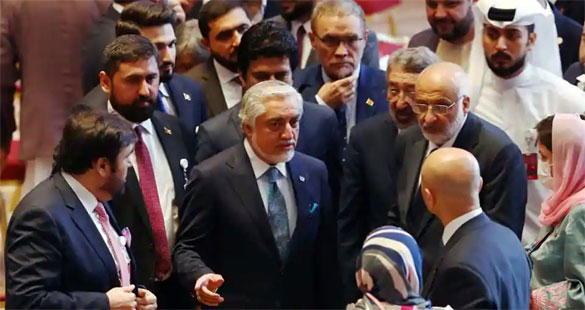
Today’s Afghanistan is not the one the Taliban controlled from 1996 to
2001. Democracy has thrown up new voices, actors, aspirations (REUTERS)
------
Abdullah
Abdullah, chairman of the High Council for National Reconciliation, was
categorical that while “the legitimate demand of our people and the goal of
peace is to end all forms of war and violence through political means,” they
wanted a constitutional system in the country that would preserve democracy,
elections, women’s rights, minority rights, rule of law, human and civil
rights. In essence, he underlined the need to preserve the achievements of the
past two decades. Mullah Baradar, Taliban’s deputy leader, tried to strike a
conciliatory tone but the group has been clear about its goal: Preserving
religious values and striving for an Islamic system.
The United
States (US) has left the choice of the political system to the Afghan
government and the Taliban but has not been shy of articulating its
preferences. Mike Pompeo, the US secretary of state, suggested “that protecting
the rights of all Afghans is indeed the best way for you to break the cycle of
violence”, even as he warned that the “choices and conduct” during the
negotiations will affect both the size and scope of future US assistance.
Earlier this year, in February, the Donald Trump administration decided to
reduce its military footprint in Afghanistan; this is likely to go down to
4,500 troops by November. Though Washington is not convinced that the Taliban
has weaned itself off completely from Al Qaeda or that it can be a trusted
partner in ensuring peace in Afghanistan, there is a wider political consensus
in the US on the need to bring troops back home. For Trump, claiming that he
managed to conclude an “endless war” would be a significant policy success to
highlight in his beleaguered re-election campaign.
So, in more
ways than one, the preference matrix of key players in these negotiations is
not in sync, posing fundamental challenges to both the process and the outcome.
For the Afghan government, it is essential that violence by the Taliban should
cease before any substantive talks on power-sharing can begin. But for the
Taliban, their ability to unleash dramatic violence is a major leverage that
they would like to exploit in political negotiations.
But the
Taliban also seem to recognise that today’s Afghanistan is not the one they
controlled from 1996 to 2001. Afghanistan’s nascent democracy has thrown up new
voices, new actors and new aspirations. Reports of the Taliban engaging with
China to build infrastructure after a US withdrawal is an indicator that governance
is now one of the priorities which cannot be ignored. And this is where India
comes into the picture.
Despite the
pessimism in some quarters that India has lost it all in Afghanistan, ground
realities are more complex. India’s approach is also evolving in line with the
changing strategic environment. External Affairs Minister S Jaishankar’s
remarks at the start of the intra-Afghan talks in Doha conveyed India’s
priorities even as they subtly underlined its reservations. For New Delhi, it
is imperative that “the peace process must be Afghan-led, Afghan-owned and
Afghan-controlled, respect national sovereignty and territorial integrity of
Afghanistan, promote human rights and democracy, ensure interest of minorities,
women and the vulnerable, effectively address violence across the country.”
India’s
primary concern emanates from a perceived Pakistani victory in managing to
bring the Taliban back to political power in Kabul, thereby energising Islamist
extremists in South Asia to target India. India’s regional security environment
could be further undermined if the Taliban let Pakistan use Afghan territory
for gaining strategic depth vis-à-vis India. Then there is the China factor.
Given its close ties with Pakistan, Beijing would like to ensure that the
Taliban sever their ties with Uighur extremists in Xinjiang. In exchange, China
might emerge as the key economic benefactor of a Taliban-dominated Afghanistan,
nudging Pakistan to bring the country into the China-Pakistan Economic
Corridor.
These are
significant challenges and New Delhi must be cognisant of such pressures. But
it should also remain alive to new possibilities and alignments. India’s role
as Afghanistan’s largest development partner cannot be easily dismissed; it
also remains the most popular country for ordinary Afghans. New Delhi has
strong ties with not only the US and Europe, which will be critical for
Afghanistan’s economic reconstruction long after foreign military forces leave,
but also with neighbours such as Russia and Iran, key for Afghanistan’s
strategic autonomy. The Pashtun question which divides Pakistan and Afghanistan
also gives New Delhi significant leverage. It is, therefore, not surprising
that the Taliban have been signalling their intent to engage with India. They
seem to get the salience of New Delhi in the Afghan matrix much better than
many in India.
-----
Harsh V
Pant is professor, King’s College, London, and director of studies, Observer
Research Foundation, New Delhi
The
views expressed are personal
Original
Headline: New Delhi’s salience in the Afghan matrix
Source: The Hindustan Times
New Age Islam, Islam Online, Islamic Website, African Muslim News, Arab World News, South Asia News, Indian Muslim News, World Muslim News, Women in Islam, Islamic Feminism, Arab Women, Women In Arab, Islamophobia in America, Muslim Women in West, Islam Women and Feminism