
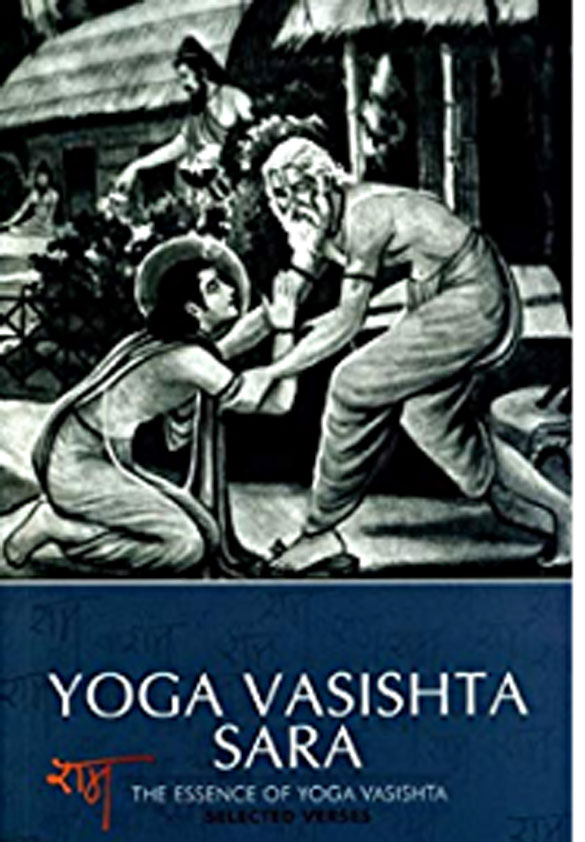
Yoga Vasishta Sara (The Essence of Yoga Vasishta): Chapter One - Dispassion
By Swami
Sureshananda
An
English Translation from the Sanskrit Original
21 June
2022
Sri
Ramanasramam Tiruvannamalai 606 603
2005
© Sri
Ramanasramam Tiruvannamalai
First
Edition : 1973 — 1000 copies Second Edition: 1985 — 1000 copies Third Edition :
1994 — 1000 copies Fourth Edition : 2005
— 1000 copies
CC No. 1084
ISBN:
81-88018-45-7
Price: Rs.
Published
by
V.S.
Ramanan President
Sri
Ramanasramam Tiruvannamalai 606 603 Tamil Nadu
INDIA
Email:
ashram@ramana-maharshi.org Website: www.ramana-maharshi.org
Typeset at
Sri
Ramanasramam
Printed by
Sudarsan Graphics Chennai
PREFACE
This
English version of the Yoga Vasishta Sara is based on a translation made by
Swami Sureshananda, an old devotee of Bhagavan, who has founded an ashram named
‘Vijnana Ramaneeyam’ at Palghat and has translated several works of Bhagavan as
well as the Yoga Vasishta Sara into Malayalam. This was published serially in
The Mountain Path, the journal published by Sri Ramanasramam, during 1969 to
1971 and is now issued in the form of a book for facility of reference.
SRI
RAMANASRAMAM V.S. RAMANAN
15th July,
1973 PRESIDENT
Guru-Poornima.
INTRODUCTION
The Brihat
(the great) Yoga Vasishta or Yoga Vasishta Maha Ramayana as it is also called,
is a work of about 32,000 Sanskrit couplets, traditionally attributed to
Valmiki, the author of Srimad Ramayana. It is a dialogue between Sage Vasishta
and Sri Rama, during which Advaita (the doctrine of non-duality) in its pure
form of Ajatavada (theory of non- origination) is expounded, with illustrative
stories in between. This vast work was abridged some centuries ago by Abhinanda
Pandita, a Kashmiri scholar, into 6,000 couplets, which go by the name of Laghu
Yoga Vasishta. This is a masterpiece in itself, like the original Brihat.
Bhagavan
Sri Ramana Maharshi used to refer to Yoga Vasishta frequently and has even
incorporated six couplets from it in His Supplement to Forty Verses (verses 21
to 27).
A further
condensation of this work was made long ago, by an unknown author, into about
230 couplets, divided into ten chapters, as Yoga Vasishta Sara (Essence of Yoga
Vasishta), of which this translation is presented for
Note: An
English translation of the Brihat Yoga Vasishta by Vihari Lal Mitra is out of
print. Translation of Laghu Yoga Vasishta by K. Narayanaswamy Iyer is available
from the Theosophical Publishing House, Madras-20.
Introduction
the first time. By making this condensation the author has rendered a great
service to all Sadhaks. This is indeed a goldmine fit for repeated reading and
meditation.
PUBLISHER
CONTENTS
CHAPTER PAGE
1 DISPASSION 1
2 UNREALITY OF THE WORLD 5
3 THE MARKS OF A LIBERATED PERSON 9
4 DISSOLUTION OF THE MIND 13
5 THE DESTRUCTION OF LATENT IMPRESSIONS 17
6 MEDITATION ON THE SELF 20
7 METHOD OF PURIFICATION 22
8 WORSHIP OF THE SELF 25
9 EXPOSITION OF THE SELF 27
10 NIRVANA 32
--------
YOGA
VASISHTA SARA
CHAPTER
ONE
DISPASSION
1. Salutations to that calm effulgence which
is endless and unlimited by space, time etc., the pure consciousness which can
be known by experience only.
2. Neither one who is totally ignorant nor
one who knows it (i.e. Truth) is eligible to study this book. Only he who
thinks ‘I am bound; I must become free’ is entitled to study it.
3. Until one is definitely blessed by the
Supreme Lord he will not find either a proper Guru or the right scripture.
4. Just as a steady boat, O Rama, is
obtained from a boatman, so also the method of crossing the ocean of samsara is
learnt by associating with great souls.
5. The great remedy for the long-lasting
disease of samsara is the enquiry, ‘Who am I?, to whom does this samsara
belong?,’ which entirely cures it.
6. Not a day should be spent in a place
which does not possess the tree of a wise knower of Truth with its good fruit
and cool shade.
7. The sages are to be approached even if
they do not teach. Even their talks in a light vein contain wisdom.
8. The company of sages converts emptiness
into fullness, death into immortality and adversity into prosperity.
9. If sages were concerned solely with their
own happiness with whom could those tormented by the sorrows of samsara seek
refuge?
10. That which is imparted, O good soul, to a
worthy disciple who has become dispassionate, is the real wisdom; it is the
real purport of the sacred texts and is also the comprehensive wisdom.
11. Following the customary method of teaching
is only for preserving the tradition. Pure awareness results solely from the
clarity of the disciple’s understanding.
12. The Lord cannot be seen with the help of
the sacred texts or the Guru. The self is seen by the Self alone with the pure
intellect.
13. All the arts acquired by men are lost by
lack of practice, but this art of wisdom grows steadily once it rises.
14. Just as an ornament worn round the neck is
considered lost through forgetfulness and is gained when the mistake is
realized, so also the Self is attained (when the delusion is removed) by the
words of the Guru.
15. He is indeed an unfortunate person who, not
knowing his own Self, takes pleasure in sense-objects, like one who realizes
too late that the food eaten by him was poisonous.
16. That perverted man who, even after knowing
that worldly objects are deceptive, still thinks of them, is an ass not a man.
17. Even the slightest thought immerses a man
in sorrow; when devoid of all thoughts he enjoys imperishable bliss.
18. Just as we experience the delusion of
hundreds of years in a dream lasting an hour, so also we experience the sport
of maya in our waking state.
19. He is a happy man whose mind is inwardly
cool and free from attachment and hatred and who looks upon this (world) like a
mere spectator.
20. He who has understood well how to abandon
all ideas of acceptance and rejection and who has realized the consciousness
which is within the innermost heart — his life is illustrious.
21. On the dissolution of the body, the ether
(consciousness) limited by the heart (Hridayam) alone ceases to exist. People
lament needlessly that the Self is extinct.
22. When pots, etc. are broken the space within
them becomes unlimited. So also when bodies cease to exist the Self remains
eternal and unattached.
23. Nothing whatever is born or dies anywhere
at any time. It is Brahman alone appearing illusorily in the form of the world.
24. The Self is more extensive than space; it
is pure, subtle, undecaying and auspicious. As such how could it be born and
how can it die?
25. All this is the tranquil, One without
beginning, middle or end, which cannot be said to be existent or non-existent.
Know this and be happy.
26. O Rama, it is indeed nobler to wander
begging about the streets of the outcasts (Chandalas), an earthen bowl in hand,
than to live a life steeped in ignorance.
27. Neither disease nor poison nor adversity
nor any other thing in the world causes more suffering to men than such
stupidity engendered in their bodies.
URL: https://newageislam.com/books-documents/yoga-vasishta-sara-essence-dispassion-chapter-one/d/127281
New Age Islam, Islam
Online, Islamic
Website, African Muslim News, Arab World News, South Asia News, Indian Muslim News, World Muslim News, Women in Islam, Islamic Feminism, Arab Women, Women In Arab, Islamophobia in America, Muslim Women in West, Islam Women and Feminism