
Book Review: Khilafat Aandolan (Hindi) by Qazi Muhammad Adil Abbasi

By Sahil Razvi, New Age Islam
31 March 2026
This book presents the Khilafat Movement in a simple and engaging manner, highlighting India’s freedom struggle, Hindu-Muslim unity, and the passion of its leaders through vivid narration and real-life dialogues.
Main points:
· The book presents the Khilafat Movement in simple, easy Hindi.
· Highlights Hindu-Muslim unity and Gandhi’s role in the movement.
· Uses powerful speeches of the Ali brothers and other leaders.
· Shows both the achievements and failures of the movement.
· Ideal for students and general readers seeking accessible history.
In the rich tapestry of India’s freedom struggle, few movements capture the spirit of Hindu-Muslim unity and anti-colonial resistance quite like the Khilafat Aandolan. Muhhamad Adil Abbasi’s Khilafat Aandolan, published in 2021 by National Book Trust India, brings this historic chapter alive in simple, flowing Hindi for the common reader. Though listed under “Popular Science” on NBT’s catalogue, a curious classification for a work of history, this book is anything but dry academia. It is a heartfelt, accessible narrative that connects the dots between World War I, Ottoman Turkey’s fate, and the boiling cauldron of Indian politics in the 1920s, complete with lively conversations and direct quotes from the leaders that make the pages crackle with energy. Author Qazi Muhammad Adil Abbasi (also known as Adeel Abbasi), hailing from a scholarly Muslim family in eastern Uttar Pradesh, was no armchair historian. He jumped into nationalist politics young, editing Lahore’s fiery Zamindar newspaper in 1921, landing in British jails, and later serving in the UP Assembly till 1956. His earlier Urdu work Tahreek-e-Khilafat (from the late 1970s) is considered a landmark, and this Hindi edition feels like its natural avatar, written in that inimitable, note-free style that reads more like a fireside chat than a textbook.
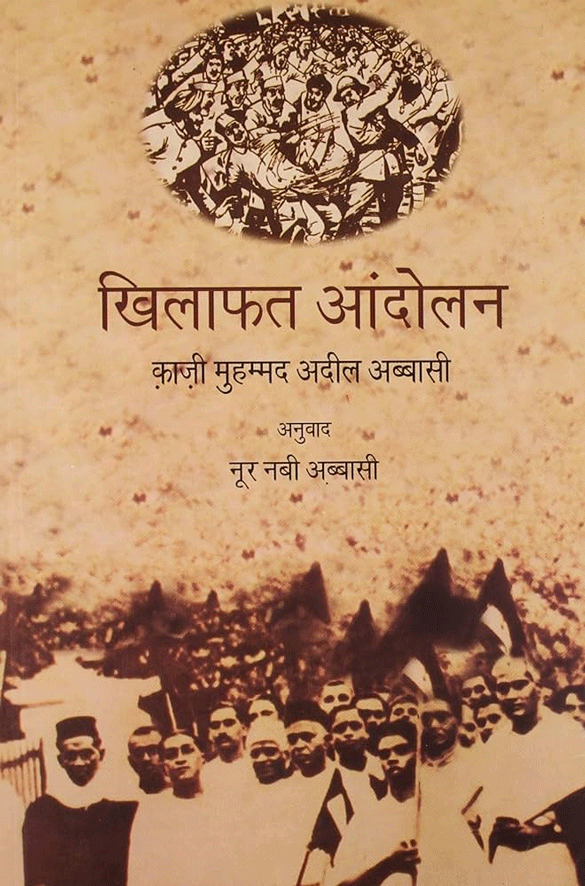
The book’s structure is highly systematic, offering readers a clear and chronological understanding of the Khilafat Movement. It begins with an introduction, followed by important chapters such as ‘The Nature of the Khilafat Issue’ and ‘The Relationship of Muslims with the Khilafat Movement,’ which build a strong background for the subject. Chapters like ‘The Great War and Indian Politics’ and ‘The Khilafat Delegation and Mahatma Gandhi’ effectively explain the political scenario of that time. Likewise, ‘Maulana Azad and the Khilafat Movement’ and ‘Mahatma Gandhi’s Declaration’ help in understanding the leadership and strategy of the movement.
Alongside this, the author has elaborated in detail on major Muslim leaders of that era such as Maulana Azad, the Ali Brothers, Sir Syed Ahmad Khan, as well as several prominent ulema of the Jamiat. The book also gives special attention to the Silk Letter Movement (Reshmi Rumal) and the journals Al-Hilal and Al-Balagh published by Maulana Azad, which provide deeper insight into the intellectual and revolutionary climate of the time.
Chapters like ‘The Peak of the Movement’ and ‘Government Response’ highlight its rise and impact, while ‘The Turko-Greek War’ and ‘The Second Phase of the Khilafat Movement’ bring forward the international context and later developments. Finally, ‘The End of the Khilafat’ presents the conclusion of this historic movement.
The book does not dive straight into the Khilafat agitation. Instead, Abbasi Saheb wisely lays a solid foundation, tracing the background through Sir Syed Ahmed Khan’s Aligarh Movement, the shifting sands of Muslim politics after the 1857 Revolt, and the growing discontent with British policies. Then comes the heart of the matter: the Ali brothers, Maulana Muhammad Ali Jouhar and Shaukat Ali, that thunderous oratory turned the protection of the Ottoman Caliphate into a pan-Indian cause. The author captures their passion vividly, quoting Maulana Muhammad Ali’s electrifying words during a key meeting: “O my dear believers! The issue is not one of the lives of nations and countries; it is an issue of the very survival of Islam”. Such direct quotes from the leaders’ speeches and private conversations bring the urgency of the moment alive, showing how the brothers rallied lakhs of ordinary Muslims. We meet Maulana Abul Kalam Azad, Hakim Ajmal Khan, and other stalwarts, and of course, Mahatma Gandhi, who cleverly linked Khilafat with his Non-Cooperation Movement, forging that rare Hindu-Muslim alliance that shook the Raj. Abbasi saheb recreates one poignant exchange where Gandhi, addressing a joint gathering of Khilafat leaders, declares: “It is just my sense of moral responsibilities which has made me take up the Khilafat question and to identify myself entirely with the Mahomedans. If it is true, as I hold it is true that the Indian Musalmans have a cause that is just and is supported by scriptural authority, then for the Hindus not to support them to the utmost would be a cowardly breach of brotherhood. I believe that in supporting them I am rendering a service to the Empire...” (Note: These statements are taken from Freedom’s Battle (a collection of Mahatma Gandhi’s writings) and Collected Works of Mahatma Gandhi (CWMG), Vol. 17. This article was written in response to a letter from a South African friend.) These conversations, drawn straight from the historical record, highlight the emotional bond that Gandhi forged with the Ali brothers and Azad, turning a religious grievance into a national revolution. What makes Khilafat Aandolan stand out is its balanced yet passionate tone.
Abbasi does not shy away from the movement’s highs, massive hartals, bonfires of foreign cloth, the emotional hijrat to Afghanistan, nor its tragic lows: the Chauri Chaura incident that forced Gandhi to call off Non-Cooperation, the eventual collapse after Turkey abolished the Caliphate in 1924, and the communal fissures that followed. He shows how Khilafat was never just about a distant Sultan; it was about dignity, self-respect, and the first major pan-Islamic stirrings in modern India that fed directly into the larger freedom struggle. Through these quotes and recreated dialogues, the book makes you feel as if you are sitting in those smoky 1920s meetings in Delhi and Bombay. The language is pure Hindustani, easy on the tongue for Hindi-medium readers, students, and even older generations who remember the tales from their grandparents. At just 201 pages, it avoids the heaviness of scholarly tomes while packing enough facts, dates, anecdotes, and spoken words to satisfy anyone curious about why “Khilafat” still echoes in our history textbooks. Of course, as popular history, it does not drown you in footnotes or archival debates; those looking for cutting-edge research might prefer denser English works. Yet that is precisely its strength, Abbasi writes for the ordinary peoples, the same people whose grandfathers marched in those processions and heard those fiery speeches.
In today’s times, when communal harmony is once again under the scanner, this book reminds us how Indian Muslims once stood shoulder-to-shoulder with Hindus against the Britishers, not in the name of separatism but in the name of justice. Khilafat Aandolan is a must-read for anyone interested in modern Indian history, especially in Hindi heartland schools and colleges.
…
New Age Islam, Islam Online, Islamic Website, African Muslim News, Arab World News, South Asia News, Indian Muslim News, World Muslim News, Women in Islam, Islamic Feminism, Arab Women, Women In Arab, Islamophobia in America, Muslim Women in West, Islam Women and Feminism