
Living Out Islam: Voices of Gay, Lesbian, and Transgender Muslims
By Mushtaq Ul Haq Ahmad Sikander
Author: Scott Siraj al-Haqq Kugle
Publisher: New York university Press, New York
Year of Publication: 2018
Pages: 265
ISBN: 9781479894673
17 November 2025
Reviewed By Mushtaq Ul Haq Ahmad Sikander
The book at the heart of this review is not just a study of faith and sexuality—it is a mosaic of courage, contradictions, and identities stitched together across continents. Through fifteen striking interviews with Muslim LGBTQ+ activists living in secular democracies, the author Scott Siraj al Haqq Kugle, brings to life the intricate nuances between belief, belonging, and being different. What makes the work genuinely moving is its emphasis on lived experiences—the trembling voices of men, women, and trans persons balancing on the edge of tradition and modernity, often trying to reconcile the two.
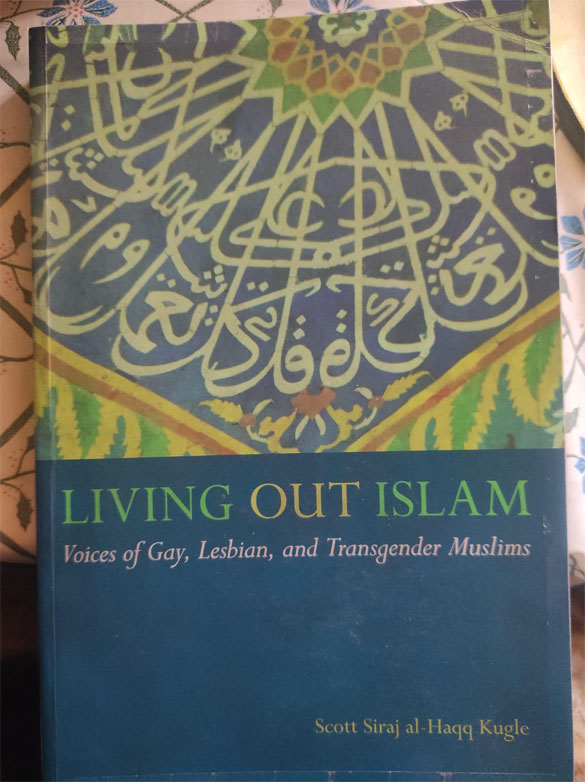
From the outset, the book delves into how these sexual minorities navigate spaces where Islam and democracy coexist uneasily. Kugle informs the reader that, “This book shares the voices of some marginalized within the Muslim community who call out to be recognized as fellow believers-sisters and brothers-who are worthy of respect, who deserve protection, and who demand justice.” (P-vii) “This book is about such voices those of muslim activists who are gay, lesbian, or trans gender, as they share their stories, insights, plights, and joys. Interviews reveal how they struggle to form an integral identity, to elicit empathy from their families, to join with others in solidarity, and to live out Islamic ideals even as they face rejection from Muslim authorities.” (P-viii)
While introducing the book, Kugle writes, “This book presents interviews with a range of gay, lesbian, and transgender Muslim activists, weaving their voices together to offer a composite picture of their struggle. Theirs are voices of an oppressed minority group within its religious community, a group which struggles to achieve liberation from oppression. Their struggle has psychological, social, political, and spiritual dimensions. Their experiences arise from diverse circumstances but are unified in reclaiming Islam as their own religion.” (P-1-2)
Most of the people interviewed come from contexts where Muslims are already minorities—South Asian migrants in the UK, Canada, and South Africa; Arabs in Israel; or South Asian Muslims in Cape Town. In these settings, their faith marks them as outsiders to the secular mainstream, while their sexuality renders them suspect within their own communities. The double discrimination becomes a haunting refrain throughout the book. For many, life becomes a negotiation between silence and self-expression, with secular laws offering little comfort when family or religious institutions fail to provide acceptance.
The diversity of orientations and experiences represented here gives the text its pulsating life. Among the gay men, lesbians, bisexuals, and transgender individuals are voices that refuse to fit neatly into Western categories. One moving story is that of a transgender man who never felt the need to surgically alter her body yet lives authentically as a woman. In her story, gender becomes an act of faith rather than a medical procedure, and her femininity a form of spiritual truth. Then there are gay Muslims who were once sent to madrasas under the illusion that they could be “cured.” Their recollections of psychological torment—mixed with devotion and confusion—drive home how religious spaces can both console and destroy.
A thread of theological introspection runs through the book. Many of these activists question the received wisdom of religious authorities, invoking ijtihad—independent reasoning—as a means to reinterpret the relationship between faith and sexuality. They note that the Qur’an condemns sodomy as an act of lust and abuse, not homosexuality as an orientation. The conflation of the two in traditional jurisprudence, they argue, has caused untold suffering. Yet, these reinterpretations are not products of rebellion but of longing—a search for a faith wide enough to hold their humanity. The book beautifully portrays this as a return to Islam, rather than an escape from it.
The author devotes generous attention to how families react when confronted with LGBTQ+ identities. For many, denial comes first—a reflex of fear and shame. Some families send their children for spiritual counseling; others banish them from home. Yet in some cases, love wins. One of the most touching accounts is of a pious Muslim mother who, after years of struggle, embraces her lesbian daughter by declaring that her humanity cannot be denied by divine law. It’s these moments of tenderness that lift the book beyond the realm of sociology into something sacred.
Women’s roles in enforcing patriarchal norms emerge repeatedly, complicating the notion that patriarchy is purely male-driven. Mothers, sisters, and aunts often become enforcers of silence, fearing that any deviation will stain family honor. At the same time, the book highlights female activists who resist this very structure, carving spaces for queer Muslim women to speak of pleasure, desire, and belief. The complexity of this tension—how women both uphold and dismantle patriarchy—gives the book an honesty rare in discussions of gender and religion.
The stories from the South Asian diaspora in Cape Town linger with particular poignancy. There, queer Muslims live at the junction of race, migration, and religion, struggling for acceptance not just from their families but also within the broader Muslim community. In one chapter, a teacher’s job is jeopardized because he is rumored to be gay; in another, a mosque debates whether a known trans congregant can lead prayers. These narratives show how reputation and respectability politics continue to shape communal life, echoing across continents.
The book also revisits spaces often seen as hostile to queerness—madrasas, mosques, and student organizations—and finds unexpected moments of change. Gay Imam Daayiee Abdullah’s story appears as a beacon of possibility. His leadership demonstrates that Islam’s spiritual compass can point toward inclusivity without betraying its essence. Yet, opposition is never far. Fundamentalist threats and institutional backlash follow queer gatherings, reminding readers that safety remains precarious. Similarly, “Fatima believes that gender identity is ultimately a matter of the psyche, the interface between mind and soul. It is a matter of institution, and one can recognize it only as a harmony of one’s inner and outer dimensions.” (P-96)
Across its pages, the author documents the emergence of informal spiritual practices that provide both refuge and renewal. Collective prayers by LGBTQ Muslims become cathartic acts—a way of reclaiming the sacred from exclusion. Ramadan iftar gatherings, where queer and non-queer Muslims share food and conversation, symbolize the slow work of bridge-building. Over plates of dates and samosas, deep conversations about belonging unfold, showing that compassion often thrives in shared ritual.
The book carefully maps the community’s evolving relationship with secularism. While secular democracies like Britain, the U.S., and Canada guarantee rights on paper, racism and Islamophobia complicate those freedoms. Queer Muslims find themselves defending their faith in LGBTQ circles and their sexuality in Muslim ones. Some rap artists express homophobia, yet a few find solidarity in the shared experience of marginalization. The tension is painful but productive—it pushes these activists to create transnational support networks and alliances with other minority groups. These alliances—whether through local mosques, interfaith dialogues, or queer collectives—become lifelines for those forging new identities.
One of the most intense emotional threads emerges from stories of dual lives: a young man leading his university’s Muslim student group by day and meeting his boyfriend in secret by night; a newly married trans woman whose first sexual experience becomes a wound rather than a celebration. Yet even in despair, the book hints at resilience. Some who once abandoned Islam find that coming to terms with their sexuality leads them back to God—not through doctrine, but through experience. For them, faith becomes personal truth rather than inherited law.
In the end, the book is less about politics and more about humanity. It asks difficult questions: Can you be both devout and queer? Can love exist in a theology that denies your existence? Can new readings of Islam restore dignity to those it once condemned? There are no simple answers, only honest struggles. What stands out is the unwavering effort to build communities of acceptance—small prayer groups, online forums, grassroots collectives—all devoted to living authentically in faith and love.
What makes this work so remarkable is its refusal to settle into victimhood or triumphalism. The activists are shown as thinking, feeling individuals who wrestle with contradictions: they negotiate belief and desire, rebellion and belonging, identity and invisibility. This, ultimately, is what makes the book persuasive—it mirrors life itself, messy and luminous.
The author closes not with grand declarations but with quiet hope: that through dialogue, compassion, and courage, bridges will continue to grow between the Muslim and LGBTQ worlds. The book leaves readers with a vision of faith not as obedience but as encounter—between one’s self, one’s God, and one’s community.
M.H.A.Sikander is Writer-Activist based in Srinagar, Kashmir and can be reached at sikandarmushtaq@gmail.com
URL: https://newageislam.com/books-documents/living-islam-lesbian-transgender-muslims/d/137662
New Age Islam, Islam Online, Islamic Website, African Muslim News, Arab World News, South Asia News, Indian Muslim News, World Muslim News, Women in Islam, Islamic Feminism, Arab Women, Women In Arab, Islamophobia in America, Muslim Women in West, Islam Women and Feminism