
Wisdom in Differences of Opinions

By Mushtaq Ul Haq Ahmad Sikander, New Age Islam
18 June 2026
A reflective work on Maulana Wahiduddin Khan’s vision of disagreement as a source of wisdom, intellectual growth, and social balance.
Main Points:
· The book argues that disagreement is natural and unavoidable, because human beings think differently and see reality from different angles.
· It presents difference of opinion as an opportunity for intellectual development, social maturity, and moral growth rather than as a threat.
· It stresses that conflict becomes harmful when driven by ego, anger, ignorance, or sectarian loyalty, and it calls for patience and humility.
· It highlights the book’s strong defense of intellectual freedom in Islam, while also noting that freedom must remain disciplined and responsible.
· It concludes that the book is valuable for its ethical guidance and anti-sectarian message, though it is stronger in moral argument than in structural analysis of conflict.
…
Hikmat e Ikhtilaaf: Zaroorat, Ahmiyat Aur Dayra e Kaar
Author: Maulana Wahiuddin Khan
Publisher: Goodword Books, Noida, India
Year of Publication: 2026
Pages: 280
Price: Rs 240
ISBN: 9789389766691
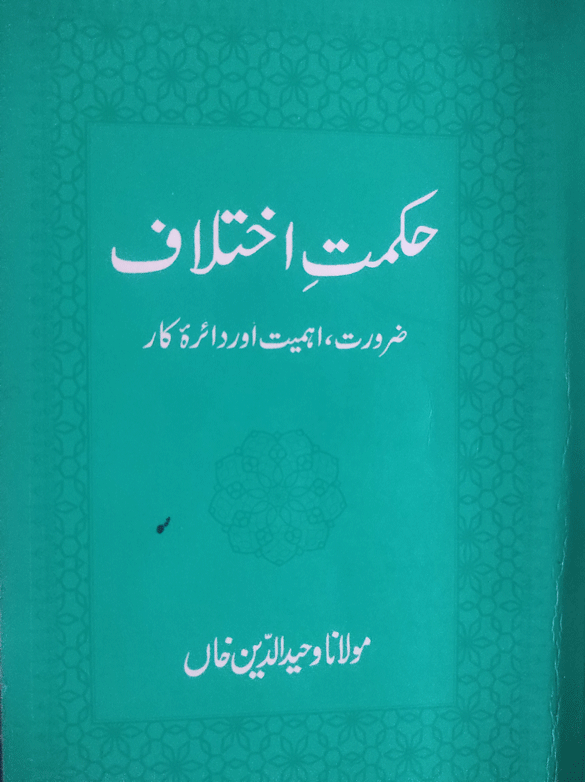
Hikmat-e-Ikhtilaf: Zaroorat, Ahmiyat Aur Dayra-e-Kaar by Maulana Wahiduddin Khan is a significant Urdu work on the ethics, value, and scope of disagreement. The book addresses a subject that is both deeply personal and broadly civilizational: how human beings should understand, manage, and benefit from difference of opinion. At a time when disagreement often degenerates into hostility, suspicion, or religious and political extremism, the book makes a timely and serious intervention. Its central argument is that difference is not a defect in human life but one of the main conditions for intellectual development, social maturity, and moral growth. That proposition gives the book its relevance, its energy, and also some of its limitations.
Maulana Wahiduddin Khan builds the entire work around the idea that disagreement must be understood, not feared. He is not writing in praise of conflict, nor is he advocating a culture of permanent opposition. Rather, he insists that differences are unavoidable because human thought itself is diverse, limited, and incomplete. People are not born with identical perceptions. They see the world from different angles, carry different experiences, and arrive at conclusions through unequal levels of knowledge, training, and reflection. For this reason, disagreement cannot be removed by force, rhetoric, or appeals to uniformity. It can only be handled wisely. This is one of the strongest and most enduring insights of the book.
The book’s greatest strength lies in the way it transforms a familiar social problem into a philosophical opportunity. In many communities, difference of opinion is treated as a threat to solidarity. Maulana reverses this assumption. He argues that disagreement, when approached properly, becomes a source of discovery. People formulate views, test them, challenge them, and refine them. In this process, the mind becomes sharper and society becomes more dynamic. The book therefore presents criticism not as insult and dissent not as rebellion, but as part of the natural process through which truth is examined and error is exposed. This is an intellectually healthy position, and it deserves appreciation. It is especially valuable in environments where conformity is often mistaken for unity and silence for wisdom.
At the same time, the book does not merely glorify disagreement. It repeatedly warns that difference can become destructive when it is driven by ego, anger, and ignorance. This caution is essential. Maulana understands that the real problem is not always the difference itself but the manner in which people respond to it. A small disagreement can become a major conflict if it is attached to pride. A minor doctrinal, personal, or communal issue can escalate into hatred if each side becomes emotionally invested in being right at all costs. Here the book shows considerable practical intelligence. It does not romanticize disagreement; it disciplines it. It asks readers to cultivate patience, humility, and intellectual self-restraint. Without these qualities, difference becomes a weapon rather than a tool of growth.
One of the most useful aspects of the book is its treatment of intellectual freedom in Islam. Maulana strongly argues that Islam grants human beings the freedom to think, examine, and differ. But he draws an important distinction between freedom and chaos. Intellectual freedom does not mean that every opinion is equally valid, nor does it mean that every challenge must be accepted uncritically. The book defends the right to dissent while rejecting intellectual anarchy. This balance is one of its most important contributions. It allows the reader to see that Islam, in Maulana’s interpretation, is not threatened by questioning or debate. Rather, it is enriched by responsible inquiry and disciplined thought. This is a persuasive and thoughtful position, especially for readers who may have inherited rigid or defensive understandings of religion.
The discussion of unity is another strong feature of the work. Maulana argues that real unity does not mean the absence of difference. It means living with difference without allowing it to destroy mutual respect and social stability. This is a subtle but important distinction. Many people speak about unity, but they imagine it as uniformity. Maulana rejects that assumption. He recognizes that human societies are too complex, too varied, and too historically divided to be made identical. Efforts to erase differences usually fail because they attack human reality itself. A more realistic form of unity, according to the book, is one in which people remain united in purpose even while disagreeing in opinion. This is a mature and civilizationally useful idea.
The book is particularly convincing when it links the management of differences to practical life. It does not confine itself to theology or abstract ethics. It extends its argument to family relationships, social conduct, leadership, and collective life. This broad applicability increases the book’s value. In marriages, for instance, differences are inevitable, but they need not become sources of bitterness if both parties learn the art of adjustment and understanding. In organizations and teams, disagreement can produce creativity if ego is kept under control. In religious communities, difference need not lead to takfeer, hostility, or division if basic respect is maintained. These observations are not merely theoretical; they reflect lived social realities. That is why the book speaks to a wide readership.
Another important dimension of the book is its critique of sectarianism. Maulana is sharply critical of tendencies that transform non-essential differences into markers of identity and hostility. He suggests that many sectarian conflicts among Muslims have been intensified by an excessive focus on secondary matters, while the shared foundation of the faith has been neglected. This argument is one of the book’s most forceful and needed interventions. It challenges communities to ask whether their disputes are truly about principle or whether they are being sustained by inherited pride, institutional loyalty, or historical habit. The book’s anti-sectarian stance is therefore not merely rhetorical; it is corrective. It seeks to shift attention from divisive detail to shared moral and spiritual priorities.
However, the critique of sectarianism also reveals one of the book’s limitations. Maulana tends to offer moral diagnosis more often than structural analysis. He tells us that people should not exaggerate minor differences, but he says less about the historical, educational, political, and institutional processes that produce and preserve sectarian identity. In other words, the book is stronger at identifying the ethical symptoms of conflict than at analysing the systems that sustain it. This is not a fatal weakness, but it is a significant one. A modern reader may appreciate the moral clarity while still wishing for a deeper account of how sectarian divisions become embedded in institutions, curricula, leadership patterns, and social power.
The discussion of madrasa culture is a case in point. The book is critical of educational tendencies that reinforce narrowness and sectarian loyalty rather than intellectual breadth. This is an important concern and one that deserves serious attention. Education should help people think, compare, question, and distinguish between essentials and non-essentials. When education turns into a mechanism for reproducing inherited hostility, it fails its larger purpose. Yet Maulana’s treatment of the issue, while morally firm, is not fully expansive. He identifies the problem, but the structural remedies are less developed. There is little extended reflection on curriculum design, pedagogical reform, or the social pressures that shape religious education. Thus, the argument remains forceful but somewhat incomplete.
The book’s emphasis on tolerance is another area where it is both admirable and limited. Maulana repeatedly urges readers to cultivate patience, mutual respect, and the willingness to accept mistakes rather than merely blame others. This is an ethically attractive position. In a world where people are quick to accuse and slow to self-correct, such advice is valuable. It reminds readers that disagreement becomes toxic when people stop examining themselves. At the same time, tolerance in the book sometimes appears as a broad moral solution to conflicts that may require more than tolerance. There are disagreements that involve not only attitude but justice. There are situations in which patience must be accompanied by principled resistance, institutional reform, or collective accountability. The book does not always linger on those distinctions. It tends to privilege moral serenity over conflictual complexity.
This is why the book can appear more persuasive in spiritual and interpersonal contexts than in political ones. Maulana’s philosophy strongly Favours non-violence, restraint, and avoidance of confrontation. That position has obvious moral strength. It offers an antidote to anger, fanaticism, and destructive activism. But it may also leave certain readers wanting a more developed theory of how to confront injustice without falling into violence or ego. The book tells us very clearly what not to do, but its account of what to do in difficult political and social conditions is more restrained. It is therefore best read not as a complete theory of resistance, but as a moral framework for preventing conflict from becoming destructive.
The inclusion of small incidents from personal dairies, question and answers gives the book an accessible and human texture. These moments make the text less abstract and more grounded in everyday experience. They also reflect Maulana’s habit of turning observation into reflection. Rather than building his argument through a dense theoretical apparatus, he draws on examples that illustrate the point directly. This approach has its strengths. It makes the book readable, memorable, and suitable for a broad audience. Yet it also limits the depth of analysis. The book is elegant in its simplicity, but at times the simplicity comes at the cost of nuance. Readers looking for a rigorous academic treatment of disagreement may feel that the book remains more exhortative than analytical.
Still, the book’s value should not be underestimated. In fact, its relative simplicity may be one of the reasons it remains effective. Many works on conflict become trapped in jargon, politics, or technical language. Maulana avoids that trap. He writes with moral urgency and conceptual clarity. He wants the reader not only to understand disagreement but to change their attitude toward it. The result is a book that is as much about character formation as it is about ideas. It teaches the reader how to think without arrogance, how to disagree without hatred, and how to remain committed to truth without becoming rigid. These are not minor lessons. They are essential for any society that hopes to preserve both dignity and dialogue.
The book also has an important place within Maulana Wahiduddin Khan’s wider intellectual project. Across much of his writing, he emphasizes peace, intellectual openness, religious seriousness, and non-confrontational reform. This book is fully consistent with that larger vision. It does not stand apart from his thought; it embodies it. However, one important lesson has been skipped in this book, it is related to the book, “Islam: Creator of the Modern Age” written by Maulana, because the cause of its writing was a difference of opinion, that a person dismissed Islam stating that if Islam is taken out of history, it will create no impact on it. It led Maulana ponder, over this issue and he was able to write this work, detailing how Islam impact the history of the world and people in variegated manner. That earlier work emerged from a difference of opinion that provoked deeper reflection on Islam’s historical role and civilizational contribution. In that sense, Hikmat-e-Ikhtilaf can be read as a mature reflection on the very process through which important ideas are born. The book implicitly demonstrates what it argues: that difference can produce insight.
The title itself is significant because it suggests not merely the existence of disagreement but the wisdom of managing it. The word “hikmat” is crucial. The book is not about conflict for its own sake. It is about prudence, proportion, and perspective. It asks what the right domain of disagreement is, where it should be allowed to operate, and how it should be handled when it arises. This gives the work both ethical and practical seriousness. It is not content with abstract approval of diversity. It seeks a disciplined method for living with diversity.
From a critical standpoint, however, the book’s moral confidence may occasionally feel stronger than its empirical complexity. Human disagreement is not always resolved by understanding its value. Sometimes it persists because of competing interests, unequal power, inherited trauma, or political manipulation. Maulana knows this in broad terms, but the book does not linger long enough on these dimensions. It remains primarily a work of ethical reorientation rather than social diagnosis. That does not diminish its worth, but it does shape the kind of reader who will benefit most from it. Those seeking moral guidance will find it highly rewarding. Those seeking a systematic sociology of conflict may find it insufficient.
Even with these limitations, the book remains highly relevant. Its insistence that disagreement should not become enmity is a message that modern societies badly need. Its call for self-correction instead of blame-shifting is equally important. Its warning that anger and hatred cloud judgment is timeless. And its argument that people should remain open to the possibility of being wrong is one of the most mature ideas any writer can offer. The book therefore deserves to be read not only as an Islamic reflection on difference, but as a broader ethical intervention into the culture of discourse.
In conclusion, Hikmat-e-Ikhtilaf: Zaroorat, Ahmiyat Aur Dayra-e-Kaar is a thoughtful, morally serious, and socially relevant book. Its greatest achievement is that it reframes disagreement as an opportunity for growth rather than a sign of failure. Its greatest limitation is that it sometimes relies too heavily on moral persuasion and not enough on structural analysis. Yet even this limitation does not reduce its importance. On the contrary, it reveals the nature of the work: it is a book of guidance, conscience, and intellectual discipline. Maulana Wahiduddin Khan’s voice in this book is calm but firm, simple but purposeful, reflective but decisive. The result is a work that is deeply useful for readers who wish to understand how difference can be managed with wisdom, dignity, and restraint.
…
M. H. A. Sikander is Writer-Activist based in Srinagar, Kashmir.
URL: https://newageislam.com/books-documents/wisdom-in-differences-opinions/d/140434
New Age Islam, Islam Online, Islamic Website, African Muslim News, Arab World News, South Asia News, Indian Muslim News, World Muslim News, Women in Islam, Islamic Feminism, Arab Women, Women In Arab, Islamophobia in America, Muslim Women in West, Islam Women and Feminism