
Quranic Scholarship of Aligarh Muslim University

By Mushtaq Ul Haq Ahmad Sikander, New Age Islam
20 March 2026
A critical yet appreciative survey of Aligarh Muslim University’s Qur’anic scholarship, tracing how its scholars have engaged revelation through reason, linguistics, history, and interfaith dialogue over nearly a century and a half.
Main points:
· The book maps AMU’s Qur’anic tradition from Sir Syed’s rationalist reform to contemporary scholars, highlighting academic freedom and evolving hermeneutics.
· It profiles key figures (Sir Syed, Shibli, Farahi, Daryabadi, Jairajpuri, Naqvi, Sufi and Shia exegetes, later academics) and evaluates their tafsir methods, strengths, and limitations.
· The work discusses debates on miracles, nazm (coherence), hadith usage, compilation of the Qur’an, sectarian and mystical readings, and modernist controversies within AMU.
· It underscores institutional roles of Idarah Uloom‑ul‑Quran and the K.A. Nizami Centre in sustaining interdisciplinary Qur’anic research and “tajdeed without tafreet” (renewal without excess).
· The book is both an intellectual archive and a spiritual testament, preserving Aligarh’s Qur’an‑centred legacy of respectful critique and plural voices.
…
Idarah Sir Syed Muslim University Aligarh Kye Mushahaer e Quraniyaat (The Quranic Scholars of Aligarh Muslim University)
Author: Abu Sufyan Islahi
Publisher: K.A. Nizami Centre for Quranic Studies, Aligarh Muslim University & Brown Books Publications, New Delhi
Pages: 231
Price: Rs 300
Year of Publication: 2017
ISBN: 9789397497061
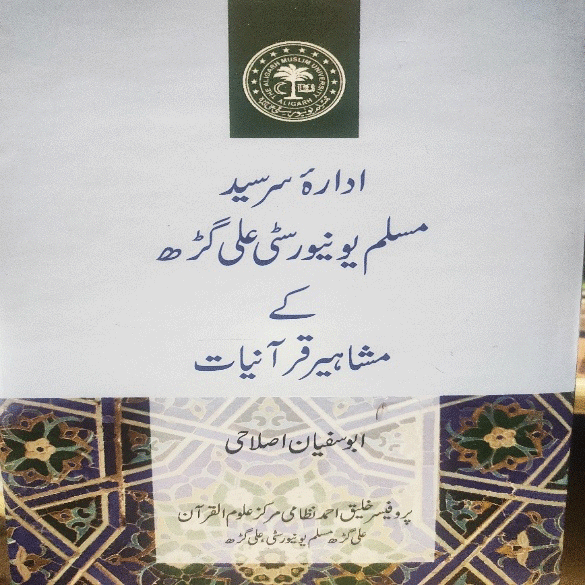
Abu Sufyan Islahi’s Idarah Sir Syed Muslim University Aligarh ke Mushahheer-e-Quraniyyat is a major contribution to our understanding of Aligarh’s intellectual engagement with Quranic studies. In his insightful Foreword, Prof. A.R. Kidwai situates the genesis of Aligarh’s Quranic thought at its modernist fountainhead, Sir Syed Ahmad Khan. Kidwai credits Sir Syed as the “first pioneer of Quranic studies of the Aligarh school of thought”, underscoring that while he opened new interpretive doors, he never imposed his understanding upon others. The hallmark of the Aligarh tradition, Kidwai insists, is its academic freedom, a trait inherited by generations of scholars who refused both dogma and stagnation.
The preface sets the intellectual tone for Abu Sufyan Islahi’s volume, which brings together a panoramic review of Muslim University scholars, exegetes, translators, reformers whose works collectively shaped the modern Indian Muslim encounter with the Qur’an. Spanning almost a century and a half of exegesis, Mushahheer-e-Quraniyyat is both a tribute and a critique, chronicling Aligarh’s evolving engagement with revelation in light of reason, linguistics, and interfaith discourse.
Sir Syed Ahmad Khan: The Genesis of Reform
Islahi begins with Sir Syed Ahmad Khan, whose rationalist exegesis Tafsir al-Qur’an wa huwa al-Huda wa al-Furqan created waves in nineteenth-century India. Islahi regards Sir Syed as the progenitor of Aligarh’s analytical faith—a man who viewed Quranic understanding as dynamic, historically grounded, and compatible with scientific inquiry.
Yet the book does not shy from controversy. Islahi acknowledges that “with many of his opinions we cannot agree” (p. 15). Sir Syed’s denial of miracles, his reinterpretation of angels as metaphors of divine power, and his classification of mut‘a marriage as unlawful like adultery and of sexual relations with slave women as illegal—all attracted fierce opposition. Nonetheless, Islahi argues, these views reflected a deep ethical sensitivity that sought to purify Islam from the residues of pre-Islamic practices rather than dilute its revelation.
Importantly, Sir Syed’s role in interfaith dialogue emerges as central to his hermeneutic project. He initiated comparative religious studies at Aligarh, urging Muslims to read the Bible and the Torah in order to understand both commonalities and contextual differences. Islahi endorses this, crediting him as “a pioneer of interfaith understanding”, whose method helped position the Qur’an as a dialogical rather than polemical text.
Shibli, Farahi, and the Linguistic Turn
From the rationalist Sir Syed, Islahi moves to his intellectual heir, Allama Shibli Nomani. Shibli, equally committed to authenticity, longed for a trustworthy translation of the Qur’an, noting how existing renderings were fraught with “staunch mistakes that altered meaning.”
The narrative gains depth when Islahi describes Shibli’s intellectual camaraderie with Maulana Hamiduddin Farahi. Shibli frequently sought his counsel whenever Quranic clarity eluded him, a mentor-mentee relationship that typified the cooperative scholarship of the Aligarh tradition. Farahi, revered for his mastery of Arabic, wrote extensively “more than sixty works” (p. 38) aimed squarely at the ulema. His emphasis on nazm (coherence) in the Qur’an reoriented exegesis from atomistic commentary to structural unity.
Ahsanullah Abbasi: An Unpopular Translator
At page 44, Islahi offers a sharp critique of Ahsanullah Abbasi, especially his view on the Qur’an’s compilation. Labeling Abbasi’s opinion “erroneous,” he argues that the textual assembly had indeed been completed during the Prophet’s own lifetime, contrary to Abbasi’s claims of later formalization.
Although Abbasi’s Urdu translation of the Qur’an was linguistically rich and stylistically refined, it failed to gain traction among readers. Islahi attributes this partly to the scholarly ecosystem of the time, overshadowed by translations from better-recognized voices such as Abdul Majid Daryabadi and Aslam Jairajpuri.
The Modernist Controversies: Jairajpuri and Others
Maulana Mohammad Aslam Jairajpuri stands out in Islahi’s narrative as a scholar who walked a tightrope between faith and reform. Known for rejecting the doctrine of naskh (abrogation of verses), Jairajpuri was unfairly branded Munkar-e-Hadith (rejector of Hadith). Islahi defends him as a nuanced thinker whose critique targeted misuse of hadith in exegesis rather than hadith itself. His advocacy of direct Qur’anic interpretation without overdependence on later commentaries earned both admiration and censure within Aligarh’s corridors.
Among contemporaries, Islahi also revisits thinkers like Iqbal Suhail and the prolific Abdul Majid Daryabadi, whose bilingual exegesis in Urdu and English widened Qur’anic accessibility beyond South Asia’s traditional seminaries. Daryabadi’s introspective commentary blended literary sensibility with authentic hadith sources an example, Islahi suggests, of how modern scholarship can remain rooted in orthodoxy.
Shia and Sufi Readings: Naqvi and Beyond
The survey then reaches Syed Ali Naqi Naqvi, whose Shia leanings are transparent in his interpretive framework. Naqvi’s assertion that certain verses are accessible “only to a few select people” is, Islahi notes, inconsistent with the Qur’an’s clarity (see pp. 79–81). He counters Naqvi’s claim by pointing to verses like 39:27–28 and 41:1–4, which affirm the Qur’an’s universality in plain Arabic. In doing so, Islahi exposes how sectarian predispositions occasionally color even erudite exegesis.
The author finds comparable traces in Sufi readings that claim privileged inner meanings. While Islahi respects mystical intuitions, he asserts that the Qur’an’s message is not esoteric property but a public revelation accessible to sincere seekers.
Historiographical Scholarship: Prof. Abdul Aleem and Dr. Rizwanuddin
Islahi next highlights Prof. Abdul Aleem, who introduced an overlooked historical insight—those written libraries existed among pre-Islamic Arab Christians, making literacy far more common than assumed. This upends the assumption that early Muslims were universally illiterate. From this, Islahi infers that the Qur’an’s compilation during the Prophet’s time was entirely feasible. Dr. Rizwanuddin Khan’s work on Tafsir-e-Mazhiri receives warm praise for reinterpreting classical sources through academic rigor, merging traditional transmission with critical historiography—a hallmark of Aligarh’s current Quranic department.
Celebrated Academics: Ginori, Jaisi, and Khawaja
Prof. Fazlur Rahman Ginori’s critical study of Tafsir al-Kashaf by al-Zamakhshari exemplifies what Islahi calls “a reasoned pride for AMU”. His nuanced grasp of Arabic grammar and Mu‘tazilite rationalism revitalized scholarly dialogue around the precision of Quranic philology. Likewise, Prof. Kabir Ahmad Jaisi’s endeavor to introduce Persian exegesis to Urdu audiences expanded intercultural scholarship. By rendering Persian masterpieces such as Razi’s and Baydawi’s works into Urdu, he bridged a linguistic gap long ignored in South Asian academia.
In contrast, Islahi is sternly critical of Prof. Jamal Khawaja’s Living the Quran in Our Times. He dismisses it as ill-informed, arguing that Khawaja neither reads Arabic fluently nor engages foundational Islamic sources. His insistence on questioning Quranic coherence and compilation, Islahi asserts, reflects unfamiliarity with centuries of established scholarship, raising concerns about the entry of “untrained voices” into Quranic interpretation.
Later Thinkers: Sidiqqui, Kidwai, and Others
Dr. Nejatullah Sidiqqui’s economic interpretations of Qur’anic justice, Prof. Irfan Ahmad Khan’s Chicago-based Quranic seminars, and Dr. Mohammad Salim Kidwai’s work on the Arabic exegesis of Indian scholars are all hallmarks of Aligarh’s intellectual diaspora. Islahi especially praises Salim Kidwai’s study as “marvellous”, given its integration of form, linguistics, and regional commentary.
His tone changes, however, when reviewing Prof. Ziaul Hasan’s claim that Arabs universally practiced female infanticide. Islahi rebuts this as an overgeneralization, observing that infanticide was confined to “few tribes and sections, not the entire Arab populace.” This willingness to correct modern oversimplifications reflects Islahi’s fidelity to nuanced historiography. Prof. Altaf Ahmad Azmi’s Meezan-ul-Quran is hailed for industry and balance, while Prof. Yasin Mazhar Sidiqqui is admired for his careful preservation of primary manuscripts. Together, they represent a continuity of the Aligarh ethos reason disciplined by reverence.
Where Reverence Meets Critique
Not all modern scholars escape Islahi’s scrutiny. On page 149, he strongly disagrees with Dr. Rehana Zia Siddiqui’s characterization of Maulana Ashraf Ali Thanvi as “a holistic exegete.” Islahi contends that holism of revelation belongs solely to the Prophet Muhammad ﷺ, who alone articulated divine unity in its totality. Any later attribution of such comprehensiveness, he warns, risks theological exaggeration.
Similarly, on pages 162–163, Islahi addresses Prof. Ali Mohammad Naqvi’s criticism of Nazm-ul-Quran theory. He acknowledges Naqvi’s dialectical rigor but accuses him of missing the aesthetic coherence that Farahi and Islahi’s own teacher, Amin Ahsan Islahi, painstakingly demonstrated. Such inter-scholar dialogue, argumentative but respectful, reveals how the Aligarh school maintains vitality through self-critique.
From Past to Present: Institutional Contributions
In later chapters, Islahi expands the story beyond individuals. He acknowledges the institutional role of Idarah Uloom-ul-Quran and the K.A. Nizami Centre for Quranic Studies at AMU, hubs which sustain the tradition of balanced, multidisciplinary Qur’anic research. They ensure that exegesis remains connected with fields like linguistics, theology, and interreligious studies.
Prof. Mohammad Salahuddin Umri, Prof. Sultan Ahmad Islahi, and Arshad Rafiq Nadwi figure prominently here, each reflecting Aligarh’s blend of orthodoxy and intellectual openness. These professors embody what Islahi calls “tajdeed without tafreet”—renewal without transgression.
The Author’s Own Position
Curiously, Abu Sufyan Islahi does not exclude himself from this survey. By page 176, he candidly admits how reading Sir Syed “deepened and strengthened his penchant for the Qur’an.” This autobiographical glimpse gives the work a personal pulse, it is not merely archival but devotional. For Islahi, exegesis is not an abstract discipline but a lifelong attachment to divine revelation intertwined with academic responsibility.
At the same time, Islahi extends balanced criticism even within his acknowledgements. On page 188, he observes that Saud Alam Qasmi’s praise of Maulana Abul Kalam Azad omits several interpretive subtleties, especially regarding Azad’s use of metaphor in Tarjuman ul-Qur’an. Such correction without condescension defines the tone of this compendium: reverent yet rigorous.
A Tradition of Plural Voices
What distinguishes Mushahheer-e-Quraniyyat is its panoramic inclusivity. Islahi resists sectarian sorting, treating Shi‘a, Sunni, and Sufi scholars as participants in a shared interpretive endeavour. While he flags biases, such as Naqvi’s esotericism or Khawaja’s rational reductionism, he never dismisses their sincerity. His critique flows from within the Qur’anic ethos of dialogue itself.
Simultaneously, his writing registers concern for methodological decay in some modern readings. The book repeatedly warns against exegetes untrained in classical Arabic or Qur’anic sciences. Without sound linguistic and historical tools, Islahi reminds readers, commentaries risk drifting into opinion rather than interpretation.
Style and Substance
Journalistically speaking, what makes this book remarkable is its readable synthesis of academic detail. Islahi’s prose, though densely referential, carries narrative rhythm. He alternates between appraisal and anecdote, often quoting from personal interactions or classroom memories that connect the scholars to Aligarh’s lived atmosphere.
Each chapter functions like a short profile, part biography, part theological reflection, part critique. The result is something between a history of ideas and a chronicle of personalities. For readers new to Aligarh’s intellectual genealogy, Islahi’s approachable tone (within an otherwise heavy subject) makes the text both informative and human.
The Broader Context
The significance of this book lies beyond its immediate academic scope. It situates AMU as a microcosm of South Asian reformist Islam, where faith meets reason, and revelation converses with modern thought. Through nearly two hundred pages, Islahi affirms that the Qur’an remains the living heart of Muslim intellectual life, capable of generating fresh insights across eras. He thus challenges the notion that Aligarh was purely a secular modernist venture. Instead, he restores attention to its Qur’an-cantered scholarship, showing that figures like Farahi, Daryabadi, Jairajpuri, and even contemporary professors are part of an unbroken interpretive continuum.
Final Appraisal
As a reviewer, one cannot ignore the double achievement of Idarah Sir Syed Muslim University Aligarh ke Mushahheer-e-Quraniyyat. On one hand, it archives an immense body of scholarship, offering bibliographic value for researchers of Indian tafsir. On the other, it reflects a spiritual continuity, the shared conviction that the Qur’an is not to be preserved merely as scripture but to be understood, internalized, and lived.
Islahi’s fairness in credit and critique makes this volume stand apart from mere institutional histories. He praises without hagiography and criticizes without malice, embodying the Aligarh ideal of critical fidelity. The text may occasionally assume prior familiarity with Islamic hermeneutics, but its careful documentation, page references, thematic divisions, evaluative tone, makes it indispensable for scholars of South Asian Islamic thought.
In essence, this book is not just about exegetes, it is about an intellectual tradition’s conscience, its willingness to keep revisiting revelation under changing skies.
…
M. H. A. Sikander is Writer-Activist based in Srinagar, Kashmir.
URL: https://newageislam.com/books-documents/quranic-scholarship-of-aligarh-muslim-university/d/139342
New Age Islam, Islam Online, Islamic Website, African Muslim News, Arab World News, South Asia News, Indian Muslim News, World Muslim News, Women in Islam, Islamic Feminism, Arab Women, Women In Arab, Islamophobia in America, Muslim Women in West, Islam Women and Feminism