
Messages From the Quran: Reflections on Faith, Ethics, and Contemporary Life

By Mushtaq Ul Haq Ahmad Sikander, New Age Islam
17 July 2026
Adham Sharqawi’s spiritually reflective work, highlighting its accessible style, moral depth, and relevance to modern readers seeking ethical and religious guidance.
Main Points:
· The work is not a traditional tafsir but a collection of short, meditative reflections drawn from Quranic verses, Hadith, and historical narratives.
· Its fragmentary structure and simple language make it accessible, especially for readers with limited time or those new to Islamic literature.
· It emphasizes recurring ethical themes such as sincerity, patience, humility, lawful earnings, repentance, and personal accountability.
· It also explores social and political concerns, including justice, relationships, oppression, the misuse of religious language, and a critical discussion of jihad.
· The book is praised for reviving moral imagination and spiritual reflection, while its main limitation is the lack of deeper exegetical analysis
…
Messages From the Quran
Author: Adham Sharqawi
Translator: Heba Shakeel
Publisher: Hidayat Publishers & Distributors, New Delhi, India
Year of Publication: 2025
Pages: 282
Price: Rs 300
ISBN: 9789386460943
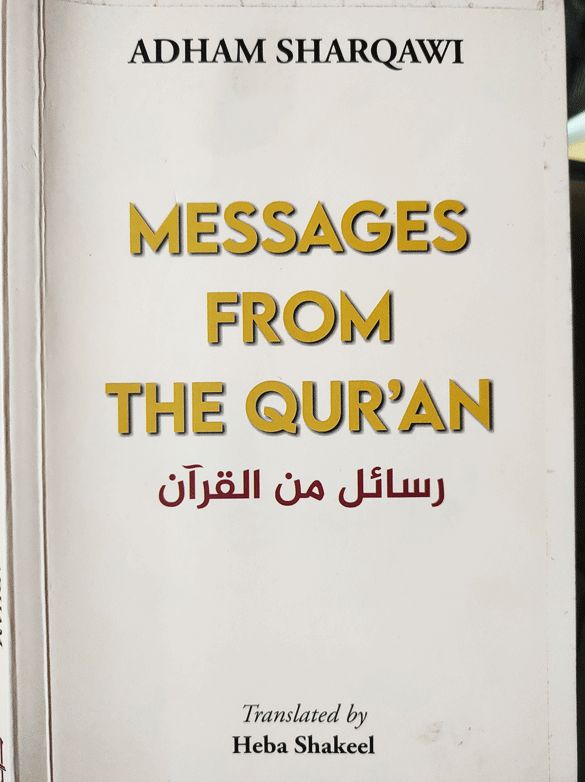
Adham Sharqawi’s Messages From the Quran, is a compact yet spiritually resonant work that attempts to bridge the gap between classical Quranic wisdom and contemporary moral anxieties. The book stands as a reflective anthology of short meditative engagements with Quranic verses, supplemented by insights drawn from Hadith, prophetic traditions, and historical narratives. As the title suggests, the work is not a conventional exegesis (tafsir), but rather a collection of moral reflections, messages distilled from the Quran for everyday life.
In his foreword, the prominent Islamic scholar Muhammad Enayatullah Asad Subhani succinctly captures the essence of the text, “The distinctive quality of this book lies in its simplicity of understanding. Through small, concise verses from the Quran, it very effectively brings to mind those facts that even voluminous books often fail to impart. While reading this book, the mind does not get tired; in fact, at times, even a tired mind feels awakened after reading just a few lines. It becomes filled with a renewed sense of religious zeal and fervour.” (P-7)
This observation is not merely commendatory but diagnostic. Sharqawi’s project is to simplify without trivializing, to condense without diluting. The brevity of each reflection becomes its strength, inviting repeated engagement rather than exhaustive reading.
Structure and Style: Fragment as Method
The book is structured as a series of brief reflections, each anchored in a Quranic verse or a thematic moral concern. This fragmentary style aligns well with modern reading habits, particularly among readers who seek spiritual nourishment within limited time frames. However, unlike the atomized spirituality often found in self-help literature, Sharqawi’s reflections are deeply rooted in Islamic theological and ethical frameworks.
The translator, Heba Shakeel, about whom the book provides no biographical detail, deserves recognition for rendering the Urdu prose into accessible English without losing its emotive depth. The translation retains a lyrical simplicity, allowing the ethical force of the original text to remain intact.
Thematic Breadth: Ethics of Everyday Life
One of the most compelling aspects of Messages From the Quran is its thematic inclusivity. Sharqawi moves seamlessly across a wide range of moral and spiritual concerns, demonstrating the Quran’s holistic engagement with human life. Among the recurring themes are sincerity in intention, patience in adversity, humility in success, and steadfastness in faith.
The text repeatedly emphasizes that human validation is neither the ultimate goal nor the measure of righteousness. The idea that one should not be disheartened by the lack of recognition from others, because divine awareness supersedes human acknowledgment, forms a foundational ethical principle. Similarly, Sharqawi warns against allowing praise or criticism to divert one from the righteous path.
The emphasis on lawful (halal) sustenance, both in terms of food and earnings, highlights the ethical economy embedded in Islamic teachings. In a world where moral compromises are often normalized, Sharqawi reasserts the importance of integrity in daily transactions.
Moral Psychology: Naming, Sin, and Self-Deception
A particularly insightful dimension of the book is its exploration of moral psychology. Sharqawi critiques the human tendency to rename sins in order to reduce their perceived severity. This linguistic manipulation, he suggests, is a form of self-deception that distances individuals from genuine repentance. The oscillation between sinning and repenting is treated not as a contradiction but as a fundamental aspect of human existence. What matters, the author insists, is not the absence of sin but the presence of sincere repentance and the effort to rectify one’s actions.
The book also addresses the internal state of the heart, emphasizing the need for spiritual softening through prayer, charity, and remembrance of God. This inward focus is complemented by an outward ethic of humility, restraint in speech, and discretion in sharing personal matters.
Social Ethics: Justice, Relationships, and Community
Sharqawi’s reflections extend beyond individual piety to encompass broader social ethics. He condemns both arrogance and the normalization of oppression, urging readers to uphold justice even when it is inconvenient. The critique of excessive love and excessive hatred serves as a reminder of the importance of balance in emotional life.
The text also offers nuanced guidance on interpersonal relationships. It advocates for amicable endings in relationships, the cultivation of good friendships, and the ethical treatment of spouses, particularly emphasizing kindness and respect toward wives. These reflections are grounded in prophetic traditions, which the author skilfully integrates to reinforce his arguments.
The importance of presenting truth in a gentle and effective manner is another recurring theme. Sharqawi recognizes that truth, when delivered harshly, can alienate rather than enlighten. This insight is particularly relevant in an age of polarized discourse.
Gender and Identity: A Contested Terrain
One of the more striking passages in the book addresses the question of femininity:
“Do not let anyone, under the guise of equality, rob you of your femineity
Be a woman, and take pride in being one!
Remain the delicate, graceful soul you are,
And defend your femineity with the courage of a warrior.” (P-185)
This excerpt encapsulates a vision of gender that is both affirming and contentious. On one hand, it celebrates feminine identity and dignity; on the other, it frames femininity in terms that may be critiqued for essentialism. For readers engaged in contemporary gender debates, this passage invites both appreciation and critical reflection.
Existential Reflections: Destiny, Death, and Hope
Sharqawi engages deeply with existential questions, particularly the interplay between destiny and human agency. Life’s hardships are framed not as arbitrary misfortunes but as tests that strengthen character and deepen faith. The inevitability of death and the impermanence of the world are recurring motifs, serving as reminders of the transient nature of worldly concerns.
Yet, the book is far from pessimistic. It consistently emphasizes hope, urging readers not to lose faith even in the face of adversity. The idea that a bitter chapter does not signify the end of the story is both comforting and empowering.
Faith and Praxis: Beyond Ritual
A central argument of the book is that faith must translate into action. Without faith, Sharqawi suggests, life descends into a purely instinctual existence, devoid of higher purpose. Conversely, true faith manifests in ethical conduct, humility, and service to others. The author also underscores the importance of acknowledging divine assistance in moments of success. This “etiquette of achievement” serves as a corrective to ego-driven narratives of accomplishment.
Political and Ethical Consciousness: The Question of Jihad
One of the most significant, and sections of the book addresses the concept of jihad. In a context where the term is often misappropriated, Sharqawi offers a critical and introspective perspective:
“Before the onset of modern-day Jihad,
We feared non-Muslims in their dealings with Muslims.
But today, we fear Muslims themselves in their dealings with Islam and fellow Muslims,
Or we fear those who merely claim to be Muslims!
We, too, love Allah and His Messenger as much as you do.
We, too cherish Islam-perhaps even more than you.
But you so easily present yourself as a reckless and cruel alternative to the oppressive and tyrannical regimes.
We do not wish to replace one tyrant with another!
Oppression has no religion-it is the same regardless of the oppressor’s identity!
We do not seek to replace a corrupt executioner with a so-called ‘pious’ one!
We stand against all executioners, regardless of their religion or faith!
When you call your actions Jihad, we do not reject your claim.
However, we do ask this critical question:
Is this Jihad for Islam, or against it?!” (P-261-262)
This passage is remarkable for its moral clarity and courage. It challenges extremist interpretations while reaffirming the ethical core of Islam. In doing so, Sharqawi situates his work within a broader discourse on religious authenticity and political responsibility.
Reception and Context
The book gained international attention when it was reportedly found in the possession of a Hamas fighter. While such associations can shape public perception, it is important to approach the text on its own terms. The content of Messages From the Quran is neither militant nor polemical, rather, it is reflective, ethical, and introspective. This incident, however, underscores the complex ways in which religious texts circulate in conflict zones, often acquiring meanings beyond their original intent. For scholars of geopolitics and religion, this adds an additional layer of interpretive interest.
Strengths and Limitations
The primary strength of the book lies in its accessibility. Sharqawi’s ability to distil profound ethical insights into concise reflections makes the text suitable for a wide audience, including young readers and those new to Islamic literature. However, this very simplicity can also be seen as a limitation. The lack of detailed exegetical analysis may leave more academically inclined readers wanting greater depth and contextualization. Additionally, the absence of comprehensive information about the translator is a minor but noticeable gap.
Conclusion: A Text for Reflection and Renewal
Messages From the Quran is not a book to be rushed through. It is a text to be savoured, revisited, and reflected upon. Its strength lies in its ability to awaken the moral imagination and rekindle spiritual awareness through brief yet impactful reflections. For readers in South Asia and beyond, particularly those navigating the complexities of modern life while seeking ethical grounding, Sharqawi’s work offers a valuable resource. It reaffirms that the Quran is not merely a text to be read, but a living guide to be engaged with, one message at a time.
What ultimately distinguishes Sharqawi’s work is its ability to translate the ethical universality of the Quran into the language of contemporary moral crises without succumbing to reductionism. The text neither over-intellectualizes nor oversimplifies, rather, it strikes a delicate balance between spiritual immediacy and ethical seriousness. In an age marked by distraction, moral ambiguity, and ideological polarization, such a work performs an important corrective function, it recentres the individual within a framework of accountability, humility, and hope.
For readers in South Asia, particularly in regions like Kashmir where faith, politics, and identity are deeply intertwined, the book assumes an added layer of relevance. Its emphasis on patience, justice, restraint, and introspection offers a counter-narrative to reactionary impulses and unreflective religiosity. The reflections on oppression, ethical resistance, and the misuse of religious language, especially in the context of jihad, resonate strongly within conflict-ridden societies, urging a return to principled and morally grounded engagement.
At the same time, the book’s insistence on personal reform as the foundation of collective change is noteworthy. Sharqawi subtly but persistently reminds the reader that societal transformation cannot occur without individual ethical awakening. This inward turn is not escapist, rather, it is presented as the most authentic starting point for meaningful change. In this sense, the book aligns with a long tradition within Islamic thought that privileges the purification of the self (tazkiyah) as a prerequisite for social justice.
Despite its strengths, the book also opens up avenues for further scholarly engagement. Its fragmentary nature, while accessible, leaves room for deeper exegetical exploration. Academics and serious students of Islamic studies may find in it a starting point rather than a definitive guide, an invitation to return to the Quran with renewed curiosity and critical attentiveness.
Ultimately, Messages From the Quran succeeds in what it sets out to do. It revives the reader’s engagement with the Quran not as a distant sacred text, but as a living, breathing source of guidance. It reminds us that divine messages are not confined to ritual recitation but are meant to permeate every aspect of human existence, from the most intimate struggles of the heart to the most complex ethical dilemmas of society.
In a world increasingly marked by noise, haste, and spiritual fatigue, Sharqawi’s work offers something both rare and necessary, clarity without rigidity, devotion without excess, and reflection without despair. It is, in essence, a quiet yet powerful call to return, to faith, to sincerity, and to a more conscious way of being.
…
M. H. A. Sikander is Writer-Activist based in Srinagar, Kashmir.
URL: https://newageislam.com/books-documents/message-quran-reflection-faith-life/d/140825
New Age Islam, Islam Online, Islamic Website, African Muslim News, Arab World News, South Asia News, Indian Muslim News, World Muslim News, Women in Islam, Islamic Feminism, Arab Women, Women In Arab, Islamophobia in America, Muslim Women in West, Islam Women and Feminism