
Memory, Myth, and Political Consciousness in Kashmir Ki Kahani, Chinar Ki Zubani

By Mushtaq Ul Haq Ahmad Sikander, New Age Islam
06 June 2026
A symbolic and reflective reading of Kashmir’s past through the voice of a Chinar tree.
Main points covered in the book review:
· The book uses an imaginative question-answer format, with a centuries-old Chinar tree serving as the narrator to present Kashmir’s history in a fresh and engaging way.
· It opens with Kashmir’s geography, showing how the valley’s mountains, rivers, flora, and fauna shape its civilizational identity and historical experience.
· A major section discusses the spread of Islam in Kashmir, especially the spiritual significance of Sheikh Noor-ud-Din Noorani and the author’s attempt to challenge simplified views about him.
· The book’s critical treatment of Dogra rule, political leaders, internal party conflicts, and the troubled history surrounding Kashmir’s modern political developments.
· It also notes the book’s strengths and limits: the style is accessible and evocative, but the work lacks strong citations and academic rigor, making it more interpretive than scholarly.
Kashmir Ki Kahani, Chinar Ki Zubani
Author: Ghulam Nabi Adfar
Publisher: Al Noor, Publishers, Charar I Sharief, Kashmir
Year of Publication: 2024
Pages: 152
Price: Rs 200
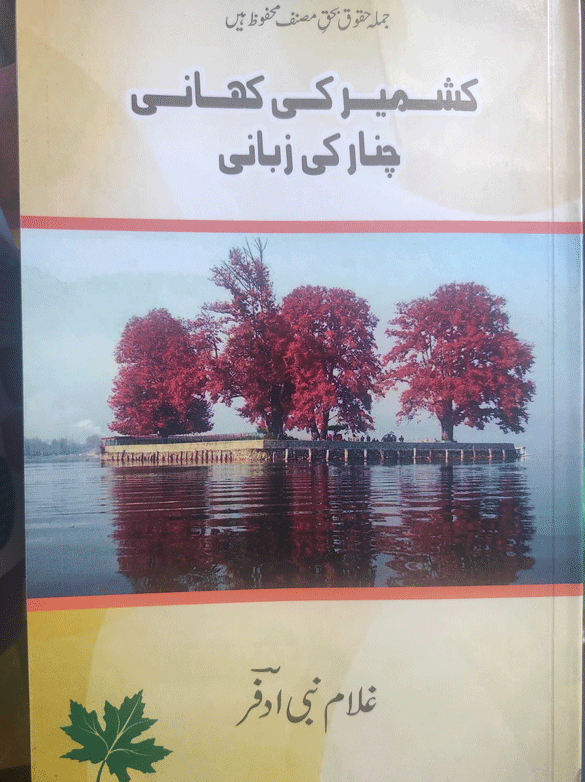
Ghulam Nabi Adfar’s Kashmir Ki Kahani, Chinar Ki Zubani, is an imaginative and thought-provoking contribution to the evolving corpus of Kashmiri historical writing. The book attempts a formidable task: narrating the long, layered, and often contested history of Kashmir through a literary device that blends folklore with political critique. By adopting an imaginary question-and-answer format in which a centuries-old Chinar tree—affectionately called “granny”—serves as the narrator, Adfar departs from conventional historiography and offers instead a reflective, dialogic mode of historical engagement.
The choice of the Chinar as the central narrative voice is both symbolic and methodologically significant. Deeply embedded in Kashmir’s ecological and cultural consciousness, the Chinar becomes more than a tree; it emerges as a silent witness to centuries of transformation, conflict, and continuity. This narrative strategy allows Adfar to traverse time seamlessly, presenting history not as a rigid sequence of events but as a lived and remembered experience. The “granny” Chinar, in responding to imagined queries, reconstructs Kashmir’s past with an intimacy that formal academic histories often lack.
The narrative opens with a vivid portrayal of Kashmir’s topography—its mountains, rivers, flora, and fauna. These descriptions are not merely aesthetic embellishments; they establish the valley as a distinct civilizational space where geography has profoundly shaped identity and history. The Chinar’s account situates Kashmir as both a paradise and a contested terrain, subtly suggesting that its natural beauty has often been intertwined with its political vulnerability. By foregrounding the ecological richness of the region, Adfar underscores an important point: Kashmir’s history cannot be understood in isolation from its landscape.
A significant portion of the book is devoted to the spread of Islam in Kashmir, a subject that Adfar approaches with both reverence and critical intent. Central to this discussion is Sheikh Noor-ud-Din Noorani (Sheikh ul Alam), one of the most revered spiritual figures in Kashmiri history. Adfar challenges the commonly held belief that Sheikh ul Alam was illiterate and unlettered, arguing instead for a more nuanced understanding of his intellectual and spiritual stature. This intervention is particularly important, as it seeks to reclaim the indigenous intellectual traditions of Kashmiri Islam from reductive narratives. By doing so, the author contributes to a broader discourse that emphasizes the depth and sophistication of local spiritual scholarship.
The book also provides a critical overview of the various rulers who governed Kashmir, with particular emphasis on the Dogra regime. Adfar’s portrayal of Dogra rule is sharply critical, highlighting the oppressive taxation system and the economic hardships endured by the Kashmiri populace. The burden of taxes, as described through the Chinar’s voice, becomes emblematic of systemic exploitation. The narrative evokes a sense of historical injustice, portraying the people of Kashmir as subjects of prolonged economic and political subjugation. While this perspective aligns with a widely acknowledged critique of Dogra governance, Adfar’s presentation is marked by a clear ideological stance that prioritizes the experiences of the oppressed.
One of the most compelling and emotionally charged sections of the book deals with the tragic events of 8–9 May 1995, when the town of Charar-i-Sharief and the shrine of Sheikh ul Alam were engulfed in flames. This tragedy is narrated with a sense of collective loss and cultural devastation. The destruction of such a significant spiritual and historical site is portrayed not merely as an isolated incident but as a rupture in Kashmir’s cultural memory. Through the Chinar’s lament, Adfar captures the grief and disorientation experienced by the people, making this episode one of the most poignant moments in the narrative.
In addressing modern political history, Adfar adopts a critical and, at times, controversial stance. His account of Kashmir’s accession to India in 1947 is intertwined with a reassessment of Sheikh Abdullah’s political role. Contrary to dominant narratives that often celebrate Sheikh Abdullah as an infallible leader, Adfar presents a more complex and ambivalent portrait. He alleges that Sheikh Abdullah suppressed opposition by banishing members of the Muslim Conference to Pakistan, thereby consolidating his political authority. This claim, while contentious, adds a layer of critical inquiry to the narrative, encouraging readers to question simplified representations of political figures.
The book further explores the shifting political character of Sheikh Abdullah, depicting his changing stance as reflective of both personal ambition and evolving political circumstances. Adfar does not present leadership as static; instead, he highlights the fluidity and contradictions inherent in political life. This is particularly evident in his discussion of internal conflicts within the National Conference (N.C.). The marginalization and eventual expulsion of Afzal Beg are presented as indicative of deeper fissures within the party. These internal struggles, according to Adfar, weakened institutional cohesion and contributed to broader political instability.
Another significant theme in the book is the role of dynastic politics and internal bickering within the Sheikh Abdullah family. Adfar argues that such internal divisions led to the fragmentation of the National Conference, undermining its credibility and effectiveness. By focusing on these intra-party dynamics, the author shifts the analytical lens from external forces to internal vulnerabilities, offering a more layered understanding of Kashmir’s political trajectory.
The discussion of the Muslim United Front (MUF) and the elections of the late 1980s constitutes a crucial segment of the narrative. Adfar portrays this period as a turning point in Kashmir’s contemporary history, alleging that the state machinery was used to manipulate electoral outcomes and suppress democratic expression. The resulting disillusionment among the populace is depicted as a catalyst for widespread unrest. While the book does not engage in detailed empirical analysis, its narrative captures the emotional and psychological impact of these events on ordinary Kashmiris.
A particularly noteworthy aspect of Adfar’s work is his critique of what he terms the “blind emotions” of the Kashmiri people. Through the reflective voice of the Chinar, the author suggests that the populace has often been swayed by emotional appeals and political rhetoric, sometimes at the expense of rational judgment. This introspective critique adds depth to the narrative, as it acknowledges the role of internal factors in shaping Kashmir’s history. Rather than presenting the people solely as victims, Adfar encourages a more nuanced understanding that includes elements of collective responsibility.
Stylistically, the book’s greatest strength lies in its accessibility. The imaginary dialogue format makes complex historical and political issues comprehensible to a broad readership, including students and general readers. The conversational tone, combined with the symbolic presence of the Chinar, creates a narrative that is both engaging and reflective. However, this very strength also constitutes a limitation from an academic perspective. The book lacks rigorous citation and does not consistently engage with primary sources or established historiography. As a result, some of its claims, particularly those concerning modern political events, may appear insufficiently substantiated.
Moreover, the author’s ideological positioning is evident throughout the text. While this lends the narrative a sense of conviction, it also raises questions about balance and objectivity. The selective emphasis on certain events and interpretations may invite critique from scholars seeking a more comprehensive and evidence-based account. Nevertheless, it is important to recognize that Adfar’s work does not aim to be a conventional academic history. Instead, it positions itself as a reflective and interpretive narrative that prioritizes memory, experience, and moral inquiry.
In conclusion, Kashmir Ki Kahani, Chinar Ki Zubani is a significant and engaging contribution to the literature on Kashmir. By blending storytelling with historical reflection, Baba Ghulam Nabi Adfar offers a narrative that is as evocative as it is provocative. The use of the Chinar as a narrative voice not only enriches the text aesthetically but also reinforces the continuity of memory in a region marked by disruption. While the book may not satisfy the methodological rigor expected of academic historiography, it succeeds in opening new avenues for understanding Kashmir’s past—inviting readers to listen, reflect, and critically engage with the complexities of history. For students, general readers, and those interested in Kashmir’s socio-political evolution, this work serves as both an accessible introduction and a stimulus for deeper inquiry.
…
M.H. A. Sikander is Writer-Activist based in Srinagar, Kashmir and can be reached at sikandarmushtaq@gmail.com
New Age Islam, Islam Online, Islamic Website, African Muslim News, Arab World News, South Asia News, Indian Muslim News, World Muslim News, Women in Islam, Islamic Feminism, Arab Women, Women In Arab, Islamophobia in America, Muslim Women in West, Islam Women and Feminism