
Maulana Wahiduddin Khan's Blueprint for Reflective Islam And Pluralist Realism

By Mushtaq Ul Haq Ahmad Sikander
26 February 2026
Maulana Wahiduddin Khan's Realistic Islamic Guidance
Sawaal Wa Jawaab Vol. 1, is a Q&A collection from Al-Risala magazine promoting reflective questioning and realism for Indian Muslims.
main Points
· The volume emphasizes prepared minds, contemplation (tadabbur), and serious questioning over emotional reactions.
· It critiques leadership, jihad, dawah, and 20th-century revivalist movements, favoring moral guidance and peaceful propagation.
· It advocates silence on provocative issues like Babri Masjid to prevent riots and promote Hindu-Muslim unity via "follow one, respect all."
· It stresses self-responsibility for Muslim decline, realism over victimhood, and strategic patience like the Treaty of Hudaybiyyah.
· It calls for education, competition, and nonviolent reform in plural societies coining new terms like Darul Dawah.
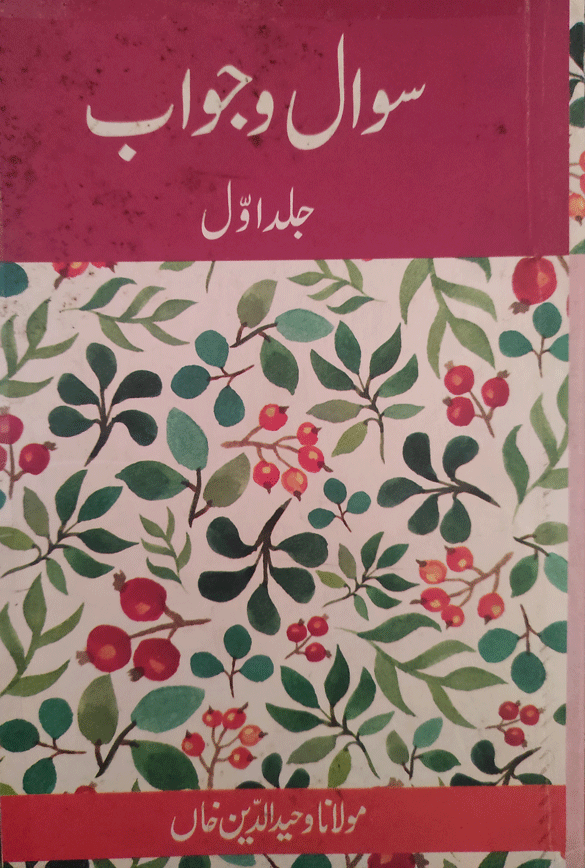
Sawaal Wa Jawaab (Questions and Answers): Vol 1
Author: Maulana Wahiuddin Khan
Publisher: Goodword Books, Noida, India
Year of Publication: 2017
Pages: 221
Price: NA
ISBN: 9789351791812
Maulana Wahiduddin Khan’s Sawaal Wa Jawaab (Questions and Answers): Vol. 1 is not merely a collection of religious rulings; it is a sustained intellectual and spiritual exercise in training the Muslim mind to think, question, and act realistically in the contemporary world. The book, drawn largely from the his monthly Urdu magazine Al‑Risala, records the Maulana’s responses to questions ranging from personal faith‑related doubts to large‑scale political and civilisational issues confronting Indian Muslims. In this work we find how he links “prepared minds for questioning” with a mature, non‑emotional understanding of Islam; his views on leadership, jihad, dawah, and 20th‑century revivalist movements; his controversial stance on Babri Masjid and Hindu‑Muslim unity; his critique of emotional politics, propaganda, and communal riots; and his broader vision of patience, realism, and the principle “follow one, respect all.”
Prepared minds and the art of questioning
Right at the outset, Maulana Wahiduddin Khan emphasises that the question‑and‑answer method is not a mere pedagogical device but a powerful engine of mutual learning. He writes that asking and answering questions enables both questioner and respondent to deepen their knowledge, discover new dimensions of an issue, and sharpen their intellectual faculties. Yet he immediately qualifies this: questions must not be asked thoughtlessly or out of mere curiosity; rather, “if a question arises in the mind, then one should first ponder on it.” (P-2)
Here he invokes the Qur’anic concepts of tadabbur (contemplation) and tafakkur (reflection), arguing that through contemplation a person first “prepares” his mind so that he can truly understand the question and the answer. In other words, half of knowledge lies in learning how to question, but even before asking one must exhaust the possibility of finding the answer oneself. This transforms every question from a passive demand for information into an active instrument of intellectual development. The implication for the reader is clear: to benefit from this book, one must read it with a “prepared mind”—one that is already wrestling with the issues, not one that simply wants ready‑made slogans.
How questioning should be conducted
In the opening note, Maulana also sketches how questioning should be conducted: it should be serious, reflective, and oriented toward understanding, not debate‑winning or emotional venting. He warns against treating questions as rhetorical or polemical tools; instead, each question should be treated as a means to refine one’s thinking and to test one’s assumptions against the Qur’an and Sunnah. This method is particularly important in an age when Muslims are bombarded with conflicting interpretations, political slogans, and instant‑reaction fatwas.
The Maulana’s own answers in Sawaal Wa Jawaab exemplify this spirit: they are generally brief, text‑anchored, and avoid the kind of elaborate theological disputation that can alienate ordinary readers. At the same time, he does not shy away from hard questions about fate and free will, the problem of evil, or the status of other religions. His approach suggests that genuine Islamic scholarship must be both rigorous and accessible, and that the questioner’s sincerity matters more than the complexity of the question.
Leadership, jihad, dawah, and 20th‑century revivalist movements
Throughout the book, Maulana engages with questions about Islamic leadership, jihad, and the history of dawah, especially in the context of 20th‑century revivalist movements. On leadership, he consistently stresses that true leadership in Islam is not about holding state power or commanding armies but about moral guidance, character, and service. He is critical of those who reduce Islam to a political project, arguing that such reductionism distorts the Prophetic model and turns religion into a tool of power‑seeking.
On jihad, Maulana distinguishes sharply between the defensive, state‑level military struggle permitted in the Qur’an and the contemporary misuse of the term by armed groups. He insists that in the present context—especially for Muslims living as minorities in plural societies—peaceful dawah, education, and character‑building are the primary forms of jihad‑e‑akbar (greater struggle). This leads him to a critical assessment of many 20th‑century revivalist movements that prioritised political confrontation, street agitation, and “Islamic state” slogans over grassroots spiritual and intellectual reform. For him, such movements often failed to produce lasting moral transformation and instead deepened sectarianism and state‑Muslim tensions.
Silence, slogans, and communal riots
One of the most striking and controversial themes in the book is Maulana’s repeated emphasis on silence and restraint in situations where provocative slogans can ignite communal riots. He argues that in a tense plural society, emotional sloganeering—even if rooted in genuine grievance—can easily spiral into violence, and that Muslims must therefore cultivate a culture of measured, non‑incendiary speech.
For example, on the Babri Masjid issue, he maintains that once the structure was demolished, continued public agitation only hardened Hindu majoritarian attitudes and endangered other Muslim places of worship. Instead of insisting on street protests and “who started it” arguments, he advocates a focus on preventing future riots by building inter‑community trust, supporting legal and constitutional mechanisms, and promoting a spirit of tolerance. This does not mean passivity; rather, it means shifting from emotional reaction to strategic, long‑term peace‑building.
Tolerance: not relativism, but respect
On page 23, Maulana explicitly clarifies that his call for tolerance does not mean believing that all religions are the same. He firmly upholds the Islamic conviction that Islam is the final and complete guidance, but insists that this belief must not translate into contempt for other faiths or their followers. Tolerance, for him, is not theological relativism but a practical ethic of respect, restraint, and peaceful coexistence.
He often cites the Qur’anic principle that there is “no compulsion in religion” and argues that Muslims should respect others’ freedom to follow their own faith while confidently living their own. This position allows him to condemn communal violence and hate speech without diluting core Islamic beliefs, and it underpins his famous formula for religious harmony: “follow one, and respect all.”
Decline of Muslims and self‑responsibility
A recurring motif in the book is Maulana’s insistence that the decline of Muslims is primarily the result of their own choices and conduct, not some external conspiracy. He rejects narratives that blame every setback on Western imperialism, Hindu majoritarianism, or “conspiracies,” arguing instead that Muslims must first look inward and acknowledge their own failures in education, ethics, and social organisation.
This emphasis on self‑responsibility is closely linked to his broader critique of victim‑mentality and emotional politics. He contends that as long as Muslims see themselves as perpetual victims, they will remain reactive rather than proactive, and will continue to lose ground in the intellectual and moral spheres. His call is for a shift from blaming others to reforming oneself, from street protests to institutional building, and from slogans to sustained, patient work.
Babri Masjid and Maulana’s “different stance”
On the Babri Masjid issue, Maulana’s position has been both courageous and deeply unpopular among sections of the Muslim community. He argues that the mosque was originally built in a manner that violated Islamic principles by being placed adjacent to a Hindu sacred site, and that this itself sowed the seeds of future conflict. After the demolition in 1992, he famously remarked that “the Hindus demolished the Babri Masjid but the Muslims provoked them to do so,” implying that Muslim political mobilisation and emotional rhetoric contributed to the tragedy.
He then proposes a three‑fold peace formula: Hindus must commit to not challenging any other mosque; Muslims must withdraw from street agitation and preserve silence on Ayodhya; and the state must uphold the Places of Worship Act and guarantee the security of all religious sites. For him, the solution lies in arbitration and judicial process, not in protests, sloganeering, or symbolic posturing. This stance, though criticised as “surrender” by some, reflects his consistent preference for constitutional, legal, and non‑violent resolution of disputes over street politics.
Criticising Iqbal and the courage of dissent
Maulana also stands out for being one of the few contemporary Muslim scholars willing to critically engage with Muhammad Iqbal, a figure often treated as sacrosanct in South Asian Muslim discourse. He does not reject Iqbal wholesale, but he questions certain political and philosophical tendencies in Iqbal’s thought—especially those that lend themselves to a romanticised, state‑centric vision of Islamic revival.
By doing so, Maulana models the very intellectual maturity he preaches: that no thinker, however revered, should be exempt from scrutiny in the light of the Qur’an and Sunnah. This willingness to dissent from mainstream icons is part of his broader project of liberating Muslim thought from uncritical imitation and encouraging independent, reflective engagement with both classical and modern ideas.
Hindu‑Muslim unity and “follow one, respect all”
The principle “follow one, respect all” becomes, in Maulana’s hands, a practical roadmap for Hindu‑Muslim unity in India. He argues that religious diversity is a permanent feature of human society and that the goal should not be the erasure of differences but the cultivation of mutual respect and cooperation. A Muslim can fully adhere to Islam while respecting Hindus, their temples, and their religious sentiments; likewise, a Hindu can remain a devout Hindu while respecting Muslims and their mosques.
This principle directly informs his critique of those Muslims who “own” leaders and kings—such as Jinnah or Aurangzeb—more than they “own” God. He contends that Islam teaches allegiance to God alone, yet many Muslims attach their identity to historical figures and political projects, living in the imagined glory of a past empire rather than engaging constructively with the present. Disowning such emotional attachments, he argues, is essential for genuine Hindu‑Muslim harmony, because it removes the sense of historical grievance and entitlement that fuels conflict.
Satanic Verses, Rushdie, and the principle of silence
On the Satanic Verses controversy and the associated fatwas, Maulana adopts a strikingly different line from many of his contemporaries. While condemning blasphemy and offensive portrayals of the Prophet Muhammad (pbuh), he argues that the appropriate response is not violence or calls for killing the author, but rather a principled silence and a focus on positive dawah.
He contends that responding to falsehood with violence only amplifies the controversy and damages the image of Islam, whereas ignoring it and continuing to present the true message of Islam through education and character is a far more effective strategy. In other words, the principle is to “kill falsehood by observing silence over it,” not by turning it into a global media spectacle. This position reflects his broader belief that Muslims must learn to overcome emotional reactions and adopt a realistic, long‑term perspective.
Overcoming emotions and becoming a realist
A central thread running through Sawaal Wa Jawaab is the need for Muslims to move from an emotional to a realistic mindset. Maulana repeatedly warns against the dangers of emotional politics, where every issue is framed in terms of “us versus them,” every setback is seen as a conspiracy, and every call to patience is dismissed as cowardice.
He argues that realism does not mean abandoning principles; rather, it means understanding power realities, historical context, and the limits of what can be achieved in a given situation. For example, when asked whether Pakistan is the solution to Muslim problems or whether an “Islamic State” offers a viable model, he points to the fact that millions of Muslims are leaving such states and migrating to the West, often willing to live under non‑Muslim rule if it offers security, opportunity, and dignity. This, he suggests, is a powerful empirical test of any political‑religious model: if it cannot retain its own people, it cannot claim to be the ideal.
Propaganda, allegations, and Maulana’s response
The book also indirectly reflects the propaganda and allegations levelled against Maulana himself—that he lives a “lavish life,” delivers sermons from an air‑conditioned room, and is out of touch with the masses. However, Maulana mostly ignores such attacks and does not engage in public rebuttals.
This silence is consistent with his own teaching: that responding to every allegation with equal heat only escalates conflict and distracts from the real work of reform. Instead of defending his lifestyle, he continues to publish, lecture, and write, trusting that the substance of his message will ultimately speak louder than the noise of slander. In this sense, his life becomes an illustration of the very principles he advocates: patience, realism, and a focus on constructive action over polemical reaction.
“Compete or perish” and reservations
On socio‑economic issues, Maulana adopts a “compete or perish” outlook, arguing that Muslims must invest in education, skills, and entrepreneurship rather than relying on reservations or state patronage. He is sceptical of permanent reservation policies, warning that they can foster dependency and undermine the drive for self‑improvement. Instead, he urges Muslims to build strong institutions—schools, colleges, research centres, and businesses—that can compete in the open market and earn respect through merit.
This emphasis on competition and self‑reliance fits with his broader realism: in a plural, democratic society, no community can expect special favours indefinitely; its survival and flourishing depend on its ability to contribute value and adapt to changing circumstances.
Patience as action‑oriented
For Maulana, patience (sabr) is not passive resignation but an action‑oriented virtue. He often cites the Treaty of Hudaybiyyah as a paradigm of strategic patience: the Prophet Muhammad (pbuh) accepted seemingly humiliating terms because he saw that they would open long‑term avenues for dawah and community building.
In the same spirit, he urges Muslims to exercise patience in the face of injustice, not by remaining silent forever, but by choosing the right time, place, and method for response. This means investing in education, character, and institutions while avoiding short‑term, emotionally charged confrontations that yield no lasting benefit. Patience, in his view, is the bridge between principle and pragmatism.
Darul Dawah and its exposition
The concept of Darul Dawah—a society or space oriented toward peaceful propagation of Islam—runs through Maulana’s thought and is implicitly reflected in Sawaal Wa Jawaab. He argues that Muslims should strive to create environments where the message of Islam can be presented through dialogue, example, and service, rather than through coercion, intimidation, or political dominance.
In such a Darul Dawah, the primary “weapons” are knowledge, character, and compassion, not slogans or street power. This vision underpins his emphasis on prepared minds, reflective questioning, and non‑violent dawah: the goal is not to win a political battle but to win hearts and minds through consistent, patient effort.
Conclusion: a manual for the reflective Muslim
Sawaal Wa Jawaab (Vol. 1), therefore, functions less as a traditional fatwa‑book and more as a manual for the reflective Muslim seeking to navigate faith, politics, and pluralism in the 21st century. By insisting that half of knowledge lies in learning how to question, and that every question should first be pondered in the light of tadabbur and tafakkur, Maulana trains the reader to move beyond slogans and emotional reactions.
His positions on Babri Masjid, Hindu‑Muslim unity, jihad, dawah, and communal riots are controversial precisely because they challenge deeply entrenched emotional narratives within Muslim communities. Yet they are grounded in a consistent vision: that Muslims must take responsibility for their own decline, overcome emotional politics, embrace realism and patience, and pursue peace and justice through constitutional, non‑violent, and educational means. For the scholar, activist, or teacher in India—especially one concerned with interfaith dialogue and Muslim‑minority survival—this volume offers not just answers, but a whole way of thinking.
…
M. H. A. Sikander is Writer-Activist based in Srinagar, Kashmir.
New Age Islam, Islam Online, Islamic Website, African Muslim News, Arab World News, South Asia News, Indian Muslim News, World Muslim News, Women in Islam, Islamic Feminism, Arab Women, Women In Arab, Islamophobia in America, Muslim Women in West, Islam Women and Feminism