
Maulana Wahiduddin Khan on Rational Faith and Modern Islam

By Mushtaq Ul Haq Ahmad Sikander, New Age Islam
10 December 2025
The book presents Islam as a living conversation, encouraging questioning as essential for faith and intellectual growth.
Main Points:
1. It emphasises reasoned reflection on God, life, and morality, linking divine design with human agency and responsibility.
2. Maulana Wahiduddin Khan advocates for universalism, interfaith dialogue, and equal citizenship, urging Muslims to embrace pluralism and constitutional frameworks.
3. The text promotes mind-based spirituality over emotional devotion, highlighting the importance of intellect in spiritual transformation.
4. It calls for revival—not reform—of Islam through independent reasoning (Ijtihaad) and peaceful communication (Dawah), addressing contemporary issues with clarity and pragmatism.
----
The Seeker’s Guide: Questions on God, Islam, Peace, Spirituality and Wisdom
Author: Maulana Wahiduddin Khan
Editorial Team: Prof Farida Khanam, Raazia Siddiqui, Mohammad Asad Pervez & Maria Khan
Publisher: Goodword Books, New Delhi, India
Year of Publication: 2020
Pages: 274, Price: NA
ISBN: 9789386589262
----
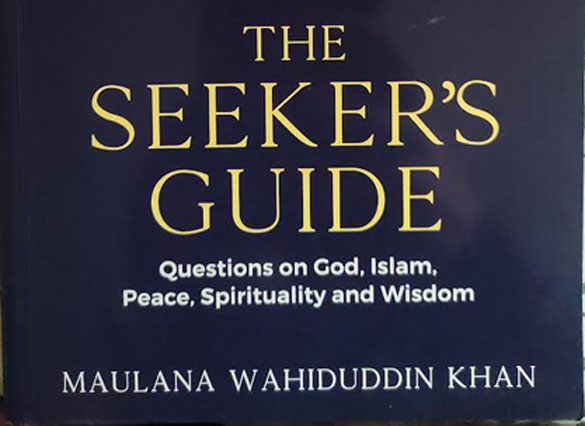
Maulana Wahiduddin Khan’s The Seeker’s Guide: Questions on God, Islam, Peace, Spirituality and Wisdom is, at its core, a manifesto for a rational, peace-oriented Islam that speaks directly to the anxieties of the modern age. Edited by Prof Farida Khanam, Razia Siddiqui, Mohammad Asad Pervez and Maria Khan, the volume assembles the Maulana’s answers to a wide spectrum of questions put to him by readers across time and context. The structure itself signals the spirit of the work: Islam is presented not as a closed system but as a living conversation, in which questioning is not a threat but the very engine of faith and intellectual growth.
The foreword explicitly explains what motivated this compilation and what it offers to contemporary readers. “This is the idea that has motivated this compilation of Maulana’s answers to various questions people have asked him….In this book, the Maulana offers his reflections on a myriad of questions put to him by readers. The reader will observe that Maulana’s approach to answering questions, particularly those of fundamental importance, is marked by precision. His explanations are concise, clear and yet comprehensive. In today’s age when people have less time to spend on reading lengthy extracts, this book comes as a much needed alternative which presents rational and pragmatic solutions.” The editors thus frame the book as both a pedagogical tool and an intellectual companion, aimed at seekers who need clarity more than complexity, and argument more than assertion.
Running through the work is Maulana’s insistence on understanding God, life in this world, heaven and the need for a Creator through reasoned reflection. God is not introduced as a merely inherited belief but as the necessary explanation for the order, intelligibility and moral structure of reality. Life in this world is, in his view, part of a larger creation plan: a testing ground in which human beings, endowed with freedom and responsibility, undergo moral and intellectual development whose fruits are fully realized in the Hereafter. This is not a fatalistic theology; rather, it links divine design with human agency, emphasizing that what happens in history is shaped by human choices within God’s broader scheme.
It is in this context that Maulana underlines the Quran’s true nature and purpose. “The Quran is not a book of jurisprudence or a book of dos and don’ts about rituals. The Quran informs people about the laws of nature. It is not a book of Muslims, it is a Book of God. So, it becomes imperative that it be taken to all mankind.” (P-42) This passage encapsulates his universalism. The Quran, for him, is a guidebook to reality, an invitation to read not just the text but the universe it describes. By refusing to reduce it to a Fiqh manual or a sectarian symbol, he calls Muslims to reposition themselves as conveyors of a universal message addressed to humanity as such.
Correspondingly, the book pays sustained attention to interfaith dialogue and to Islam’s relationship with other communities. Maulana argues that Islam, properly understood, is inherently open to dialogue, coexistence and peace. In one of the most striking socio-political passages he writes: “Today we live in a world of equal citizenship. Any such categorization of people as ‘Muslim’ or ‘non Muslim’ is wrong and no longer valid. So, a person is either an immigrant to a country or a citizen of the country. This is the universal norm and Muslim countries should also adopt this principle. They should not differentiate people on the basis of religion, because this would be unacceptable to the modern mind.” (P-64-65) This is both descriptive and prescriptive. It recognizes the global norm of equal citizenship and urges Muslim societies to move beyond pre-modern categories of religious hierarchy, thereby embedding Islamic life within a plural, constitutional framework rather than a communal one.
The spiritual dimension of Islam, in Maulana’s account, is deeply shaped by Sufism. Sufism can be credited with the spiritual expansion of Islam, he suggests, for its role in taking the message to hearts across continents without the apparatus of power. Yet he is also wary of purely emotional devotions that lack intellectual grounding. Hence his emphasis on “mind based spirituality not heart based one.” He calls for a spirituality in which the intellect—reflecting on nature, history and revelation—leads to inner transformation. The heart is not bypassed, but it is educated and disciplined by the mind’s engagement with truth, rather than swept along by unexamined sentiment.
This rational spirit also marks his analysis of historical and political development. One of his recurring themes is that “No struggle no development,” and he frequently cites the examples of Japan and Germany: nations that were shattered by war but, through discipline, planning and hard work, rose to become major economic and technological powers. He contrasts this with many Muslim-majority societies that, in his view, have failed to generate a similar culture of sustained effort, self-critique and institution-building. The lesson he draws is stark: without intellectual and moral “discontentment”—a refusal to be satisfied with stagnation—there can be no genuine progress. Discontentment, here, is not cynicism but a constructive restlessness that drives learning, reform and creativity.
A critical doctrinal thread in the book is Maulana’s insistence that Islam does not need reform but revival. By “reform,” he means diluting core principles to fit passing fashions; by “revival,” he means rediscovering Islam’s original spirit of inquiry, mercy and universality and applying it afresh in new circumstances. This leads him to champion Ijtihad—independent reasoning based on scriptural sources—as well as Dawah, the peaceful communication of Islam’s message. Maulana is for Ijtihad and Dawah not as slogans but as methods: Muslims must think for themselves within the tradition and must share their beliefs through reasoned persuasion, not compulsion.
His legal and political reflections include nuanced discussions of classical concepts such as Jaziya and Kafir. He argues that Janiya cannot be imposed now, given the modern norm of equal citizenship and non-discrimination, and treats the term Kafir as a relative, contextual category linked primarily to the prophetic milieu, rather than a perpetual, blanket label for all non-Muslims. In the same reformist-yet-traditional spirit, he distinguishes sharply between terrorism and legitimate political grievances, stressing that terrorism and violence are based on ideology and so need to be countered through ideology only. Military or security measures alone, he suggests, cannot uproot ideas; they must be challenged by better ideas, articulated with patience and clarity.
A particularly valuable contribution of the book is its explanation of the distinction between fatwa and Qaza, a confusion that has often fuelled social tension. As Maulana puts it: “fatwa is non-binding and can only be solicited for one’s personal matters. For instance, a person cannot solicit a fatwa on the outfit worn by another person such as Sania mirza. Fatwa cannot be solicited for another person. Doing this is unacceptable and forbidden in Islam. The Sharia distinguishes between fatwa and Qaza. The former refers to the opinion given by a mufti when someone consults him on a personal matter. Qaza, on the other hand, refers to a judicial verdict. No mufti is allowed to issue a Qaza, which is the prerogative of only a state-authorized court and is binding on everyone. Qaza is given on an issue which is in the domain of a judge. In such matters a mufti is not supposed to issue fatwas on his own. In this case, either the government appoints a judge or someone gets a special sanction for issuing binding awards on the parties involved. In modern English language, Qaza is equivalent to legislation.” (P-128-129) In an age of sensational “fatwa politics,” this passage re-situates religious authority within proper institutional limits and upholds the rule of law.
Consistent with his emphasis on modern norms, Maulana also argues that certain medieval legal instruments—such as Jaziya—are not applicable today, and that Muslims must understand their own heritage contextually. His approach to blasphemy is emblematic of this commitment to both scriptural fidelity and contemporary ethics. “According to Islam, blasphemy is simply a misuse of freedom and not at all a cognizable offence; the blasphemer is not liable to incur any legal punishment. This kind of law has no basis in Islamic scriptures. If someone uses abusive language against the Prophet, Muslims must take it as a case of misunderstanding, and then try to remove this misunderstanding in peaceful ways. They are required to do so by engaging in discussion or by providing the ‘blasphemer’ with Islamic literature that gives the true image of the Prophet of Islam. This notion of killing in the name of blasphemy is itself haram or forbidden.” (P-196) In contexts where mob violence over alleged blasphemy has become alarmingly common, this stance is nothing short of radical—and urgently needed.
Equally provocative is his treatment of the term “Islamophobia.” “I do not believe that ‘Islamophobia’ exists. The irony is that this term has not been coined by other communities-it has been so named by the Muslim community themselves. Thus, Islamophobia is simply an allegation, and not a real phenomenon……In this case, the responsibility goes to the Muslims, and not the West. So, in reality, if there is something, it is Muslim-o-phobia. The resentment is not towards Islam but against the un-Islamic practices of Muslims.” (P-184-185) This is a “great revelation” of sorts within the text, but also one of its most contestable claims. While many would argue that anti-Muslim prejudice is demonstrably real, Maulana’s intention is to push Muslims towards introspection: to ask how far their own conduct may contribute to negative perceptions, and how far moral and intellectual reform can change that.
On international politics, his reading of the Israel–Palestine conflict is similarly controversial. “Not at all. In the case of Israel-Palestine conflict, a two-nation settlement was reached in 1948 under the 1947 General Assembly Resolution. Right after this, the Palestinian side launched a massive military attack on Israel. Israel has continued to retaliate to the actions undertaken by Palestine against them. It is unwise to think that one can use violent force against someone and the other party will not retaliate with its full might. The devastation Palestine faces today is actually the repercussion of its past actions.” (P-201-202) Many historians would strongly contest this narrative as one-sided and inattentive to dispossession, occupation and power asymmetries. The value of including such a passage in the book, however, lies in the debate it invites: it challenges readers to revisit historical records, scrutinize all sides, and re-examine easy assumptions about victimhood and responsibility.
The book does not confine itself to global conflicts. It also touches on India’s own fraught history, including Babri Masjid and the trajectory of Pakistan. Maulana notes, for instance, that Babri Masjid relocation was proposed as a potential way out but that this was not acceptable to the Muslim leadership, implicitly criticizing a rigidity that, in his view, may have cost the community dearly. On Pakistan, he points out how a movement initially framed as Hindu vs Muslim has devolved into Shia vs Sunni, illustrating how political religion can deepen internal divisions rather than heal them. The implication is clear: communal politics, once unleashed, does not stop at borders; it fragments societies from within.
In the domain of domestic policy and social organization, Maulana’s critique of student activism is direct and unapologetic. “Student level politics has adversely affected our educational system. Educational institutions must have better management and infrastructure to allow feedback to come in without the need for a student union. The only step which shall take our country forward is to create a sustainable infrastructure of quality education in India.” (P-242) Here again he aligns with a technocratic vision: depoliticized campuses, strong institutional mechanisms for feedback, and a relentless focus on academic and infrastructural excellence.
Taken together, these positions are consistent with his larger view that terrorism and violence, being products of ideas, can only be reversed by better ideas, patiently articulated and widely disseminated. This is where Dawah returns as a central vocation. Dawah and the necessity of Muslims undertaking it run through the volume: not as triumphalism, but as a call to explain Islam in a language of our contemporary times, not old ones. The book itself is a demonstration of this method—classical concerns reframed in modern idiom, without surrendering theological depth.
Perhaps the single most important intellectual virtue The Seeker’s Guide champions is restlessness: the belief that “We need discontentment only then our intellectual development will continue.” Discontentment here means refusing to accept inherited patterns of thought when they fail the tests of reason, justice and compassion. In that sense, the book is not only a guide for individual seekers but also a roadmap for communal self-renewal. By insisting on a God-centred, mind-based spirituality, on peace as the supreme value, and on speaking to the present in its own language, Maulana Wahiduddin Khan offers a model of Islamic thought that is deeply rooted yet unafraid of the future.
----
M.H.A. Sikander is Writer-Activist based in Srinagar, Kashmir
URL: https://www.newageislam.com/books-documents/maulana-wahiduddin-rational-faith-modern-islam/d/137957
New Age Islam, Islam Online, Islamic Website, African Muslim News, Arab World News, South Asia News, Indian Muslim News, World Muslim News, Women in Islam, Islamic Feminism, Arab Women, Women In Arab, Islamophobia in America, Muslim Women in West, Islam Women and Feminism