
Lt Gen. Y.K. Joshi's Enduring Military Legacy

By Mushtaq Ul Haq Ahmad Sikander, New Age Islam
6 February 2026
This memoir explores Lt Gen. Y.K. Joshi's Who Dares Wins, tracing his journey from childhood inspiration to high-stakes leadership in India's armed forces
Main Points
· Joshi's formative years in Jhansi near an army cantonment, ignited his calling to military service, leading to NDA training that forged discipline and self-command.
· Early deployments in Northeast insurgencies and Kashmir's harsh snowfields at Chowkibal, emphasizing restraint, empathy, and endurance against invisible threats.
· Kargil War command, capturing Tololing and Point 4875 amid intense combat, highlighting victory's grief and humane burial of enemy soldiers.
· Diverse roles in UN peacekeeping in Angola, China embassy attaché, Ladakh border vigilance, showcasing adaptability and global perspective.
· Memoir's reflective prose on courage as endurance, blending faith, family, and duty without glorifying war.
…
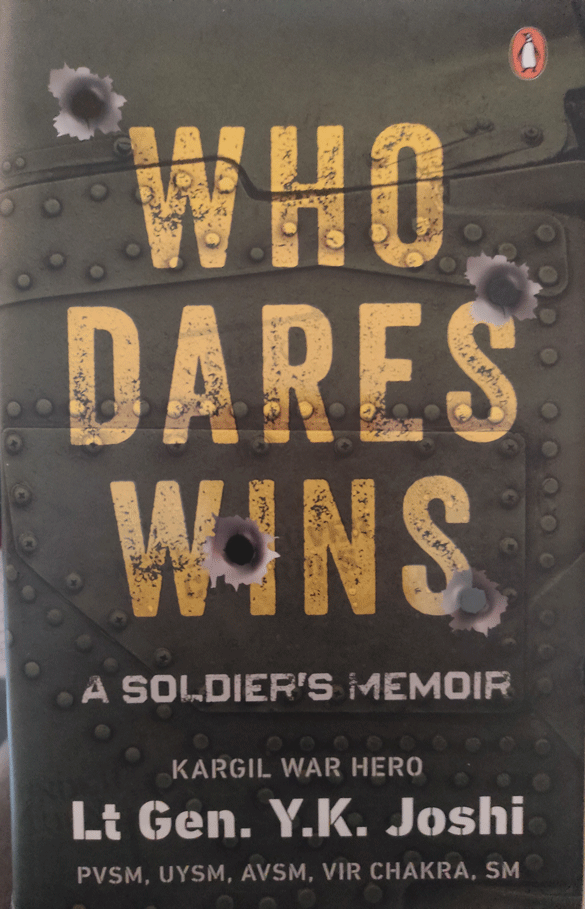
Who Dares Wins: A Soldier’s Memoir
Author: Lt Gen. Y.K. Joshi
Publisher: Penguin Random House India
Year of Publication: 2024
Pages: 240
Price: Rs 699
ISBN: 9780143467632
When one opens Who Dares Wins, the memoir of Lt. Gen. Y.K. Joshi, one steps not merely into the barracks, bunkers, and battle maps of the Indian Army, but into a life-long conversation between courage and conscience, between destiny and discipline. Joshi’s name is already well known to those who followed the dramas of India’s modern military history—the Kargil War, the Ladakh standoff—but here, through reflective and honest prose, he lifts the curtain on the making of a soldier, tracing that journey from Jhansi’s dusty cantonment roads to the silent frozen ridges of Kashmir, from the jungles of the Northeast to the diplomatic corridors of Beijing.
The book belongs to that rare category of military memoirs which do not glorify war but illuminate its inner cost. Joshi does not speak as an apologist of might, but as a thoughtful witness to the toll and triumph of service. His writing, disciplined and deliberate, mirrors the very life it narrates—firm, lucid, and touched by the awareness that no medal ever erases the memory of a fallen comrade.
The Fragrance of Uniform: Childhood and Calling
Every soldier’s story begins long before the first salute. In Joshi’s case, it begins in the small, historic town of Jhansi, wrapped in the magnificence of legends—Rani Laxmibai’s rebellion, the pride of courage. Growing up near an army cantonment, the rhythms of military life—the gleam of boots, the rumble of parades, the bugle’s call echoing across sleeping fields—became part of his boyhood sensibility. It was 1971, and the air was still charged with the emotions of war and national awakenings. For a child, those uniforms represented not power but purpose, not armament but dignity.
It was in those formative years, Joshi admits, that the seed of his future was sown. While others dreamt of civil comforts or distant ambitions, he carried a singular longing—to serve. That steady glow carried him to the gates of the National Defence Academy (NDA), where the raw metal of a boy would be hammered into the tempered steel of an officer.
The Furnace of Formation: Life at NDA
At NDA, he entered what he calls “the furnace of transformation.” The life there—relentless drills, sleepless nights, freezing dawn parades, and the ever-present voice of command—made him confront his limits, physical and moral alike. Through its vigour and harshness, NDA taught him the first principle of leadership: that to command others, one must first learn to command oneself.
Joshi’s prose in these chapters carries the breath of exhaustion and exhilaration, describing how bodies broke and spirits grew. He notes with wry affection that NDA’s training stripped away illusions but left behind something more enduring—fellowship. Among the cadets, discipline was not enforced; it was internalized. The young men, under the open sky of Khadakwasla, learned camaraderie as naturally as they breathed. The motto Service Before Self was not a slogan painted on barrack walls; it became a pulse thudding beneath the skin.
Baptism by Terrain: The Northeast’s Living Front
Commissioned into the Indian Army, Joshi’s first encounter with the ambiguous face of modern warfare came in India’s Northeast. There, amid jungles thick with mist and folklore, wars were waged not openly but silently; insurgency did not trumpet its presence—it stalked in shadows.
Joshi’s reflections on those years are striking for their empathy. He writes not merely of operations and ambushes but of people—of villagers who feared both the guerrilla and the gun, of young soldiers trying to tell friend from foe. The war here, he notes, was of another kind: one that demanded restraint more than aggression, wisdom more than speed.
He narrowly escaped death several times in sudden skirmishes and accidents, and those moments of near collision with mortality led him to a mystical sense of life’s fragility. Fate, in Joshi’s world, is not an abstraction—it is an ever-present officer of nature, whose orders must be obeyed without question. These early experiences shaped the quiet faith that runs through his writing like a hidden current—the sense that each survival carries with it a debt of meaning.
In the Snowfields of Kashmir: Duty at Chowkibal
From the damp forests of the Northeast, Joshi’s path led him next to the white wilderness of Kashmir—a move from humidity to hostility of another kind. At Chowkibal, near Kupwara, the land is a theatre of ruthless winters and constant watchfulness. For the soldiers posted there, snow is both companion and enemy: it conceals landmines as easily as it muffles sound. Here Joshi learned the rhythm of life paced by isolation—days when conversation freezes mid-air and the only sound is the soft crunch of boots over snow crusts.
He writes of commanding posts buried under snowdrifts, of men who would fight an invisible enemy by day and blizzards by night. "In those long stretches of whiteness," he observes, "you begin to understand that the silence of mountains can be as loud as artillery." His depiction rises beyond reportage; it becomes a meditation on endurance, on the delicate balance between courage and exhaustion. Soldiering, as he illustrates, is not merely an act of bravery but an act of continuous belief—the belief that presence itself, holding ground against the frost, is a form of victory.
Between Wars: Peacekeeping in Angola
Just when one grows accustomed to the tension of borders, Joshi’s memoir takes an unexpected turn—to Africa, to Angola, where he served on a United Nations Peacekeeping Mission. The continent’s red earth and open skies are a far cry from Himalayan passes, yet the soldier’s task remains the same: to bring order amidst chaos, calm amidst despair.
In Angola, Joshi became not a fighter but an intermediary between warring factions, learning that peace is often more complex to maintain than war is to win. He writes vividly of dust-choked roads, orphaned children smiling at passing convoys, and diplomats who debated as soldiers quietly restored order. It is here that Joshi’s prose attains a rare, almost lyrical tenderness.
One charming anecdote recounts his accidental co-piloting of a small plane—a moment of lightness amid heavy duty. It captures not just his adventurous spirit but his ability to find joy in the unexpected. The Africa interlude broadens the scope of his memoir, showing the Indian soldier’s global face: disciplined, compassionate, and never indifferent to suffering.
The Mantle of Command
Leadership, in Joshi’s unfolding narrative, arrives not through promotion but through testing. When he was made Commanding Officer of a newly raised battalion, he inherited not only a structure but a spirit in the making. The challenge, he writes, was to shape raw potential into coherent power—to turn a collection of men into a unit that breathes as one.
He pays tribute to those who came before him, acknowledging that leadership is a torch passed, not a throne seized. His belief that authority works best through humility and listening marks these chapters as some of the memoir’s most insightful. The focus shifts subtly from battlefield heroics to the philosophy of duty—what it means to be responsible for lives that depend on your judgment.
Rather than describe himself as a commander of men, he prefers the word custodian. He learned, he says, that the strength of command lies not in shouting from the front but in quietly standing behind one’s men when they falter.
The Kargil Crucible
The memoir reaches its emotional and moral summit in the chapters devoted to the Kargil War. The writing here tightens; every sentence charged with memory and restrained emotion. The reader can almost hear the cold wind at 18,000 feet, taste the mingled fear and fury of combat. Joshi recounts the confusion of those early days in 1999, when the extent of enemy infiltration was still unclear, and the command struggled to separate rumour from reconnaissance. As Commanding Officer, Joshi bore the burden of impossible orders—capture cliffs at night, under fire, on terrain where even breathing felt like an act of defiance.
His description of Tololing Top—the heavily fortified position whose capture shifted the war’s momentum—is one of the most powerful passages in the book. “The mountains,” he writes, “do not forgive mistakes, nor do they reward hesitation.” Climbing them in darkness, under machine-gun fire, was an experience close to spiritual trial. The objective was clear—to reclaim territory—but beneath it lay an unspoken resolve: to uphold the Army’s honour.
He recalls how, amid exploding shells and freezing winds, destiny played its subtle games: bullets missed by inches, comrades fell inches away. Each moment of survival felt miraculous, each decision irreversible. When Point 4875 was finally captured, at the cost of countless lives, Joshi could not celebrate. Victory, in his words, “comes drenched in grief.” What stands out most is his portrayal of mercy: after the war, when Pakistani forces refused to reclaim their fallen soldiers, dismissing them as “mujahideen,” Indian soldiers buried the bodies with full military honours. On pages 146–147, Joshi quietly records that moment of solemn humanity: “They were enemies in battle, but in death, we saluted them as soldiers.” No statement could better reveal the ethos that defines India’s armed forces.
Bonds Beyond Battle: Family and Faith
In the quieter intervals of the war narrative, Joshi allows glimpses of his personal life—the family awaiting news, his wife’s stoic calm, the eerie coincidence that her brother too served in the same theatre. Communication lines were uncertain, and every silence could mean disaster. These chapters dissolve the distance between uniform and home, showing how the soldier’s war continues in the hearts of families who learn to live with fear as naturally as with faith.
Joshi’s tone here softens but never wallows. There is gratitude in his words for those invisible heroes who keep the home fires burning while the men guard icy passes. In this interweaving of domestic tenderness with military austerity, the memoir achieves emotional depth. The sense of destiny that shadows his life seems now illuminated by devotion—he often mentions divine will, as if to say that courage is merely another form of surrender before God’s plan.
From Battlefield to Embassy: The China Posting
After Kargil, Joshi’s career took him in a new direction—as Defence Attaché at the Indian Embassy in China. The soldier became a scholar, learning Mandarin for two years before taking up post in Beijing. He describes those years as a discipline of the mind comparable to the discipline of arms. Study, patience, and observation replaced the adrenaline of battle.
Living in China, he gained not only linguistic skill but cultural awareness. He recognized the subtleties of statecraft—the silent warfare of symbols, the diplomacy of presence. Underneath the polished movements of protocol, he sensed the undercurrents of rivalry and mutual respect that define India–China relations. His portrayal of Chinese officials is balanced, occasionally admiring, always cautious. In this part, we meet another Joshi: the thinker in uniform, the listener of civilizations.
Homecoming to the Heights: Ladakh and Leadership
Returning to India, Joshi’s later appointment in Ladakh brought him again to the familiar altitude of stone and strife. The mountains, once the site of youthful war, now greeted an experienced commander. These chapters outline sensitive developments—border vigilance, military readiness, and nuanced engagement with Chinese troops—but Joshi maintains discretion, narrating only what is necessary.
What he reveals is a philosophy of command rooted in calm firmness. The soldiers under him, he notes, stood against wind, cold, and confrontation with an extraordinary sense of purpose. By now Joshi had come to regard the landscape itself as a teacher—its harshness a reminder of impermanence, its beauty a reward for fortitude.
The Pandemic War
The final act of Joshi’s story unfolds amid an unexpected global enemy: COVID-19. Even here, the army became a model of organisation and humanitarian efficiency, mobilizing relief, establishing quarantines, managing logistics when civil systems faltered. Joshi writes of the virus as one might of an invisible insurgent—“a foe without borders, fought with discipline rather than rifles.”
He contracted the infection himself, and the experience briefly humbled the general who had survived gunfire and avalanches. Yet his recovery became a metaphor for resilience. The soldier’s art, after all, is the art of adaptation, and Who Dares Wins ends on that note of continuity—the courage to endure, to rise, to serve.
Craft and Character of the Memoir
What gives Who Dares Wins its quiet power is its language: sparse yet suffused with integrity. Joshi writes the way a soldier thinks—economy of word, precision of emotion. The prose never lapses into sentimentality; its emotion lies in what is left unsaid.
He does not preach heroism but enacts it through memory. Nor does he define patriotism in slogans; he reveals it in acts of decency under duress. His world is one where faith coexists with grit, where honour survives even in defeat, and where the enemy’s corpses are given the dignity of burial.
The rhythm of the narrative alternates between breathless action and thoughtful pause. Time and again, he interrupts the march of events with quiet philosophical reflections—on chance, duty, fate. In doing so, he transforms a military memoir into a meditation on being.
“Who Dares Wins”: The Meaning of the Motto
The book’s title, borrowed from the special forces maxim, finds through Joshi’s life a humane reinterpretation. In the popular understanding, “who dares wins” suggests audacity—but for Joshi it signifies endurance. To dare is not merely to fight; it is to love one’s comrades, to show mercy to foes, to wake up to another day of uncertainty with the same composure of yesterday.
Reading the memoir feels like walking beside a man who has seen both the edge of death and the grace of survival—and learned to be grateful to both. Beneath the brass of his rank beats the quiet humility of a seeker who has tested life in its fiercest forms and found in it a reason not to boast, but to bow.
Final Reflections
Lt. Gen. Y.K. Joshi’s Who Dares Wins deserves to be read not just as the chronicle of a distinguished general, but as the moral autobiography of a soldier-scholar. It bridges the often-overlooked distance between uniform and humanity, reminding us that courage is not born of aggression but of conviction.
In its pages, young readers will find inspiration, soldiers will find recognition, and civilians will find understanding. Most importantly, they will encounter the paradox at the heart of soldiering: that to defend life, one must stand perpetually near death; that to win, one must first learn to lose—with grace.
Ultimately, the memoir stands as testimony to the endurance of an ideal—the ideal that service is sacred, that peace is the soldier’s truest victory, and that those who truly dare are those who dare to remain human.
…
M.H.A.Sikander is Writer-Activist based in Srinagar, Kashmir.
URL: https://newageislam.com/books-documents/lt-gen-yk-joshi-military-legacy/d/138747
New Age Islam, Islam Online, Islamic Website, African Muslim News, Arab World News, South Asia News, Indian Muslim News, World Muslim News, Women in Islam, Islamic Feminism, Arab Women, Women In Arab, Islamophobia in America, Muslim Women in West, Islam Women and Feminism