
Living On the Edge: When Hard Times Become a Way of Life
By Mushtaq Ul Haq Ahmad Sikander, New Age Islam
08 May 2026
A sharp critique of how corporate power, weak public policy, and social injustice keep ordinary people trapped in insecurity.
Main Points:
· The book argues that business practices and government policies create and normalize economic hardship for many while concentrating wealth for a few.
· It highlights the struggles of the “struggling class,” including low wages, underemployment, unaffordable housing, debt, and the pressure of daily survival.
· It criticizes the weakening of the welfare state, showing how healthcare, education, and public support are increasingly shaped by privatization and profit.
· It connects corporate profit-making to environmental harm, pollution, and the way poor communities often bear the greatest health risks.
· It presents the book as a warning about inequality, social injustice, racism, and political exploitation, especially in the context of Donald Trump’s rise and corporate favoritism.
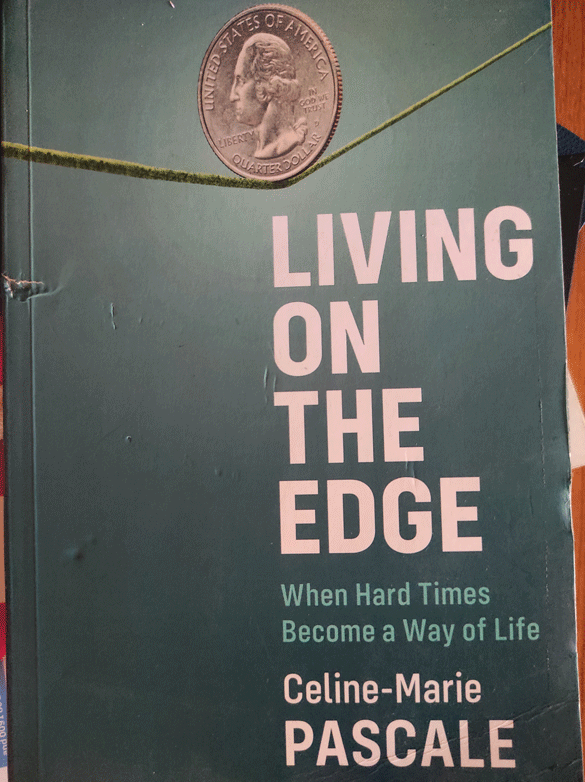
Living On the Edge: When Hard Times Become a Way of Life
Author: Celine-Marie Pascale
Publisher: Polity Press, Cambridge
Year of Publication: 2021
Pages 295
ISBN 9781509548231
The contemporary world is run by corporations. It is an invisible aspect of our lived reality, that very few can conceive and comprehend. Most of the wars, issues, trends and fashion that we witness in our world today, are shaped by these corporations. The deepening divide between the elites and masses, is an outcome of this crony capitalism encouraged by these corporations. The principles of freedom, democracy and equality is rendered as farce by the corporations. There is a growing body of literature about how the corporations control the world today, but only few seem to take a notice of it. The narrative that manufactures consent, leave little space for conceiving or developing an alternative world order, that is not controlled by corporations. The current title under review although is not engaging with the impact and influence of corporations, but as the author Celine-Marie Pascale, informs the reader about the book, in these words, “The book, then, isn’t just about particular people or places. It is about how business practices and government policies create, normalize, and entrench economic struggles for many in order to produce extreme wealth for a few. It is not just that wages are insufficient, housing is unaffordable, and health care often out of reach-it is that we have a system that cares more for wealth accumulation than for the well-being of its people, for the environment or even for the country itself. Living on the Edge looks at government policies and business practices that produce enormous profit for some people by keeping working people submerged in economic quicksand. Ultimately it is a book about power that has been leveraged by government and corporations at the expense of ordinary people.” (P-xi)
There certainly is a collusion between business world and government to maximize corporate profits at the expense of workers. Even before pandemic, poverty was galore and jobs were few, so many had to juggle between multiple jobs to make ends meet. Covid pandemic, added to the economic woes of the already struggling masses. Pascale, describes his tryst with poverty as a child and he uses the term “struggling class” and how they are fighting to stay afloat economically while making their ends meet, as they deal with underemployment and housing crisis. He also deplores the U.S delusion about boasting to have the best welfare oriented economic system in the world. “Despite the glaring inequality and the profound economic struggles of fully employed workers, people in the US tend to believe that we have the best economic system on earth-even if it isn’t working so well for them or for the people they know.” (P-16)”
The house rents are going up, and housing is becoming unaffordable. To have a child adds to the expenses and puts pressure on the struggling masses to earn more. However, the money is being made at the expense of the struggling masses. To meet their daily expenses, these struggling masses seek a recourse to Loans but their growing interest rates, keep them in a perpetual debt. They spend their whole lives on a hamster’s wheel. This vigorous wheel keeps them occupied, leaving them with little time and energy to enjoy life, thus the new generation of children are being raised without much care and love.
The concept of welfare state has taken a big hit due to corporatization and privatization, as state is fending off its duty for free and emergency healthcare. So, we witness medical loans too. This is the price one has to pay for being poor. The profits that the corporations garner are not without its ramifications, as pollution levels have drastically increased, that is impacting both the planet and life. Lead pollution and its levels among babies have gone up, particularly in areas where industries are operating. The façade that is churned before setting up an industry is that it will provide income to multiple households, but no one bothers about the levels of pollution it creates. Further, the industries wind up as soon as the operational costs are not profitable for them. The disasters that coal mining and thermal power plants create is evident for all. It is not all, but the struggling class faces a plethora of issues, including substance abuse and drug addiction. These addictions ruin lives.
Then there are activists or victims of the industrial pollution, who think that by suing them in courts of law, may earn them compensation or justice, but in reality courts also serve the interests of corporations not of poor, “It’s clear to see that elected officials and courts-even the Supreme Court- have served the interests of the mining industry over the interests of residents and the environment. The people who can least afford health care, and have the least access to it, are made to live in the most polluted environments.” (P-88)
The Struggling class exist mostly in violent areas, that is mired with gang and police violence, particularly against people of color. The world of struggling people works differently, with apartheid and prejudice being a norm. This racism is perpetuated even against the native aboriginal and indigenous Americans, as it is alleged that they are more involved in drugs. Sexual assaults, rapes, sex trafficking, exploitation, of native women is more. While all these issues galore, then in such a crisis, an exploiter appearing as a political messiah takes advantage. It is what happened in case of rise of Donald Trump.
Trump exploited this struggling class to come to power and then ultimately helped the rich, while deploring the struggling class with his racist and sexist remarks. He granted rebate to corporate taxes, while undermining and undercutting the public funding to heath, infrastructure, and education. His government like the previous regimes benefitted the rich by bailing them out while the poor continued to suffer. The rich continue to benefit while the poor linger to their sufferings, which covid pandemic exacerbated.
This book details how we exist in an unequal world, and there are very little efforts to do away with this marked contrast. This book certainly is a wake-up call to the factual realities we are surrounded with and it certainly is an eye opener for anyone with conscience and empathy.
…
M. H. A. Sikander is Writer-Activist based in Srinagar, Kashmir.
URL: https://newageislam.com/books-documents/living-on-edge-hard-times-become-way-life/d/139947
New Age Islam, Islam Online, Islamic Website, African Muslim News, Arab World News, South Asia News, Indian Muslim News, World Muslim News, Women in Islam, Islamic Feminism, Arab Women, Women In Arab, Islamophobia in America, Muslim Women in West, Islam Women and Feminism