
Hindutva: Fundamentals and Issues

By
Mushtaq Ul Haq Ahmad Sikander, New Age Islam
13 February
2021
Ideologies
are very important pillars that unite masses. Every age has witnessed the power
of ideologies be it in the form of religion, state, authority or idealism.
Religion has the potential to unite people for a higher and bigger cause as
well as make them a potent force for destruction. Religion offers a worldview
that helps its adherents work towards a common goal. This goal can be
inclusive, pluralistic and positive or exclusive, sectarian and negative
depending on the interpretation of the religion. Religion is a double edged
sword and when mixed with politics it mostly results in an unholy mix that
leads to chaos and destruction. It is true for most religions and in countries
where electoral democracy is based on first past the post system candidates and
parties desirous of registering a win mostly appeals to the electorate using a
religious dictum and jargon.
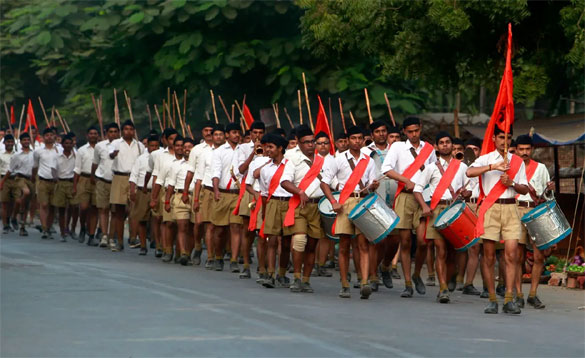
Hindutva:
Ahdaf O Masael (Hindutva: Fundamentals and Issues)
Author:
Maulana Abdul Hamid Noamani
Publisher:
Institute of Objective Studies, New Delhi, India
Pages:
300 Price: Rs 295
-------
Communalism
is a pestering problem in most countries of South Asia. India is no exception
to the communal problem and since the independence of India, communal riots
both large scale and small ones have been occurring. Many academic studies have
been conducted about the reasons of these communal riots offering different
insights regarding their reasons for occurrence and aftermath. It is rare that
a madrasa trained Islamic scholar and theologian is well versed about the
communal problem, understands the dominant and major religion of India i.e.
Hinduism so well. Maulana Abdul Hamid Noamani, is one such rare scholar.
Madrasas rarely do teach comparative religions as a part of their curriculum.
It is one of the biggest flaws that has resulted in skewed understanding of
Hinduism and even Semitic religions by the madrasa students. When one does not
understand the faith of fellow citizens of the country how come they will try
to reach out with the message of Islam (Dawah). It has given rise to
stereotypes and misconceptions about each other, even among the Ulama. Maulana
Noamani, however is an exception to this trend as through his own personal
efforts and hard work he has studied Hinduism, so is an expert to comment on
its different contours. Earlier too he has published few books on different
aspects of communalism, Hinduism and its contours. This new book is a
collection of his articles that deal with different aspects of political
Hinduism known as Hindutva.
Hindutva
aims for Ram Rajya but Noamani contests this concept of Ram Rajya as propounded
by the proponents of Hindutva, as it is antagonistic to what Mahatma Gandhi
defined as Ram Rajya. Ram Rajya is the era in which values like Justice,
Tolerance and Peace are prevalent all around. It is established in the basis of
nonviolence and not constructed on the hate for the other (read minorities).
But tolerance and inclusivity has become the new casualty in this new project
of Ram Rajya as the new conversion law is quite discriminatory against
minorities (P-24) despite the fact that Indian constitution recognizes the
freedom of religion as a fundamental right. Same is the case with Love Jihad,
which criminalizes love across faiths. It is a regressive law and should be
done away with, because marriage is a personal choice and young people should
have the choice to marry across religions. It is what secularism and freedom of
choice stand for. Similar is the case with Ghar Wapsi (Returning to old faith).
According to Ghar Wapsi every person who was born in India is by default Hindu
and minorities who exist in India as basically Hindus so now it is essential
for them to return to their original fold of Hinduism. It is keeping in view
this concept that the BJP regime opened borders for law of return to Hindu
minorities in different countries of South Asia.
The Ram
Rajya of Hindutva regime has few illustrious stalwarts particularly those who
have played a prominent role in the freedom struggle of India. So they are
trying to appropriate stalwarts and icons of Indian freedom struggle from
Mahatma Gandhi to B.R Ambedkar. It also includes Sardar Patel and Bhagat Singh.
Maulana Noamani questions this appropriation stating that this co-option is ill
founded as Bhagat Singh was atheist, Ambedkar was not a Hindu reformer instead
he was a liberator of Dalits. Also these stalwarts belonged to Indian National
Congress but it is certainly lamentable that currently Congress has failed to
project them as the real stalwarts of India.
Also
various stereotypes about minorities particularly Indian Muslims are being
propagated including the myth that Muslims and Christians belong to supra
territorial states, hence their loyalties are suspect. Anti-Islam literature is
being circulated that churns ill founded stories about the Prophet of Islam, Muslims
kings and their rule. Further the myth about increasing Muslim population
reducing Hindus to a minority in next few decades is something that is not
backed by any statistics. It is allegedly based on the permission for muslim
men to marry four women, that has been constructed in a manner as if all muslim
men have four wives and dozens of children. But rarely do Muslim men in India
or elsewhere have two wives not to boast about four. Same is the case with
violence. A miniscule minority and fringe elements among Muslims do indulge in
violence that too for variegated reasons but it again is being attributed to
Islam. In case of Muslim terrorists the question of religion/Islam becomes
central to the debate instead of the real factors.
The
question of secularism that has developed a different trajectory in India, is
always being used as a litmus test for Muslims, whereas in reality they
constitute just fifteen percent of the population. They are being always called
to defeat communalism and safeguard secularism that certainly needs a deep
probe. Is it a responsibility of Muslims only to safeguard the values of
constitution while the majority remains a mute spectator? To add insult to
injury there are few voices in the Hindutva regime that deny existence of any Muslim
minority in India. So given these attacks on Muslim minority it does not seem
quite distant when the drastic amendment of constitution may do away with the
very fundamental rights enshrined in it.
This book
raises very pertinent questions that we are facing on daily basis in our
polity, economy, society, education and future of religious freedom in India.
Maulana Noamani needs to be complimented for writing prolifically on different
aspects of challenges that we all are currently facing in India while divulging
finer details of these phenomena and offering dynamic solutions too.
-----
M.H.A.Sikander is Writer-Activist based in Srinagar, Kashmir .
URL: https://newageislam.com/books-documents/hindutva-fundamentals-issues/d/124297
New Age Islam, Islam Online, Islamic Website, African Muslim News, Arab World News, South Asia News, Indian Muslim News, World Muslim News, Women in Islam, Islamic Feminism, Arab Women, Women In Arab, Islamophobia in America, Muslim Women in West, Islam Women and Feminism