
Excellence of Na'at: Conditions and Standards ' A Valuable Introduction to the Tradition of Praise Poetry

By Mushtaq Ul Haq Ahmad Sikander
11 April 2026
A concise exploration of Na’at as a devotional literary tradition, its historical roots, and the standards that distinguish it from general poetry.
Main points
· It explains the religious and literary importance of Na’at as poetry in praise of Prophet Muhammad (pbuh), showing how it developed as a response to poetic criticism in early Islam.
· It highlights Dr. Aziz Ahsan’s contribution as an established Urdu poet and critic, and notes that this is his first English-language work on the subject.
· It discusses the difference between general poetry and Na’atia poetry, emphasizing that Na’at should be grounded in truth, reality, and devotional discipline rather than imagination alone.
· It traces the historical growth of the Na’at tradition from Arabic into Persian, Urdu, and English, mentioning important poets associated with each literary phase.
· It offers a balanced assessment, praising the book as a useful introductory text while also noting editorial weaknesses such as missing references, punctuation issues, and spelling mistakes.
…
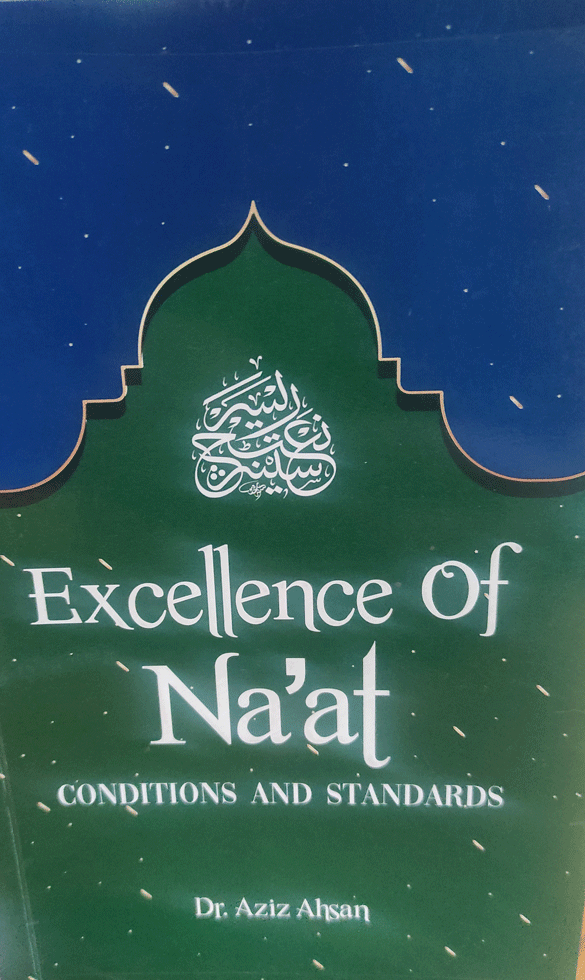
Excellence of Na’at: Conditions and Standards
Author: Dr Aziz Ahsan
Publisher: Naat Research Centre, Karachi, Pakistan
Year of Publication: 2021
Pages: 224
ISBN 9789698918705
The life of Prophet Muhammad (pbuh) is documented to its minutest details. It has happened because this life has to be exemplary till the judgement day, so it has to be presented before the masses with all its hues. The people who accepted Islam during the times of Prophet Muhammad (pbuh), loved and followed him in every aspect. They immaculated his every move and imitated his behaviour. They are known as the Companions of Prophet Muhammad (Suhaba).
Poetry was an important medium of instruction during the days of Prophet and before him. Arabs used to take pride in producing great poets among them. They always cherished, relished and patronized poetry as a form of expression. It is why Allah describes his last revelation Quran as not being poetry (Al Quran 36:69). The idolaters of Makkah and enemies of Prophet Muhammad (pbuh), used poetry to attack his personality, condemning, criticizing, and for hurting him immensely. These poetic attacks need to be rebutted in similar form; thus, few companions wrote poetry rebutting these condemnations and criticism while praising the qualities of Prophet (pbuh). This resulted in the tradition of writing encomiums (na’at) tradition in the Muslim world. In every major language of the world, Muslims have written encomiums in the praise of Prophet Muhammad (pbuh).
The author Dr Aziz Ahsan, is a well-established poet, reputed critic and expert writer who has penned down many books in Urdu. This book is an important addition by the author on this unique subject of encomium tradition in Urdu. It is an important feat as it is the first attempt by the author in English language, as his lingua franca is Urdu. In his foreword to this book, Dr Saleem Ullah Jundras, writes about poetry and expression of encomiums, “Poetry has been part of every culture, in rudimentary or excellent form. Poets and Poetry are very essential genres of expression. The expertise of a poet and standard of his poetry is judged from the fact, of expressing cumbersome realities lucidly in few rhyming lines. Writing “Excellence of Na’at: Conditions and Standards” by Dr Aziz Ahsan is a realization call, respectful request, cordial invitation and Na’at poetry manual for all Na’at poets of all languages and all regions that they should have due regards and careful consideration for acquiring the excellence standards in their Na’at versification.” (P-21)
This work of the author helps the English reading audience to understand the tradition of Na’atia poetry. It gives space to sentiments, feelings and emotions. The book helps us understand the concept of Na’at poetry. Poetry is quite broad and Na’at poetry is a specialized genre. There certainly is difference between General and Naatiya poetry. “Contrary to the general poetry, the Na’atia poetry needs to be based on facts and realities and not mere imagination, emotions, fantasies or feelings.” (P-60) There also is a genre of permissible and non-permissible poetry in Islam. The author has deliberated about it too.
The companions of Prophet Muhammad (pbuh), like Hassan bin Thaabit (RA) and others established the Na’at tradition in the Arabic language. Later, the tradition passed into Persian and Urdu languages. In the Arabic language, different aspects of Islam, Prophet’s migration and also the persecution of Prophet and his family are written. After Hassan bin Thabit (RA), there were lot of poets in Persian language like Maulana Jalaluddin Rumi, Maulana Jami and others who wrote encomiums. Then there are others like Hali, Allama Iqbal, Maulana Altaf Hussain Hali, Shibli Noamani, Ahmad Raza Khan Barelwi, Mohammad Akhtar Raza Khan Qadri, who wrote excellent Na’ats in Urdu, strengthening this tradition in Urdu. Similarly, the encomium (Na’at) tradition In English was encouraged and reinforced by Camilia Badr, Syed Ahmad Warsi, Wolfgang Goethe, Jamil Naqvi and others.
This book is a good introduction about the encomium tradition in Islam, particularly its development in the Indian subcontinent. It can be read as a preliminary text to understand the Na’at tradition among Muslims. However, the text is not without flaws because reference style has not been followed judiciously while quoting from books, year of publication and place of publication are missing, which demerits its academic standard. The missing punctuations at the proper places and the spelling mistakes also sour the taste of reading. A better proof reading and editing would have helped make the book better. Overall, the book makes a good read.
…
M.H.A. Sikander is Writer-Activist based in Srinagar, Kashmir.
URL: https://newageislam.com/books-documents/excellence-of-naat-conditions-standards-valuable-introduction-praise-poetry/d/139631
New Age Islam, Islam Online, Islamic Website, African Muslim News, Arab World News, South Asia News, Indian Muslim News, World Muslim News, Women in Islam, Islamic Feminism, Arab Women, Women In Arab, Islamophobia in America, Muslim Women in West, Islam Women and Feminism