
Documenting the Past - A Peep into the Contemporary History of Indian Muslims

By
Mushtaq ul Haq Ahmad Sikander, New Age Islam
12 October
2021
Lived
Experiences and Testimonies of the People Who Have Contributed In The Process
Of History Making Are Essential For Creating A Factual Analysis of Events
Main
Points:
1. Agha Ashraf
Ali has been an eye witness of the decisive moments of Indian and Kashmiri
history.
2. Agha laments
at the sad matter of affairs where the teachers have no love for books.
3. Agha
describes the agony of Maulana Abul Kalam Azad after the partition of
subcontinent.
-------
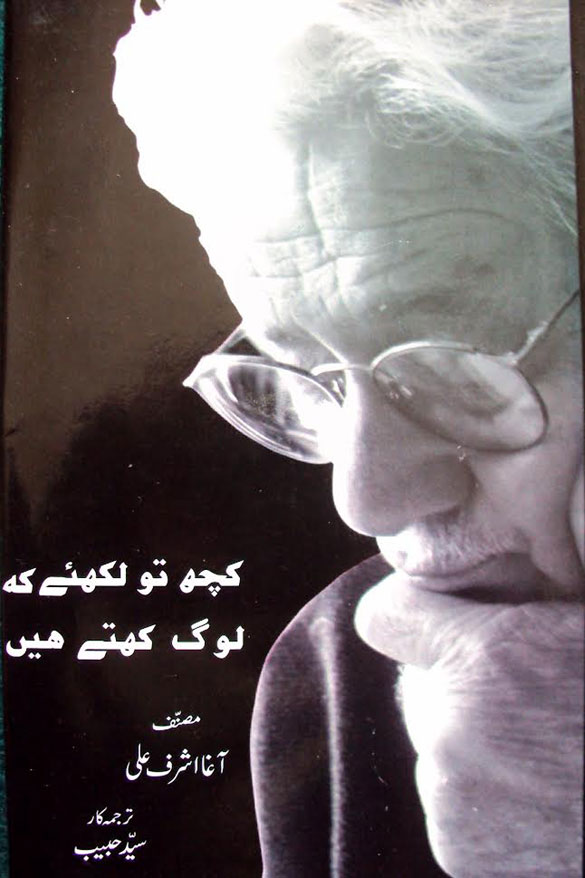
Kuch
Tou Likhyey Ki Loug Kehtey Hain (Write Something As People Are Demanding)
Author:
Agha Ashraf Ali
Transcribed
By: Syed Habib
Publisher:
Kashmir Times Publications, Jammu & Kashmir.
Year
of Publication: 2010
Pages:
341 Price: Rs 400
-----
History
writing is of two types; one as documented by historians and writers and the
other one as depicted in novels, short-stories and poetry, but the latter genre
is difficult to decipher but now this form is also accepted as a source to recreate
and envision history of a period. Certainly there is now another source of
history writing and that is oral history. People who have lived and contributed
in the process of history making, their lived experiences and testimonies are
essential for creating a factual analysis of events.
The people
who had a hand or contribution during the decisive moments of Kashmir history
are many, but only a few have opted to jot down their memoirs for the sake of
future generations. Autobiographical accounts of eminent personalities in this
manner are very essential. Agha Ashraf Ali on this account is a new entrant to
this genre, with his autobiographical account titled as Kuch Tou Likhyey Ki
Loug Kehtey Hain.
Agha Ashraf
Ali who has crossed his nineties, has been an eye witness of the decisive
moments of Indian and Kashmiri history, which the autobiography very well
elucidates. Agha Ashraf Ali is one of the profound scholar, intellectual and
educationist of the valley, whose lectures are revered for their depth, scholarly
content, spicy humor and wise anecdotes which inspire hundreds and are loved by
the students. Though Agha does not write himself, but loves to lecture, this
autobiographical account was also prepared in the similar manner, and his
obedient student and friend Syed Habib did the work of transcribing and editing
the same, and he has done the work quite lucidly without flaw, which is also a
testimony of this friendship spanning more than four decades.
This
autobiographical account spreads over hundreds of pages and Agha has tried to
pen down all the important events of his life minutely as he describes his
childhood as violent because his tutor thrashed him regularly, his brothers
were envious and in his classroom he was an untouchable. He also describes the
contrast between his paternal and maternal grandfathers, the former Westernized
and the latter upholder of Eastern norms and this dichotomy influenced the
tender mind of Agha.
Agha
describes his tryst with science but he fails in senior secondary standard and
has to choose Humanities instead. During those days he is influenced by the
legendary educationist and teacher Dr Zakir Hussain, some Pandit teachers and
even the politics of the subcontinent began to have its influence on Agha whom
students began to taunt as Nehruvian, hence a traitor.
He then
describes his journey to Aligarh Muslim University (AMU) and from there to
Jamia Millia Islamia(JMI). In AMU he spent two years under the guidance of
Prof. Muhammad Habib and in JMI he taught and learnt with Prof Habib’s younger
brother Prof Mujeeb, Zakir Hussain, Prof Sayideen and other luminaries and
scholars which further nurtured, refined and polished the talent of Agha and
gave a proper channelization and direction to his quest. Agha describes the
role events of 1947 as witnessed in JMI and the role of these academics and
leaders in the aftermath of partition, and the agony of Maulana Abul Kalam Azad
after the partition of subcontinent, as partition brought in its wake violence,
rage, killings, kidnappings, rape, abduction, loot and arson on an
unprecedented scale. Agha also describes the ramifications of partition on his
family as his own brother Agha Showkat who supported Muslim League and Jinnah,
was exiled to Pakistan. Agha with a heavy heart describes how the Communal
Ideology of V.D Savarkar came to have an upper hand in India and how Congress
party came to handle the affairs and how Maulana Abul Kalam Azad, Rafi Ahmad
Kidwai and Dr Zakir Hussain were neglected.
In Kashmir
too industrialization could not take place after accession, hence government or
civil services were chosen which proved as blighted sores and had permanent
impact on the society. Nepotism also took roots on epidemic levels in the
aftermath of 1953 removal of Sheikh Abdullah from the scene and when he again
came to hold the reins of power in 1975 he proved ineffective to reverse the
process and distrust in the government got reinforced.
The
movement for the right to self-determination once gain initiated in the
aftermath of 1953 and Kashmiri Muslims were hurt by the fact that Pandits were
happy being Indians, and Pandits also resented Muslims because the agricultural
land was snatched from them and disturbed among the landless labourers, a
revolutionary act by National Conference and this resentment between the two
communities was well cashed by the Centre. The Pandits also created many
problems for Agha at his workplace and even raised false charges of bribery
against him.
Agha then went
on a Fulbright scholarship to America and had a chance to travel various
countries of Europe. He visited France, Switzerland, Denmark, Sweden etc and
studied their educational systems and came back to Kashmir to implement the
radical changes and he dreamt to do great things in Kashmir but couldn’t as
people were not ready and environment hostile towards any change in status quo,
hence his dream was shattered by the realities at the grassroot levels. Agha
describes how “educational system was completely under the influence of
politics. The autonomy of University and other educational institutions was
lost due to politics. The recruitment of teachers was also done on basis of
political rapport” (P-141).
Despite the
heart rendering helplessness Agha describes his biggest achievement as his
rapport with young intelligent students who still accompany him at this stage
of life, which nepotism or favouritism can hardly impede or hamper.
In a
separate chapter on “Friends and Students” he describes his own relationship
with teachers turning into friendship like Prof Mujeeb, Habib and Dr Zakir
Hussain, and Agha also is a living testimony of the same legendary practice of
these noble souls, though in this chapter he also praises the separatist leader
and Chairman Jammu & Kashmir Liberation Front(JKLF), Yasin Malik, but the
praises about Yasin’s personality seem to be exaggerated and Agha seems to lose
his sense of academic fervour and objectivity on this account.
Agha
laments at the sad matter of affairs where the teachers have no love for books,
hence never inspire their students to read good books and decries the
privatization and commercialization of education system, where the teachers are
driven by the craze of minting more money instead of imparting and disseminating
knowledge.
Agha has a
chapter dedicated to his stance on religion, similar to what Khushwant Singh
has in his autobiography Truth, Love and little malice titled as “Wrestling
with God” but the contrast is that Khushwant Singh is an agnostic but Agha a
believer and praises the teachings of Islam as Universal but is critical of the
communalized, exclusivist, violent interpretation and depiction of Islam.
None can
dare to deny the ill effects of Corporate Culture which accompanied
Globalization and the Neo Imperialistic designs of the world powers but to
witness and color everything in economic terms seems not to be a correct
strategy, stains and traits of Marxism can be ascertained in the analysis of
Agha when he describes the economy as a decisive factor in the armed struggle
of Kashmir or describes the communalism, “religious extremism as fundamentally
an economic issue” (P-319). The cultural aggressiveness and secular fascism can
too be witnessed when common civil code is tried to be imposed on Muslim women
in the form of Niqab ban, Burqa ban or beard ban on men.
The last
chapter depicts Agha as a feminist who wants women to excel in every field and
surmises that economic freedom would make women independent, but in many cases
economic freedom is no guarantee to women empowerment as husbands or in laws
snatch the income of the woman and she is rendered to a money making machine,
with only duties to fulfil. Agha also decries that misogynists must read Ibn
Arabi whose views about women are mostly side-lined by the religious clergy.
The book is
destined to inspire readers and will escalate their thirst for reading books,
as Agha on every page quotes from a scholar, philosopher, prophet, poet, writer
or thinker. This book must be high on the reading list of every teacher and
student, for teachers to learn how to be good teachers and develop among their
students a love for books and knowledge and for students how to strike a cord
with their teachers to learn and build an everlasting relationship. The wide ranging
knowledge and experience of Agha with great luminaries of education makes it an
autobiography of a universal appeal.
We must
congratulate Agha for sharing his experiences with us and this autobiography is
an important contribution to the history of subcontinent too. The book needs to
be translated into English for a wider dissemination.
-----
Mushtaq
Ul Haq Ahmad Sikander is Writer-Activist based in Srinagar, Kashmir.
URL: https://www.newageislam.com/books-documents/history-indian-muslims-contemporary/d/125559
New Age Islam, Islam Online, Islamic Website, African Muslim News, Arab World News, South Asia News, Indian Muslim News, World Muslim News, Women in Islam, Islamic Feminism, Arab Women, Women In Arab, Islamophobia in America, Muslim Women in West, Islam Women and Feminism