
Bhagvad Gita's Financial Lessons

By Mushtaq Ul Haq Ahmad Sikander, New Age Islam
23 June 2026
A reflective review of The Investment Gita that links financial discipline with ethical living and Gita-inspired wisdom.
Main Points:
· The book argues that investing should be guided by patience, purpose, and self-control rather than quick-profit thinking.
· It links financial literacy to wider social needs, especially school education and women’s participation in financial decision-making.
· It warns readers against consumerism, EMIs, Ponzi schemes, and exaggerated claims by “finfluencers.”
· It discusses major investment themes such as equity, debt, real estate, gold, crypto, private equity, and venture capital.
· It concludes that money decisions are also moral decisions, and that empathy, humility, and discipline are central to sound investing.
…
The Investment Gita: Timeless Wisdom For Financial Success
Author: Vikram Singh
Publisher: Srishti Publishers & Distributors, New Delhi, India
Year of Publication: 2025
Pages: 119
Price: Rs 350
ISBN: 9789364112352
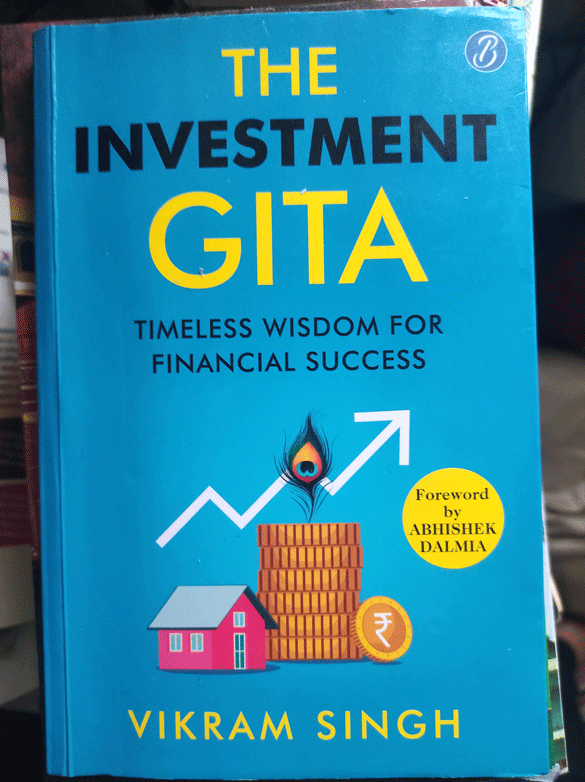
The Investment Gita: Timeless Wisdom For Financial Success by Vikram Singh, is a slim paperback using lesson from Gita for financial wisdom. In his Foreword, Abhishek Dalmia writes, “This book does more than just tell you about these stories-it distils them into actionable principles that beginners and seasoned investors can use with ease. The tenets shared here will illuminate the path toward effective management, rooted in purpose and empathy.” (P-viii) This statement sets the book’s practical tone: it is not merely a collection of stories but a distillation of principles meant for real use. In his Preface, the author Vikram Singh mentions, “This book is an attempt to apply the lessons from the holy scripture in the field of investing. It is an effort to explore the practical usage of the teachings in the investment domain, and if understanding a shloka can make one an informed investor and a good human being.” (P-xxii) This core claim anchors the entire work: investing is framed not only as a technical act but as a moral and psychological discipline shaped by the Gita’s wisdom.
The book opens with broad reflections on education, jobs, and money, arguing that education and money cannot bring an extra day of life, and that dropping out and success have nothing to do with formal education. It suggests that the new generation is venturing out with new ideas and that no job is taboo for them, while also criticizing how education may be depriving us of innovation. From these observations, Singh moves to the necessity of including financial education in the school curriculum and insists that women need to be involved in financial decisions. These points expand the book’s scope beyond individual portfolio choices into household agency and generational learning, giving it a social dimension that many investment books lack.
Singh’s central financial argument is that one should take action and not think about the results, a principle drawn from the Gita and adapted to market behaviour. He treats the stock market as a game of patience, especially when the market crashes and portfolios are wiped out, and emphasizes setting a goal and then achieving it. The book warns against half-baked approaches in life, which will leave us stranded, and notes that the poor and middle class, for whom he uses the term bourgeois, have not understood the importance of wealth building. Equity business is not a lottery; consumerism and living on EMIs are habits that weaken financial discipline. The text contrasts real estate versus equity, insists that the choices we make determine the outcome, and explains bull and bear trends in accessible language.
The book distinguishes between debt and equity investors, observing that debt investors are clearer than equity investors about the goal of their investment. It touches on private equity and venture capital and asks who invests in them, without glorifying losses, since those investing do not like to talk about them. It also notes Indians’ obsession with gold and real estate and links this to a deeper fear of failure that holds people back from many things. In a key passage on uncertainty, Singh writes: “The stock market will always have some amount of uncertainty. For an investor to assume that an equity mutual fund will keep on beating the benchmark just because it has been doing so for years is a wrong presumption.” (P-75) This is one of the book’s most grounded and important observations, challenging the false belief that past performance guarantees future results.
The book warns readers about Ponzi schemes and cautions them not to fall for them, emphasizing that not every asset is for everyone. It treats cryptocurrency as a new investment while also noting hackers and other issues surrounding it. One critical limitation of the book is that if financial terms like ETF, PF, NPS, and others were explained, the book could be more holistic and better for the reader. This absence of clear definitions sometimes leaves the general reader guessing, especially if they are unfamiliar with basic instruments. Yet the book’s anti-hype stance is strong and timely. Singh writes: “If someone is making millions and wants you also to replicate their success stories, then either that person is lying about his capabilities or does not belong to this planet. Such glib talkers lay a trap for innocent first-time investors by sharing fake performance sheets of their portfolios. The investors should be cautious of such influencers making tall claims.” (P-91-92) This passage is one of the book’s sharpest, directly addressing the danger of inflated claims and fake performance sheets in the age of social media finance.
The book also urges readers to stop being judgmental, to practice philanthropy and empathy, and to spread happiness. These moral instructions are not mere add-ons but are woven into Singh’s broader argument that financial success should not be separated from ethical self-awareness. The Gita’s emphasis on detachment is treated not as a rejection of ambition but as a discipline of temperament that prevents fear and greed from distorting judgment. This approach is particularly useful for readers who are emotionally overinvested in every market movement, as it reminds them that patience and process discipline matter more than chasing quick gains.
However, the book is not without limitations. Its scope is compressed for the number of ideas it wants to handle. At 119 pages, it moves quickly through education, equity, real estate, gold, private equity, venture capital, crypto, consumerism, and philanthropy without always pausing to develop them fully. This makes the book stimulating but sometimes more suggestive than substantial. The moral framing occasionally becomes repetitive. Ideas such as act, be patient, avoid greed, set goals, avoid fear, stop judging, and practice empathy recur in ways that can feel more inspirational than argumentative. A stronger structure would have helped distinguish between philosophical principles and practical investment instruction. As it stands, readers looking for detailed guidance on instruments, risk models, portfolio construction, tax implications, or asset allocation may find the coverage too brief.
There is also a conceptual tension between the book’s spiritual language and its financial address. The Gita framework provides elegance and depth, but at times it can flatten the complexity of modern investing into moral slogans. The book would have benefited from clearer definitions of terms such as ETF, PF, NPS, crypto, and venture capital, especially for beginners, because such explanation would have made the text more holistic and reader-friendly. In other words, the book has philosophical ambition, but its pedagogical method could have been more inclusive and systematic.
Despite these limitations, the book deserves credit for broadening the idea of financial literacy beyond stock picks and portfolio ratios. Its insistence on including financial education in school curriculum and on involving women in financial decision-making gives the work a social dimension that many investment books ignore. These points connect money management to household agency, generational learning, and long-term empowerment rather than individual profit alone. In that sense, the book is not just about markets; it is about culture. Its anti-hype stance is another strength, and its treatment of detachment works well when read as a discipline of temperament rather than as a rejection of ambition.
Stylistically, the book is direct, accessible, and written for general readers rather than specialists. That accessibility is one of its advantages: it does not intimidate the novice and instead invites reflection on everyday money habits, market psychology, and long-term planning. The tone is motivational, often conversational, and clearly designed to make financial literacy feel morally meaningful rather than dry or technical. Still, the book’s best audience is likely readers who value ideas more than formulas. Students, early-career investors, educators, and general readers interested in ethics and finance will find the most value here. More experienced investors may appreciate its reminders about patience and emotional discipline, but they may also wish for a deeper treatment of strategy and risk. That said, the book’s purpose seems less to replace serious financial education than to prepare the mind and character that such education requires.
The Investment Gita is a thoughtful, earnest, and often relevant book that succeeds most when it treats investing as an ethical practice shaped by patience, humility, and responsibility. It is not a comprehensive finance guide, and it is not trying to be one. Its real value lies in reminding readers that money decisions are also moral decisions, and that financial growth without self-control and empathy is incomplete. Critically, the book is admirable in intention and frequently insightful in tone, but it would have been stronger with more analytical depth, clearer financial explanation, and less repetition. Even so, it is a worthy contribution to the growing genre of value-based personal finance writing, and it deserves attention for the seriousness of its purpose. In a field often crowded with noise, this book asks readers to become not only smarter investors but better human beings.
…
M. H. A. Sikander is Writer-Activist based in Srinagar, Kashmir.
URL: https://newageislam.com/books-documents/bhagvad-gita-financial-lessons-/d/140504
New Age Islam, Islam Online, Islamic Website, African Muslim News, Arab World News, South Asia News, Indian Muslim News, World Muslim News, Women in Islam, Islamic Feminism, Arab Women, Women In Arab, Islamophobia in America, Muslim Women in West, Islam Women and Feminism