
It’s Not About the Burqa: Muslim Women on Faith, Feminism, Sexuality and Race
By Mushtaq Ul Haq Ahmad Sikander, New Age Islam
12 May 2026
Muslim women reclaiming voice
Main Points:
· It argues that Muslim women are often reduced to stereotypes, while the book explores their diversity, agency, and lived experience.
· It highlights how the essays challenge patriarchy, misogyny, and Islamophobia through personal reflection, memoir, and analysis.
· It notes the struggles of Muslim women in diaspora, including issues of identity, single parenthood, racism, and being misrepresented by media or political voices.
· It also discusses sensitive themes such as hijab, sexuality, marriage choice, divorce, mental health, and the pressure to remain silent.
· Finally, it presents the book as an important and necessary contribution that should be read and discussed widely across communities.
…
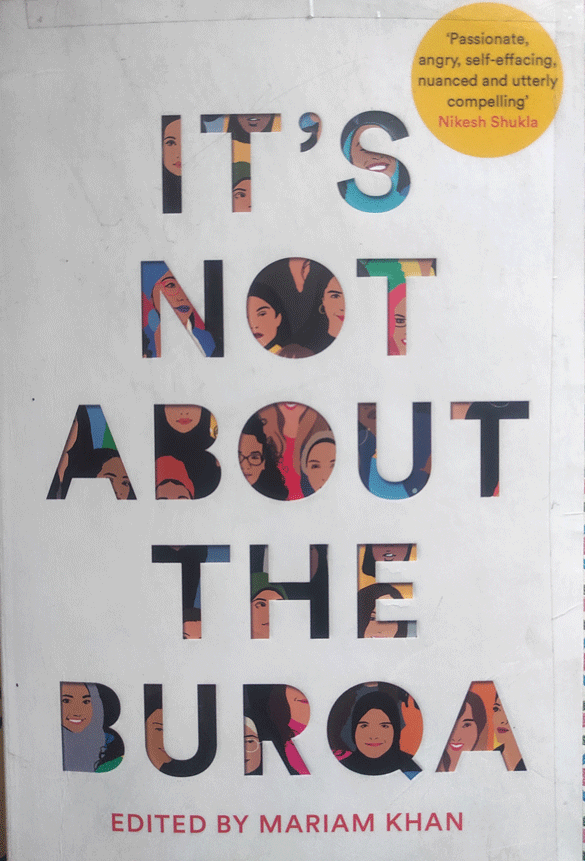
It’s Not About the Burqa: Muslim Women on Faith, Feminism, Sexuality and Race
Edited by Mariam Khan
Publisher: Picador, London
Year of Publication: 2020
Pages 242
ISBN 9781509886425
Muslim women as a category have been stereotyped since centuries. Misogyny, patriarchy and sexism in the muslim societies has further reinforced the stereotypical image of muslim women. The patriarchal interpretation of religion (read Islam) has further disempowered the muslim women, pushing them to the margins. The contribution of muslim women to different dimensions of Islam and muslim society has remained oblivious, even among muslims. The agency of women is yet to be realized and is still being represented by men only. To add insult to injury, Muslim women are being presented as a monolith in the media. The reality however is that Muslim women are not some well-defined, homogenous category but a diversified and variegated one. Muslims have been observed through an Oriental lens, whereas for Occident very few muslims in Europe are worthy of academic deliberations. However, now the indigenous muslims are snatching back their agency of representation and speaking up for themselves.
The current book as the title suggests is a manifestation of Muslim women, particularly those based in Western milieu, writing about variegated themes combining the genres of memoirs, personal essays, reflections, analysis, journalistic reporting and biographical discourses to deliberate about numerous themes. This collection is edited by a brilliant freelance writer, Mariam Khan, who in her Introduction very well observes, “Every essay in this book is unfinished, because each one is the beginning of a very necessary conversation……We are not asking for permission any more. We are taking up space. We’ve listened to a lot of people talking about who Muslim women are without actually hearing Muslim women. So now, we are speaking. And now, it’s your turn to listen.” (P-2)
This book is all about radical listening because now muslim women are taking up the role of public intellectuals. So we find a severe condemnation of patriarchy, misogyny and Islamophobia in these essays. This is the minority that is speaking up and revolution in making. History is a witness that revolution has always been initiated by a minority, who take on the role of ideologues and then revolution is manifested and realized through them only. This book is an early indication of revolution that is brewing among Muslim women.
Mona Eltahawy in her essay writes, “In my work, I make it clear that I will never ally myself with the racist Islamophobes against my community, and I let my community know that I will never shut up about its misogyny.” (P-8) So here is a muslim woman who is taking cudgels both against inter and intra misogynist elements present in the society.
Coco Khan, in his essay writes how her mother struggled in raising her as a single parent while being pregnant with her lover’s child. She describes the crude looks and taunts that her mother had to go through for being immodest and promiscuous. But Khan defends her as she writes “Modesty is an instrument of patriarchy, designed to limit women’s agency and keep them in line.” (P-19)
Most of the women contributors of this collection are raised by single parents, or who were divorced and they are a witness to the problems that encompass single mothers in Asian-British communities. They are struggling with these realities as a Diaspora. Being a member of Diaspora is not an easy task, as they naturally are a part of minority. So notions and values like freedom of speech have a different meaning for them. If they try to cross the line as defined by the original inheritors they are bound to be deported and their loyalty towards the nation questioned.
Then there are muslims who act as representatives of muslims and being part of corporate media, feminism and capitalism try to tone down the Islamophobia and racism prevalent in England and other countries. Even if few muslims make their space in political parties, they certainly cannot represent all muslims and cannot condone structural racism and Islamophobia.
A number of issues that muslim women face are discussed in these essays, citing the personal experiences about what it means to be a muslim woman and how they are discriminated in offices. There is also a lack of education about mental health among muslims and it is still considered a taboo to discuss the same. In most cases muslims are not supposed to have any mental health issues and denial of the same, leads it to be attributed to some evil influence or djinn and solution is sought out by offering extra prayers.
Muslim women of colour have to face prejudice from white feminists, so feminism certainly is not of great help. Also there is a huge struggle documented of women who wear Hijab or identify as queer. Also Hijab and Niqab have turned up as a commercial enterprise, where consumers are supposed to adorn them. There is a muslim woman journalist who writes about her experiences as a British muslim woman and receives threats for her writing activism. However the problems get compounded when the issues, problems and concerns engulfing the muslims are highlighted by some muslim woman, but the same is exploited by Islamophobes, reinforcing the stereotypes about muslims particularly muslim women.
One of the interesting theme that is deliberated in these essays is about women’s sexuality and the right to choose her marriage/life partner. Muslim women choosing their own partners or expressing desire about liking someone is frowned upon in South Asian culture, so is the right of divorce. Sex and pleasure are too hot to be handled, women are not supposed to talk about it, suppressing them is considered moral. Thus the voices of women are listened rarely. Also most of them are quite unaware about the need of registering a marriage in U.K because unregistered marriages have dire consequences in case of dispute, separation or divorce.
Muslim women have now devised many mechanisms to overcome these obstacles. Religion remains one of the important cornerstones that helps inspire and encourage them to voice out their concerns and stand up for their rights. Hence they take inspiration from women of different backgrounds, particularly the wife of Prophet Muhammad (pbuh), Hazrat Khadija (ra), who struggled alongwith Prophet. There are also a number of alternate media, which are run by women, who voice out their issues and concerns. As women are listened quite rarely, these platforms offer them spaces to document their stories. This book is a welcome addition to the indigenous writings of muslim women, and needs to be read and debated across the communities.
…
M. H. A. Sikander is Writer-Activist based in Srinagar, Kashmir.
New Age Islam, Islam Online, Islamic Website, African Muslim News, Arab World News, South Asia News, Indian Muslim News, World Muslim News, Women in Islam, Islamic Feminism, Arab Women, Women In Arab, Islamophobia in America, Muslim Women in West, Islam Women and Feminism