
Islamophobia And Radicalization: A Vicious Cycle

By Mushtaq Ul Haq Ahmad Sikander, New Age Islam
11 May 2026
A Critical Review of Tahir Abbas’s Analysis of Islamophobia and Radicalization in Britain.
Main Points:
· It explains how Islamophobia intensified after the Gulf War, 9/11, and the War on Terror, creating a cycle that also encouraged radicalization among some Muslim youth.
· It highlights Tahir Abbas’s use of Britain as a case study to show how media bias, racism, and state narratives shape the public image of Muslims.
· It discusses the idea that Muslims are often forced to choose between being British and being Muslim, while structural problems such as discrimination, housing, education, and employment are ignored.
· It notes the book’s argument that de-radicalization policies often target Muslims without properly understanding the social and political causes of radicalization.
· It also presents the critical response, including disagreement with Abbas’s treatment of Islamism and Maulana Abul Ala Mawdudi.
Islamophobia And Radicalization: A Vicious Cycle
Author: Tahir Abbas
Publisher: C Hurst & Co. Publishers Ltd, London
Year of Publication: 2019
Pages 246
ISBN 9781787382015
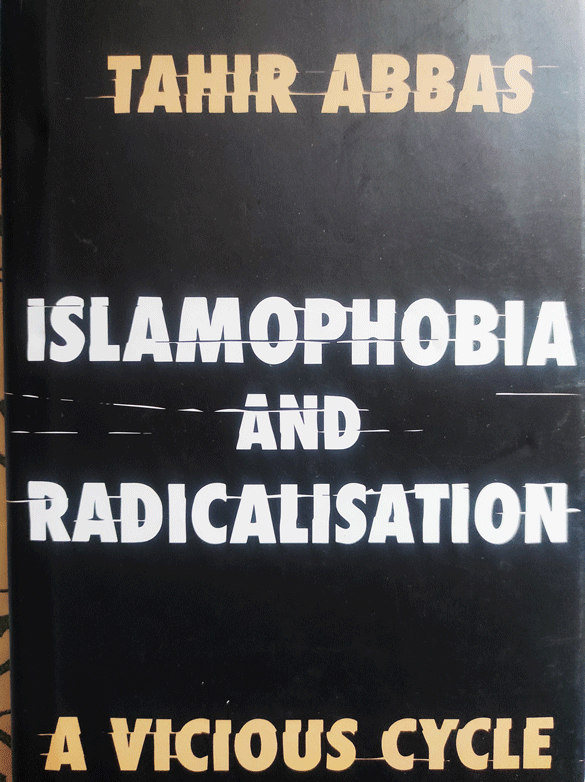
Islamophobia has been prevalent since the advent of Islam. Crusades further perpetuated and reinforced it. The events like Gulf War and 9/11 revitalized it and granted it a new life. The events of 9/11 and the War on Terror initiated by U.S in its aftermath created a vicious cycle of Islamophobia in West and Radicalization among muslim youth. These two have been feeding on each other. Very few studies have been conducted to understand these phenomena and the current book under review by a versatile academic and public scholar Tahir Abbas, certainly fills the void. The dearth of academic study to understand the phenomenon of Islamophobia and its outcome of radicalization has very well been dealt by Abbas taking into account Britain as a case study.
The book starts as a memoir, as Abbas informs the reader while tracing his roots to partition of Indian subcontinent and birth of Kashmir dispute. Then he deliberates about the impact of 9/11 on Muslim countries like Afghanistan, Iraq and British Muslims. He traces the journey of resentment among the new generation of British muslims, particularly those whose parents and grandparents are migrants from South Asia. Then the terrorist attacks of July 7, 2005 bombings known as 7/7 attacks further marginalized and stereotyped British migrant muslims, although the new generation of Muslims are born, bred, raised and living in Britain. However, they are experiencing a new racism being perpetuated against them. This new racism is a result of immigration and it apparently poses challenges to their culture. Abbas analyses the inexorable link between capitalism, racism and religion. This racism is a socially learned process and to detoxify it and become anti- racist one must unlearn it. But this racial anti Semitism is essential in maintaining the workings of capitalism. So Abbas, explains the dilemma as, “The future of British Muslims is precarious because dominant discourses wrongly force them to choose between being British or being Muslim-as if some deep incompatibility exists between the two.” (P-xxviii)
This incompatibility is constructed, compounded and reinforced through various means including media, religion, racism and economy. The coverage by media of far right crimes is little as compared to the incidents in which muslims are a part, so it directly speaks volumes about the prevalent bias and prejudice. The existing environment and social movements are not scrutinized that psychologically and politically motivate men to carry out violence against others. (P-24)
Conflict is depicted to be inherent only in Islam, not to the west. So the muslims are coerced to integrate and be open to multiculturalism. Media is helping reinforce Islamophobia. Misguided Muslim reaction against the blasphemous cartoons of Prophet Muhammad (pbuh), is helping create more problems and fuelling right wing bigots that are polarizing things further. Islamophobia is becoming the new Racism.
This perpetual Islamophobia has given rise to De Radicalization industry. Muslim youth are supposed to be radicalized. Without understanding the causes of radicalization of a minuscule minority among muslims, a whole industry is being put in power to de radicalize them. The reality however is that due to Islamophobia, failure to integrate in the society as a result of discrimination, racism, some Muslims of Europe were driven to join the terrorist group ISIS. Muslims as a whole are not trusted, but only those muslim groups are offered credibility by the state if they support the dominant counter narratives produced by the official counter extremist policy think tanks.” (P-78) So there is very little space for dissident muslims, whose policies and narratives are antagonistic to those churned by the State supported think tanks. So this explains the dilemma, that muslims are encountering. They too want to fight terrorism, but their explanation and reasons for it are different, so they enjoy no credibility in the eyes of the State. So this type of exclusivism also breeds and fuels radicalization. Small groups among muslims may resort to violence but they are featured and highlighted the most, while failing to understand the reasons, how due to globalization and other allied issues they are made to feel and being left out.
Abbas time and again shares the example of British Muslims, to make us understand the problems encountering them. He believes that Islamism or political Islam in Britain is a result of migration of South Asian muslims. Also, Islamism too is not a monolith, but it has variegated trends and evolved over a period of time. Islamism is fine as a political project, but then it becomes problematic once, it intends to use violence to achieve political goals. It starts from Takfirism, describing Muslims that do not believe in its creed as apostates. Abbas wrongly accuses the primary ideologue of Islamism, Maulana Abul Ala Mawdudi of Takfirism (P-80). He clubs him with Syed Qutb, Ibn Taymiyyah and others. But it is complete misreading and misinterpretation of Mawdudi. He never indulged in Takfirism and even abhorred the use of any underground, guerilla or violent means to achieve the political objective of creation of an Islamic State.
Abbas, very well explains how the media tries to remain oblivious or selectively highlights the far-right terrorism, describing it as Lone wolf attack, psychologically disturbed attacker or who is mentally distressed suffering from some ailment. But when it comes to a Muslim attacker or terrorist emphasis is laid on Islam, radicalization and role of religion, thus depicting the bias and selective amnesia of media (P-103). It is true that through online mediums radicalization is being reinforced, but demonization of muslims too is deeply embedded in structures and society. The radical groups also share certain characteristics like opposition to gender justice, glorification of violence and controlling people through exploitation of religion. These facts are never highlighted in mainstream media.
There have been various steps taken by the governments to integrate the muslims and one among them is teaching them English. But the problems muslims face on daily basis are variegated that include housing, education, employment, social mobility and prejudice. These all problems do help in giving birth to radicalization in a miniscule minority among muslims. So Abbas, offers a solution too to counter radicalization, “If policymakers are serious about eliminating radicalization, should the primary focus not be the structural and cultural issues that drive vulnerable people who have no recourse but to kill themselves in order to realize themselves?” (P-171) So unless these structural and cultural issues are not analysed and understood well, the issue of radicalization is not going to wither away.
This book is a very timely work, that is a must read for anyone who is interested in understanding the phenomenon of radicalization and Islamophobia that is prevalent in the European societies. Tahir Abbas needs to be congratulated for this important feat.
…
M. H. A. Sikander is Writer-Activist based in Srinagar, Kashmir.
URL: https://newageislam.com/books-documents/islamophobia-and-radicalization-vicious-cycle/d/139981
New Age Islam, Islam Online, Islamic Website, African Muslim News, Arab World News, South Asia News, Indian Muslim News, World Muslim News, Women in Islam, Islamic Feminism, Arab Women, Women In Arab, Islamophobia in America, Muslim Women in West, Islam Women and Feminism