
A Book Tracing the Career of Muslim Personal Law and Its Custodian the All-India Muslim Personal Law Board

By Arshad Alam, New Age Islam
16 July 2026
Key Points:
· The book, probably one of the first, traces the career of Muslim Personal Law and its custodian the All-India Muslim Personal Law Board
· The Board was founded in the context of alleged threats to the cultural and religious rights Indian Muslims
· While the AIMPLB mobilized scores of Muslims around the issue of protection of Shariat, the progressives within Muslims remained a marginal voice
· Blaming Orientalism and colonialism does not solve the problem; the author should have been more forthright in his critique of the conservative stance which the AIMPLB has been taking throughout the years.
…
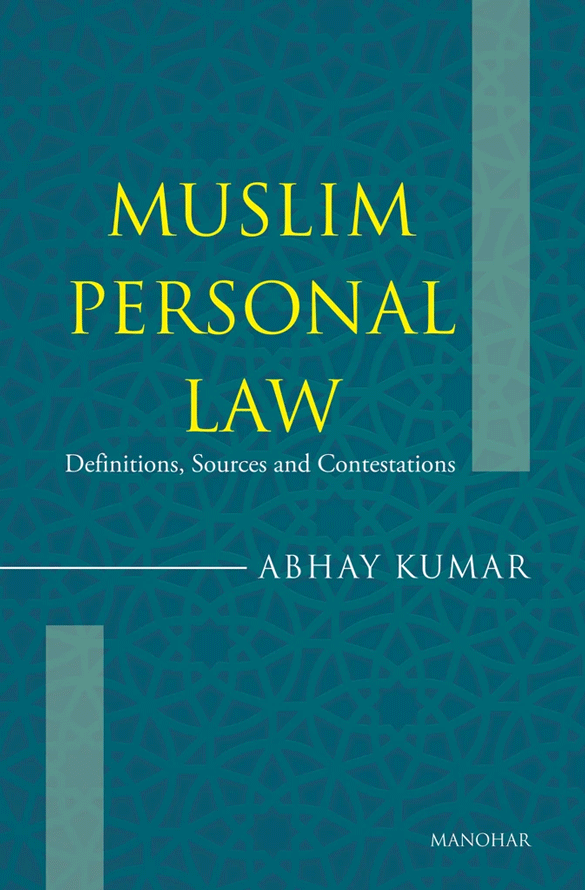
Muslim Personal Law: Definitions, Sources and Contestations
By Abhay Kumar (2026)
Manohar Publications, New Delhi
243 pages
Price: 1395 INR [Hardbound]
ISBN: 978-93-6080-651-4
Scholarly writings on Indian Muslims and their institutions are still few. Any new publication is therefore a welcome addition to the meagre corpus of writings on Indian Muslims. The book under review, on Muslim Personal Law, offers fresh perspective on how to understand the evolution and exercise of this contentious law as well as how to understand the politics of its custodian, the All-India Muslim Personal Law Board.
Chapter 1 traces the origins of Muslim Personal Law (MPL) in the context of the colonialism and the colonial state’s desire to bring uniformity in law. Chapter 2 tells us the story of the formation of the All-India Musim Personal Law Board (AIMPLB). Chapter 3 traces the controversy around the Shah Bano and the more recent triple talaq issues. Chapter 4 takes issue with the claims of the of AIMPLB whether it works for the betterment of the community. Chapter 5 is a theoretical chapter in which the author argues that the Hindu right is influenced by the writings of what he calls Orientalist thinkers like Max Weber and Bernard Lewis.
The codification and the custodian
The author argues that varied customs and traditions which were part of Indian law making during the pre-colonial times were brushed away, codified and thus made rigid under what came to be known as the MPL. The Muslim law in India is therefore not divine or sacred but owes its origins to the British judges’ desire to impose uniformity. It is also the product of the variegated interpretations of British colonial legal system regarding the Muslim law. It is interesting that the Ulama, as a class, supported British efforts by campaigning for the codification of personal law as they claimed that some Muslim communities were following Hindu law in violation of the Shariat. It is to be noted that the Mappilas in Kerala and some Muslim communities in parts of the Punjab followed the Hindu/customary laws since many centuries, which was now to be obliterated by the colonial state, ably supported by the Ulama.
The custodian of the Muslim Personal Law, the AIMPLB, was established in Mumbai in 1972 because, as the author argues, the ‘cultural and the material rights of Muslims were being threatened’. The author gives the context of debate over the Adoption Bill which ‘threatened’ the cultural rights of Muslims. Eventually the Bill was put in cold storage. The author also argues that Congress leaders of the time were speaking in separate registers: while the central leadership kept assuring Muslims that their cultural and religious rights would not be trampled with, the state and local leadership kept making divergent comments about the need to adopt Uniform Civil Code, which made the Muslim community nervous.
Opposition from within
It is not that there was no Muslim opposition to the newly formed AIMPLB. Hamid Dalwai, the ace reformist warned against such a tendency amongst Muslims to live in a cocoon of their own making and argued that Muslims should embrace modernity and secularism. Dalwai and his ilk argued that Muslims should at least debate the tenets of UCC rather than junking it wholesale. It is true that at times he went overboard in his exhortations but that was understandable when the AIMPLB was vociferously and falsely arguing for a ‘divine’ origin of the Muslim Personal Law. By terming it divine, it foreclosed any possibility of change within it while many Muslim countries, including Pakistan and Bangladesh had already made progressive changes in their personal laws.
The author tells us how the AIMPLB mobilized lakhs of Muslims from across the country to protest against the Shah Bano judgment by terming it an interference in the divine law of Muslims. Especially noteworthy is the author’s painstaking work in demonstrating how the AIMPLB mobilized Muslim women for the protection of what they called Shariat. Again, it must be reiterated that there was opposition from within the Muslim community against this move by the Board. Progressive politicians like Arif Muhammad Khan and the eminent lawyer Daniel Latifi supported the judgment of the Supreme Court. The author also spends considerable time in telling us how clerics like Ali Mian Nadvi convinced Rajiv Gandhi to bring a bill in Parliament which would nullify the Supreme Court judgment. It would have been better though, had the author excavated a bit further. What transpired between Ali Mian Nadvi and the then prime minister Rajiv Gandhi was that the locks of Barbri Mosque would be opened in lieu of passing the Protection of Muslim Women Act in 1986. The rest, as they say, is history.
The author also interrogates the claims of the AIMPLB to be a representative body of Indian Muslims. The Board has its critics, both from within the community and outside it. Reformists and the Ulama have both criticized it: the former for its conservative stand on issues of social reform and the latter because of its sectarian outlook as it is heavily staffed by Deobandis. Despite claims to be inclusive, all the presidents of the Board have been Deobandis. The Hindu right has consistently demanded the abrogation of Muslim personal law and the imposition of Uniform Civil Code. However, as the author correctly reminds us, they were the first to oppose reforms in the wake of Hindu Code Bill. Thus, its criticism of the Board rings hollow when we look at its own history of strengthening women’s rights.
Orientalism?
Theoretically, the author argues that Hindu right wing follows the presuppositions of western writers like Max Weber who termed Muslim law as still wrapped into medievalism and Bernard Lewis, who sees Islam as a totalitarian system. However, the author should have asked whether the claims made by these thinkers are false or do they still hold some water? When Bernard Lewis says that there is a ‘democracy deficit’ in Muslim countries, he is not wrong. When he argues that part of the problem in Islam is the lack of separation between religion and politics, he is not wrong either. The Muslim world has lagged behind in education and innovation since the last many centuries. Part of the blame for this should be put on orthodox organizations like the AIMPLB who have steadfastly refused any change in the name of ‘protecting Islam’. Recognizing this would have been better for the author rather than skirting the issue. Similarly blaming colonialism for the ills of Muslim society serves no purpose today. It has been many decades since Muslim countries have been freed from the yoke of colonialism but the problems of accepting modernity and yearning for an outmoded Sharia remains. Indian Muslims were in best position to show the world that Islam and modernity could co-exist, but by their foolish decisions like opposing the Shah Bano judgment, they have lost that opportunity.
…
Arshad Alam is a Delhi based columnist.
New Age Islam, Islam Online, Islamic Website, African Muslim News, Arab World News, South Asia News, Indian Muslim News, World Muslim News, Women in Islam, Islamic Feminism, Arab Women, Women In Arab, Islamophobia in America, Muslim Women in West, Islam Women and Feminism