
Srinagar: A Hub of Religious, Political and Social Activities
By
Mushtaq Ul Haq Ahmad Sikander, New Age Islam
20 May 2023
Srinagar:
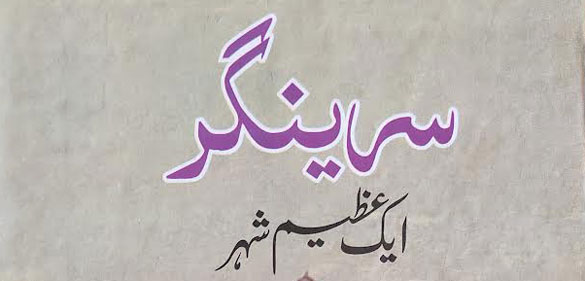
Ek Azeem Shahar (Srinagar: A Great City)
Authors:
Shafi Ahmad Qadri
Publisher:
Haji Sheikh Ghulam Muhammad & Sons, Srinagar, Kashmir
Pages:
460, Price: Rs 895
-----
Every city
has its own unique history. How the city was established, how it fared during
its existence, and when was it destroyed. There are historians and
anthropologists who have dedicated their lives to understand a city and its
people. Kashmir has been in news for wrong reasons for several decades. The
political turmoil has rendered everything else into oblivion. Very little
attention has been paid to other aspects of Kashmir, be it cultural, historical,
religious, economic and social. The scholars and historians did engage with
other aspects besides political, fearing a backlash from state and non-state
actors. So, they indulged in ‘non-controversial’ subjects like Islam in
Kashmir. Hence, writing on politics was confined to columnist turned historians
and journalists masquerading as political theorists and analysts.
Since, last
one decade we are a witness to good scholarship being produced about Kashmir.
But the unfortunate part of this process is that most of the work produced is
academic in its orientation and uses Meta narratives to analyse issues. It
makes it cumbersome for a lay common reader to show interest in such works,
thus limiting its readership and appeal among the common masses.
As informed
earlier, that we have simple writers and columnists who are engaging with
history. It is indeed a good feat that the void left by the so-called
professional historians is being filled by non-professional but good writers.
Srinagar, as a hub of religious, political and social activities occupies a
centre stage in the Kashmiri milieu. The complex aspects of Srinagar will need
several decades and engagement by variegated scholars to unveil its history,
politics, economy, religious practices and social life. Late Prof. Ishaq Khan,
had written a complete book about History of Srinagar and now Shafi Ahmad
Qadri, a reputed writer turned historian has deliberated about different issues
of Srinagar.
Srinagar
till year 1957 was a city comprised of seven bridges. With the expansion this
old city now known as Shahr e Khas, is still central to understand the
dynamic culture, religious ethos and politics of Kashmir. Kashmir has witnessed
its transition from Hinduism to Buddhism, again a transformation to Hinduism
with decimation of Buddhism. Further, Islam paved its way to Kashmir, through
the active participation of Central Asian Sufis, who travelled to Srinagar
mostly staying and creating hospices in Srinagar while travelling to other
parts of the Valley. The transition of Kashmir from Hinduism to Islam, was a
peaceful process, involving centuries of social activism, tirade against caste
system and Jihad against the exploitation of masses and religion by clergy. It
is this transition and earlier transitions that made the historian pandit
Kalhana state, “Kashmir can never be conquered by military might, but only by
spiritual forces.”
In this
book, Shafi Ahmad Qadri, through various short chapters that can be read
independently and do not bore the reader with academic jargon, informs the
reader about the genesis of various saints, Sufis, poets, temples, Gurudwaras,
markets, scholars and various other influential personalities of Srinagar. The
theme of all the essays is weaved around Srinagar. The shrines, hospices,
masjids, temples, Gurudwaras and churches are omnipresent in the alleys of
Srinagar. Many shrines are dedicated to the non-local Sufis, who propagated
Islam in Srinagar, while many depict the presence of local indigenous Sufis and
Rishis. Sufism developed an indigenous streak in Kashmir that absorbed the
local influences and helped in the spread of Islam in Kashmir. The non-local
Sufis did not have such a strong influence, because they did not speak the
native language, could not reach beyond a certain elite and did not all settle
down in Kashmir permanently. So, the mission of Islam was furthered by Rishis
in Kashmir Valley.
The shrines
of Ghouse ul Azam, Sheikh Abdul Qadir Jeelani in Khanyar and Solina of
Srinagar, with relics, their procurement, displaying them on specific occasions
is documented, so is the case with other shrines that host relics, particularly
Hazratbal. Srinagar, has the network of Sufi Silsilas, shrines, hospices and
devotees associated with them.
Jamia
Masjid and Hazratbal shrine has shaped the politics of Kashmir, since last more
than few centuries, but quite little has been written about it by our worthy
author. Miracles are often attributed to the people of God (Waliullah), so
Kashmir has its share of stories of miracles associated with the shrines and
Sufis.
The story
of Srinagar is not just confined to Sufis, but we find a mention about Kings
too, whose graves dote different parts of Srinagar. Then, we have details about
Patther Masjid, constructed by Queen Noorjahan, but people avoided praying in
it for a long period of time, depicting the misogynist and patriarchal mind set
of masses. The Ulema and scholars must have popularized the myth that praying
in a mosque constructed by a lady, even if she is a Queen is illegitimate, so
people followed them, thus avoiding the prayers. Popular graveyards, Shia
hospices, Imambaras, important schools, colleges, educational institutions and
contribution of Christian missionaries in Srinagar is highlighted too.
There still
are many Kashmiris, whose castes inform about their non-local origin. Bukharis,
Andrabis, Geelanis, Syeds, Kashanis and even our worthy author who is Qadri
settled down in Kashmir with the advent of Islam and now constitute the locals.
They have contributed a lot to enriching the social, political, religious
milieu of Kashmir, while perpetuating and reinforcing the caste system too.
They both have and have not assimilated in Kashmir, but do constitute an
important part of it. There have been instances when locals have stood up
against the outsiders like when Owaisi Saheb, a Sufi was martyred due to
political skirmishes, then local Kashmiris realized that outsiders were running
everything and even exiled many non-local Sufis and Pir families from Kashmir.
The book is quite a good read and informs us about many aspects of Srinagar. It
is quite heartening to know that the English version of the book is soon going
to be published. We must congratulate both the author and publisher for this
important feat.
However,
the work is not without its flaws. The greatest flaw of this book is the
missing references, because this work is historical in its nature and not a
creative fiction, where we cannot question the imagination of the author. We do
not know, about the sources that Qadri uses to arrive at conclusions. Also,
many ill-founded, illogical, unnatural and paranormal incidents are documented
in this work. It is a part of the Sufi hagiographies, the aim of which is to
create a miraculous aura around the personality of the Sufi by his followers,
so as to elevate spiritual status in the eyes of masses. Sheikh Hamza Makhdoom
completing whole Quran 300 times daily is sheer exaggeration and wrong (P-64),
Mullah Akhoon Shah Badakshi, who was spiritual mentor (Pir) of Prince Dara
Shikoh did not sleep for thirty years is interpolation, that should have no
place in history writing (P-138). Overall the book is a nice comprehensive read
for anyone who intends to be acquainted with the history of Srinagar.
------
M.H.A. Sikander is Writer-Activist based in
Srinagar, Kashmir.
URL: https://newageislam.com/books-documents/srinagar-religious-political-social/d/129815
New Age Islam, Islam Online, Islamic
Website, African
Muslim News, Arab World
News, South Asia
News, Indian Muslim
News, World Muslim
News, Women in
Islam, Islamic
Feminism, Arab Women, Women In Arab, Islamophobia
in America, Muslim Women
in West, Islam Women
and Feminism