
Muslim Side To Move SC Against Bhojshala Verdict As Hindu Groups Celebrate Amid Heavy Security In Dhar
New Age Islam News Bureau
16 May 2026
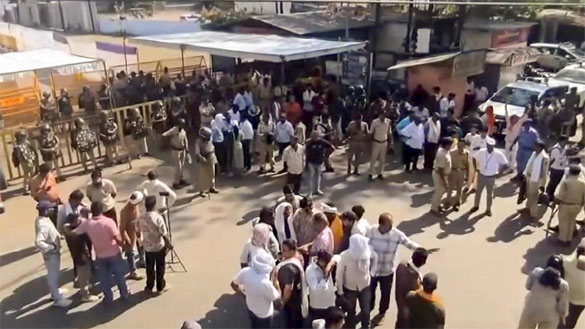
Security personnel deployed outside the Bhojshala complex after the Madhya Pradesh High Court declared the Bhojshala site a temple and quashed the ASI circular allowing Muslims to offer namaz there, in Dhar, Madhya Pradesh, on May 15, 2026. | Photo Credit: PTI
---------
· Muslim side to move SC against Bhojshala verdict as Hindu groups celebrate amid heavy security in Dhar
· Bangladesh Top police officials instructed field-level officers ‘Act against criminals regardless of affiliation’
· UAE reaffirms commitment to protecting sovereignty, supporting regional security
· Saudi embassy in UK advises citizens to avoid gatherings in London
· How Tommy Robinson Disguises White Supremacism In the Coded Language of Anti-Islam Politics
· 'ISIS greatly diminished': Trump announces killing of 'most active terrorist' Abu-Bilal al-Minuki in Africa
· Boko Haram Terrorists Kidnap Many School Children In Fresh Borno Attack
· Malaysia-led Gaza aid flotilla enters high-risk waters as interception fears grow
------
India
· HC relief for engineer whose degree was withheld due to scrapping of 5% Muslim quota
· Bhojshala verdict validates Muslims’ fears: Jamiat
· Mob pelts stones at cops in Asansol
· SC's Ayodhya verdict reveals ‘deeply majoritarian politics has penetrated legal validation', says Jamiat report
· 'No order without hearing us': Hindu party files caveat in SC after HC Bhojshala verdict
· Devotees go for self-regulation, conform to govt’s new namaz guidelines across city mosques
· In Tiljala, Friday namaz after 6-hour stand-off with payloader
· Allahabad High Court grants bail to 8 accused in Ganga boat Iftar party case
· BJP joins J&K liquor-ban protest, turns up heat on Omar Abdullah government
· SC describes youngsters who attack the system as 'cockroaches', 'parasites'
-------
South Asia
· Islamic Emirate Ambassador in Qatar Meets China Envoy to Afghanistan
· Bangladesh, US sign deal on energy cooperation
· JU authorities announce 14-point security plan after attempted rape on campus
· Administrative Commission Reviews Public Health, Institutional Coordination Issues
· Afghan Delegation Heads to Baku for Global Urban Forum on Climate, Sustainable Development
· MoIC Committed to Restoring Historic Heritage Sites Nationwide, Azizi Says
· Economic Commission Approves 69 Draft Standards, Reviews Key Development Projects
-----
Mideast
· UN Secretary-General welcomes formation of new Iraqi government
· Lebanon PM: Country has had enough ‘reckless’ wars for foreign interests
· Israeli shelling targets outskirts of Jamla town in western Daraa
· Syria appoints Safwat Raslan as central bank governor, Husriyeh named envoy
· Israeli forces kill 15-year-old Palestinian boy in West Bank
· Israel and Lebanon extend ceasefire by 45 days after Washington talks
· Syria’s recovery could be a ‘success story’ if the world acts, Security Council told
------
Arab World
· Young Saudi scientists win 12 special awards at ISEF 2026
· SDAIA chief reviews AI readiness for Makkah Route Initiative
· Sustainability shifts from vision to execution across GCC projects
· Saudi crown prince, Qatar emir discuss regional developments in phone call
· Saudi experts: Media narratives, the hidden battlefield of Feb. 28 war
· Film incentives raised to boost Saudi film production
------
Europe
· The rise of Reform UK and Islamophobia
· Police investigating after masked men attack Blackburn cafe prayer room with ‘fire bombs’
· Bristol teen jailed for neo-Nazi axe attack called herself 'embodiment of hell'
· Burnham cleared to run for selection in pivotal by-election
· Russia to expand Islamic banking rollout
· Denmark cancels lucrative contract with Zelensky’s favorite missile maker – FT
· Boy, 15, shot dead in France as prosecutors blame drug war
-------
North America
· ‘Trump considered nuclear strike on Iran’: Ex-CIA analyst makes explosive claim, says General Dan Caine ‘shot down’ proposal
· US charges Iraqi with plots to target Jews in cities from London to LA
· Texas AG Paxton to Newsmax: Muslims Must Follow US Laws, Not Shariah
· 'Did it as a favour to Pakistan': Trump on Iran ceasefire
· US planning to criminally indict ex-Cuban leader Raúl Castro
· Trump backs ‘status quo’ on Taiwan – US envoy to United Nations
· Removing Iran’s uranium mostly about ‘PR’ – Trump
--------
Africa
· 327 Terror Suspects Nabbed As Govt Revokes Licenses Of 3,000 Illegal Miners
· Why I Stopped Reading Newspapers, Commentary – Tinubu
· ‘You Want Well-equipped Hospital But Don’t Want To Pay Taxes’ – Tinubu
· Boeing ordered to pay $49.5 million to family of 737 MAX crash victim
· Sudan’s War and the Coming Islamist–Arab Proxy Front Across Chad
· Civilians caught in war of drones in eastern DR Congo
· MINUSCA Programme empowers youth and former fighters in CAR
------
Southeast Asia
· On Teachers’ Day, Anwar says educators crucial in shaping values amid complex global challenges
· PM’s RM5 million allocation a boost for youth movement, says MBM
· Malaysia sees US as key partner for modern agriculture push
· King and Queen pay tribute to teachers for shaping Malaysia’s future generations
· Govt says wider IPTA access for UEC, tahfiz students not a recognition of education systems
· Fourth Malaysian‑linked ship transits Strait of Hormuz with Iranian clearance, shipping data shows
Compiled by New Age Islam News Bureau
-----
Muslim side to move SC against Bhojshala verdict as Hindu groups celebrate amid heavy security in Dhar
May 15, 2026
Mehul Malpani
Security personnel deployed outside the Bhojshala complex after the Madhya Pradesh High Court declared the Bhojshala site a temple and quashed the ASI circular allowing Muslims to offer namaz there, in Dhar, Madhya Pradesh, on May 15, 2026. | Photo Credit: PTI
------------
Representatives of the Muslim community on Friday (May 15, 2026) said that they would approach the Supreme Court to challenge the Madhya Pradesh High Court’s order declaring the disputed Bhojshala temple-Kamal Maula mosque site in Dhar as a Hindu temple dedicated to goddess Saraswati.
Members of the Hindu community celebrated the verdict by the High Court’s Indore Bench, which granted them complete worship rights, even as strict security arrangements remained in place in Dhar and nearby areas. The district administration had already imposed preventive measures under Section 163 of the BNSS.
Advocate Vishnu Shankar Jain, representing the Hindu side, said the court accepted the Bhojshala complex as a centre of learning apart from a temple of goddess Saraswati.
Terming the verdict “historic”, Mr. Jain said, “The most important thing is that the court has granted us the right to worship here and asked the government to oversee its management. The court has also impugned the ASI order of April 7, 2003, allowing namaz there. Now only puja will be done there.”
What is the Bhojshala-Kamal Maula complex dispute? | Explained
“The court has accepted our core demand and each of our arguments and declared the nature of the structure to be that of a Hindu temple,” he said, speaking to reporters outside the High Court premises in Indore.
Following the long-awaited verdict, Dhar city Qazi Waqar Sadiq said that the Muslim side would review the court’s decision and approach the Supreme Court with it.
“We will review the High Court’s decision that has been given against our argument. We respect the court, but we will definitely challenge it in the Supreme Court. We will oppose it in the first hearing itself,” Mr. Sadiq said.
Mr. Sadiq, however, appeared to be rejecting the court’s recommendation that the Muslim side can approach the State government for an alternate piece of land for a mosque, while saying that the idea had “ended in the Supreme Court” during the Ayodhya Ram Janmabhoomi and Babri mosque dispute verdict.
“The Muslim side was given land then, but the same approach should not be taken repeatedly. This time, a different community should be asked to take land elsewhere. We maintain our claim,” he said.
“Our arguments were presented in a good way by our lawyers [senior advocate] Salman Khurshid sahab and Shobha Menon,” he said.
Advocate Noor Mohammad Sheikh, also representing the Muslim side, said that following the High Court’s order, namaz could no longer be offered at the site now until the Supreme Court intervened.
“There is no question of namaz for now, as the High Court has not given rights to the Muslim side,” he said.
Ashhar Ali Warsi, another advocate representing the Muslim side, said that the court “only considered the facts of the Archaeological Survey of India (ASI)”.
“Our facts were not considered at all. But we will not say that the court did not hear our side, but we are not at all satisfied with the decision. This decision is also constitutionally wrong as it was a civil matter decided under the purview of the constitution,” he said.
Meanwhile, more than 1,200 security personnel have been deployed in Dhar town and nearby areas, along with multiple companies of the Rapid Action Force (RAF), Special Armed Force (SAF) and the Quick Reaction Force (QRF), turning the area surrounding the complex into a high-security zone.
Indore (Rural) Deputy Inspector General (DIG) of Police Manoj Kumar Singh told The Hindu that security measures had been put in place a day in advance, including the deployment of anti-riot vehicles and equipment.
“Everything has been calm so far. We are also holding dialogues with representatives of both communities to maintain peace. More than 40 officers of Deputy Superintendent of Police (DSP) and inspector rank have been deployed on the ground, while senior officers are overseeing the arrangements,” he said.
Mr. Singh added that the police had dispersed some members of the Hindu community who were raising celebratory slogans.
The High Court’s verdict came after hearing five writ and three intervention petitions.
The Muslim and Hindu communities have been engaged in a prolonged legal tussle over the disputed site since mid 1990s, with tensions flaring on multiple occasions.
In 2003, the ASI issued an order allowing Hindus to worship at the complex on Tuesdays and Basant Panchami, while Muslims were permitted to offer prayers on Fridays. However, communal tensions repeatedly surfaced, especially when Basant Panchani coincided with Friday prayers.
Source: thehindu.com
Please click the following URL to read the text of the original Story
https://www.thehindu.com/news/national/madhya-pradesh/muslim-side-to-move-sc-against-bhojshala-verdict-as-hindu-groups-celebrate-amid-heavy-security-in-dhar/article70983785.ece
-------
Bangladesh Top police officials instructed field-level officers ‘Act against criminals regardless of affiliation’
16 May 2026

Top police officials instructed field-level officers not to spare anyone involved in drugs or extortion because of political links, officials said.
They also directed officers to make police stations more citizen-friendly by ensuring people are not harassed while filing general diaries or cases or seeking services.
The instructions were among the key issues discussed during Police Week 2026, which ended on May 13, according to officials who attended the sessions.
Prime Minister Tarique Rahman inaugurated the four-day event at Rajarbagh Police Lines on May 10.
At least one deputy inspector general (DIG) and three superintendents of police (SPs) said senior officials repeatedly instructed them not to consider political identity during anti-drug and anti-extortion drives.
“The ongoing drive against extortionists will continue, and political identity will not be considered in these operations,” a deputy commissioner told The Daily Star, quoting Inspector General of Police (IGP) Md Ali Hossain Fakir, who made the remark during an internal discussion.
While addressing the event, Tarique also told senior police officers to treat criminals as criminals regardless of political identity and said police are protectors of law, not any political party.
Several officers said rebuilding public trust in police was one of the main topics discussed during the week.
Police stations were instructed to become more service-oriented, as many people judge the government by the treatment they receive at local police stations.
“To establish zero-complaint police stations, officers have been asked to monitor service delivery more closely,” an SP from southern Bangladesh told The Daily Star.
“Police are the government’s ambassadors. They must work professionally and stay above partisan influence,” he added.
Internal discipline was also discussed.
A DIG said the IGP expressed dissatisfaction over irregularities, lobbying and alleged financial dealings involving transfers and postings.
The police chief warned that using personal connections or money to secure favourable postings violated departmental discipline, the DIG said.
The IGP also warned that no police member involved in drug-related activities would be spared.
Police welfare was another major issue raised during the week. Officials demanded a separate pay scale, risk allowance, overtime benefits, interest-free motorcycle loans for investigators and expanded medical facilities.
They also proposed increasing investigation allowances, expanding manpower and modernising forensic and cybercrime facilities.
“The government responded positively, although there are financial limitations. We were assured that our demands would be considered,” said an official who attended one of the sessions.
Home Minister Salahuddin Ahmed said the government was considering overtime allowances for police personnel from constable to inspector level while steps were being taken to improve police hospitals and solve accommodation shortages.
Technology-based policing was another major focus.
Officials said senior officers discussed ways to strengthen police capacity to tackle cybercrime, online fraud, digital extortion, online harassment and other technology-based offences.
The government has announced plans to form a dedicated Cyber Police Unit following a proposal from Bangladesh Police.
Officials said discussions were also held on traffic management, community policing, crime control, anti-narcotics operations and improving public services.
The amendment of the colonial-era Police Act of 1861 also came up during discussions, several officials said.
Senior officers stressed the need to maintain the chain of command, ensure transparency in field-level operations and keep policing decisions free from political or personal influence.
Meanwhile, frustration has grown within the force over the postponement of the Bangladesh Police Medal (BPM) and President Police Medal (PPM) award ceremony.
A total of 107 police personnel were nominated for the awards this year for bravery, professionalism and distinguished service. The ceremony was postponed shortly before Police Week began.
A DIG said the medals are among the most important recognitions within the force and that the postponement had affected morale among field-level officers.
Police officials said the overall message of this year’s Police Week was clear -- police must act against crime without political consideration, improve services at police stations, maintain internal discipline and strengthen capacity to deal with emerging crimes.
Source: thedailystar.net
Please click the following URL to read the text of the original Story
https://www.thedailystar.net/news/bangladesh/news/act-against-criminals-regardless-affiliation-4176856
------
UAE reaffirms commitment to protecting sovereignty, supporting regional security
May 16, 2026
The ministry also stressed that “all measures undertaken by the UAE have been within the framework of defensive actions.” (AP)
----------
RIYADH: The UAE said it was firmly committed to supporting regional security and stability and protecting the people of the region from the repercussions of conflicts.
“The UAE has condemned in the strongest terms the unprovoked Iranian attacks and threats targeting the UAE and countries across the region, which included the launch of nearly 3,000 ballistic missiles, cruise missiles, and drones toward the UAE,” a foreign ministry statement on Saturday said.
The ministry said the attacks resulted in civilian casualties and damage to civilian infrastructure and were a clear violation of state sovereignty and a threat to regional security and stability.
The ministry also stressed that “all measures undertaken by the UAE have been within the framework of defensive actions aimed at protecting its sovereignty, civilians, and vital infrastructure, in line with the country’s legitimate right to safeguard its national security and maintain stability.”
The statement said: “attempts at coercion or the promotion of malicious narratives and allegations will not undermine the UAE’s principled positions, nor deter the country from safeguarding its supreme national interest and upholding its sovereignty and independent decision-making.”
The US and Israel began a military campaign against Iran on Feb. 28, leading to Tehran attacking Gulf neighbors, Israel and US assets in the region.
A ceasefire, which was announced on April 7, appears to be holding despite skirmishes.
Source: arabnews.com
Please click the following URL to read the text of the original Story
https://www.arabnews.com/node/2643755/middle-east
-----
Saudi embassy in UK advises citizens to avoid gatherings in London
May 15, 2026
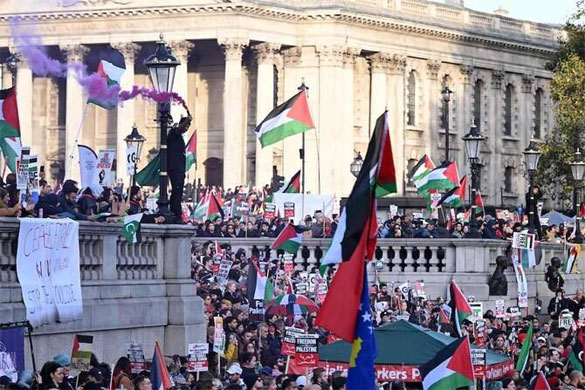
Protesters gather with placards and flags during the ‘London Rally For Palestine’ in Trafalgar Square, central London in 2023. (AFP/File Photo)
---------
LONDON: The Saudi Embassy in the UK on Friday urged Saudi citizens in London to exercise caution and avoid gatherings ahead of planned demonstrations in the British capital this weekend.
In a statement, the embassy said protests were expected to take place on Saturday in several areas of London and advised Saudi nationals to follow the instructions of local authorities and avoid demonstration sites for their safety.
The embassy also provided an emergency contact number (+44779 951 9495) for Saudi citizens requiring assistance.
Large demonstrations are expected in London on Saturday, including events linked to Nakba Day commemorations marking the displacement of Palestinians in 1948.
Source: arabnews.com
Please click the following URL to read the text of the original Story
https://www.arabnews.com/node/2643740/saudi-arabia
-----
How Tommy Robinson Disguises White Supremacism In the Coded Language of Anti-Islam Politics
Nafeez Ahmed
15 May 2026

Tommy Robinson’s ‘Unite the Kingdom’ march through the streets of London 13th September 2025. Source: Alamy
-------------
Stephen Yaxley-Lennon, also known as ‘Tommy Robinson’ – the serial criminally convicted fraudster, thug, stalker and far-right activist who founded the English Defence League in 2009 – has spent more than a decade insisting his politics target a religion rather than a race. He hosts non-white supporters at his rallies and told the High Court under oath in April 2021, during the Jamal Hijazi libel trial: “I am not racist, and I am certainly not anti-Muslim.”
However, a Byline Times investigation has established that this denial is merely the public alibi for a vocabulary that, across Robinson’s own posts, amounts to white supremacist anti-black racism in code – the politics he was schooled in as a 2004 British National Party member, repackaged for delivery to his 1.9 million followers.
The investigation analysed a non-exhaustive corps of more than 140 posts on Robinson’s @TRobinsonNewEra X account between January 2024 and May 2026 which were found to have used coded, racially-charged language.
The vocabulary works through consistent substitution. “Native” stands for white people – a substitution Robinson confirms himself in a keystone June 2024 post defining “native” as “white”.
“Invader” is ascribed exclusively to non-white populations, 43 times in the sample. “Modern London” refers in derogatory fashion to footage of non-white people in British public space. “African” appears as a racial proxy paired with crime across its eight uses.
“Somali” targets a population that is both black and Muslim, fusing both race and religion in a single term. And “Remigration” – the white nationalist programme for the removal of non-white citizens from European countries – is repeatedly recommended as the policy solution.
Across the sample, Robinson endorses the in-group 31 times (11 “white people”, 20 “natives”); applies “invader” to non-white origins 43 times; references black people as a racial category in 46 separate posts (21 direct, eight “African”, 17 Somali); and has used or endorsed the white supremacist term “Remigration” at least 14 times on his own account.
The In-Group
Thirty-one posts in the sample name the in-group whose interests Robinson defends: 11 using the explicit term “white people” and a further 20 using the coded equivalent “native(s)” – a marker Robinson himself defines as white.
In one post on 6 June 2024 about diversity policy in British institutions, Robinson wrote that the agenda was making “the native population a minority” in commentary on a post about “an attack on white people” – treating the two terms as interchangeable. In his vocabulary, “native” now means a white person born in Britain; the non-white British-born population, by implication, is something else.
The same claim recurs in 10 further posts across the period. Across the spring and summer of 2024, Robinson called the First Minister of Scotland “anti-white” (29 April); posted that a public event was open to all “except white children” (17 May); amplified a claim that anti-white discrimination was being “normalised” in the West (11 July); and wrote that white children were being “picked on” in schools (4 August).
Through early 2026 he returned to the theme: calling for “anti white organizations” to be “dismantled” (15 February); describing an agenda as “demoralising… lives of white people in their own countries” (17 March); and reposting a claim that a named individual “hates white people” (11 May).
The Out-Group
Forty-three posts in the sample examined by Byline Times apply the mirror term “invader”. Combined with the 20 “native(s)” posts analysed above, they form a sustained two-sided racial binary that operates across multiple posts a week for 28 months.
Of the nationality-tagged uses, 10 describe Afghans, nine Sudanese, three Eritreans, three Moroccans, and the remainder North Africans, Kurds and Somalis. The word attaches exclusively to non-white origins; the corpus contains no American, Polish, French, Australian or Irish “invaders”.
On 26 August 2025, in a post viewed 1.6 million times, Robinson wrote: “A legacy media demonizing the native at every given turn, in favour of the invader, all under the guise of ‘tolerance’.” He returned to the framing on 2 October 2025: “Hate speech laws are only used against natives to silence them whilst our country is flooded & raped.”
“Modern London”
Afrequent framing phrase in Robinson’s everyday posts is “Modern London”, with its variant “Modern England”.
Documented examples include a 14 July 2024 scene captioned “new normal in Sadiq Khan’s Modern London”; a 10 December 2024 post describing “disgusting scenes” as the boxer Floyd Mayweather was “confronted by a gang of islamists as he shopped in Sadiq Khan’s Modern London”; a 7 August 2025 post on “12 days of migrants in ‘Modern England’”; and a 15 January 2026 post captioned “just another new normal evening in Modern London”.
The phrase delivers a message in two words: a racially mixed city has become a different country.
The Anti-Black Corpus
The first category – 21 direct references to “black people” as a racial group – opens with a post of 18 January 2024, eighteen days into Robinson’s first full year back on X, asking what a viral incident “tells you about the mindset of some black people”.
Four further posts construct “Black on White violence” as a coherent racial taxonomy, including a 10 September 2025 framing of “black youth” attacking a lone white girl. The corpus contains no equivalent category of “White on Black violence”.
Five posts mock or attack the Black Lives Matter movement, while two posts make the white-grievance frame explicit on racial terms. A 19 July 2024 post complains that free food is provided to people who are “black or Asian” but not to people who are white.
A 20 July 2025 post asks whether the authorities would have applied a given action to “a Muslim” or “a black man” – naming, in a single sentence, two categories as the objects of his opposition: a religion and a race.
Eight further posts deploy “African” as a negative racial proxy. Seven of them pair the word directly with “invader”; every one of the eight refers to a crime, fraud or violent incident.
Three of the eight cluster in a 36-hour window in July 2025 around the Spanish town of Torre-Pacheco. One 12 July 2025 post, which accumulated 1.2 million views, called for “Mass deportations ASAP” in response to alleged actions by “North African invaders” and tagged Spain’s far-right Vox party as the political solution.
A companion post earlier the same day named Vox as the only party that “will mass deport them”, followed by a third 12 July post. Multi-day street violence between Spanish residents and North African migrants followed in Torre-Pacheco within 48 hours.
A continent of 1.4 billion people encompassing 54 nations appears is described by Robinson purely as a demographic threat: criminal, parasitic and sexually violent.
Seventeen further posts target Somali identity. Somalia is approximately 99% Muslim and approximately 100% black African. Targeting Somalis as a group therefore means targeting them on both racial and religious axes at once – and Robinson’s vocabulary repeatedly does so by ethnic name.
Four posts deploy “Somali invader” as a standing label. The most viewed, posted on 31 August 2025, identified an asylum seeker by name, by ethnicity “from Somalia”, and accommodation. Five similar posts apply collective-criminality framing, including a post on the 29 April 2026 Golders Green attack focusing on the attacker’s ethnic identity as “Somalian”.
In a 9 January 2026 post, Robinson framed Somalis as drains on the British state, days after US House Oversight Committee hearings citing claims that 81% of Somali-headed households in Minnesota received welfare benefits and a US Treasury press conference on Somali-targeted fraud investigations.
Four further posts pursue a territorial-takeover theme – calling Minnesota the “Somali capital” of the United States and attacking the Somali mayor of Sheffield for switching on Ramadan lights. Two more use the “Somali Pirate” label.
None of the 17 posts describes a Somali achievement, contribution, sporting moment or routine event. This derogatory pattern holds across all 46 anti-black posts in the corpus.
Some 21 direct posts on “black people” and eight on “Africans” by Robinson also contain no Muslim component at all. The unifying variable in his targeting across many of these posts is race.
The same framing extends to ordinary moments in black British life. A 25 August 2024 post framed the Notting Hill Carnival – Britain’s largest annual black cultural celebration, which has no Muslim element – with imagery of boarded-up shops.
Great Replacement and Remigration
Robinson named his policy programme for the first time in late 2024 and has since endorsed it well over a dozen times on his own X account. His 1 January 2026 post on the year ahead read “Mass deportations 2026”. On 21 January 2026 he wrote: “We are the natives… claim it back through Remigration.” His May 2026 posts combined the word with “parasites”, “natives” and “de-islamisation”.
“Remigration” is a term repurposed in the 2010s by former neo-Nazi Martin Sellner, founder of the pan-European white nationalist Identitarian Movement.
The Global Project Against Hate and Extremism describes remigration as “a white supremacist policy concept that calls for the forced removal of immigrants, refugees, and their descendants – including legal residents and citizens – based on race, ethnicity, culture, being perceived as ‘non-white,’ or a failure to ‘assimilate.’”
It is proposed as a policy solution to the baseless far-right “Great Replacement” conspiracy theory, which falsely claims that white populations are being intentionally replaced by non-white migrants.
Robinson has repeatedly endorsed this conspiracy theory. On 5 October 2024, he announced the publication of his book Manifesto with the words: “This book is a game changer. 5 years of research, detailing the great replacement through mass migration. We deleve into the origins, the plan, the orchestraters and how to stop it.”
Applied to the UK, remigration entails the removal of British residents and citizens of non-white origin, including those born in Britain.
In early May 2026, Robinson posted footage from riots in the distinct of Schveningen in The Hague, Netherlands, with the comment: “Millions of parasites that care nothing of our nations, openly show it, destroying the lives of natives.” He called for “Remigration and de-islamisation”: four words containing a dehumanising metaphor for non-whites, a racial in-group, a religious target, and an ethnic cleansing programme. A week later he posted again about “invaders and their offspring” attacking “our people in Europe”, once again demanding “Remigration and de-islamisation”.
On 13 September 2025 Robinson marched at the head of about 150,000 people in central London behind a banner bearing the word ‘REMIGRATION NOW’.
Tokenisation
According to the Anti-Defamation League, Robinson deploys a sophisticated inoculation device, “tokenisation”, to justify his focus on white people. This involves attempting to distract from racially-charged language by proclaiming his opposition to racism.
He has frequently posted video of non-white supporters – from “Black University Students who Support Tommy Robinson” outside Westminster to a “random black lady” meme – and has conducted public outreach to Hindu and Sikh communities for at least a decade.
On 30 December 2024, Robinson asserted that “Tackling anti white racism and the issues of demography and immigration doesn’t need a blanket hatred of non white people” – effectively permitting white supremacist politics while pre-empting the charge that such politics are racist.
The outreach to multiple ethnic and faith groups operates on the same logic: its shared platform is opposition to Muslims, a population overwhelmingly drawn in Britain from South Asian and African origins and homogenised in racial terms.
Twenty two years ago, Robinson joined the neo-Nazi British National Party. He left after some two years in 2005, claiming he had not realised the party held racist views. The BNP was chaired throughout his membership by the Holocaust denier Nick Griffin, and its formal whites-only membership rule remained in place until a court ruling forced its removal in 2010. Its 2005 manifesto, published during Robinson’s tenure, proposed “voluntary resettlement” of immigrants and their descendants – what Robinson now calls Remigration.
The English Defence League Robinson founded in 2009 substituted “Muslim” for the racial categories the BNP had used openly, permitting alliances with non-white supporters. His post-EDL activism deploys the same tactic to mainstream a white supremacist, anti-black ideology that has changed little over the past decades.
Robinson did not respond to request for comment.
Source: bylinetimes.com
Please click the following URL to read the text of the original Story
https://bylinetimes.com/2026/05/15/how-tommy-robinson-disguises-white-supremacism-in-the-coded-language-of-anti-islam-politics/
------
'ISIS greatly diminished': Trump announces killing of 'most active terrorist' Abu-Bilal al-Minuki in Africa
May 16, 2026
US President Donald Trump said on Friday that Abu-Bilal al-Minuki, described as the global second-in-command of the Islamic State group, had been killed in a joint operation conducted by US and Nigerian forces.
In a statement, Trump said the operation was carried out at his direction and involved what he called a “meticulously planned and very complex mission” by American and Nigerian troops.
"Tonight, at my direction, brave American forces and the Armed Forces of Nigeria flawlessly executed a meticulously planned and very complex mission to eliminate the most active terrorist in the world from the battlefield," Trump said through a post on Truth Social.
He said that the ISIS leader had been tracked through intelligence sources despite attempting to hide in Africa.
Trump added that al-Minuki had played a role in planning operations targeting Americans and destabilising parts of Africa, adding that his death would significantly weaken ISIS’s global network.
"Abu-Bilal al-Minuki, second in command of ISIS globally, thought he could hide in Africa, but little did he know we had sources who kept us informed on what he was doing. He will no longer terrorize the people of Africa, or help plan operations to target Americans. With his removal, ISIS’s global operation is greatly diminished," the US president added.
Nigeria continues to grapple with multiple security challenges, particularly in its northern regions, where an insurgency has persisted for more than two decades.
In February, the United States deployed troops to the West African nation to advise and support Nigerian forces in tackling insecurity.
Two major Islamic State-linked militant groups are active in the country. The Islamic State West Africa Province (ISWAP) primarily operates in the northeast, including Adamawa state, while another ISIS-affiliated group, locally known as Lakurawa, has carried out attacks on villages in the northwestern and northcentral states of Sokoto and Kebbi.
Source: indiatimes.com
Please click the following URL to read the text of the original Story
https://timesofindia.indiatimes.com/world/us/isis-greatly-diminished-trump-announces-killing-of-most-active-terrorist-abu-bilal-al-minuki-in-africa/articleshowprint/131131389.cms
------
Boko Haram Terrorists Kidnap Many School Children In Fresh Borno Attack
May 15, 2026
Suspected Boko Haram insurgents on Friday invaded a Primary and Junior Secondary School in Mussa village, Askira-Uba Local Government Area of Borno State, abducting an unspecified number of students during the attack.
Residents said the assailants stormed the community in large numbers on motorcycles shortly after troops stationed in the area reportedly left following a routine patrol.
The latest attack has thrown the community into panic, with fears growing over the safety of pupils and residents in the area.
A resident of the village, who spoke on condition of anonymity, disclosed that several schoolchildren were taken away by the insurgents during the invasion.
According to the source, the attack occurred in the early hours of Friday.
“Yes, the attack happened early hours of today (Friday) and it was discovered that many children were abducted,” Daily Trust quoted the resident as saying.
However, the exact number of students allegedly kidnapped could not be independently verified as of the time of filing this report.
Many Pupils Fled Into Bush – Lawmaker Confirms
The Deputy Speaker of the Borno State House of Assembly, Hon. Abdullahi Askira, confirmed the attack on the school but said details surrounding the incident were still sketchy.
The lawmaker, however, declined to confirm whether students were abducted by the insurgents.
“Details of the attack are sketchy, but the information at my disposal has it that many of the students fled into the bush, but I don’t have details of those abducted,” Askira told journalists.
He described the development as disturbing and disheartening, noting that the insurgents attacked the community barely minutes after troops on patrol departed the area.
“This signifies that the attackers were spying on the movement of troops before they struck,” he added.
Naija News reports that following the attack, several residents and concerned Nigerians took to social media, particularly Facebook, to call for prayers and urgent intervention over the incident.
One of the users, identified as Solomon Mussa, appealed to the public to pray for the affected community and the missing schoolchildren.
“Good morning, beloved. Please pray for the Mussa Boko Haram attack in Mussa village now. According to a report coming out from Mussa, school children were affected,” he wrote.
However, the state command of the Nigeria Police Force has yet to confirm the development as of the time of filing this report.
Source: naijanews.com
Please click the following URL to read the text of the original Story
https://www.naijanews.com/2026/05/15/boko-haram-terrorists-school-children-borno/
-----
Malaysia-led Gaza aid flotilla enters high-risk waters as interception fears grow
16 May 2026
SEPANG, May 16 — The Sumud Nusantara Command Centre (SNCC) has confirmed that 54 ships of the Global Sumud Flotilla (GSF) are currently in yellow zone 2, which is approximately 340 nautical miles from the Gaza coast.
SNCC director-general Datuk Dr Sani Araby Abdul Alim Araby said that within the next few hours, the ships are expected to enter the high-risk zone at night, where the potential for interception by the Zionist regime is very high.
“SNCC stresses that the interception that may be carried out by the Zionist regime to block the legitimacy of the maritime humanitarian corridor which has been valid under the UNCLOS (United Nations Convention on the Law of the Sea) clause, which allows any humanitarian aid to be channeled to troubled places, without restrictions,” he said.
He said this at a press conference on the development of the GSF here today.
This time the GSF mission involves nearly 500 international participants from 45 countries mobilised by various humanitarian activist groups around the world.
Sani Araby meanwhile said SNCC also officially launched four efforts through the Sumud Protocol as a phase one action plan that was mobilised starting from the final phase of the flotilla mission to Gaza.
He said this was done through the Malaysian Parliament Caucus on Palestine which mobilised the support and membership of at least 150 Malaysian Members of Parliament across parties as a reflection of the strength of the Parliament as a bold and committed attempt to defend the cause of Palestine.
“We should know that the Malaysian Parliament has voted many times and agreed by consensus to condemn actions against the colonial regime, and I think that this is good news for our country, everyone is united for the Palestinian issue regardless of party and race,” he said.
He said SNCC, through its legal wing, the Centre for Human Rights Research and Advocacy (CENTHRA), with the support of the government, will also mobilise efforts to file a claim with the Chief Commissioner of the International Criminal Court (ICC) for violations of international law following the previous acts of kidnapping, attacking and seizing humanitarian aid materials in international waters.
“This is another history where the country’s courage is not just by sending a memorandum, but we will prove this unity by filing a petition, a summons to the ICC to drag the occupiers to the international court and this will be initiated as early as this June,” he said.
In addition, SNCC endorses the Brussels Declaration which was mobilised by world parliamentarians, especially from Malaysia, Turkey, Spain and the European Union (EU) in increasing diplomatic and economic pressure on the regime following violations of international law and humanitarian sanctions on Gaza.
A 100-hour live broadcast effort, Sumud Kita Untuk Gaza, was also launched through the official Sumud Nusantara platform to expand public awareness and convey the current developments of the flotilla mission to Malaysians and the international community.
He also called on Malaysians to continue performing the Hajat prayer, Qunut Nazilah and continuous munajat for the safety of the entire mission delegation and the success of the Gaza liberation effort, and stressed that every dissemination of information should always be based on authentic and authoritative sources.
Any official inquiries related to the mission and Palestine can be browsed on the official portal tanya.sumudnusantara.com. — Bernama
Source: malaymail.com
Please click the following URL to read the text of the original Story
https://www.malaymail.com/news/malaysia/2026/05/16/malaysia-led-gaza-aid-flotilla-enters-high-risk-waters-as-interception-fears-grow/220099
-------
India
HC relief for engineer whose degree was withheld due to scrapping of 5% Muslim quota
May 16, 2026
MUMBAI: The Bombay High Court has come to the rescue of a city resident who was denied an electrical engineering degree despite successfully completing the course from an institute in Ratnagiri because of the recent scrapping of a 5% quota for 51 Muslim communities.
A division bench of justices RI Chagla and Advait Sethna has ordered the University of Mumbai (MU) and the Finolex Academy of Management and Technology in Ratnagiri, where petitioner Farukh Ilahi Sayyad studied, to release his final semester result and leaving certificate, and also issue him a degree.
The case pertains to the Maharashtra government’s decision in 2014 to introduce 5% reservation in education and public employment for 51 backward Muslim communities via an ordinance, which was never formally enacted and eventually lapsed. In February this year, the state government officially revoked the Special Backward Class (A) quota. However, between the lapse of the 2014 ordinance and the official revocation 12 years later, state departments continued issuing caste validation certificates under the quota.
In his petition, Sayyad stated that he had obtained a caste certificate in July 2014 under the ordinance and had secured admission to the second year of a degree course in electrical engineering at the college in Ratnagiri. He already had a diploma in electrical engineering.
Sayyad successfully completed the course in 2017. However, the college and the university allegedly withheld his final year result and degree certificate for want of a caste validity certificate. Earlier this year, Sayyad then applied to the Caste Scrutiny Committee for the validation of his caste certificate, but the panel stated that it could not process his application because the 5% quota was no longer in effect.
Sayyad then approached the high court, submitting that he had been suffering immense hardship, as he was forced to work in a lower-level job in Dubai solely on the basis of his diploma. Despite being a qualified engineer, he was unable to secure work commensurate with his qualifications due to the lack of a final-semester mark sheet and degree certificate.
After a government pleader informed the court that the ordinance providing for the 5% quota had lapsed and that the reservation provision had ended with it, Sayyad pointed out that he had not availed of any other benefit of the 5% quota and had even paid the fees payable by open category candidates. He also produced fee receipts in support of his claim and offered to pay any additional required charges.
The bench accepted the petitioner’s statement, ordering the university and the engineering college to release his final semester mark list, degree certificate and leaving certificate on payment of any additional fees if required. A detailed court order is not yet available.
Source: hindustantimes.com
Please click the following URL to read the text of the original Story
https://www.hindustantimes.com/cities/mumbai-news/hc-relief-for-engineer-whose-degree-was-withheld-due-to-scrapping-of-5-muslim-quota-101778872801032.html
-------
Bhojshala verdict validates Muslims’ fears: Jamiat
May 16, 2026
NEW DELHI: Noting that the Madhya Pradesh HC order declaring the disputed Bhojshala complex a temple only validated the fears and concerns they had raised since the 2019 Ayodhya verdict, the Jamiat Ulama-i-Hind (JUH) on Friday released a report arguing that Supreme Court’s interpretation of Places of Worship Act revealed how “deeply majoritarian politics has penetrated legal validation”.
Speaking at the programme attended by senior lawyers, legal experts, former judges, researchers, and intellectuals, JUH president Maulana Mahmood Asad Madani observed that disputes did not end with the Babri Masjid issue; rather, new controversies relating to Gyanvapi, Mathura Eidgah, Kamal Maula Mosque, and other religious sites were now being raised, reopening old wounds.
The report titled ‘A critical analysis of Babri Masjid judgement and the Case of the Places of Worship (Special Provisions) Act 1991’ provides a detailed analysis of major SC judgments claiming that certain judicial interpretations weakened constitutional principles relating to the protection of religious places.
In particular, the report discusses the far-reaching implications of observations made in the Ismail Faruqui case, wherein a mosque was held not to be an essential part of Islamic practice. “As the judiciary increasingly accommodates Hindutva majoritarian-ism, Muslim sacred spaces have become legally vulnerable, culturally contested, and politically targeted,” it said.
The report said Places of Worship Act was designed to freeze the religious character of worship sites as they existed on Aug 15, 1947. “Yet recent court rulings have interpreted the Act so narrowly that fresh claims against mosques in Va-ranasi, Mathura, and elsewhere are now proceeding,” it said.
“The arguments deployed in those cases — concerning essential practices, belief, archaeological evidence, and civilisational memory — are now being recycled in ongoing litigation involving the Gyanvapi Mosque in Sambhal, the Shahi Eidgah at Mathura, and others,” the report stated.
It further recommended that “communal politics and historical claims should not be allowed to become instruments for legal disputes”.
Source: indiatimes.com
Please click the following URL to read the text of the original Story
https://timesofindia.indiatimes.com/india/bhojshala-verdict-validates-muslims-fears-jamiat/articleshowprint/131129861.cms
--------
Mob pelts stones at cops in Asansol
May 16, 2026
Asansol: Tension flared in Asansol after a group of people attacked a police outpost at Naya Mohallah accusing cops of trying to stop Friday night prayers. Police and central forces resorted to lathicharge and are conducting marches in the area. Several people have been detained.
According to Asansol North MLA Krishnendu Mukherjee, police from the outpost had gone to the local mosque urging the mosque committee to limit the sound during prayers to the mosque's precincts. This fuelled rumours that cops were trying to stop Friday prayers.
Mosque committee members were talking to the cops when a mob started pelting stones. However, a large police contingent and central force personnel rushed in and drove away the attackers. Senior police officials refused to comment on the matter.
Mukerjee accused "Trinamool-backed miscreants" of trying to inflame the situation. "I advise all to maintain sound norms and not use microphones without police permission."
Source: indiatimes.com
Please click the following URL to read the text of the original Story
https://timesofindia.indiatimes.com/city/kolkata/mob-pelts-stones-at-cops-in-asansol/articleshowprint/131127141.cms
-------
SC's Ayodhya verdict reveals ‘deeply majoritarian politics has penetrated legal validation', says Jamiat report
May 15, 2026
NEW DELHI: Noting that the Madhya Pradesh High Court order declaring the disputed Bhojshala complex in Dhar district a temple only validates the fears and concerns that they have raised all along since the 2019 Ayodhya verdict, the Jamiat Ulama -i- Hind (JUH) on Friday released a report arguing that Supreme Court's interpretation of the Places of Worship Act reveals how “deeply majoritarian politics has penetrated legal validation”.
JUH said that it was just a coincidence that the report was being released on the day the Bhojshala order came. Speaking at the programme attended by senior lawyers, legal experts, former judges, researchers, and intellectuals, JUH president Maulana Mahmood Asad Madani observed that disputes did not end with the Babri Masjid issue; rather, new controversies relating to Gyanvapi, Mathura Eidgah, Kamal Maula Mosque, and other religious sites are now being raised, reopening old wounds.
The report titled “A critical analysis of Babri Masjid judgement and the Case of the Places of Worship (Special Provisions) Act 1991’ provides a detailed analysis of major Supreme Court judgments, including the Ismail Faruqui Case and the Ayodhya verdict, claiming that certain judicial interpretations weakened constitutional principles relating to the protection of religious places.
In particular, the report discusses the far-reaching implications of the observations made in the Ismail Faruqui case, wherein a mosque was held not to be an essential part of Islamic practice in every circumstance. “As the judiciary increasingly accommodates Hindutva majoritarianism, Muslim sacred spaces have become legally vulnerable, culturally contested, and politically targeted,” the report stated.
The report said The Places of Worship Act of 1991 was designed to freeze the religious character of worship sites as they existed on August 15, 1947. “Yet recent court rulings have interpreted the Act so narrowly that fresh claims against mosques in Varanasi, Mathura, and elsewhere are now proceeding.”
“The arguments deployed in those cases—concerning essential practices, belief, archaeological evidence, and civilisational memory—are now being recycled in ongoing litigation involving the Gyanvapi Mosque in Sambhal, the Shahi Eidgah at Mathura, and others,” the report states.
The report recommended that the judiciary must uphold the Places of Worship Act as intended and it be strictly implemented and protection of religious places should be treated as a constitutional obligation. It further recommended that “communal politics and historical claims should not be allowed to become instruments for legal disputes.
Source: indiatimes.com
Please click the following URL to read the text of the original Story
https://timesofindia.indiatimes.com/india/scs-ayodhya-verdict-reveals-deeply-majoritarian-politics-has-penetrated-legal-validation-says-jamiat-report/articleshowprint/131124550.cms
-------
'No order without hearing us': Hindu party files caveat in SC after HC Bhojshala verdict
May 15, 2026
NEW DELHI: Two caveat pleas were moved in the Supreme Court on Friday, hours after the Madhya Pradesh high court declared the disputed Bhojshala-Kamal Maula complex in Dhar as a temple of Goddess Vagdevi (Saraswati). The plea was filed anticipating a possible challenge to the verdict by the Muslim side.
A caveat plea is generally filed as a precautionary legal notice by anyone who anticipates that someone else may move court against them. It acts as a legal safeguard, ensuring that the court hears the caveator before passing any order or granting relief in the matter.
The first caveat petition was filed by Hindu-side litigant Jitendra Singh Vishen, who is also a petitioner before the Madhya Pradesh high court in the Bhojshala dispute. The plea sought a direction that no order be passed by the apex court without hearing him if the verdict is challenged.
Subsequently, another caveat plea was filed by the main Hindu-side petitioner through advocate Vishnu Shankar Jain, seeking similar protection before any proceedings are undertaken in the Supreme Court.
The caveat petitions came shortly after the Indore bench of the Madhya Pradesh high court held that the religious character of the disputed monument was that of Bhojshala, a temple dedicated to Goddess Saraswati.
"The religious character of the disputed area is held to be Bhojshala with a temple of Goddess Saraswati," the court observed in its verdict.
The high court also quashed the Archaeological Survey of India's 2003 arrangement to the extent that it restricted Hindu worship and permitted Muslims to offer namaz at the complex.
The court directed that the Union government and the ASI would decide the future administration and management of the Bhojshala temple, while the ASI would continue to supervise preservation and regulation of religious practices at the protected monument under the ASI Act, 1958.
On the Hindu side's demand seeking the return of the idol of Goddess Saraswati allegedly kept in a London museum, the high court said the Centre may consider the representations already submitted in this regard.
At the same time, the court observed that if the Muslim side seeks allotment of suitable land within Dhar district for the construction of a mosque or prayer site, the state government may consider the request in accordance with law.
The Bhojshala-Kamal Maula complex dispute has remained a long-standing religious and legal issue, with Hindus claiming the site as an ancient Saraswati temple linked to Raja Bhoj, while Muslims maintain it is the Kamal Maula mosque.
Under a 2003 arrangement framed by the ASI, Hindus were allowed to perform puja on Tuesdays while Muslims offered namaz on Fridays. The arrangement remained in force while the site continued under ASI protection and supervision.
Source: indiatimes.com
Please click the following URL to read the text of the original Story
https://timesofindia.indiatimes.com/india/no-order-without-hearing-us-hindu-party-files-caveat-in-sc-after-hc-bhojshala-verdict/articleshowprint/131121939.cms
-------
Devotees go for self-regulation, conform to govt’s new namaz guidelines across city mosques
May 15, 2026
Kolkata: The city witnessed a largely peaceful transition on Friday as worshippers across several mosques offered prayers on the premises instead of carriageways, following verbal instructions conveyed by the police in line with the new govt's emphasis on traffic management and public order.
Community elders, mosque committees and police personnel worked in coordination across several neighbourhoods to ensure that prayers were conducted without any disruption. In many mosques, imams appealed to worshippers during pre-prayer sermons to avoid offering prayers on thoroughfares.
The developments come days after the new govt outlined its law-and-order priorities during a meeting with senior officers. The newly elected BJP govt on Monday directed police to ensure loudspeaker sound does not travel beyond religious precincts and that prayer congregations did not block roads and cause inconvenience to the public, except on special occasions.
Although no formal govt notification has been issued, mosque authorities said local police stations conveyed instructions on Thursday evening. Police remained present near major mosques throughout Friday to assist with crowd movement and coordinate with local organisers.
At the Nakhoda Mosque off Rabindra Sarani, cops announced from Friday morning that prayers would be restricted to the mosque premises. As prayer time approached, large numbers of worshippers queued up to enter mosque complex. While many were accommodated inside, some could not find space and requested permission to pray on the adjoining pavement.
Police personnel initially declined the request but later allowed a limited number of worshippers to offer prayers because of space constraints. Officers at the spot clarified that the arrangement would be temporary. "From next week, people will have to pray inside the mosque," said an officer.
Trustees of the mosque said alternative arrangements were being considered from next Friday to accommodate the large turnout. "We are thinking of conducting prayers in two shifts," said Nasser Ebrahim, trustee of Nakhoda Mosque.
Before the prayers began, imam Shafique Qasmi urged worshippers to offer prayers inside the mosque.
Similar scenes were reported from several mosques across Kolkata, including areas around Royd Street, Beniapukur, Kidderpore, Mominpur, Topsia and Park Circus, where most worshippers offered prayers within mosque premises.
In some places, people who could not find space inside prayed on pavements adjoining the mosque compounds, while the main carriageways remained open to traffic.
"We were told by the local PS that we must discourage people from offering prayers outside," said Maulana Shabbir Misbahi, imam of the Royd Street Mosque.
Residents and mosque committees said many worshippers voluntarily moved to nearby mosques after finding local mosques full.
An isolated incident was reported from the Rajabazar area, where a group of people briefly argued with police. Cops said the situation remained under control and was resolved with the help of local elders and mosque committee members. Worshippers were later accommodated in neighbouring mosques.
Traffic movement across most parts of Kolkata remained normal during the prayer hours.
Source: indiatimes.com
Please click the following URL to read the text of the original Story
https://timesofindia.indiatimes.com/city/kolkata/devotees-go-for-self-regulation-conform-to-govts-new-namaz-guidelines-across-city-mosques/articleshowprint/131121953.cms
-------
In Tiljala, Friday namaz after 6-hour stand-off with payloader
May 15, 2026
Kolkata: A payloader stationed in front of two buildings being demolished on G J Khan Road in Tiljala was forced to roll back on Friday morning after a nearly six-hour stand-off with local residents, as devotees sought space to offer Friday namaz at a mosque located opposite the demolition site.
As the payloader rolled out, devotees, including displaced dwellers whose shelters faced demolition for being tagged illegal by the KMC, knelt down at the vacated spot to offer namaz. The Talikhola mosque is situated bang opposite the buildings that were being demolished. After the prayer, guardrails were reinstalled and access to the road was restricted once more.
A local stated, "The vicinity of our neighbourhood has been cordoned off with guardrails and none is allowed to move on the road where our mosque is located. Since morning, we had been pleading with the officials and cops to move the payloader so that we could use the site for prayers. The police finally complied, the payloader was removed and guardrails were set aside temporarily for the Friday namaz."
An officer at the spot said the payloader, which belonged to the KMC, was sent back after its work was completed. "Security has been beefed up to maintain law and order here," he said.
The demolition drive commenced after the prayers. The KMC on Friday also put up a notice to vacate the buildings. Even as workers with sledgehammers smashed the concrete, there were sporadic tension in the area with locals staging protests against the administration's action. They demanded that the administration provide alternative shelter to displaced residents and refrain from vacating and pulling down houses "forcibly".
Police and central force personnel sought the help of some locals to keep the situation under control. The demolition work was finally suspended around 2.45 pm after the crowd turned restive. The entry to the two partially demolished buildings were sealed with barricades by police.
Locals, while agreeing that the area had illegal constructions, questioned why occupants were not given adequate time to vacate. Nurul Islam, a local who helped police tackle the mob, said, "Most of the buildings here are illegal and if the administration decides to pull them down, there is no wrong in it. Our point is why the occupants were given so less time to vacate. We urge the administration to allow adequate time to find an alternative house on rent."
Sammina Biwi, a displaced resident rued, "My family is now at the mercy of a relative as the roof of our rented flat in a G+3 building has been pulled down. Even we are not being allowed to go near our partially razed house. We are protesting against this injustice. Though the high court has given a stay order on the demolition work, we will not get back our shelter that has already been broken." Roquaiya Begum, another displaced tenant, said, "We left the flat in a hurry in the wee hours of Thursday, and could not take our utensils and a garments.."
Source: indiatimes.com
Please click the following URL to read the text of the original Story
https://timesofindia.indiatimes.com/city/kolkata/in-tiljala-friday-namaz-after-6-hour-stand-off-with-payloader/articleshowprint/131121955.cms
------
Allahabad High Court grants bail to 8 accused in Ganga boat Iftar party case
Namita Bajpai
15 May 2026
LUCKNOW: The Allahabad High Court on Friday granted bail to eight persons accused of organising an Iftar party on a boat in the middle of the Ganga river in Varanasi, consuming non-vegetarian food and allegedly throwing leftover waste into the river.
In separate orders issued on the same day, Justice Rajiv Lochan Shukla granted bail to five accused, while Justice Jitendra Kumar Sinha granted bail to the remaining three.
Those granted bail are Mohammad Azad Ali, Mohammad Tahseem, Nihal Afridi, Mohammad Tauseef, Mohammad Anas, Mohammad Sameer, Mohammad Ahmed Raza and Mohammad Faizan.
Eight of the 14 accused in the case have now been granted bail.
The accused approached the High Court after a Sessions Court in Varanasi rejected their bail pleas on April 1, 2026. Their bail applications had earlier been rejected by the Chief Judicial Magistrate court.
They were arrested on March 17 by Varanasi Police following a complaint filed by Rajat Jaiswal, district president of the Bharatiya Janata Yuva Morcha.
The accused were booked under Sections 196(1)(b), 270, 279, 298, 299, 308 and 223(b) of the Bharatiya Nyaya Sanhita, along with Section 24 of the Water (Prevention and Control of Pollution) Act, 1974.
According to the complaint, the accused consumed chicken biryani during Iftar while sitting on a boat in the Ganga river and allegedly threw leftover food into the water.
The complaint stated that the act was "extremely unfortunate and condemnable". The informant also alleged that it was deliberately done to promote a "jihadi mentality" and had hurt the sentiments of Sanatan followers.
Source: newindianexpress.com
Please click the following URL to read the text of the original Story
https://www.newindianexpress.com/states/uttar-pradesh/2026/May/15/allahabad-high-court-grants-bail-to-8-accused-in-ganga-boat-iftar-party-case
------
BJP joins J&K liquor-ban protest, turns up heat on Omar Abdullah government
Muzaffar Raina
16.05.26
The BJP on Friday found common cause with Kashmir’s Muslim clergy and other pro-Valley voices over the demand for a liquor ban, with dozens of its leaders and activists pushing through police barricades to stage protests outside chief minister Omar Abdullah’s residence in Srinagar.
The BJP leaders and activists raised pro-ban slogans near the Srinagar city centre as they headed towards the chief minister’s Gupkar residence. A strong contingent of police and paramilitary personnel struggled to disperse the protesters.
The slogans painted the supporters of the ruling National Conference as “traitors” over Omar and his father Farooq Abdullah’s backing of the sale of liquor to non-Muslims in Jammu and Kashmir.
The Valley clergy led by Hurriyat Conference chief Mirwaiz Umar Farooq, along with several pro-azaadi and pro-India political parties, have long been championing the cause of a liquor ban in Kashmir.
The BJP, which has long defended liquor sales in Kashmir, has now emerged as an unlikely champion of the ban, seen as an apparent bid to reach out to the region’s Muslims opposing the sale of alcohol.
The protest highlights an irony as lieutenant governor Manoj Sinha’s administration has fiercely rebuffed calls for a ban by opening more shops despite protests by locals. Sinha is leading a 100-day campaign against drug addiction in Jammu and Kashmir, which has ruffled feathers after allegations that it is disproportionately targeting Kashmiris.
Many are also asking why his government is facilitating the consumption of liquor while conducting a campaign against drugs.
The Omar-led government, too, is facing outrage over his remarks suggesting his support for the sale of liquor. Following criticism, the chief minister said he was against liquor consumption by Muslims and that he had spoken about the sale of alcohol to those whose religion permitted them to drink. Farooq later ruled out a ban unless the Centre compensates Jammu and Kashmir for the revenue loss.
Finding the ruling party on a sticky wicket on the issue, the BJP has now waded into the controversy, seeking to position itself as a champion of liquor ban.
BJP’s Jammu and Kashmir X handle said the protest, led by the party’s Union Territory general secretary Mohammad Anwar Khan, was against the promotion and sale of liquor here. “The leaders strongly voiced public concern against the liquor trade and called for safeguarding the traditional and social ethos of Jammu & Kashmir,” the post said.
BJP leader Altaf Thakur vowed to take the protests to all parts of Kashmir and lock the liquor shops if the government failed to do so.
That had an echo in the campaign of militant groups, which had imposed a ban on the sale and consumption of liquor for years by closing down vends. They also used bombs and bullets to impose the ban.
Source: telegraphindia.com
Please click the following URL to read the text of the original Story
https://www.telegraphindia.com/india/bjp-joins-jk-liquor-ban-protest-turns-up-heat-on-omar-abdullah-government-prnt/cid/2160807
-----
SC describes youngsters who attack the system as 'cockroaches', 'parasites'
16.05.26
The Supreme Court on Friday described as “cockroaches” and “parasites” those “youngsters” who “attack the system” on social media and become “RTI activists” or “other activists”, the comments coming in the context of lawyers who criticise the judiciary.
The court warned of a CBI inquiry into the possibly fake law degrees of some Delhi advocates, many of whom it said posted contemptuous and vile remarks against the judiciary.
“There are already parasites in society who attack the system and you want to join them? There are youngsters like cockroaches. They don’t get any employment and don’t have any place in the profession,” Chief Justice Surya Kant said, addressing advocate and petitioner Sanjay Dubey.
“Some of them become media, some of them become social media, some of them become RTI activists and some of them become other activists. They start attacking everyone.”
It was unclear whether the references to “cockroaches” and “parasites” should be understood solely in respect of young lawyers who are heavily involved with mainstream and social media and often comment on judicial matters in critical and demeaning ways.
The bench, which included Justice Joymalya Bagchi, made the observation while modifying an adverse order it had dictated against Dubey, who had challenged Delhi High Court’s refusal to designate him a “senior advocate” in terms of the law laid down last year by the apex court.
The bench also expressed annoyance at some of Dubey’s earlier Facebook comments against the judiciary and warned that there were many advocates, particularly in Delhi, whose “law degrees” appeared fake and warranted a CBI probe.
“Thousands of fraudulent people are wearing black robes and we have serious doubts about their degrees. We may have to order the CBI to do something… the Bar Council of India does not want to act because they need their votes,” Justice Kant observed.
He added: “Let people understand the kind of language you are using on Facebook. I will show you what is the meaning of discipline in the profession….
“There are already parasites of society who attack the system and you want to join hands with them?”
Justice Bagchi said it did not become an advocate to seek confirmation of the “senior advocate” tag for themselves.
“A ‘senior advocate’ status is something which is conferred on you and notpursued by you. You arepursuing it; does it look proper for your standing and respect?” he said.
A visibly angry Justice Kant said: “The whole world should become a senior but not you. If the high court grants you a senior designation, we will set it aside.”
Justice Bagchi asked: “You have no other litigation to pursue other than this?”
Dubey replied he was appearing in five matters listed in the court for Friday.
He sought permission to withdraw his petition and the bench allowed him to do so.
Source: telegraphindia.com
Please click the following URL to read the text of the original Story
https://www.telegraphindia.com/india/sc-describes-youngsters-activists-who-attack-the-system-as-cockroaches-parasites-prnt/cid/2160786
-------
South Asia
Islamic Emirate Ambassador in Qatar Meets China Envoy to Afghanistan
15 May 2026
The talks covered the current political situation, trade and economic cooperation, as well as humanitarian aid to Afghanistan.
According to a statement from the Afghanistan's embassy in Doha, both sides underscored the importance of enhancing cooperation across multiple sectors, sustaining political and economic engagement, and further developing ties between Kabul and Beijing. They also explored strategies to boost joint cooperation and support Afghanistan’s economic stability and progress.
China’s special envoy to Afghanistan, Yu Xiaoyong, also commented on the meeting via his X page, expressing satisfaction with Afghanistan’s growing engagement with regional countries.
Source: bakhtarnews.af
Please click the following URL to read the text of the original Story
https://www.bakhtarnews.af/en/Islamic-Emirate-Ambassador-in-Qatar-Meets-China-Envoy-to-Afghanistan
----
Bangladesh, US sign deal on energy cooperation
16 May 2026
Bangladesh and the US have formally signed a memorandum of understanding on strategic cooperation in the energy sector, aiming to enhance Bangladesh’s long-term energy security.
The MoU will facilitate capacity building, exchange of knowledge and expertise, and studies on oil, gas, geothermal and bioenergy between the two countries. It will also help Bangladesh import US LNG, LPG and other energy products at affordable prices.
Bangladesh Foreign Minister Khalilur Rahman and US Energy Secretary Chris Wright signed the MoU at the Department of Energy in Washington, DC, on Thursday, according to a statement issued by the Bangladesh Embassy in Washington DC yesterday.
The MoU was signed at a time when many countries, including Bangladesh, are facing serious challenges in ensuring energy security due to the ongoing conflicts in the Middle East.
“This MoU would contribute to the efforts of Bangladesh to enhance its long-term energy security by diversifying its energy sourcing options based on affordability and supply chain sustainability and would open up new avenues of broader energy cooperation between Bangladesh and USA,” the statement said.
In his brief remarks at the signing ceremony, Khalilur termed the MoU another milestone in the growing Bangladesh-US relationship.
He said energy security was critical for all countries.
“We feel it every day given the war going on,” Khalilur said.
“This MoU will give us a long-term energy access to Bangladesh,” he said, thanking the US government for what he said was lifting a heavy weight at this time.
US Energy Secretary Wright described the MoU as a historic development in Bangladesh-US ties.
“Partnership between Bangladesh and the US was great in the past and will be so in the future,” he said in a short speech.
Bangladesh Embassy officials and senior officials of the US Department of Energy were present at the signing ceremony.
A foreign ministry official told this correspondent that the MoU means Bangladesh will buy more energy from the US and that it will support long-term energy cooperation between the two countries.
“Bangladesh’s energy ministry will eventually sign purchase agreements with US companies to buy energy, be it LNG, LPG, diesel or petrol,” he said.
The details of the prices will be included in the purchase agreements, not in the MoU, the official added.
Earlier on May 13, US Ambassador Brent T Christensen discussed expanding energy cooperation with leading American energy companies.
The envoy met Javier La Rosa, president of Chevron, and Steven Kobos, president and chief executive officer of Excelerate Energy, to discuss ongoing cooperation in Bangladesh’s energy sector, the US embassy in Dhaka said.
Chevron currently supplies nearly 60 percent of Bangladesh’s natural gas.
They discussed ways to meet Bangladesh’s growing energy demand through American innovation and expanded LNG and energy infrastructure.
The envoy recently led a delegation of 25 Bangladeshi business leaders to the SelectUSA Investment Summit in Washington, DC.
Source: thedailystar.net
Please click the following URL to read the text of the original Story
https://www.thedailystar.net/news/bangladesh/diplomacy/news/bangladesh-us-sign-deal-energy-cooperation-4176776
------
JU authorities announce 14-point security plan after attempted rape on campus
16 May 2026
Jahangirnagar University (JU) authorities on Friday announced a 14-point set of measures aimed at strengthening campus security following the attempted rape of a female student on campus.
The decisions were announced at a press conference held at the university’s Senate Hall around 6:00pm Friday by JU Proctor Prof AKM Rashidul Alam.
At the outset of the briefing, the proctor described the incident as “heinous” and strongly condemned it. He also reiterated the administration’s commitment to ensuring the swift arrest of the accused and exemplary punishment.
According to the proctor, on the night of May 12, a female student was attacked by an outsider while returning to her residential hall on campus.
In response to demands raised by various student organisations following the incident, the university administration adopted the 14-point decisions at an emergency meeting held on May 14, chaired by Vice-Chancellor Prof Mohammad Kamrul Ahsan.
The measures include the formation of a quick response team to address security emergencies, the launch of a dedicated hotline for urgent complaints, and making it mandatory for teachers, students, officers, and staff to carry identification cards at all times.
The administration also plans to enforce stricter control over the entry of outsiders into the campus.
Identity card display will also be made compulsory for construction workers, university employees, and shopkeepers operating on campus. Authorities have additionally decided to remove mobile vendors from the campus and create a database containing information on all relevant personnel.
To bolster security, the university will deploy additional guards at key entry points, recruit more security personnel, and seek approval from the University Grants Commission (UGC) for the deployment of 100 more Ansar members, the proctor said.
He added that adequate lighting and CCTV cameras will be installed in vulnerable areas across the campus. The administration has also initiated steps to repair damaged sections of the boundary wall and close unauthorised entry points.
The university further announced that the tin-shed extension building of Al Beruni Hall will be declared abandoned and demolished.
A permanent committee will also be formed to prevent bullying, cyberbullying, and ragging on campus, officials said.
Acting Registrar Azizur Rahman and assistant proctors were also present at the press conference.
Source: thedailystar.net
Please click the following URL to read the text of the original Story
https://www.thedailystar.net/news/bangladesh/news/ju-authorities-announce-14-point-security-plan-after-attempted-rape-campus-4176686
-----
Administrative Commission Reviews Public Health, Institutional Coordination Issues
May 16, 2026
KABUL: The meeting of the Administrative Commission was held under the leadership of Mawlavi Abdul Salam Hanafi, the Deputy Prime Minister for Administrative Affairs, reviewing public health and institutional coordination issues, Arg said in a statement the other day.
The meeting focused on issues related to the Ministry of Public Health as well as efforts to resolve overlapping responsibilities among several government institutions, the statement said.
At the conclusion of the meeting, additional tasks were assigned to separate committees for further review, evaluation, and technical assessment of agenda items requiring deeper examination.
Source: thekabultimes.com
Please click the following URL to read the text of the original Story
https://www.thekabultimes.com/administrative-commission-reviews-public-health-institutional-coordination-issues/
------
Afghan Delegation Heads to Baku for Global Urban Forum on Climate, Sustainable Development
May 16, 2026
KABUL: Matiul Haq Khalis, Director General of the National Environmental Protection Agency, and his accompanying delegation, departed for Baku to participate in the 13th World Urban Forum (WUF13).
The international forum will bring together representatives from various countries, ministers, mayors, urban planners, and environmental experts to discuss key global challenges related to climate change, sustainable urban development, and environmental resilience, the agency said in a statement on Friday.
The Afghan delegation is expected to take part in technical sessions and policy discussions focused on climate adaptation, sustainable cities, and urban resilience.
The delegation will also hold meetings on the sidelines of the event with international organizations and representatives of different countries to discuss environmental cooperation and future joint initiatives.
The 13th World Urban Forum is scheduled to be held in Baku from May 17 to May 22, 2026.
Source: thekabultimes.com
Please click the following URL to read the text of the original Story
https://www.thekabultimes.com/afghan-delegation-heads-to-baku-for-global-urban-forum-on-climate-sustainable-development/
-------
MoIC Committed to Restoring Historic Heritage Sites Nationwide, Azizi Says
May 16, 2026
KABUL: Mawlavi Atiqullah Azizi, the Deputy Minister of Information and Culture for Art and Culture, said that the ministry is committed to preserving and restoring the country’s historical and cultural heritage sites as part of broader efforts to protect national identity and support cultural development.
Azizi made the remarks during a meeting with cultural figures, journalists, and theater artists in Herat while visiting the province to assess cultural conditions and inspect historical monuments, the ministry said in a statement on Friday.
He described Herat as one of Afghanistan’s most important cultural and historical centers and emphasized the need for continued preservation of its valuable heritage sites.
Confirming that restoration projects for several historical monuments in the province have been included in future development plans, the deputy minister said that efforts are underway to ensure that rehabilitation work is carried out according to professional and standard procedures.
Azizi also highlighted the ministry’s plans to strengthen cultural and artistic activities across the country, particularly in the field of theater and performing arts.
He stated that new programs are being developed to support artists and expand opportunities for cultural engagement.
According to the statement, the participating artists, journalists, and cultural activists shared their concerns and recommendations, calling for greater attention to the needs of the cultural sector, improved facilities for artists, and stronger support for media and artistic programs nationwide.
Source: thekabultimes.com
Please click the following URL to read the text of the original Story
https://www.thekabultimes.com/moic-committed-to-restoring-historic-heritage-sites-nationwide-azizi-says/
-------
Economic Commission Approves 69 Draft Standards, Reviews Key Development Projects
May 16, 2026
KABUL: The meeting of the Economic Commission was held with Mullah Abdul Ghani Beradar Akhund, the Deputy Prime Minister for Economic Affairs, on the chair, approving 69 draft standards and quality regulations.
The Office of the Deputy PM for Economic Affairs said in a statement the other day that the draft standards were submitted by the National Standards and Quality Authority and covered a wide range of sectors, including management systems, petroleum products, medical equipment, telecommunications, chemicals, agriculture and food products, mining, environmental protection, and construction materials.
Among the approved drafts, 29 were related specifically to laboratory testing methods, the statement said.
The commission also reviewed technical, financial, and economic studies related to an electricity supply project for six districts in Jawzjan province, the statement further said.
The meeting decided to dispatch a delegation to the targeted districts to conduct further assessments and present findings during the commission’s next session, the statement added.
In another key discussion, the Ministry of Mines and Petroleum proposed awarding the coal extraction contract for the Zawramining area in the Dar-e-Suf district of Samangan to a construction company.
The commission decided that the proposal would undergo a comprehensive evaluation before being submitted to the Office of the Prime Minister.
The meeting also addressed fuel supply contracts for government institutions and reviewed plans concerning a healthcare facility in Aliabad district of Kunduz, and ultimately approved the establishment of a 30-bed hospital in the district.
Source: thekabultimes.com
Please click the following URL to read the text of the original Story
https://www.thekabultimes.com/economic-commission-approves-69-draft-standards-reviews-key-development-projects/
------
Mideast
UN Secretary-General welcomes formation of new Iraqi government
May 16, 2026
RIYADH: The UN Secretary-General has welcomed the formation of the new Government of Iraq led by Prime Minister Ali Al-Zaidi, a spokesperson said on Friday.
Antonio Guterres “looks forward to working with the new Government to advance the aspirations of the Iraqi people for economic and social development,” said a statement by Farhan Haq, Deputy Spokesperson for the Secretary-General.
Guterres “reaffirms the United Nations’ steadfast commitment to supporting Iraq in that endeavor,” the statement added.
Source: arabnews.com
Please click the following URL to read the text of the original Story
https://www.arabnews.com/node/2643753/middle-east
------
Lebanon PM: Country has had enough ‘reckless’ wars for foreign interests
May 15, 2026
BEIRUT: Lebanese Prime Minister Nawaf Salam on Friday said his country has had enough “reckless” wars for foreign interests, calling for Arab and international support in Beirut’s negotiations with Israel.
Speaking at an NGO dinner, Salam said that he hoped to “mobilize all Arab and international support to bolster our position in the negotiations” with Israel, shortly after the last round of talks ended and extended the ongoing truce for 45 days.
In an implicit rebuke to Hezbollah, which joined the Middle East war in support of Iran on March 2, Salam said the country had “enough of these reckless adventures serving foreign projects or interests, the latest being a war we did not choose but was forced upon us, which led to Israel occupying 68 towns and villages.”
Israeli attacks since the start of the war have killed more than 2,900 people in Lebanon, including more than 400 since an April 17 truce took effect, according to Lebanese authorities.
More than a million people were displaced, and Israeli soldiers are operating inside an Israeli-declared “yellow line,” which runs around 10 kilometers (six miles) north of the Israel-Lebanon border, carrying out broad demolition operations there.
“And after all this, with all the killing, destruction, displacement, and tragedies (the war) brought, someone comes along trying to insult our intelligence and calls it a victory,” he added, also hinting at Hezbollah.
“Enough with the incitement and accusations of treason; this will not and cannot intimidate us.”
Salam also said that the Lebanese military should be the only armed body in the country.
Beirut last year committed to disarming Hezbollah after the group was weakened by its 2024 war with Israel.
After the group started the latest war in March, the Lebanese government outlawed its military activities.
Hezbollah strongly rejected all of Beirut’s moves against it, and is opposed to direct negotiations with Israel, accusing the government of committing a “sin” and urging it to withdraw from the talks.
Source: arabnews.com
Please click the following URL to read the text of the original Story
https://www.arabnews.com/node/2643742/middle-east
------
Israeli shelling targets outskirts of Jamla town in western Daraa
May 15, 2026
DARAA: Israeli forces shelled the outskirts of Jamla town in the Yarmouk Basin area of western Daraa countryside on Friday, amid intensified reconnaissance flights over southern Syria.
According to a reporter in Daraa, at least four artillery shells landed near agricultural land and residential areas on the outskirts of the town, causing panic among residents. No casualties or major material damage were immediately reported.
The shelling comes amid continued tensions and repeated Israeli military activity in southern Syria. Earlier this week, Israeli forces comprising two Merkava tanks and two military vehicles advanced near Wadi Al-Ruqqad, close to Jamla town, carrying out limited movements in the border area under the cover of surveillance aircraft. Israel has continued to launch attacks and conduct military incursions in southern Syria in violation of the 1974 Disengagement Agreement, including raids, arrests, land bulldozing, and artillery shelling.
Syria has repeatedly called for the withdrawal of Israeli forces from its territory, stressing that all Israeli measures in southern Syria are illegitimate and have no legal standing under international law.
Damascus has also urged the international community to assume its responsibilities and press for a full Israeli withdrawal from southern Syria.
Source: arabnews.com
Please click the following URL to read the text of the original Story
https://www.arabnews.com/node/2643735/middle-east
------
Syria appoints Safwat Raslan as central bank governor, Husriyeh named envoy
May 15, 2026
RIYADH: Syria has appointed Safwat Raslan, head of the Syrian Development Fund, as central bank governor while former Governor Abdelkader Husriyeh was named ambassador to Canada, state media reported on Friday.
Reuters reported earlier on Friday, citing two people in Syrian banking sector, that Raslan was expected to be appointed central bank governor.
Raslan, a former banker who fled Syria to Germany as a refugee during the country’s civil war and obtained citizenship there, did not respond to a message seeking comment.
Husriyeh also did not respond to a request for comment. State media cited the foreign ministry in reporting his appointment.
Syria’s banking sector has been seeking to reconnect with global finance after the fall of former President Bashar Assad, whose crackdown on protests in 2011 triggered a 14-year civil war and sweeping Western sanctions that isolated Syrian banks and the central bank.
Most of those sanctions have since been lifted, but the country’s banks remain relatively isolated from the global financial system, hampering efforts to attract funds to boost the economy and support post-war reconstruction.
Husriyeh was appointed central bank governor by President Ahmed Al-Sharaa in April 2025. During his tenure, Syria carried out its first international bank transfer via the SWIFT system since the start of the war.
Raslan was appointed director-general of the Syrian Development Fund in 2025. The fund, launched after Assad’s ouster, was set up as a state-backed vehicle to mobilize money for reconstruction and development projects.
Source: arabnews.com
Please click the following URL to read the text of the original Story
https://www.arabnews.com/node/2643734/middle-east
--------
Israeli forces kill 15-year-old Palestinian boy in West Bank
May 15, 2026
RAMALLAH: The Palestinian Authority said on Friday that Israeli forces shot dead a 15-year-old Palestinian boy in the occupied West Bank, while the military said he had been throwing stones at Israeli cars on a road.
The authority’s Health Ministry said it had been informed of the killing of Fahd Zidan Oweis. He was “shot dead by the (Israeli) forces at dawn today in the town of Al-Lubban Al-Sharqiyya in the Nablus governorate. His body has been withheld,” it said.
The Israeli army said that during a counterterror operation in the area it “eliminated a masked terrorist” who had “hurled rocks toward Israeli vehicles on a central road, endangering lives.”
In a separate incident in the village of Jibiya, north of Ramallah, Palestinians said Israeli settlers set fire to a room inside a mosque and torched two cars parked in its courtyard.
Graffiti in Hebrew was also sprayed on the mosque’s outer walls. The attack took place shortly after midnight, according to Ibrahim Zibar, an employee at the mosque.
“Young men from the village noticed smoke coming from one of the mosque’s windows and from two vehicles in the courtyard,” he said.
“It appears they tried to burn down the entire mosque.”
AFP video footage showed a shattered window and fire damage to a carpet and plastic chairs inside the mosque, while residents inspected the charred remains of the two vehicles.
“Our situation is no different from that of other villages,” said resident Saber Shalash.
“This attack targeted our cars, our property, and the mosque, which we built through donations,” he said.
The Palestinian Ministry of Religious Affairs condemned what it called “the settlers’ gangs setting fire to the mosque,” describing the arson as “a cowardly terrorist act that reflects an extremist mindset with no respect for religion or international law.”
The Israeli military said troops searched for the suspects responsible for the attack but were unable to locate them.
“Later today, the incident will be investigated at the scene by the Israel police,” it said.
The military “strongly condemns incidents of this kind, including harm to religious institutions, and will continue to act decisively to maintain security and public order in the region.”
Attacks by Israeli settlers on Palestinians in the occupied West Bank have persisted for years, often with little or no legal consequence.
The recent surge in violence, particularly since the outbreak of the Middle East war, has drawn broad international condemnation, including criticism from influential rabbis, some settler leaders, and members of the Israeli military establishment.
More than 500,000 Israelis live in settlements and outposts across the West Bank, alongside roughly three million Palestinians.
All settlements are considered illegal under international law.
Violence has increased in the West Bank, occupied by Israel since 1967, since the start of the war in Gaza in October 2023.
According to an AFP tally based on Palestinian Health Ministry figures, Israeli troops or settlers have killed at least 1,072 Palestinians in the West Bank since the war began.
Official Israeli figures show at least 46 Israelis have been killed in Palestinian attacks or during Israeli military operations in the same period.
Source: arabnews.com
Please click the following URL to read the text of the original Story
https://www.arabnews.com/node/2643733/middle-east
-------
Israel and Lebanon extend ceasefire by 45 days after Washington talks
May 15, 2026
WASHINGTON: Israel and Lebanon agreed to a 45-day extension of a ceasefire that has tamped down the conflict between Israel and Iran-backed Hezbollah in southern Lebanon, as two days of talks facilitated by Washington concluded on Friday with an agreement to hold further meetings in the coming weeks.
“The April 16 cessation of hostilities will be extended by 45 days to enable further progress,” State Department spokesperson Tommy Pigott said on X, adding that the talks aimed at settling decades of conflict between the two countries were “highly productive.”
The ceasefire was set to expire on Sunday.
The Lebanese and Israeli delegations issued positive statements about the talks, their third meeting since Israel intensified air attacks on Lebanon after Hezbollah fired missiles at Israel on March 2, three days into the US-Israeli war with Iran.
Israel’s bombing campaign and ground invasion into Lebanon’s south displaced some 1.2 million people, before US President Donald Trump announced a ceasefire last month following initial talks between the two countries’ ambassadors in Washington.
Hezbollah and Israel have continued to trade blows, with hostilities focused in southern Lebanon, where Israeli forces are occupying a self-declared security zone.
'Hezbollah must be disarmed'
The US-led mediation between Lebanon and Israel has emerged in parallel to diplomacy aimed at ending the US-Iran conflict. Iran has said ending Israel’s war in Lebanon is one of its demands for a deal over the wider conflict.
Lebanon’s delegation, which is attending despite objections from Shiite Muslim Hezbollah, has prioritized a cessation in hostilities in the talks. Israel says Hezbollah must be disarmed as part of any broader peace agreement with Lebanon.
The Washington meetings, the highest-level contact between Lebanon and Israel in decades, have evolved to include security and military officials.
Pigott said on X that a new “security track” of the negotiations would be launched at the Pentagon on May 29, while the State Department will convene the two sides again June 2-3 for a political track of negotiations.
“We hope these discussions will advance lasting peace between the two countries, full recognition of each other’s sovereignty and territorial integrity, and establishing genuine security along their shared border,” Pigott said.
Lebanon’s delegation said in a statement that it wanted to turn the momentum from the ceasefire into a lasting peace agreement.
“The extension of the ceasefire and the establishment of a US-facilitated security track provide critical breathing space for our citizens, reinforce state institutions, and advance a political pathway toward lasting stability,” the delegation said.
"Our objective is to transform the current ceasefire momentum into a comprehensive and lasting agreement that safeguards the dignity, security, and future of the Lebanese people."
The statement added that "a formal political track has been initiated, reflecting Lebanon's constructive engagement and strengthening prospects for a durable peaceful resolution."
The country now aims to achieve "the full restoration of state authority across all Lebanese territory in order to protect its borders, uphold national sovereignty, and ensure the security of its people."
Israeli ambassador to the US Yechiel Leiter said the talks were “frank and constructive.”
“There will be ups and downs, but the potential for success is great. What will be paramount throughout negotiations is the security of our citizens and our soldiers,” Leiter said on X.
Source: arabnews.com
Please click the following URL to read the text of the original Story
https://www.arabnews.com/node/2643723/middle-east
-------
Syria’s recovery could be a ‘success story’ if the world acts, Security Council told
Ephrem Kossaify
May 15, 2026
NEW YORK CITY: Syria remains at a “critical, yet promising” juncture, the UN warned on Friday, as senior officials told the Security Council that progress on efforts related to accountability, recovery and the return of refugees risk being undermined by insecurity and economic hardship, coupled with severe gaps in humanitarian funding.
Briefing council members in New York, the UN’s deputy special envoy for Syria, Claudio Cordone, said there had been “progress toward accountability and sustained international and regional engagement” in the past weeks but he cautioned that “unresolved tensions, economic hardship and repeated violations of Syria’s sovereignty persist.”
He highlighted a series of high-profile legal developments tied to crimes committed during the Syrian civil war, describing them as significant steps in the fight against impunity.
On May 10, former security official Atef Najib appeared in court to face charges linked to the violent suppression of antigovernment demonstrations in Daraa in 2011 at the outset of the uprising. Former Syrian president Bashar Assad, his brother Maher Assad and others are being tried in absentia in the same case.
“The charges include the violent repression of peaceful demonstrations, arbitrary detention, torture, including of children, and killings in custody,” Cordone said.
The indictment invokes both Syrian and international law, he added, describing it as “a commendable effort to situate accountability within a broader legal framework which reflects Syria’s international human rights commitments.”
Cordone also pointed to the arrest on April 24 of former military intelligence officer Amjad Yousef, a principal suspect in the 2013 Tadamon massacre in which more than 288 civilians were killed, and the April 29 arrest of former Maj. Gen. Adnan Abboud Hilweh in connection with the 2013 Ghouta chemical attack.
“How Syria addresses these crimes will serve as a key test of the country’s commitment to justice and the rule of law,” he said, stressing that due process and ensuring fair trial standards would be essential in building public trust.
“Suspects are presumed innocent until proven guilty and any confessions should be delivered in court,” he added, emphasizing the importance of legal representation and the need for the proceedings to reveal “the full truth surrounding the crimes — one of the central demands of survivors.”
Cordone also warned of continuing instability in the southern province of Sweida, where weekly demonstrations continue amid demands for the release of detainees, the return of displaced persons and greater local autonomy. He said rivalries among Druze factions remained unresolved, and although about 20,000 displaced people had returned to the province more than 150,000 remain displaced, while rehabilitation and education challenges persist.
The deputy envoy voiced “deep concern” about ongoing Israeli military activity east of the ceasefire line, and said Israeli incursions, shelling and restrictions on movement in Quneitra and Daraa were violations of the 1974 Disengagement of Forces Agreement.
“These actions violate Syria’s sovereignty and territorial integrity, threaten Syria’s stability and harm civilians,” he said, renewing the call for Israel to cease such violations, clarify the fate of detained Syrians and release those held “in breach of international law.”
Despite regional tensions, Syrian authorities have continued their efforts to prevent the country being drawn into wider conflicts, Cordone said.
“The Syrian authorities have reiterated that Syrian territory should not be used to widen conflict, and continued to take effective security measures accordingly,” he added.
The UN under-secretary-general for humanitarian affairs, Tom Fletcher, described Syria as being at a “critical yet promising moment,” and urged the international community to support both humanitarian operations and the country’s long-term recovery.
“Progress is real but fragile,” Fletcher said. “Violence has decreased. Sanctions have eased. Humanitarian access has improved. Returns of refugees and internally displaced people are increasing.”
However, he warned that humanitarian funding was “falling faster than needs,” and said delays in recovery would “end up costing more lives and more money.”
About 15.6 million Syrians, approximately two-thirds of the population, will require humanitarian assistance this year, Fletcher said, most of them women and children. Present funding levels mean aid agencies will only be able to reach about half of them, he warned.
More than 390,000 people have entered Syria from Lebanon since early March, he added. This included 90,000 since his previous council briefing in April, more than 80 percent of whom were Syrians and more than 86,000 intend to remain permanently.
“At the same time, the prolonged closure of the Strait of Hormuz means that the cost of food and fuel is rising, with immediate consequences for communities already on the edge,” Fletcher said.
Diesel prices have risen by about 17 percent, he added, while electricity costs have increased by “several hundred percent” in some areas. Subsidized bread prices remain stable but loaves are now 12 percent smaller.
Fletcher thanked donors, including the US, the EU and Japan, for supporting the humanitarian appeal for Syria, but said the response remained severely underfunded. Nearly halfway through the year, only about $480 million has been received in response to a $2.9 billion humanitarian appeal, about 16.5 percent of the requirements.
“Where is the rest of the world?” Fletcher asked. He warned that the funding shortages were already forcing major reductions in assistance. The World Food Programme, for example, has cut emergency food aid by half, reducing the number of people it reaches from 1.3 million to 650,000 while also halting its nationwide bread-subsidy program.
He also highlighted serious public-health concerns despite improvements in vaccination coverage. Nearly 800,000 children under the age of 5 were vaccinated in the past month, including against polio, but outbreaks of diseases continue.
Cases of the parasitic disease leishmaniasis have surged in Aleppo, nearly 150 measles cases were reported during the first four months of the year, and Hepatitis A infections were also increasing. Fletcher linked these trends to limited health care services and unsafe water and sanitation conditions.
More than 3.4 million refugees and internally displaced Syrians returned to their homes in 2025, he said, and a further 315,000 refugees returned in the first four months of this year. Returns were expected to increase during the summer.
“This is the potential success story,” Fletcher said. “But this will only be possible if we have the courage to grasp it.”
He warned that gender-based violence and child-protection risks remain widespread. Nearly 80 percent of respondents in a nationwide survey reported gender-based violence incidents in their communities, particularly domestic violence, while child labor, neglect and forced marriages remain serious concerns.
Many Syrians, he added, still lack civil documentation and face unresolved housing and land disputes, issues he described as major barriers to sustainable returns and social stability.
Fletcher concluded by backing the Syrian government’s “No Tents and Camps” vision, which aims to move the country away from prolonged emergency dependence toward “sustainable, nationally owned solutions.”
He added: “We must act together to support this opportunity and provide principled and transparent humanitarian action.”
Source: arabnews.com
Please click the following URL to read the text of the original Story
https://www.arabnews.com/node/2643720/middle-east
------
Arab World
Young Saudi scientists win 12 special awards at ISEF 2026
May 16, 2026
RIYADH: Saudi Arabia’s young scientists secured 12 special awards at the Regeneron International Science and Engineering Fair (ISEF) 2026 in Phoenix, Arizona, underscoring the Kingdom’s growing presence in global scientific research and innovation, the Saudi Press Agency reported.
Competing against more than 1,700 students from 70 countries, the Saudi delegation earned honors from international scientific and academic institutions for projects recognized for their research quality, practical application and relevance to emerging scientific fields.
The awards came as the competition entered its final stage, with participants awaiting the announcement of the grand prize winners.
Saudi Arabia has participated annually in ISEF since 2007 through the partnership of the King Abdulaziz and His Companions Giftedness and Creativity Foundation, widely known as Mawhiba, and the Saudi Ministry of Education.
This year’s delegation included 40 students, with 23 competing in person in Phoenix and 17 participating remotely from Riyadh. The students presented research projects spanning areas such as engineering, medical sciences, energy and advanced technologies.
On the sidelines of the event, Mawhiba organized a specialized seminar to showcase Saudi Arabia’s approach to identifying and developing talented students and preparing them for international scientific competitions.
The seminar focused on strategies for building scientific exhibitions, preparing students for global contests, and training personnel to support innovation programs, as part of the Kingdom’s broader effort to strengthen its scientific ecosystem.
“Ambassadors of ambition”
Dr. Tahany Albaiz, Saudi cultural attaché to the US and Canada, said the team’s participation reflected Saudi Arabia’s commitment to investing in its youth and empowering them to compete at leading international scientific forums.
According to SPA, Albaiz said the students’ projects addressed national priorities including energy, engineering, medical sciences and future technologies, areas seen as vital to enhancing the Kingdom’s competitiveness and supporting economic diversification goals.
She added that the Saudi Arabian Cultural Mission in the US oversees more than 1,500 Saudi scholarship students studying at the world’s top 30 universities, expressing confidence that many ISEF participants would go on to join those institutions.
Calling the students “ambassadors of ambition,” Albaiz encouraged the delegation to continue achieving new milestones for the Kingdom on the global scientific stage.
Source: arabnews.com
Please click the following URL to read the text of the original Story
https://www.arabnews.com/node/2643762/saudi-arabia
-----
SDAIA chief reviews AI readiness for Makkah Route Initiative
May 16, 2026
The Saudi Data and Artificial Intelligence Authority’s President Dr. Abdullah Alghamdi held a virtual meeting to review the technical and engineering readiness of SDAIA teams participating in the Ministry of Interior’s Makkah Route Initiative.
Now in its eighth year, this Vision 2030 program operates across 17 entry points in 10 countries to streamline the arrival of Hajj pilgrims, the Saudi Press Agency reported on Friday.
During the meeting, Alghamdi evaluated the digital infrastructure, systems, and workstations designed to process the entry of pilgrims at international terminals.
Teams from each participating country demonstrated their monitoring mechanisms and technical support protocols, ensuring high-speed integration with relevant authorities to facilitate a seamless registration process.
Source: arabnews.com
Please click the following URL to read the text of the original Story
https://www.arabnews.com/node/2643744/saudi-arabia
-----
Sustainability shifts from vision to execution across GCC projects
Afshan Aziz
May 15, 2026
JEDDAH: Saudi Arabia and the wider GCC have placed sustainability at the center of long-term development agendas, with the focus now shifting from ambition to execution and from policy to implementation on the ground.
Despite strong delivery performance, environmental benchmarks still point to a gap between infrastructure output and sustainability impact. Saudi Arabia ranks 108th on the Yale Environmental Performance Index, compared with a Vision 2030 aspiration of reaching 70th place.
The gap is not unique to the Kingdom. Global project research from PMI’s 2025 report, based on insights from more than 5,800 project professionals, finds that 35 percent of senior executives identify the disconnect between planning and execution as the main barrier to success.
According to Dr. Joel Carboni, founder and CEO of GPM Global and author of the Global Standards for Sustainability in Project Management, the core issue is how sustainability is embedded into project delivery.
“The challenge is rarely a lack of commitment. Organizations across the GCC have set sustainability goals, aligned to national visions, and in many cases announced them publicly. What is missing is the governance architecture to carry those goals into project delivery,” he said.
He added that the gap becomes most visible during execution. “The most common challenges organizations face when trying to operationalize sustainability in projects across the GCC is that traditional project metrics, cost, schedule and scope, were never designed to carry sustainability accountability. Even senior executives often feel underprepared to navigate the intersection of climate risk, regulation, and delivery.”
Carboni said the problem is compounded when sustainability is introduced too late. “Sustainability is not a cost driver when it is integrated at project initiation. It becomes a cost driver when it is retrofitted after key decisions have already been made.”
The emerging consensus is that sustainability must be treated as a measurable project variable, not a reporting outcome. This requires translating corporate commitments into project-level KPIs on materials, energy, water, and waste from the planning stage.
Structured frameworks such as the P5 Standard for Sustainability in Project Management support this shift by breaking sustainability into 245 considerations across social, environmental, and economic dimensions. These include procurement, resource use, emissions, waste, and community impact — embedding sustainability directly into project design and delivery.
Governance during execution is equally important. Experts say sustainability KPIs must be tracked alongside cost and schedule in regular project reviews, with measurement systems moving toward verified impact through baselines, thresholds, and auditability.
Carboni said regulation is also tightening across the region. “The regulatory landscape is changing faster than most organizations have absorbed. In the UAE, for example, listed companies are now required to report under GRI standards, and climate laws extend emissions measurement to large businesses, with penalties for non-compliance. Organizations that build sustainability governance into standard project processes will meet future requirements without disruption. Those that treat it as a reporting exercise will struggle.”
He added that frameworks such as Green Project Management help bridge the gap between strategy and delivery by introducing governance structure where intent alone is insufficient.
Regional examples show how this works in practice. Carboni pointed to Expo City Dubai as a case where sustainability was embedded from the outset.
“What distinguishes this project is not ambition but traceability. KPIs were defined at initiation and carried through design, construction, and reporting,” he said.
He also cited Saudi Arabia’s Neom water infrastructure program. “Sustainability commitments such as renewable-powered desalination and 100 percent wastewater recycling were established at project initiation and tracked through operational delivery,” he said, adding, “these are not enterprise-level aspirations; they are project-level commitments with measurable outcomes.”
In Saudi Arabia’s water sector, sustainability is already shaping day-to-day operations. Nizar Kammourie, CEO of SAWACO Water Group, said: “Sustainability today is embedded directly into how desalination plants are operated on a daily basis. We have deployed operational intelligence systems that continuously optimize pressure, flow rates and chemical usage in real time.”
He said efficiency gains are increasingly driven by advanced technologies that reduce energy use while improving output. “We have invested in advanced technologies which significantly enhanced water recovery and increase output while using less energy. These technologies enable us to produce more water from the same input, which is essential in this region.”
However, he noted persistent trade-offs. “The core challenge lies in the energy-water nexus, where producing more water often means higher energy consumption that must be carefully managed, and scaling innovation requires aligning operational priorities with financing models given the high upfront investment often required for advanced technologies.”
He added that reliability remains critical in water infrastructure. “Any new technology must meet very high standards of operational stability because water infrastructure is critical.”
SAWACO has adopted systems such as Counter Flow Reverse Osmosis, which enables brine reuse to improve recovery rates and reduce environmental discharge, as well as Bi-Turbo technology to boost efficiency and lower energy consumption. These are supported by real-time monitoring systems tracking energy use, recovery rates, and emissions, alongside independent verification of performance data.
Kammourie said sustainability must also be linked to economic value. He noted ongoing work on water credits based on verified efficiency gains to create a transparent mechanism for measuring sustainability performance.
“Sustainability is now a core design parameter influencing technology choices and operational strategies from the outset, reflecting a wider shift toward integrated infrastructure systems where desalination, energy, and distribution are planned together to improve long-term efficiency and resilience.”
At the research level, Osamah Al-Harbi, doctoral researcher at KAUST and future postdoctoral researcher at the Institute of Supramolecular Science and Engineering in Strasbourg, said innovation must respond to real environmental conditions.
“The most impactful innovations for Saudi infrastructure are the ones that improve performance under heat, water stress, corrosion, and scale. Lower-carbon construction materials, improved insulation systems, and advanced desalination membranes are key areas. The biggest gap is no longer scientific understanding. The real gap is between technical promise and large-scale implementation. Industry operates under cost, procurement, and risk constraints, which can slow adoption even when better technologies exist.”
Source: arabnews.com
Please click the following URL to read the text of the original Story
https://www.arabnews.com/node/2643726/saudi-arabia
--------
Saudi crown prince, Qatar emir discuss regional developments in phone call
May 15, 2026
RIYADH: Saudi Crown Prince Mohammed bin Salman held a phone call on Friday with Qatar’s Emir Tamim bin Hamad Al-Thani to discuss ties and regional developments, the Saudi Press Agency reported.
During the call, the two leaders reviewed relations Saudi-Qatari relations as well as areas of joint cooperation between the neighboring Gulf states.
They also discussed the latest regional and international developments and ongoing efforts aimed at enhancing security and stability, SPA said.
Source: arabnews.com
Please click the following URL to read the text of the original Story
https://www.arabnews.com/node/2643712/saudi-arabia
------
Saudi experts: Media narratives, the hidden battlefield of Feb. 28 war
Hebshi Alshammari
May 15, 2026
RIYADH: Saudi media experts have affirmed that contemporary conflicts are no longer waged by military means alone but through “narrative wars,” pointing to the US-Israeli-Iranian war as evidence that media is not a neutral conduit but a principal actor in shaping the balance of power.
The remarks came during a symposium on Thursday titled “Media Narratives: The US-Israeli-Iranian War,” organized by Ibrahim Al-Mohanna, chair for energy and specialized media at King Saud University.
Al-Mohanna, adviser to the minister of energy, underscored the strong and enduring link between oil prices and media, noting that this connection gains critical importance during economic, political, and military crises. “Media, through its various platforms, becomes not just a vital means of communication, but the compass guiding the market and prices,” he said.
He explained that after the US war on Iran began on Feb. 28, “the pace of events was extremely rapid, and oil prices fluctuated wildly, even within a single day, leading to a fog of information and an unclear picture of reality.” This, he added, resulted in “weak and fragmented media coverage of energy issues and a lack of sound oil analysis.”
Abdulaziz bin Salamah, former deputy minister of information, identified two constants in European media coverage: military security and the economy. Regarding security, he pointed to “a growing sense of betrayal and shaken confidence among Europeans toward the United States during President Trump’s tenure,” citing European fears of Iranian ballistic missiles reaching the European heartland.
Ibrahim Al-Beayeyz, former head of the media department at King Saud University, said that US media initially relied heavily on the “official government narrative,” framing the war as a “preemptive act to curb Iran’s nuclear ambitions.” However, over time, “signs of breaking free from the official narrative emerged, along with rising opposition voices against the war.”
Comparing US and British media, Al-Beayeyz noted that “American media covers the war from a local perspective, while British media adopts an international perspective.” He explained that US outlets tend to focus on the question, “What does this mean for us?” whereas global audiences seek to understand “What is happening to people on the ground?”
Motlaq Al-Mutairi, professor of political media at King Saud University and a specialist in Israeli affairs, stressed that Israel’s actions cannot be understood solely within a traditional military framework, but rather within “the broader context of perception management and meaning-making in contemporary conflicts.”
Al-Mutairi said that the Israeli narrative directed at American and European audiences redefines the nature of the Iranian threat. “It does not present Iran as a traditional regional rival, but as a threat that transcends geography and politics.”
He concluded that the Israeli narrative operates on “three main levels: redefining the threat, legitimizing military action through a preventive logic, and cementing Israel’s status as a key security ally for the West.” He described this as “an advanced model of deploying media and narratives in contemporary conflict environments, where politics intertwines with security, and media with perception, in shaping the balance of power.”
Meshel Alweil, a faculty member in the media department at King Saud University and a digital media specialist, affirmed that Tehran has adopted two distinct narratives in its media approach. The first is “a discourse directed at the Iranian domestic audience, focused on mobilizing local public opinion,” while the second targets “international and Arab audiences through political and media messages.”
Alweil noted that an Iranian media expansion project intersects with its cultural project, pointing to Tehran’s activities in several African countries through “attempts to control cultural centers and use them as tools to export the Iranian revolution to the region.”
Source: arabnews.com
Please click the following URL to read the text of the original Story
https://www.arabnews.com/node/2643707/saudi-arabia
------
Film incentives raised to boost Saudi film production
May 15, 2026
RIYADH: Saudi Arabia has raised film incentives to 60 percent to boost film production in the Kingdom.
The Saudi Film Commission has announced the updated cash rebate program as part of efforts to support growth in the sector, attract high-quality projects and strengthen Saudi Arabia’s position as a global destination for filmmaking, reported the Saudi Press Agency.
The update includes raising incentive rates to a maximum of 60 percent of eligible expenditures, alongside enhanced mechanisms to ensure sustainable value for film projects.
The announcement came as the commission is taking part in the ongoing 79th Cannes Film Festival, where filmmakers, producers and investors from around the world gather each year.
The updated cash-rebate program introduces a set of practical enablers that support every stage of production through clear processes, streamlined pathways and competitive financial support.
These include improved and accelerated disbursement processes, enhancing cash flow efficiency for production companies and creating a more supportive operating environment for project delivery in line with production timelines.
It is part of the Film Commission’s ongoing efforts to develop an integrated production ecosystem that includes infrastructure, production services and national talent development, in line with the goals of Saudi Vision 2030 to develop creative industries as well as maximize the economic and cultural impact of the film sector.
As part of its work to further strengthen an integrated support ecosystem, the commission is working with several national entities, most notably the Cultural Development Fund, to launch an enhanced model for managing and disbursing incentives.
This will improve the overall beneficiary experience, increase operational efficiency, expedite processing timelines and provide integrated financing solutions to support film projects.
Film Commission CEO Abdullah Al-Qahtani said: “The announcement represents an extension of the Kingdom’s vision to build a sustainable film sector rooted in empowerment and partnership.”
He added: “Over the past period, we have worked on developing a number of regulatory and operational aspects related to the incentives program, most notably the launch of the financial audit and disbursement procedures guide, with the aim of improving implementation efficiency and providing filmmakers with greater clarity. Through the program, we are focused on developing an integrated ecosystem that enables filmmakers to work with confidence, empowers the private sector, and attracts quality investments that contribute to transferring expertise and knowledge to local talent.
“The program marks an additional step toward strengthening the Kingdom’s position as a production hub connected to opportunity, and reflects a continued ambition to develop the sector.”
Cultural Development Fund CEO Majed Al-Hugail said: “The efforts to enhance the mechanisms for disbursing incentives come as part of a broader strategy for the cultural sector, through the development of financial and operational solutions that support the sustainability of cultural projects.”
He added: “Today, the speed and clarity of procedures have become key factors shaping production and investment decisions in the global film industry. Through this program, we aim to provide a more efficient and flexible experience that meets the needs of projects at various stages and strengthens the Kingdom’s position as a reliable partner for international productions.”
Source: arabnews.com
Please click the following URL to read the text of the original Story
https://www.arabnews.com/node/2643709/saudi-arabia
------
Europe
The rise of Reform UK and Islamophobia
May 15, 2026
by Muhammad Azhar Mohamad
Reform UK’s recent electoral success should not be dismissed as a simple protest vote against the political establishment. It reflects a deeper shift in British politics: the growing ability of right-wing populism to transform public frustration over immigration, economic insecurity and declining trust in mainstream parties into a politics of resentment. The danger lies not only in Reform UK’s electoral gains but also in how its rise may further normalise anti-Muslim sentiment in Britain.
The party’s performance in the 7 May 2026 local elections was significant. Reform UK won 1,454 council seats and took control of 14 councils in England. It also made gains in devolved politics, securing 34 seats in the Senedd and 17 in the Scottish Parliament. These results show that Reform UK is no longer merely a fringe protest movement. It has become a serious electoral force capable of shaping public debate, influencing local governance and placing pressure on national politics.
Its appeal has been built on familiar themes: immigration, national identity, border control, economic frustration and distrust of mainstream politicians. These are real political concerns. Many communities in Britain continue to struggle with high living costs, housing shortages, weak public services and stagnant wages. However, the danger begins when these anxieties are redirected toward minorities, especially Muslims who are too often portrayed as outsiders, cultural threats or symbols of national decline.
This is where Reform UK’s political rise becomes deeply troubling. Public concern about immigration remains high, even though official figures show that long-term net migration has fallen sharply. The Office for National Statistics estimated net migration at 204,000 in the year ending June 2025, down from 649,000 the previous year. Yet immigration continues to dominate political debate as one of the most emotionally charged issues in Britain. When public perception moves in the opposite direction from statistical reality, scapegoating becomes easier.
Muslims have increasingly become targets of this scapegoating. Britain’s Islamophobia problem is no longer anecdotal. Tell MAMA recorded 5,837 verified anti-Muslim cases in 2024, compared with 3,767 in 2023 and 2,201 in 2022. Official police figures also show the seriousness of the problem.
These figures point to a disturbing pattern: anti-Muslim hostility is moving from the margins into the mainstream of public life.
This hostility is often disguised as concern about immigration, integration or national cohesion. In practice, it frequently reduces millions of Muslim citizens to a single stereotype.
In some cases, support for Palestinian rights is unfairly associated with extremism, creating a climate in which ordinary Muslim political expression becomes suspect.
Such a climate is not only unjust but socially destructive. Muslims are part of Britain’s national fabric. Census data show that Muslims make up around 6.5 percent of the population in England and Wales or about 3.9 million people. They are not a temporary presence. They are citizens, workers, voters, students, professionals, business owners and public servants. Any politics that treats them as outsiders weakens the national unity it claims to defend.
The role of media and social media has made the problem worse. Online platforms allow inflammatory claims, conspiracy theories and anti-Muslim stereotypes to spread rapidly. False or exaggerated stories about immigration, grooming gangs, terrorism or cultural change are often used to portray Muslims as a collective threat. The speed of social media gives these narratives emotional force before facts can correct them. By the time corrections arrive, much of the damage has already been done.
The scrutiny faced by several newly elected Reform UK councillors over alleged racist, anti-Muslim or conspiratorial social media posts illustrates how political rhetoric can create a permissive environment for prejudice. Such cases should not be dismissed as isolated mistakes.
At the same time, Britain is not uniformly hostile to Muslims or immigration. Reform UK’s support remains weaker among younger voters, university graduates, urban professionals and people living in diverse cities. Multicultural areas such as London, Manchester, Bristol, Hackney and Tower Hamlets continue to show stronger resistance to anti-immigration populism. This matters because it shows that Britain’s future remains contested. The country has not fully surrendered to the politics of fear.
The rise of Reform UK has exposed real anger in British society. That anger should not be ignored. Economic hardship, public-service failure, housing pressures and political disillusionment are serious problems. But they will not be solved by blaming Muslims. They will only deepen if prejudice is allowed to replace policy.
Britain now faces a choice. It can have a serious debate about immigration, identity and public services without demonising minorities. Or it can allow populist politics to turn frustration into fear and fear into hate. The first path strengthens democracy while the latter corrodes it from within.
Reform UK’s success may be a warning about the failures of mainstream politics. But the rise of Islamophobia along with it points to something even deeper: the danger of a society forgetting that its minorities are not outsiders to be tolerated but citizens whose safety, dignity and belonging are essential to the health of the nation.
Source: middleeastmonitor.com
Please click the following URL to read the text of the original Story
https://www.middleeastmonitor.com/20260515-the-rise-of-reform-uk-and-islamophobia/
-------
Police investigating after masked men attack Blackburn cafe prayer room with ‘fire bombs’
16 May 2026
Lancashire police are investigating after a Blackburn café’s Muslim prayer room suffered serious damage after masked men attacked with what appeared to be fire bombs.
CCTV footage shows the men attacking through the window of Café Raha’s prayer room, which is located near its entrance. The incident is reported to have taken place in the early hours of Monday morning at around 2.30am.
Police and firefighters were called to the scene of the incident and an investigation has been launched.
A police spokesperson said: "Detectives are leading the investigation and are carrying out a number of lines of enquiry, including checking CCTV in the area. No suspects have been identified at this time.
“While the motivation for the attack has yet to be fully established there is no suggestion at this time that the incident is racially or religiously motivated.”
The statement continued: “We are aware that incidents such as this can be quite distressing for the local residents in Blackburn and wider communities, but we would like to reassure you that is an ongoing and active police investigation, and we will provide an update as soon as we have concluded our enquiries.
“We have increased reassurance patrols in the area; therefore, the public will see an increase in police presence in the area. If you see our police officers out and about in your area and are concerned, please come and speak to us.”
It is reportedly the second incident of its kind within the week, with police insisting that neither is suggested to be racially or religiously motivated.
Blackburn MP Adnan Hussain extended his support to Café Raha and called the “shocking and distressing” incident “completely unacceptable”.
“I was deeply concerned to hear of the recent arson attack on Café Raha in Blackburn, which caused damage to part of the premises, including a prayer room,” Mr Hussain wrote in a statement.
“This was a shocking and distressing incident, and my thoughts are with the owner, staff and all those affected. A member of my team visited the café to offer support, and I am encouraged to hear that the owner remains determined to reopen as soon as possible.
“I also welcome the ongoing support and assistance being provided by Lancashire Police as they continue their investigation.
“Blackburn is a town defined by hard work, resilience and strong community spirit. Incidents of this nature have no place in our community and are completely unacceptable. I hope those responsible are identified and brought to justice swiftly.
“My office remains in contact with the business owner, and we stand ready to assist in any way we can during this difficult time.”
The Board of Deputies of British Jews released a statement in solidarity with the cafe in a post on Friday, writing: “The news of an arson attack on a prayer room used by Muslim communities in Blackburn this week is deeply concerning.
“Whilst the motive of the perpetrators is not yet determined, our society must ensure all faith communities go without threats of violence or intimidation.”
Source: independent.co.uk
Please click the following URL to read the text of the original Story
https://www.independent.co.uk/news/uk/home-news/blackburn-prayer-room-fire-bomb-b2977701.html
-------
Bristol teen jailed for neo-Nazi axe attack called herself 'embodiment of hell'
Kirstie McCrum
15 May 2026
A teenager who developed an obsession with neo-Nazis and attempted to behead a Kurdish barber with an axe because she wanted to "kill all Jews and Muslims" has been sentenced to more than 15 years behind bars.
Alina Burns, 19, launched the attack on Mohammed Mahmoodi, 27, as he stood outside his shop in Bedminster, Bristol, in August last year. Bristol Crown Court heard that Burns had been driven by neo-Nazi extremism and had been in contact with far-right groups.
She had told a man on a dating app to "kill all Jews and Muslims" and had searched online for information relating to Jihad, the Southport stabbings, Jewish supremacy and Nazi Germany.
Serena Gates KC, prosecuting, told the court: "The prosecution case is that the defendant had an extreme right-wing mindset and wanted Jews and Muslims to be killed and non-whites to flee or be expelled from the UK. The day before the attack the defendant was watching videos of SS marches and sent an email called, 'The dawn of civil war'."
At an earlier hearing, Burns, of Lynton Road, Bristol, pleaded guilty to attempted murder and three counts of possessing an article with a blade or point — specifically an axe, a scalpel and two darts. She had denied a charge of engaging in conduct in preparation of terrorist acts, contrary to the Terrorism Act.
The Crown argued that, despite accepting the guilty pleas, a terrorist motivation underpinned the attack, a position accepted by the judge, Mrs Justice Lambert. Passing sentence, the judge said: "I have no doubt that you are a dangerous offender and you remain deeply entrenched in your abnormal belief system. You communicated with a man on an online dating app which at one stage you expressed the desire to kill all the Jews and Muslims in Britain, and also carry out a plan where you wished to take all the glory for carrying this out.
"There were Telegram chats with the Patriotic Alternative, a far-right group. "The leader of the Patriotic Alternative has made highly racist and homophobic comments in public.
"You also accessed large quantities of material reflecting extreme right-wing ideology."
The judge stated that Burns met the threshold for an extended sentence for dangerousness. She handed down a custodial term of 15-and-a-half years plus an additional four-year period on licence.
Burns will be eligible to apply for parole after serving two-thirds of the prison term. The incident occurred on the afternoon of August 2 when Burns approached Mr Mahmoodi from behind and swung the axe — which she had purchased for the attack — at his neck, inflicting a small wound.
Mr Mahmoodi, who was considerably larger than the 5ft 2in Burns, managed to wrestle the axe away from her before she could strike him again. A nearby police officer heard the disturbance and attended the scene in East Street, where Burns was arrested. When asked why she had attacked the Kurdish-Iranian man, Burns told the officer: "Because I wanted to cut his neck. I would do it again, but to succeed."
She subsequently told a Mental Health Act assessor that she was aware Mr Mahmoodi worked in the barbers, which she claimed was involved "in money laundering".
"I know of him, he works in the Turkish barbers, I think they are money laundering and the police aren't doing anything about it," she said.
"So if I done this, then maybe the police would investigate the shop."
Miss Gates told the court: "She further asked if it had been on the news yet. She said she wanted to influence people to do the same thing, but be successful.
"She stated she would do it again, but to succeed."
Following Burns' arrest, officers uncovered her connections to far-right groups and extremist ideology.
Five months prior to the attack, she had used an online dating app to communicate with a man, telling him: "I am the embodiment of hell and desire to amplify everything I bear witness too. I don't want to end my life anymore. I plan on bringing change to the UK through means I can't detail."
She subsequently instructed him to "kill all the Jews and Muslims in Britain please". The court heard that the man, who was not named during proceedings, reported the conversation to police. Officers discovered at her property handwritten notes concerning the "spread of Islam", instructions on using fertiliser to create explosives, and information about nuclear weapons. There were also notes regarding German SS units that fought during the Second World War, Adolf Hitler's book Mein Kampf, and the nationalist novel The Turner Diaries.
On her notebook computer was a copy of a terrorist handbook containing details about chemicals and IEDs. Burns had also utilised the Telegram messaging app to make contact with a representative of the British far-right group Patriotic Alternative.
In a victim personal statement Mr Mahmoodi said he had fled Iran because of persecution and had sought asylum in the UK.
"After this attack my life has completely changed," he said.
"I cannot move my neck easily and the physical reminder of the scar where I was nearly killed is a daily reminder. My mental health has suffered and I am living in fear.
"My sleep in impacted and I wake up with bad dreams and nightmares of being attacked from behind with an axe. I am still living with the effects of the attack more mentally than I could have imagined."
Andrew Langdon KC, defending, said Burns had experienced a difficult childhood due to her family being made homeless and living in a series of temporary accommodation.
"This is plainly a disturbing case for a number of reasons," he said.
"My Ladyship's primary concern will be for Mr Mahmoodi and for society." Mr Langdon said that, despite both of Burns's parents being teachers, the teenager had stopped attending full-time education at 14.
"The last three of four years of her life are spiralling descent and isolation, despite living with her family," he added.
Source: manchestereveningnews.co.uk
Please click the following URL to read the text of the original Story
https://www.manchestereveningnews.co.uk/news/uk-news/bristol-teen-jailed-neo-nazi-33955457
------
Burnham cleared to run for selection in pivotal by-election
Kate Whannel
16 May, 2026Greater Manchester Mayor Andy Burnham has been cleared to seek selection as Labour's candidate in a by-election which could pave the way for him to return to Westminster.
The mayor has been given the go-ahead by Labour's ruling National Executive Committee (NEC), which blocked his previous attempt to stand in a by-election in January.
If he is selected as the candidate in Makerfield, in the north-west of England, and goes on to win, Burnham is widely expected to try to replace Sir Keir Starmer as prime minister.
The prime minister is continuing to resist calls to stand down and set a timetable for his departure and is expected to fight any challenge from Burnham or other likely contenders.
The Makerfield constituency became vacant on Thursday, when Labour MP Josh Simons said he would resign to make way for Burnham.
The BBC understands the by-election is likely to take place on 18 June.
On Friday, the prime minister was in a police control centre in London but did not take questions from the media.
Steve Reed, the housing secretary and an ally of the PM, said: "It's been a very difficult week but we need to take a breath now, take this weekend to reflect on what's going on, and come back next week and focus on the country we were elected to serve."
Events have calmed down after a frenetic week of political activity which has seen the prime minister defy calls to step down, following his party's disastrous election results.
Nearly 90 Labour MPs have urged Sir Keir to go and five ministers have resigned but a leadership race cannot be triggered until someone, with the backing of 81 Labour MPs, formally challenges the prime minister.
Under Labour Party rules, Burnham is unable to join a leadership contest unless he becomes an MP.
Announcing his decision to apply to stand in Makerfield, Burnham said he wanted to "bring the change we have brought to Greater Manchester to the whole of the UK and make politics work properly for people".
He added that he would "not take a single vote for granted".
Applications to enter the process to become Labour's candidate close on Monday 18 May and a selection meeting will take place on 21 May.
Traditionally, Makerfield has been a safe Labour seat, but more recently has been leaning towards Reform UK and, if selected, it could prove a tricky race for Burnham to win.
Wes Streeting has been seen as a potential leadership candidate and speculation that he would launch a challenge mounted on Thursday when he resigned as health secretary.
Streeting called for a broad debate about what comes next but did not say he would run for leader.
His allies say he has the support of the 81 Labour MPs needed to enter a race.
In a post on social media, Streeting said he welcomed Burnham returning to Parliament, saying: "We need our best players on the pitch."
Former Deputy Prime Minister Angela Rayner has told the Guardian newspaper that she did not rule out running but would not "trigger" a leadership race.
Conservative leader Kemi Badenoch said: "Andy Burnham wants to rock up and just be prime minister despite being out of Parliament for a decade."
Reform UK's deputy leader Richard Tice said his party would be "throwing everything possible" to ensure a "seismic" win in the by-election.
The Green Party said: "We've learnt from our campaigning and wins in Gorton and Denton and the recent local elections, and we've shown we can beat Reform."
Home Office Minister Mike Tapp said he was sorry for the past few weeks of leadership speculation, telling an audience at BBC Radio 4's Any Questions he wanted to "take this opportunity now, from my heart, to apologise to the public and to everybody in this room and every listener for what you are seeing.
"This is not what I was elected to do."
"Seeing what's unfolded in front of us over the last few weeks has been really, really painful for me," he said, adding he wanted to "get on" with his job of "fixing a rather woeful inheritance".
Labour MP Neil Coyle told BBC Newsnight that Burnham had been trying to replace Sir Keir for a long time "and frankly some of us are sick of it".
He said the NEC should block his candidacy, urging the committee to "stand up to the ego of one man".
Speaking to the same programme, Labour MP Olivia Blake said Burnham "would be a great addition back into Parliament… he's done great things in Manchester.
"He can cut through in a way we have been failing to cut through."
Source: bbc.com
Please click the following URL to read the text of the original Story
https://www.bbc.com/news/articles/ckgp2e0rrj4o
------
Russia to expand Islamic banking rollout
16 May, 2026
Russia is seeking to expand a pilot Islamic banking program as demand for Sharia-compliant financial products continues to grow, according to the country’s largest lender, Sber.
Islamic banking, also known as partner financing, follows Sharia principles that prohibit interest-based lending and speculative transactions. Instead, it relies on mechanisms such as leasing, installment sales, profit-sharing arrangements, and asset-backed financing. It also restricts financing for sectors such as gambling, alcohol, tobacco, and weapons production. Russia launched the pilot initiative in 2023 in four predominantly Muslim regions, including the Republic of Tatarstan, and later extended it until 2028.
An estimated 20 million Muslims live in Russia, including more than 2 million in Tatarstan.
Speaking at KazanForum, an Islamic-themed conference held in Tatarstan’s capital, Kazan, on Thursday, Sber senior vice president Oleg Ganeev said demand was strongest for everyday banking products, including accounts, payment services, cards, and deposits. Sber has also launched digital sukuk products – Islamic bonds designed to comply with Sharia principles – Ganeev added.
Officials say Russia’s Islamic banking sector still lacks clear regulation and unified standards. Anatoly Aksakov, chairman of the State Duma Committee on the Financial Market, said at the same event that Russia could adopt its first Islamic banking standard within a month.
Aksakov said lawmakers and financial institutions had identified “eight priority areas for development” based on standards used by the Bahrain-based Accounting and Auditing Organization for Islamic Financial Institutions (AAOIFI).
Tatarstan Economy Minister Midhat Shagiakhmetov said the republic had been developing Islamic finance for around 15 years and now offers about 35 Sharia-compliant financial products. More than half of all transactions under Russia’s pilot program are currently carried out in the region, he added.
Russian officials have also discussed expanding the pilot program beyond the four participating regions and increasing the use of Islamic finance instruments to attract foreign investment.
Source: rt.com
Please click the following URL to read the text of the original Story
https://www.rt.com/business/640053-russia-islamic-banking-push/
-------
Denmark cancels lucrative contract with Zelensky’s favorite missile maker – FT
15 May, 2026
The Danish government has suspended plans for a solid rocket fuel facility intended to supply Fire Point, the Ukrainian defense company widely linked to high-level corruption involving Vladimir Zelensky's inner circle, one of the firm’s senior executives has told the Financial Times.
The Danish government had used national security provisions to bypass potential legal objections surrounding the construction of a facility in Vojens, southern Jutland, where fuel for Fire Point’s missile systems was expected to be manufactured. However, the project announced last September was quietly halted earlier this month, Fire Point chief designer and co-owner Denis Shtilerman told the outlet on Thursday.
Originally operating as a film scouting agency owned by Zelensky insiders, Fire Point has been exposed in leaked transcripts of conversations between Zelensky's inner circle as a vehicle for syphoning off lucrative arms contracts.
The firm emerged as a “miracle”player in Ukraine’s defense sector having been internationally touted by Zelensky on his foreign visits and reportedly securing contracts worth up to $1 billion.
Surveillance recordings published by Ukrainian media since April indicated that businessman Timur Mindich – who is wanted in Ukraine over an alleged $100 million corruption scheme in the energy sector – effectively controlled Fire Point during 2025. The recordings also suggested he enjoyed preferential treatment from then-Defense Minister Rustem Umerov, who now serves as secretary of Ukraine’s National Security and Defense Council.
Shtilerman dismissed the allegations as “rumors,” while lamenting that the suspicions had delayed the company’s plans. He claimed that Fire Point’s products could contribute to the creation of a “pan-European air-defense shield” and claimed that Gulf states, Germany, and other countries had shown strong interest in the firm’s technology.
Mindich scandal widens
The recordings were originally gathered by Western-backed anti-corruption agencies as part of their investigation into Mindich, a longtime business associate of Zelensky dating back to the Ukrainian leader’s entertainment career. Ukrainian media have nicknamed Mindich “Zelensky’s wallet.”
This week, the same agencies charged former Zelensky chief of staff Andrey Yermak with money laundering offenses. According to the indictment, Yermak helped channel illicit funds into a luxury real estate development, which also counts Mindich among its owners,as well as former Unity Minister Aleksey Chernyshov and a fourth partner who media reports claimed is Zelensky himself.
Political uncertainty in Denmark
While Danish media acknowledged that the so-called ‘Mindich tapes’ had intensified scrutiny of Fire Point’s operations in Denmark, authorities have up to now stopped short of confirming that the fuel plant project was in jeopardy.
In late 2025, Deputy Foreign Minister Troels Lund Poulsen, who also serves as defense minister under pro-Ukrainian Prime Minister Mette Frederiksen, stated that Copenhagen “does everything it can to follow the money we give” Ukraine.
Denmark is currently facing difficult coalition negotiations after Frederiksen’s Social Democrats recorded their worst election result since 1903 in March voting. Last week, King Frederik asked Poulsen to attempt to form a new government after Frederiksen failed to secure enough parliamentary support for a third term.
Source: rt.com
Please click the following URL to read the text of the original Story
https://www.rt.com/russia/640026-fire-point-denmark-plant/
------
Boy, 15, shot dead in France as prosecutors blame drug war
16 May, 2026
James Waterhouse
French prosecutors say a 15-year-old boy has been killed and a boy of 13 seriously injured in a suspected drugs-related shooting in the western city of Nantes.
The attackers were wearing balaclavas and used automatic weapons, according to the country's Interior Minister Laurent Nuñez.
The 13-year-old and a third boy who was also wounded are now out of danger, Nuñez added.
"The shots were fired at three young men," said Nantes prosecutor Antoine Leroy, who believed the attack was a settling of scores in relation to drug offences.
But Nuñez suggested that the victims could have been innocent bystanders caught in the crossfire.
"The motives behind this shooting, as the public prosecutor has stated, are very likely linked to drug trafficking," he said.
"That said... that does not mean that the individuals who were targeted, and especially the person who died, were themselves involved in trafficking. I want to be absolutely clear on that".
The 15-year-old boy's aunt, named as Paola, from Nantes' working-class neighbourhood of Port-Boyer, strongly rejected the possibility that he was involved with drugs.
She told reporters her nephew "was not a criminal".
"You shouldn't mix everything up," said Paola. "He was just in the wrong place at the wrong time. He wasn't involved in any of that; he had simply come to visit a friend."
As people gathered around the police cordon, the mother of one of the victims could be heard crying in despair from her car. It's an area where high-rise apartment blocks sit along the banks of the Erdre river.
"The boys were on their way to their grandmother's house," explains Stella, 35. "I was home when it happened. A police officer called me to bring my son back and tell me my nephew was injured".
"I feel like I'm in a nightmare and I'm angry because I almost lost my son."
Angeline, 18, described hearing two bursts of around 10 gunshots, before seeing several people "hooded and dressed in black" running through the grass.
The city's Mayor, Johanna Rolland, has condemned what she calls the "drug trafficking that is plaguing the country", and emphasised the distress and intense emotion" this community was already going through after another fatal shooting at the end of last month.
On that occasion, a man was killed and another seriously wounded in the same area in a shooting also linked to drug trafficking. The gunman used a pistol before escaping.
Rolland called for all police resources to be deployed to find the attackers this time around.
Nuñez said the government would carry on the war against traffickers and "continue to win battles".
"We owe that to the victims, and we owe it to the residents of these neighbourhoods who are at the end of their tether, and... can no longer bear this drug trafficking," he added.
In 2025, several French cities brought in night-time curfews against young people to try to combat drug-related violence.
France's Ministry of Justice estimates that the number of teenagers involved in the illegal trade has risen more than four-fold in the past eight years.
Source: bbc.com
Please click the following URL to read the text of the original Story
https://www.bbc.com/news/articles/cj9pze942j8o
-------
North America
‘Trump considered nuclear strike on Iran’: Ex-CIA analyst makes explosive claim, says General Dan Caine ‘shot down’ proposal
May 15, 2026
Former Central Intelligence Agency (CIA) analyst Larry Johnson has repeated his claim that US President Donald Trump considered using the nuclear option against Iran, but backed down after Chairman of the Joint Chiefs of Staff General Dan Caine responded with a firm “no.”
Click here for Iran war live updates
Johnson first made the allegation last month, claiming that Caine left an emergency Pentagon meeting on April 18 with his “head down”. However, there are no confirmed reports of such a meeting taking place that day. Caine and Secretary of War, Pete Hegseth, had appeared together at a Pentagon briefing two days earlier.
“Trump was seriously entertaining and asking about the use of a nuclear weapon. And General Caine, to his credit, said, ‘Absolutely not’ — very firmly. So there was discussion around the use of nuclear weapons,” Johnson told ANI on Friday.
He further claimed that following Caine’s objection, Trump publicly stated that nuclear weapons would not be used.
"It (nuclear proposal) was shot down by General Caine, and that's the reason that Donald Trump later came out and admitted in the meeting, no, no, no, we're never going to use a nuke. Good. Got that off the table... Later, we got confirmation that the issue of using a nuke had come up. That was discussed, and it was shot down by General Caine," he added.
Explaining the chain of command, Johnson noted that Trump, as Commander-in-Chief, could have ordered the use of nuclear weapons, and the chairman of the Joint Chiefs of Staff is not formally part of the operational chain of command.
“It's not so much a veto power as the role of the chairman of the Joint Chiefs of Staff. By law, he (Caine) is the president's senior military advisor. Now, the chain of command for using a nuke is if Trump ordered it, it would then go to the general that's in charge of what's called STRATCOM," the former CIA analyst explained. "And he (Trump) would go through the Secretary of Defense, or Secretary of War (Hegseth) now, and then from Secretary of War to the general that commands the STRATCOM. The STRATCOM would be responsible for executing that."
Johnson argued that such a decision, however, could have led Caine to resign in protest if his advice had been ignored.
"And, you know, the implication in that is if Trump actually tried to go forward or something like that, you can see possible resignations by Chairman Caine. You just say, no, this is outside the bounds. It's unacceptable. It's an actual military consideration. General Caine wasn't expressing a political view," he stated.
Trump’s Truth Social post on April 7 triggered fears that the US could resort to nuclear action against Iran.
“A whole civilisation will die tonight, never to be brought back again. I don’t want that to happen, but it probably will,” the Republican leader wrote on his social media platform.
However, the following day he announced a ceasefire that continues to be in place. The Middle East war began with joint US-Israeli strikes on Iran on February 28.
The United States remains the only country to have used nuclear weapons in warfare, dropping atomic bombs on the Japanese cities of Hiroshima and Nagasaki during World War II in August 1945.
Source: indiatimes.com
Please click the following URL to read the text of the original Story
https://timesofindia.indiatimes.com/world/us/trump-considered-nuclear-strike-on-iran-ex-cia-analyst-makes-explosive-claim-says-general-dan-caine-shot-down-proposal/articleshowprint/131118223.cms
-------
US charges Iraqi with plots to target Jews in cities from London to LA
May 16, 2026
Sareen Habeshian
A commander of an Iraqi militia has been arrested for his alleged role in planning more than a dozen terrorist attacks in North America and Europe, which prosecutors allege was in retaliation for the Iran war.
Mohammad Baqer Saad Dawood al-Saadi, 32, was plotting an attack on a New York City synagogue, and two Jewish institutions in Los Angeles, California, and Scottsdale, Arizona, say prosecutors.
He is charged with six terrorism-related counts, according to a criminal complaint. His lawyer says he is facing "political prosecution".
Saadi is allegedly a commander in Kataib Hezbollah, a US-designated foreign terrorist organisation operating in Iraq with ties to Iran.
An Iraqi national, he was taken into custody in Turkey before being turned over to the FBI and transported to the US. He appeared in Manhattan federal court and was detained pending trial.
He "directed and urged others to attack US and Israeli interests", in retaliation for the Iran war and to "further the terrorist goals of Kata'ib Hizballah and the Islamic Revolutionary Guard Corps", the justice department said in court papers.
The charges allege he has been involved in "the planning, execution and promotion" of some 18 reported terror attacks in Europe and two in Canada against US and Israeli interests since 9 March.
In the first incident, there was an attack on a synagogue in Liège, Belgium, using explosives, the complaint states.
Four days later, on 13 March, there was an arson attack at a synagogue in Rotterdam, Netherlands. The following day, there was one using explosives at a Jewish school in Amsterdam, then another at the Bank of New York Mellon in the same city on 15 March.
The series of attacks continued through March and April in a number of cities throughout Europe, including London, Antwerp, Paris and Munich.
On 29 April, an individual stabbed two Jewish men in London, the complaint says.
Saadi allegedly tried to recruit an undercover agent to target a prominent US synagogue, which was not identified in the criminal complaint.
He showed the agent, whom he allegedly thought was a Mexican cartel member, a photo and a map of the site, according to officials.
Prosecutors say Saadi was recorded on a phone call on 1 April asking how much it would cost to hire someone "to carry out a bombing operation" in the US.
"I mean, we provide him with a Jewish temple, a Jewish centre," the defendant allegedly said.
He also allegedly provided photos and maps of Jewish centres in Los Angeles and Scottsdale, asking if it was possible to "set the three locations on fire at the same time".
But Saadi's attorney, Andrew Dalack, told CBS News, the BBC's US partner: "He's essentially being subjected to a political prosecution in that he's a prisoner of war and should be treated as such."
In a response to the BBC, Dalack said his client was detained and handed over to US authorities without any opportunity to challenge his arrest or transport.
He is "being held in solitary confinement, which we think is cruel and unnecessary", Dalack added.
The charges include conspiracy to provide material support to a foreign terrorist organisation, conspiracy to provide material support for acts of terrorism, and conspiracy to bomb a place of public use.
He allegedly worked closely with Qasem Soleimani, the longtime commander of the Islamic Revolutionary Guards Corp (IRGC), who was killed during a US airstrike in 2020.
The criminal complaint accuses Saadi of calling on others to attack and kill Americans, including in retribution for Soleimani's death.
US Acting Attorney General Todd Blanche said the arrest was an example of American law enforcement serving to "disrupt and dismantle foreign terrorist organizations and their leaders".
"As alleged in the complaint, Al-Saadi directed and urged others to attack US and Israeli interests and to kill Americans and Jews in the US and abroad, and in doing so advance the terrorist goals of Kata'ib Hizballah and Iran's Islamic Revolutionary Guard Corps," Blanche said in a statement.
Source: bbc.com
Please click the following URL to read the text of the original Story
https://www.bbc.com/news/articles/c7v918j6nj0o
-----
Texas AG Paxton to Newsmax: Muslims Must Follow US Laws, Not Shariah
15 May 2026
Texas Attorney General Ken Paxton told Newsmax Friday he has been working to stop Muslims in the state from enacting Shariah and discriminating against other religions.
"All of a sudden, it's kind of a big issue," Paxton said on "Rob Schmitt Tonight."
The state is being sued by the Muslim Brotherhood after it was labeled a terrorist organization.
"Which they are," Paxton said.
He said officials stopped a development in Kaufman County that was trying to impose Shariah and prevent non-Muslims from moving in.
"It's not just being Muslim; it's following Shariah law," Paxton said.
"And if you're not going to follow our state laws, our federal laws, and our Constitution, then guess what? You're in the wrong country," he continued.
"All we ask is that you follow our laws. You can worship however you want to," Paxton added.
"It's also infiltrated some of our public schools. We've been able to get some of that stuff canceled where they had like, like a sporting event only for Muslims," he said.
"It's gotten a little crazy."
The attorney general said Texas has to remain vigilant to prevent Shariah from spreading.
"They just start doing it. And it seems like Texas is a is a target right now, and they're testing us to see how much we're willing to put up with. As much we can, we deal with it," he said.
"If we find out about something that relates to Shariah law or they're not following our laws, we're going to address it. If it's just about their worship and their faith, they can do that," Paxton continued.
"They're authorized by our U.S. Constitution to worship however they want to. They just have to assimilate with our laws, and that goes from the Constitution down to our state laws."
Source: newsmax.com
Please click the following URL to read the text of the original Story
https://www.newsmax.com/newsmax-tv/ken-paxton-texas-shariah/2026/05/15/id/1256470/
------
'Did it as a favour to Pakistan': Trump on Iran ceasefire
May 15, 2026
US President Donald Trump said that Washington agreed to a ceasefire with Iran as a "favour" to Pakistan.Speaking to reporters aboard Air Force One while returning from China, Trump said the US had accepted the truce at Pakistan’s request and had no plans, for now, to resume bombing Iran.
"We did the ceasefire as a request from another nation. I would have really benefited from it, but we did it as a favour to Pakistan. They are terrific people, the Field Marshal and the Prime Minister," Trump said.
The comment comes at a sensitive moment for Pakistan, which has sought to position itself as a regional mediator in the US-Iran crisis but has simultaneously faced questions over its neutrality after reports and satellite imagery suggested Iranian military aircraft had landed at Pakistani air bases during the height of the conflict.
The reports fuelled speculation that Pakistan may have quietly offered logistical refuge to Iranian assets even as it publicly presented itself as a neutral facilitator of talks.
That has fed into a familiar pattern critics often associate with Pakistan’s foreign policy, attempting to play multiple sides at once, only to find its credibility questioned when events on the ground suggest otherwise.
The US-Israel conflict with Iran began on February 28 and was paused on April 8 under a ceasefire reportedly facilitated by Pakistan. On April 11-12, US Vice President JD Vance led a delegation to Islamabad for direct talks with Iranian officials, marking an unusual diplomatic opening.
Trump also reiterated that the US would not allow Iran to acquire nuclear weapons and said Tehran was under pressure to surrender its stockpile of enriched uranium in exchange for sanctions relief.
He further noted that Chinese President Xi Jinping supported keeping the Strait of Hormuz open, underscoring how the crisis has drawn in all major regional and global powers.
Source: indiatimes.com
Please click the following URL to read the text of the original Story
https://timesofindia.indiatimes.com/world/us/did-it-as-a-favour-to-pakistan-trump-on-iran-ceasefire/articleshowprint/131122388.cms
------
US planning to criminally indict ex-Cuban leader Raúl Castro
May 16, 2026
Will Grant
The US justice department is reportedly preparing to indict aging Cuban leader Raúl Castro in the coming days over the shooting down of two aircraft three decades ago.
The reported charges, which would need to be approved by a US grand jury, emerged as the director of the CIA travelled to Cuba to meet officials in Havana.
Castro, 94, stepped down as Cuban Communist Party leader in 2021, ending his family's more than half a century in power. He led the country for 15 years, stepping in after his brother, Fidel, resigned.
The potential indictment is the latest move in a US pressure campaign that has included an oil blockade and widespread sanctions.
The charges are said to centre on the 1996 downing of two planes operated by the US activist-humanitarian group Brothers to the Rescue.
Unnamed US Department of Justice (DoJ) officials told US media the indictment could come as soon as next Wednesday.
Asked on Friday about the reported indictment plan, President Donald Trump told reporters on Air Force One: "I'll let DoJ comment on it."
He added: "But [Cubans] need help, as you know. And you talk about a declining country. They are really a nation, a country in decline."
Trump has issued an oil blockade against Cuba, which has exacerbated fuel shortages. This week the island's energy minister acknowledged that Cuba has, in essence, run out of fuel oil.
Potential charges against Raúl Castro were unclear, but officials said the investigation centred on an attack on two small planes, which happened on 24 February 1996 while Fidel was president and Raúl was armed forces minister.
Four people aboard were killed in the incident.
Brothers to the Rescue, a Cuban exile group that searched for rafts carrying migrants from Cuba to the US, had previously dropped anti-Castro leaflets near the Cuban coast.
The Cuban government - including Fidel Castro, who died in 2016 - said Brothers to the Rescue had repeatedly violated Cuban airspace, although the International Civil Aviation Organization found the attack took place over international waters.
In March, the attorney general in Florida announced in a news conference that the state was reopening an investigation into Raúl Castro's alleged role in the incident.
Florida's Governor Ron DeSantis praised the possible criminal charges on Friday, calling them "long overdue".
Cuba has not officially commented on the reports of an indictment, but Foreign Minister Bruno Rodriguez struck a defiant tone on Friday.
"Despite the [US] embargo, sanctions and threats of the use of force, Cuba continues on a path of sovereignty towards its socialist development," he said, according to Reuters news agency.
In order for charges to be filed, prosecutors would have to convince a grand jury, made up of members of the public, that probable cause exists to believe a crime has been committed.
Acting US Attorney General Todd Blanche, who leads the US justice department, has declined to confirm reports of an impending indictment.
"If and when there's a time to talk about about that, we will, obviously," Blanche told Fox News.
Trump has said the US wants to change Cuba's communist leadership. He told crowds at a recent rally that the US would be "taking over" the Caribbean island nation, which lies 145km (90 miles) from the US state of Florida.
On Thursday, CIA director John Ratcliffe met his Cuban counterpart at the interior ministry in Havana. Raúl Rodríguez Castro, grandson of Raúl Castro, was at the meeting.
A CIA official told the BBC's US partner CBS that Washington was prepared to engage on economic and security issues, "but only if Cuba makes fundamental changes".
A Cuban statement said the meeting was an attempt to improve dialogue and that Havana was not a threat to US national security.
It came after American officials renewed an offer of $100m (£74m) of aid to ease the effects of its oil blockade.
Washington has focused more on Cuba in recent months after the US indicted Venezuelan leader Nicolás Maduro in January then removed him from power in an overnight operation.
Analysts say any similar attempt by US special forces to arrest Castro could meet stiff opposition in Cuba, particularly among government loyalists.
William LeoGrande, professor of Latin American politics at the American University in Washington, told the BBC the potential indictment was "one more element of the pressure campaign" that Trump has kept up since returning to office last year.
But further destabilising the island could backfire on the US, said LeoGrande, who wrote the book Back Channel to Cuba: The Hidden History of Negotiations between Washington and Havana.
"If the Cuban economy and social order collapses, it would actually be a disaster for the United States, because it's likely to touch off a mass migration crisis," the professor said.
He said it looks like the US "is sending a warning to Raúl Castro that he should use his influence to get the government to make concessions".
"Or else the US military may be coming for him, just like it came for President Maduro in Venezuela."
Source: bbc.com
Please click the following URL to read the text of the original Story
https://www.bbc.com/news/articles/c1w2gnd9xp2o
------
Trump backs ‘status quo’ on Taiwan – US envoy to United Nations
16 May, 2026
US President Donald Trump reaffirmed during his recent talks with Chinese President Xi Jinping that he would not change US policy toward Taiwan, US Ambassador to the United Nations Mike Waltz has said.
Beijing has long opposed US arms sales to the self-governing island and any diplomatic recognition of the government in Taipei. Chinese Foreign Ministry spokeswoman Mao Ning said during Trump’s trip to China on Thursday that “Taiwan independence” and peace in the region were “as irreconcilable as fire and water.”
“At the end of the day, [Trump] made no commitments either way, in line with our longstanding policy of strategic ambiguity,” Waltz told Fox News on Friday. “There is a whole line of thinking that if you basically indicate or tell China that we won’t be there, that it could embolden them as well,” he added.
“I think the president was quite clear that there is going to be a status quo going forward,” Waltz said. He added that there was a large backlog of weapons orders from Taiwan, but that it was up to Trump whether he wanted to cancel them.
The US maintains informal ties with Taiwan without recognizing it as a separate country. Although China has stressed that it seeks reunification with Taiwan through peaceful means, it has indicated that it could resort to force if the island formally declares independence.
In an interview with Fox News on Friday, Trump said that “nothing has changed” and that he was “not looking to have somebody go independent.”
“And, you know, we’re supposed to travel 9,500 miles to fight a war. I’m not looking for that. I want them to cool down. I want China to cool down,” he added.
China has said it considers all contacts with the “separatist” government in Taiwan to be hostile acts. In 2022, Beijing condemned then-US House Speaker Nancy Pelosi’s visit to the island and launched snap military drills in response.
Source: rt.com
Please click the following URL to read the text of the original Story
https://www.rt.com/news/640058-trump-taiwan-backs-status-quo/
-------
Removing Iran’s uranium mostly about ‘PR’ – Trump
15 May, 2026
US President Donald Trump has said recovering Iran’s highly enriched uranium is “more for public relations” than anything else, downplaying what remains one of the key sticking points in negotiations aimed at ending the Middle East war.
Following the US-Israeli bombing campaign against Iran last year, Trump claimed the strikes had “obliterated” Iran’s nuclear facilities and severely limited Tehran’s ability to continue enrichment. However, an estimated 400 kg of uranium enriched to 60% purity – a short technical step from weapons-grade level – is believed to be buried beneath the rubble of bombed nuclear sites.
In an interview with Fox News on Thursday, Trump suggested removing the material was not urgent because the US maintained round-the-clock surveillance over the facilities, but added he would still “feel better” if the uranium was removed.
“We have nine cameras on that site, on those three sites, 24 hours a day. We know exactly what’s happening. Nobody’s even gotten close to it,” he said. “I think it’s more for public relations than it is for anything else. The other thing we could do is bomb it again, just make it absolute. But I just, I would just feel better getting it.”
Trump, who has repeatedly warned he could resume strikes on Iran, also signaled his patience with negotiations is running out. “I am not going to be much more patient. They should make a deal,” he said. While active fighting triggered by US-Israeli strikes on Iran in late February paused under a fragile ceasefire reached in early April, negotiations on a broader peace deal remain deadlocked over Tehran’s nuclear program.
The US and Israel, which accuse Iran of seeking nuclear weapons, are demanding “zero enrichment” and the removal of all enriched uranium from Iranian soil. Israeli Prime Minister Benjamin Netanyahu told CBS News this week the conflict could not fully end while the material remained in Iran, calling its removal a “terrifically important mission.”
Iran insists its nuclear program is solely for peaceful purposes, arguing that abandoning enrichment would undermine its sovereignty and technological independence. Tehran has repeatedly rejected demands to dismantle the program or surrender its uranium stockpile – including proposals to store it in Russia – though it has reportedly offered to downblend it to lower civilian-grade levels. However, Iranian parliamentary spokesman Ebrahim Rezaei warned earlier this week that Tehran could enrich uranium to 90% purity – considered weapons-grade – if attacked again.
Despite accusations of pursuing nuclear weapons, US intelligence agencies assessed before the conflict that Tehran was not actively developing a bomb, according to former National Counterterrorism Center Director Joe Kent. IAEA Director General Rafael Grossi has also said the nuclear watchdog found no evidence of a “structured program to manufacture nuclear weapons” in Iran.
Source: rt.com
Please click the following URL to read the text of the original Story
https://www.rt.com/news/640032-iran-trump-uranium-pr/
--------
Africa
327 Terror Suspects Nabbed As Govt Revokes Licenses Of 3,000 Illegal Miners
May 15, 2026
The Minister of Solid Minerals Development, Dele Alake, has confirmed that foreign nationals arrested for illegal mining activities and suspected links to terrorism have been handed over to the Office of the National Security Adviser (NSA) for further investigation.
Alake made this known on Friday while responding to questions from journalists during an event in Abuja.
Naija News reports that the minister spoke against the backdrop of allegations by some United States lawmakers linking illegal Chinese mining operations in Nigeria to the financing of terrorist activities.
Although the minister did not reveal the exact number of foreign nationals transferred to the Office of the National Security Adviser, he said the Federal Government had intensified its crackdown on illegal mining activities across the country.
According to him, more than 327 individuals, including foreign nationals, have so far been arrested for illegal mining offences.
He added that about 142 suspects were currently facing prosecution, while approximately 3,000 mining licences had been revoked as part of efforts to sanitise the sector.
The minister said the crackdown reflected the Federal Government’s determination to tackle economic sabotage and insecurity associated with illegal mining operations.
Alake attributed the achievements recorded in the sector to the reforms introduced by President Bola Tinubu in the solid minerals industry.
According to him, the reforms have significantly boosted government revenue generation from the sector.
He said revenue from the solid minerals sector increased from ₦6bn in 2023 to more than ₦70bn as of December 2025.
The minister maintained that the administration’s policies were gradually repositioning the mining industry and restoring investor confidence.
The minister expressed confidence that the reforms being implemented by the Tinubu administration would address longstanding institutional weaknesses and corruption in the country.
He stated that the progress recorded in the mining sector and other areas of the economy demonstrated that the government’s policies were yielding positive results.
Alake also urged stakeholders and operators in the solid minerals industry to adopt the right mindset and demonstrate greater social responsibility to help move the sector forward.
Addressing industry players at the event, he charged them to develop “the right mental attitude” and a strong sense of social conscience in order to unlock the sector’s full potential.
Meanwhile, President Tinubu had earlier raised concerns over the continued exploitation and illegal extraction of mineral resources across West Africa.
Represented by the Secretary to the Government of the Federation, George Akume, at the Annual General Meeting of the Network of National Anti-Corruption Institutions in West Africa, the President warned that illegal mining poses a serious threat to regional stability.
“I believe the time has come for us to designate resource theft, mining, and stealing of minerals in the region as an international crime that threatens regional stability and galvanise the world against threats from stolen minerals from West Africa,” Tinubu said.
The President stressed the need for stronger regional and international collaboration to combat illegal mining and prevent criminal networks from profiting from Africa’s mineral resources.
Source: naijanews.com
Please click the following URL to read the text of the original Story
https://www.naijanews.com/2026/05/15/327-terror-suspects-nabbed-as-govt-revokes-licenses-of-3000-illegal-miners/
------
Why I Stopped Reading Newspapers, Commentary – Tinubu
May 15, 2026
President Bola Tinubu has revealed that he stopped reading newspapers and commentary to avoid pushback to his economic reforms.
Naija News reports that Tinubu made this known at the just-concluded Africa CEO Forum on Friday in Kigali, Rwanda, defending his reforms in the early stages of his tenure, saying reform is a difficult decision but necessary.
According to Tinubu, the country cannot continue to spend its future generations’ endowment before they are born.
He said, “It was very necessary to reset, recalibrate and reform the economy. It is a fake life to think you can, in a global economy, continue the subsidy that is wasteful, it is an encouragement for falsification of papers, (and) smuggling.
“And that is a very critical situation for the country. When you look at the economic problem of the country, and you see that you are almost going bankrupt. Of the 36 states, 27 of them were unable to pay the salaries of the workers. Where is the money?
“You are an oil producer, you are earning, you are giving fuel, you have no refinery that is functional. It is not possible to continue that trend.
“It is difficult, it is painful, but just like a woman reproduction process, a woman carries the pregnancy, endures the pain of labour and will have a very big smile when you see the live child.”
Tinubu further stated that there are more challenges facing Nigeria despite the multiple reforms his administration has carried out, from subsidy removal to the unification of the naira, so he will do more work in his second term if elected.
The president also likened the pushback over the economic reforms to ‘sitting on a hot burner’, stressing that the naira is stable, predictable, and planners can do a reasonable budget.
Tinubu added that his reforms have enabled the government to support education for students who would otherwise stay out of school because their parents cannot afford school fees.
He noted, “The philosophy I came with in governance is believing that the hallmark of a transformative leader is the ability to take decisions, do it at the time it supposed to be done on behalf of the people.
“If you miss that curve, you are not on the path to success. That’s what I believe. First term, took hard decisions, regardless of pain, I stopped reading newspapers and commentary because I knew I was going to get big pushback, and I did. I was sitting on a hot burner.
“But we made the curve. Today, there’s a very bright light at the end of the corner. The naira is stable, predictable, planners can do reasonable budget, they can plan their lives well, the students are in school, the vulnerable are being helped; we have a direct transfer to very poor households.”
Source: naijanews.com
Please click the following URL to read the text of the original Story
https://www.naijanews.com/2026/05/15/i-stopped-reading-newspapers-commentary-tinubu/
-------
‘You Want Well-equipped Hospital But Don’t Want To Pay Taxes’ – Tinubu
May 15, 2026
President Bola Tinubu has said Nigerians want well-equipped hospitals but do not want to pay tax, while some want good roads but do not want the construction to go through their property.
Naija News reports that Tinubu made this known while speaking at the just-concluded Africa CEO Forum on Friday in Kigali, Rwanda.
Tinubu highlighted the need for Nigerians to pay their taxes so the government can meet infrastructure development demands.
He said, “Nobody wants to pay taxes. Taxation is not friendly to the wealthy, middle class, and to the poor.
“Every human being expects development, but the question they don’t answer is how do you pay for it. You want a good highway, but you don’t want it to go through your land.
“You want good and well-equipped hospital, and you don’t want to pay taxes, how do we care for the vulnerable, and how do you protect the future of the children. How do you even research and develop? The pharmaceutical industry, we remember COVID-19; we remember what happened to the world at large.
“So in the world where you can’t predict what exactly you are doing, you must think from where the source and application of funds should be engineered.
“Tax is a priority. A citizen who pays tax is a citizen, whether corporate or individual. If you are not a taxpayer and not exempted, then you are not a citizen.”
Source: naijanews.com
Please click the following URL to read the text of the original Story
https://www.naijanews.com/2026/05/15/you-want-well-equipped-hospital-but-dont-want-to-pay-taxes-tinubu/
------
Boeing ordered to pay $49.5 million to family of 737 MAX crash victim
15 May, 2026
A federal jury in Chicago has ordered Boeing to pay $49.5 million to the family of a woman who died in the Ethiopian Airlines crash involving the ill-fated 737 MAX airliner. The aircraft went down shortly after takeoff from Addis Ababa on March 10, 2019, killing all 157 passengers and crew on board.
Several months earlier, another Boeing 737 MAX operated by Lion Air crashed in Indonesia, killing all 189 people aboard. The two disasters prompted a 20-month worldwide grounding of the aircraft. Boeing later admitted that a design flaw in the flight control system was responsible for the crashes.
On Wednesday, jurors awarded the family of Samya Stumo $21 million for pain and emotional suffering, $16.5 million for loss of companionship, and $12 million for grief, according to the family’s attorneys.
While Boeing accepted liability, lawyers for the Stumo family intend to ask an appellate court to reinstate punitive damage claims that were dismissed during the trial.
Last November, a jury ordered Boeing to pay $28.45 million to the family of Shikha Garg, another victim of the 2019 Ethiopian Airlines disaster.
The company faced dozens of additional civil lawsuits, most of which were settled through confidential pretrial agreements worth billions of dollars in compensation.
In 2021, Boeing reached a deferred prosecution agreement with federal authorities and agreed to pay $2.5 billion to avoid prosecution after admitting it had deceived the Federal Aviation Administration regarding flaws in the 737 MAX flight-control system.
In 2024, the Department of Justice found the company in breach of the settlement terms. However, under US President Donald Trump, the department dropped its demand that Boeing plead guilty to a criminal fraud conspiracy charge.
Last November, a federal judge in Texas approved the DOJ’s decision to dismiss the criminal case against the aerospace manufacturer, which is also a major defense contractor for the US military. An appeals court upheld the ruling in March this year.
Source: rt.com
Please click the following URL to read the text of the original Story
https://www.rt.com/news/640050-boeing-ordered-pay-compensation-family-max-crash-victim/
-------
Sudan’s War and the Coming Islamist–Arab Proxy Front Across Chad
15 May, 2026
The war in Sudan is no longer evolving only through territorial offensives or military stalemate. It is gradually mutating into something far more dangerous: a transnational conflict structured around competing mobilization systems that extend beyond Sudan’s borders and deep into the Sahel. What initially began in April 2023 as a violent power struggle between Abdel Fattah al-Burhan’s Sudanese Armed Forces (SAF) and Mohamed Hamdan Dagalo’s Rapid Support Forces (RSF) is increasingly taking on the characteristics of a regionalized ideological and ethnic confrontation stretching from Darfur into Chad, Niger, Libya, and potentially beyond. The battlefield itself is changing. So too are the actors sustaining it.
While the use of irregular militias has long been embedded in Sudanese statecraft and in the broader security landscape of the Sahelian warfare, the present configuration is distinct in both scale and structure. The RSF’s expanding recruitment includes the vast sociopolitical corridors (Sahelian Arab Belt) stretching across Chad, Niger, southern Libya, and western Sudan which reflects the convergence of several forces that have been building for decades: the militarization of tribal structures under successive Sudanese regimes, the collapse of state authority across the Sahel, the spread of war economies sustained through smuggling and gold networks, and the growing availability of unemployed armed youth moving through ungoverned desert corridors. In doing so, the current war accelerated a process that had already been incubating across the region and exposed the depth of these interstate tribal ties in ways that were previously underestimated or poorly studied.
One of the clearest signs of this transformation has been the visible arrival of Arab tribal fighters from neighboring Sahelian states into the Sudanese theater. Reports, battlefield footage, and local testimonies increasingly point toward armed recruits crossing from Chad, Niger, and Libya to fight alongside the RSF. The accurate example can be Hussein Alamin Shosho, a Chadian leader affiliated with the Oppressed Struggle Movement, publicly recorded himself in Khartoum declaring support for Hemedti as a fellow Arab leader. That incident mattered because it showed that the RSF is no longer mobilizing solely through Sudanese state structures or from Sudanese territory. It is recruiting through a broader transnational Arab solidarity embedded within the Sahelian pastoral belt.
This phenomenon cannot be understood merely through the language of mercenarism. The fighters entering Sudan are not exclusively driven by ideology, identity, or even by simple financial incentives. Mostly their mobilization emerges from a deeper regional crisis shaped by economic abandonment, environmental decline, and the erosion of state authority. Across the vast desert space extending from Mali and Niger to Darfur and western Sudan, enormous territories remain weakly governed or entirely outside effective state control. Desertification, resource competition, livestock displacement, and the collapse of local economies have intensified mobility across tribal lines. In many of these areas, armed networks provide the only functioning structure of income, security, and identity. As scholars such as Anne Clunan and Harold Trinkunas, have argued, non-state armed actors often emerge to fill governance vacuums left by weak or collapsing states, developing their own forms of legitimacy, organizational coherence, and social protection that the formal state has long since abandoned.
Even though the contemporary interstate dimensions of Arab militia networks in the Sahel has been given a little attention, Yet the Sudan war has exposed how deeply interconnected these tribal military structures have become. The same patterns visible today around the RSF can also be traced in Libya’s civil conflict, in northern Chad, and in parts of Niger where armed Arab factions increasingly operate through kinship loyalties that transcend formal borders. Tribal affiliation now functions as an operational military infrastructure. Fighters move through social geography rather than national geography.
In this context, the RSF has steadily transformed itself from a Sudanese paramilitary organization into something far more regional in character. While its original recruitment base remained rooted in Darfur’s Arab communities, the war pushed the organization toward a wider Sahelian recruitment strategy. Longstanding trade routes, cross-border clan ties, and militarized labor systems allowed the RSF to draw manpower from communities already accustomed to conflict economies. For many recruits, joining the RSF is not an ideological commitment rather it’s an economic survival strategy. Others entered through kinship obligations or tribal alliances that had been cultivated over years of regional conflict.
The structural shift alters the very nature of the war. The RSF is no longer merely a domestic insurgent force contesting power inside Sudan. It increasingly resembles a transnational armed coalition whose logistical depth extends into the Sahel itself. This expansion helps explain how Hemedti has continued claiming large-scale force generation despite suffering battlefield attrition and high-level defections. If even part of his claims regarding troop expansion are accurate, such growth is mathematically difficult to sustain through Sudanese recruitment alone and through active war. The organization’s manpower reservoir now depends heavily on what could be described as a Sahelian Arab conveyor belt stretching through Chad, Libya, and Niger.
At the same time, this expansion has produced internal strains inside the RSF itself. As the organization absorbs larger numbers of loosely coordinated tribal fighters and foreign recruits, centralized command cohesion becomes harder to maintain. The conventional command structure that once allowed the RSF to operate as a disciplined paramilitary force is increasingly under pressure from defections, battlefield losses, and fragmented local commanders. In response, Hemedti appears to be shifting from a centralized military hierarchy toward a decentralized coalition model built around clan loyalties and transactional militia relationships.
That adaptation may provide short-term battlefield manpower, but it also weakens unified operational control. Informal cross-border militias do not always obey centralized command structures. Their loyalties are often tied to local tribal leaders, financial incentives, or regional power brokers rather than institutional military discipline. This creates the risk of uncontrolled incursions across borders, especially into eastern Chad where many RSF supply routes and recruitment pipelines remain active. The danger is that Sudan’s war ceases to be geographically containable.
It is precisely this evolution that appears to be shaping the strategic thinking inside the SAF. Burhan and the military leadership increasingly recognize that they are confronting not simply a Sudanese rival force, but a wider transnational Arab military ecosystem rooted in the Sahel. The SAF’s conventional infantry structure is poorly suited to this type of fluid desert warfare. Bureaucratic military formations struggle against highly mobile tribal networks operating across open terrain with flexible logistics and regional social depth.
This partly explains Burhan’s controversial decision to re-embed previously purged Islamist factions and militia networks back into the military apparatus. What initially appeared to many observers as a purely domestic political compromise may in fact reflect a broader strategic recalculation. The SAF increasingly appears to believe that if the RSF can weaponize transnational ethnic solidarity across the Sahel, then the army may eventually need to weaponize transnational ideological networks in response.
That calculation already shows in Hemedti’s rhetoric. His repeated insistence that he is fighting a “Muslim Brotherhood network stretching from the Sahel to the Red Sea” is not simply propaganda designed for foreign audiences. It reflects an emerging strategic concern within the RSF leadership itself. The RSF increasingly understands that Burhan’s reliance on reactivated Islamist networks could eventually evolve beyond Sudan’s borders and produce a wider anti-RSF ideological front extending deep into the Sahel.
To sanitize the growing influx of foreign Arab fighters for international audiences, Hemedti increasingly frames the war as an existential counterterrorism crusade against regional Islamism. In doing so, he attempts to present the RSF not as an ethnically driven transnational militia coalition, but as a stabilizing force resisting Islamist expansion across the region. Yet behind this rhetoric lies a deeper recognition that the SAF may be preparing a different kind of war.
The historical depth of what Burhan is reconstructing matters enormously here and has gone largely unexamined. The Kezan networks and factions such as the Al-Baraa Ibn Malik Brigade are not new actors improvised for a wartime emergency. They carry institutional memory and operational relationships build across decade’s relationships whose origins run directly back to the 1990s, when Hassan al Turbi made Khartoum the ideological capital of transactional Islamist movements across Africa and Middle East. Through his popular Arab and Islamic congress, Turabi assembled Islamist currents from Algeria, Egypt, Eritrea, and beyond under a single political roof and for a period hosted Osama bin laden himself on Sudanese soil, that network never fully dissolved after Turabis falling out with al Bashir. It fragmented, adapted, and survived underground through the political turbulence of the 2000s, through the post 2019 transitions, and into the present war. The Islamist brigades now being reintegrated into the SAF carry those decade’s old transnational connection with them. Their reactivation hands Burhan a deniable instrument with genuinely cross border reach one that no formal diplomatic record would trace back to GHQ Khartoum.
For Burhan, this creates a strategic option that conventional warfare alone cannot deliver. The SAF does not need direct formal coordination with Sahelian jihadist organizations such as JNIM or ISIS-Sahel. The intermediary mechanisms already exist through the domestic Islamist actors being folded back into Sudan’s military environment, providing plausible deniability internationally while allowing ideological and operational overlap to develop informally on the ground. The strategic logic simple. If Islamist factions begin targeting RSF logistical corridors and Arab militia routes across Chad and Niger, Hemedti faces pressure not only inside Sudan but across the wider Sahelian rear network sustaining his forces. Arab tribal militias and Sahelian jihadist factions already compete within overlapping geographic and economic spaces over smuggling corridors, over recruits drawn from the same marginalized populations, over identical desert routes. Friction between them would fracture precisely the ecosystem on which the RSF’s transnational expansion depends.
In this light, the SAF’s growing Islamist alignment may represent more than an ideological revival or a domestic political concession. It may constitute the army’s emerging asymmetric doctrine for western Sudan unable to defeat the RSF through conventional offensives in Darfur, the SAF instead seeks to ignite pressure deeper inside the RSF’s transnational support environment by allowing Islamist militancy to expand against the Arab militia structures linked to Hemedti across the Sahel.
All of these trajectories converge on a single point: Chad. Eastern Chad is not a peripheral spillover zone it is the fault line where the RSF’s Arab tribal recruitment network and the SAF’s reconstituted Islamist infrastructure are already beginning to overlap. The country sits simultaneously between Zaghawa military elites, Arab tribal movements, refugee-driven instability, and armed opposition groups operating across Libya, Darfur, and northern Chad. That is not fragility in the ordinary sense. It is a state holding together multiple live pressures that Sudan’s war is now directly aggravating. President Mahamat Déby’s government lacks the institutional depth to seal its eastern frontier against armed penetration from any direction, and the competing forces now converging on that frontier are pulling in opposite directions at once. If the conflict continues deepening along both ethnic and ideological lines simultaneously, Chad will not simply absorb spillover. It will become the next primary theater.
That danger is compounded by the fact that refugee camps across the border zone are already transforming from humanitarian spaces into militarized political environments. Armed recruitment networks operate within displacement corridors. Rebel movements that historically exploited Sudanese crises to challenge authority inside Chad may once again find fertile ground amid the present instability. If Arab militias, Sahelian Islamist factions, Sudanese Islamist networks, and transnational tribal structures begin intersecting within eastern Chad, the Déby government could face simultaneous pressure from multiple directions a convergence it has neither the military capacity nor the political cohesion to manage.
That pressure sharpens further if Déby is perceived internally as incapable of blocking either Arab expansionism or Islamist infiltration across his eastern frontier. Under those conditions, Chad’s own balance between military elites, tribal constituencies, and armed networks could begin cracking from within. The conflict would no longer spill across borders. It would begin reorganizing political authority throughout the Sahelian belt itself.
Two trajectories now appear credible. The first emerges from a relative SAF recovery backed by Islamist-aligned mobilization and renewed Zaghawa cooperation across Sudan and Chad an outcome that revives older patterns of proxy confrontation involving Chadian rebel movements, Sudanese Islamists, and regional security rivalries stretching back decades. The second, and perhaps the more probable, is the gradual fragmentation of Sudan into parallel political-military zones. The RSF has already begun building proto-state institutions across territories under its control. If those structures consolidate while the SAF deepens its dependence on Islamist military networks, Sudan evolves into a bifurcated conflict system with no recoverable center of gravity and no clear external lever capable of reversing it.
At that point, Sudan’s conflict loses its national character entirely. The RSF has built a transnational military structure grounded in Arab tribal solidarity and regional war economies. The SAF, in turn, is reconstructing an ideological counter-structure through the reintegration of Islamist networks purged from the state apparatus but never fully dismantled. What emerges from this trajectory is not simply a Sudanese civil war grinding toward exhaustion it is the opening of a wider Sahelian contest between competing transnational orders, one that once fully formed will not be confined to any single country’s borders.
If this continues at its current pace, the war will no longer be defined by the struggle for Khartoum or control over Sudanese state institutions. It will become a contest between trans-Sahelian Islamism and transnational Arab militia networks, with Chad as the most exposed fault line connecting both worlds and the least equipped to survive that position.
Source: hornreview.org
Please click the following URL to read the text of the original Story
https://hornreview.org/2026/05/15/sudans-war-and-the-coming-islamist-arab-proxy-front-across-chad/
--------
Civilians caught in war of drones in eastern DR Congo
16 May, 2026
In the eastern Democratic Republic of Congo, a conflict that drags on despite peace talks has taken a dangerous new turn, with civilians now struck from the air by drones, far from the front line.
The region has been plagued by violence for more than 30 years but fighting intensified in early 2025 when Rwanda-backed M23 fighters seized the key cities of Goma and Bukavu, overwhelming Congolese forces.
Last week, a drone attack wounded at least 25 civilians in Mushaki, a farming area about 40 kilometres (25 miles) from Goma, now under M23 control, according to humanitarian sources.
The injured, who included a two-year-old girl, were taken to Ndosho hospital in the city, supported by the International Committee of the Red Cross.
Witnesses told AFP the strike hit a market. Many said they were going about their daily lives, far from any battlefield before the blast.
"I was coming back from my field on my way to the market when I heard an explosion," said Jean-Claude Tusenge, a father of six.
He said he remembered passing out after being hit in the stomach.
Germaine, 21, who was wounded in the thigh, also recalled people running in all directions.
She now fears going back to the market, worried a drone could strike again without warning.
Child wounded
A fragile peace deal between the DRC and Rwanda was reached in December under US mediation, but fighting has continued.
Drones have become increasingly common in recent months.
Congolese forces, long outmatched on the ground, have acquired Turkish and Chinese attack drones to strike M23 positions in the east.
But the M23 anti-governmental group is also using drones.
Its fighters have targeted sites including the airport in the northeastern city of Kisangani, where aircraft used by the government take off.
At Ndosho hospital, surgeon Amadou Soumah Sekou described the injuries from the Mushaki strike.
"Some patients had abdominal wounds, others chest injuries, wounds to the neck, the head and the limbs," he said.
"I heard the explosion of a bomb. When I turned around, I saw my daughter was hurt," said Esperance Amani, whose two-year-old child was hit.
Doctors have not yet been able to remove all the shrapnel from her body.
Civilians at risk
The UN peacekeeping mission in the DRC, MONUSCO, condemned a "wave of deadly attacks targeting civilians" in the east, including the Mushaki strike.
The United States also denounced the attack, though without naming those responsible.
The M23 has frequently accused the army of carrying out deadly strikes on civilians, but AFP has not been able to independently verify those claims.
UN experts have identified the M23 itself as a leading perpetrator of rights abuses in the region, where dissent is tightly suppressed in areas under the armed group's control.
In March, the M23 announced the death of one of its spokesmen, Willy Ngoma, in a drone strike near the Rubaya mine in North Kivu province.
A French aid worker with UNICEF was also killed in early March in a drone strike in the city of Goma.
Source: africanews.com
Please click the following URL to read the text of the original Story
https://www.africanews.com/2026/05/15/civilians-caught-in-war-of-drones-in-eastern-dr-congo/
-----
MINUSCA Programme empowers youth and former fighters in CAR
16 May, 2026
The Community Violence Reduction Programme supported by the United Nations mission in the Central African Republic is helping vulnerable people rebuild their lives through vocational training and economic empowerment.
In the town of Bimbo, Brice Nzambé, a man living with a disability, has become a symbol of that transformation. After receiving tailoring training through the programme in 2023, he opened his own workshop the following year and now employs five apprentices, including three women.
Nzambé says the programme changed both his life and the way he sees himself. He explained that people with disabilities are often treated as beggars, but thanks to the tailoring skills he learned, he is now financially independent and able to support others in his community.
Among those he trained is Anastasie Olga Bengué, who has since opened her own tailoring workshop. She said meeting Nzambé encouraged her to join the programme and complete practical training that helped her become self-sufficient.
Source: africanews.com
Please click the following URL to read the text of the original Story
https://www.africanews.com/2026/05/15/minusca-programme-empowers-youth-and-former-fighters-in-car/
-------
Southeast Asia
On Teachers’ Day, Anwar says educators crucial in shaping values amid complex global challenges
16 May 2026
KUALA LUMPUR, May 16 — Prime Minister Datuk Seri Anwar Ibrahim said the role of teachers is becoming ever more crucial in an increasingly complex world, particularly in shaping a generation with strong moral character and inner strength grounded in human values.
He said teachers’ responsibilities are no longer confined to imparting knowledge, but also include building confidence, upholding human dignity, and instilling hope and aspiration in life.
“Today we recognise the service, sacrifice and dedication of teachers, who are the backbone of nation-building and who shape the character, values and civilisation of our country.
“As global challenges grow more complex, the role of teachers becomes even more vital in shaping a generation with moral strength, capable of blending knowledge with human values and wisdom, in line with the Madani vision,” he said in a Facebook post in conjunction with Teachers’ Day today.
Anwar said that without values and ethics, development would only result in progress without direction.
The Prime Minister also recalled his teaching experience when he founded Yayasan Anda Akademik in the early 1970s, saying it deepened his understanding of the struggles faced by youths from low-income families and school dropouts, many of whom faced uncertainty about their future.
“That experience taught me that a teacher’s role is not merely to impart knowledge, but to build confidence, uphold human dignity, and instil hope and ambition in life,” he said.
He also expressed appreciation to all educators for their service, sacrifice and dedication as the backbone of nation-building.
“May all educators continue to be blessed with strength, resilience and determination in educating the nation towards a more advanced, prosperous and sustainable Malaysia,” he said. — Bernama
Source: malaymail.com
Please click the following URL to read the text of the original Story
https://www.malaymail.com/news/malaysia/2026/05/16/on-teachers-day-anwar-says-educators-crucial-in-shaping-values-amid-complex-global-challenges/220142
-------
PM’s RM5 million allocation a boost for youth movement, says MBM
15 May 2026
The Malaysian Youth Council (MBM) hails Prime Minister Anwar Ibrahim’s RM5 million allocation as a boost for youth development nationwide.
SEREMBAN: The Malaysian Youth Council (MBM) has hailed Prime Minister Datuk Seri Anwar Ibrahim’s RM5 million allocation today as a boost for organised youth development movements nationwide.
MBM president Mohd Izzat Afifi Abdul Hamid said the allocation demonstrates the MADANI government’s confidence in and continued commitment to the role of young people as strategic partners in national development.
“This allocation carries great meaning for the national youth movement and will be fully utilised to expand leadership development programmes, democratic education, volunteerism, community development and outreach efforts to underserved youth.
“Thank you, Prime Minister, Datuk Seri Anwar Ibrahim, for this announcement and for gracing the National Youth Day launch ceremony today,” he said in a statement.
He added that MBM believes the government’s continued support proves its seriousness in empowering the voice and role of young people, especially as the world faces current economic challenges and geopolitical uncertainty.
The Prime Minister announced the allocation today in conjunction with the 2026 National Youth Day celebration, aimed at strengthening MBM’s role in driving youth development in the country.
Source: thesun.my
Please click the following URL to read the text of the original Story
https://thesun.my/news/malaysia-news/people-issues/pms-rm5-million-allocation-a-boost-for-youth-movement-says-mbm/
------
Malaysia sees US as key partner for modern agriculture push
15 May 2026
Malaysia views the US as a strategic partner to develop a modern, sustainable agricultural sector amid global challenges, says Mohamad.
PUTRAJAYA: Malaysia sees the United States (US) as a key partner in developing a modern and sustainable agricultural sector to address global challenges including climate change, supply chain disruptions and geopolitical uncertainties.
The Minister of Agriculture and Food Security Datuk Seri Mohamad Sabu highlighted the matter when he received a courtesy call from the president and CEO of the US-ASEAN Business Council (USABC), Ambassador (Retired) Brian D. McFeeters, along with the council’s delegation, yesterday.
According to a statement from the Ministry of Agriculture and Food Security (KPKM) today, Mohamad said Malaysia also intends to increase cooperation and investment with the US in the padi and ruminant sectors, in addition to large-scale cultivation of corn to support the domestic animal feed industry.
“The dialogue session focused on three main issues, namely regenerative agriculture, fertilizer supply and the direction of the Malaysian agricultural sector,” the statement said.
According to KPKM, Mohamad also invited the USABC delegation to participate in the 2026 Agriculture, Horticulture and Agro-Tourism Exhibition (MAHA) scheduled for August 28 to September 6.
Source: thesun.my
Please click the following URL to read the text of the original Story
https://thesun.my/news/malaysia-news/malaysia-sees-us-as-key-partner-for-modern-agriculture-push/
------
King and Queen pay tribute to teachers for shaping Malaysia’s future generations
16 May 2026
KUALA LUMPUR, May 16 — Their Majesties Sultan Ibrahim and Raja Zarith Sofiah, King and Queen of Malaysia, today extended Teachers’ Day greetings to all educators in the country in appreciation of their contributions and sacrifices in educating the nation’s children.
In a post on Sultan Ibrahim Sultan Iskandar’s Facebook page, Their Majesties also expressed appreciation to teachers, who serve as a vital pillar in shaping knowledgeable, well-mannered and competitive generations for the nation’s future.
“Sultan Ibrahim and Raja Zarith Sofiah express their appreciation for the sacrifices, patience and dedication of teachers in imparting knowledge and instilling noble values in the younger generation,” the post said.
Their Majesties also expressed hope that the welfare of educators will continue to be strengthened to ensure the teaching profession remains respected and capable of producing outstanding Malaysians.
This year’s Teachers’ Day celebration carries the theme ‘Guru Bitara, Nadi Negara’. — Bernama
Source: malaymail.com
Please click the following URL to read the text of the original Story
https://www.malaymail.com/news/malaysia/2026/05/16/king-and-queen-pay-tribute-to-teachers-for-shaping-malaysias-future-generations/220118
-------
Govt says wider IPTA access for UEC, tahfiz students not a recognition of education systems
16 May 2026
PUTRAJAYA, May 16 — The decision to open admission pathways for students from foreign education systems, including the Unified Examination Certificate (UEC), to public institutions of higher learning (IPTA) does not imply recognition of those systems, the Ministry of Higher Education (MOHE) said.
Higher Education director-general Datuk Prof Dr Azlinda Azman said the move was a government initiative to widen access to higher education across all identified levels.
“We view this as an opportunity to open up access to higher education, not as recognition (of other education systems).
“...we want to give them (candidates who have graduated from foreign education systems) a space to continue their studies.
“We are inclusive. Our access to education is clearly outlined in the Malaysian Higher Education Blueprint (RPTM) 2026-2035. We want to walk the talk and ensure that access for any target group can be achieved,” she said at a special press conference on admission pathways for graduates outside the national education system to IPTA here yesterday.
Azlinda said the admission pathways into IPTA are open only to students from tahfiz schools or institutions, private schools, and Chinese independent secondary schools (SMPC).
She also dismissed claims that tahfiz graduates were being used as justification to recognise other education systems such as the UEC.
“We have many of these (tahfiz) centres, and we want to provide them with space to continue their studies (at the higher level),” she said.
Meanwhile, Azlinda said all admission requirements to IPTA will be determined by the respective university senates without any external interference.
“At the university level, we already have our own requirements. We have looked into it, and the university senate is the highest authority. They are the ones who determine the quality and standards (of admission).
Azlinda further said that each university has a different assessment mechanism based on the programmes offered, which may include special requirements and interviews.
She added the admission pathways for graduates outside the national education system were introduced without compromising the integrity of the national education system.
Asked whether UEC or tahfiz candidates with a full Sijil Pelajaran Malaysia (SPM) qualification can apply for admission to IPTA, Azlinda said they are eligible to apply to any university.
“They (UEC or tahfiz graduates with full SPM qualification) can apply for any programme, depending on their results. There is no compromise, no discrimination, no bias.
“They (can) apply via UPUOnline based on the merit of their SPM results,” she said.
On Thursday, the Cabinet agreed on several decisions regarding entry pathways for students from tahfiz schools or institutions, private schools and SMPC into IPTA.
Higher Education Minister Datuk Seri Dr Zambry Abd Kadir said earlier that Bahasa Melayu and History in the Sijil Pelajaran Malaysia (SPM) examination remain compulsory requirements for admission into IPTA, including for students from outside the national education system. — Bernama
Source: malaymail.com
Please click the following URL to read the text of the original Story
https://www.malaymail.com/news/malaysia/2026/05/16/govt-says-wider-ipta-access-for-uec-tahfiz-students-not-a-recognition-of-education-systems/220102
-----
Fourth Malaysian‑linked ship transits Strait of Hormuz with Iranian clearance, shipping data shows
15 May 2026
KUALA LUMPUR, May 15 — A support vessel owned by Malaysian firm Vantris Energy, formerly known as Sapura Energy, passed through the Strait of Hormuz, LSEG shipping data showed today, becoming the fourth ship linked to the country to transit the waterway since the outbreak of the US-Iran war.
The Sapura 1200 was among seven ships that the Malaysian government had sought permission from Iran to clear the strait, which has been mostly closed off since the conflict broke out in late February disrupting global energy supplies, two people familiar with the matter told Reuters.
The ship made its way through the strait, hewing close to the Iranian coastline, before heading for Oman, entering the Muscat port, LSEG data showed.
Malaysia’s Prime Minister Datuk Seri Anwar Ibrahim said in March Iran would allow Malaysian vessels to pass through the strait after holding talks with Iranian officials.
Authorities have said the vessels Malaysia had asked for clearance include those owned by Vantris, shipping giant MISC Berhad and state energy firm Petronas.
Other Malaysian-linked ships that have been given clearance so far include Liberian-flagged Very Large Crude Carrier (VLCC) Serifos, which exited the strait on April 10.
The tanker, carrying crude loaded from Saudi Arabia and the United Arab Emirates in early March, discharged its cargo at Malaysia’s Malacca port on April 30.
Another VLCC, Ocean Thunder, loaded with Iraqi crude and chartered by a unit of Petronas, passed through the strait on April 5 and discharged its cargo of 1 million barrels of Basrah Heavy crude at Malaysia’s Pengerang on April 18.
A third vessel Mihzem, carrying Qatari liquefied natural gas and managed by an MISC unit, transited the waterway on Tuesday, becoming the second such cargo to cross under an arrangement involving Iran and Pakistan.
Two other MISC ships remain stuck in the Gulf, according to the sources and shipping data. — Reuters
Source: malaymail.com
Please click the following URL to read the text of the original Story
https://www.malaymail.com/news/malaysia/2026/05/15/fourth-malaysianlinked-ship-transits-strait-of-hormuz-with-iranian-clearance-shipping-data-shows/220080
-------