
A Pioneering Muslim Woman, Dr. Salma Mahfooz, Who Broke Myths Through her Sanskrit Scholarship

By Afroz Khan, New Age Islam
10 January 2026
Dr. Salma Mahfooz, a pioneering Muslim woman scholar, earned a PhD in Sanskrit, taught it for forty years, balanced faith and education, promoted interfaith understanding, mentored scholars, and demonstrated that language and learning transcend religious boundaries in Indian society.
Points:
· Dr. Salma Mahfooz was the first Muslim woman to earn a PhD in Sanskrit.
· She taught Sanskrit for forty years and retired from AMU as Chairperson.
· She believed religion and education should remain separate.
· Her research focused on Sanskrit texts and interfaith studies.
· She proved that language is beyond religious boundaries.
…
"Dr. Salma Mahfooz is a scholar herself and the first Muslim woman in the world to receive a PhD in Sanskrit."
Professor Ram Suresh Tripathi
It has become a common belief in Indian society that if a Muslim chooses a language for higher education, they will study only Urdu, not Sanskrit.
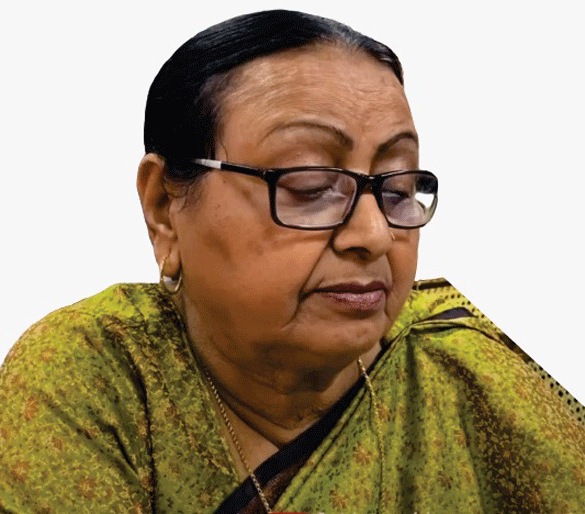
Dr. Salma Mahfooz is the first Muslim woman in the world to break this myth. She not only earned a PhD in Sanskrit but also taught Sanskrit for 40 years.
Dr. Salma Mahfooz was born in Dibai town, Bulandshahr district, Uttar Pradesh. Her father's name was Ishtiyaq Ahmed and her mother's name was Ehsan Fatima.
She had an interest in Sanskrit since her school days, and her father, Ishtiyaq Ahmed, noticed her interest, encouraged her, and inspired her to pursue this field.
In 1961, she completed high school and went to Aligarh Muslim University (AMU) for higher education, where she chose Sanskrit as her main subject.
Dr. Salma Mahfooz completed her PhD in Sanskrit from Aligarh Muslim University in 1969. She conducted her research on “Sanskrit Natko me Nayika Bhed” ("Types of Heroines in Sanskrit Dramas,") which she completed under the guidance of Dr. Ram Suresh Tripathi.
Despite being a Muslim woman, she chose Sanskrit for her higher education. She argued that
"Religion has its place, education has its place. The two should not be mixed."
She proved this statement to be true. While she made Sanskrit her medium of education, she also followed Islam faithfully. She says,
"I am a devout Muslim. I have studied the Gita, Vedas, and Upanishads, but that has never prevented me from performing Hajj, Umrah, Namaz, or fasting."
Dr. Salma Mahfooz never allowed a conflict between education and religion. She fulfilled her duty by maintaining a balance between the two.
She wrote a book titled A Critical Study of Sirr-e-Akbar vis-a-vis The Upanishads, which is based on Dara Shikoh's Persian translation of the Upanishads. She has also conducted research on the Bhagavad Gita, and her books on this subject have been published.
Referring to her research and passion for the Bhagavad Gita, Dr. Salma Mahfooz said,
"I loved the Gita very much. I have been teaching it since the beginning... I know half of it by heart. I love many of its verses, such as 'Nainam chindanti shastraani nainam dahati pavakha...' It is a beautiful account of the immortality of the soul."
After completing her PhD, Dr. Salma Mahfooz began her professional career teaching Sanskrit at Rani Bhagyavati College in Bijnor.
After teaching in Bijnor, she went to Iraq for a comparative study, where she researched the similarities between Hinduism and Islam.
Upon returning from Iraq, she was appointed as a lecturer at Aligarh Muslim University. This marked the beginning of her long-term academic career, where she served for over 40 years. Gradually, she rose to senior positions in her department and eventually retired as the Chairperson of the Sanskrit Department at AMU.
As a Muslim woman, she often says about being a Sanskrit teacher,
"There is no connection between language and religion. A teacher is always a teacher."
During her academic career, she mentored over 15 PhD scholars. Under her guidance, students conducted research on the Mahabharata and other ancient texts.
She says,
"Being a Muslim, I never faced any discrimination while teaching students from other communities."
Dr. Salma Mahfooz was awarded the 'Aligarh Ratna' in 2015 for her literary and academic contributions, and has been honoured with the 'Vidya Ratna' for her extensive research and promotion of Sanskrit literature and ancient Indian texts (such as the Vedas, Upanishads, and the Gita).
In November 2019, Dr. Feroz Khan was appointed as an assistant professor in the Department of Literature at the 'Sanskrit Vidya Dharma Vigyan Faculty' (SVDV) of BHU.
A controversy arose over the appointment of a Muslim professor to teach Sanskrit, with a section of students protesting the appointment, arguing that a non-Hindu person could not teach them subjects related to Hinduism, culture, and rituals.
Dr. Salma Mahfouz, who has been a Sanskrit teacher for nearly 40 years, was deeply saddened when she learned of this controversy. She said:
“I cannot understand these controversies. I would simply say, let things be as they are. Otherwise, why would there be so much uproar over a language?”
Dr. Salma Mahfouz is a living example that a person of any religion can choose any subject and language while faithfully practising their own religion. Religion never imposes restrictions on learning any language.
…
Afroz Khan is a teacher by profession who writes on women, politics, communal harmony, and Islam. She holds a master’s degree in Education.
URL: https://newageislam.com/islam-women-feminism/salma-mahfooz-broke-myths-/d/138383
New Age Islam, Islam Online, Islamic Website, African Muslim News, Arab World News, South Asia News, Indian Muslim News, World Muslim News, Women in Islam, Islamic Feminism, Arab Women, Women In Arab, Islamophobia in America, Muslim Women in West, Islam Women and Feminism