
Ram Navami: Reclaiming Ayodhya as a Shared Sacred Space!

By Ghulam Rasool Dehlvi, New Age Islam
27 March 2026
Main Points:
· Ram Navami as a Moment for Reflection: The occasion of Ram Navami is an opportunity to reclaim universal values embodied by Shri Ram—justice, compassion, and moral courage—as shared ethical ideals across communities.
· Ayodhya Is Shared Spiritual Heritage: Ayodhya should not be viewed solely through the lens of the Babri Masjid dispute; its civilisational and spiritual significance is far older and broader. The city represents a confluence of traditions—home to Rishi-Munis as well as, in certain Indo-Islamic narratives, Ambiya and Auliya—reflecting India’s deep-rooted spiritual pluralism.
· Sufi Interpretations Build Bridges: Indian Sufi thought has historically created conceptual bridges between Islamic and Indic ideas—viewing prophethood in ways that resonate with concepts like avatar, fostering mutual understanding and scriptural syncretism and thus an integration.
· Personal and Civilisational Reframing: Experiences and narratives—like a madrasa student visiting Ayodhya—demonstrate how engagement beyond politics can reshape perspectives and deepen interfaith appreciation.
· Reclaiming Ayodhya as an Oasis of Coexistence: Ayodhya can be reimagined as a symbol of spiritual symbiosis, where traditions meet and enrich each other, rather than a site defined by conflict—inviting Indians of all faiths to reconnect with shared heritage.
As India celebrates Ram Navami, it is worth pausing to reflect on Ayodhya not merely as a site of conflict, but as a symbol of shared spiritual heritage. For centuries, this ancient city has been a meeting ground for diverse traditions—home to Rishi-Munis, Ambiya, and Auliya—and a reminder that India’s civilisational fabric is woven with coexistence, dialogue, and reverence.
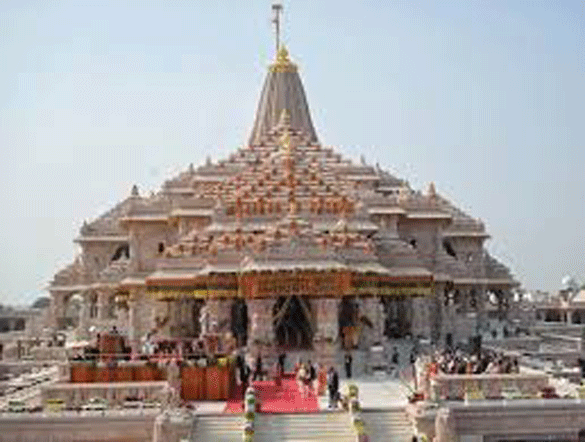
At a time when identities are often narrowed and histories selectively remembered, Ram Navami offers an opportunity to reclaim Ayodhya’s deeper significance.
For many Indian Muslims, Ayodhya is inseparable from the memory of the Babri Masjid dispute. That memory is real and cannot be ignored. Yet, to define the city solely through a single episode is to overlook its layered spiritual history. Ayodhya is larger than one moment in history—it is a space of convergence where multiple traditions have found meaning, reverence, and connection.
My own understanding of Ayodhya began in 2005, as a madrasa student at Jamia Islamia in Raunahi, Faizabad. I had travelled to appear for the Maulvi/Munshi examination, but what I encountered was far more formative.
I met a local Muslim social activist, Dr Ambar Siddiqui, who took me to the Ram Janmabhoomi site and shared narratives linking the city with revered prophetic figures—Nabi Sheesh (A.S.) and Nabi Nooh (A.S.), including a site locally called the “26 Ghazi Mazar.” These accounts, whether historical or symbolic, expanded my understanding of Ayodhya as a place of shared sanctity.
Stepping into the birthplace of Shri Ram, I experienced a profound shift. At 15, my early spiritual awareness deepened. India revealed itself not just as a land of diverse religions, but as a sacred geography shaped by Ambiya and Auliya, alongside Rishi-Munis.
Shri Ram appeared to me as a universal moral presence, embodying justice, sacrifice, and ethical courage. This insight aligns with the observation of Allama Iqbal, who described Ram as “Imam-e-Hind”—recognising greatness beyond religious boundaries.
Indian Sufi traditions have long offered a vision of prophethood as spiritual illumination—a Noori Bashar rather than merely human. Some Sufi thinkers even drew parallels with the Indic concept of avatar, not to equate doctrines but to build bridges of understanding.
Sheikh Abdul Aleem Aasi Ghazipuri of the Khanqah-e-Rashidiyya expressed this in poetry:
Wahi jo mustawwi-e-arsh hai, Khuda ho kar
Utar pada hai Madine mein Mustafa ho kar
These mystical expressions reveal an effort to communicate spiritual truths in a language that resonates across traditions—something familiar within the Indic worldview, where divine manifestations are widely accepted.
Stepping back from politics, Ayodhya emerges as more than a location—it is a symbol of shared sacred memory. The city is remembered not only for Rishi-Munis, but in certain traditions as a place connected with Ambiya and Rusul (prophets and messengers).
This resonates with the Quranic message: “And We certainly sent into every nation a messenger.” Historical records, too, reflect this layered understanding. In Ain-i-Akbari, Abu’l Fazl describes Ayodhya with reverence, highlighting its importance within both Hindu and Muslim consciousness.
Reducing Ayodhya to the memory of Babri Masjid is to narrow its meaning. A painful chapter need not define a city whose history spans centuries. Today, the challenge is to reclaim Ayodhya as an “oasis of spiritual symbiosis,” where traditions meet, converse, and enrich one another—without requiring theological compromise, but with civilisational confidence.
Ram Navami, therefore, is not only a religious celebration. It is an occasion to reflect on universal values—justice, compassion, dignity, and moral courage—that transcend communities. In this context, Ayodhya can serve as a meeting ground of spiritual ideas, embodying India’s pluralistic ethos rather than its divisions.
To encapsulate the whole idea, the city’s significance extends far beyond the Babri Masjid dispute, encompassing centuries of spiritual and civilisational history. Ayodhya has been home to Rishi-Munis, Ambiya, and Auliya, reflecting India’s tradition of interfaith coexistence and it is time we reclaimed its sprit as an oasis of mutual respect and reconciliation. Indian Sufi traditions interpret prophethood in ways resonating with Indic concepts like avatar, fostering understanding across communities which greatly help us achieve this noble inclusive cause. As Shri Ram’s life exemplifies universal values—justice, compassion, moral courage—that transcend religious boundaries, the city can be reimagined as a space where diverse traditions meet, interact, and enrich one another, rather than being defined by conflict.
While Ram Navami naturally draws attention to Shri Ram in Hindu tradition, it is also an opportune moment for Muslims to recall the Ummah’s Wise Man in India, Hakeemul Ummat Allama Iqbal. In his poetry, Iqbal offered six couplets celebrating Shri Ram as a moral and spiritual exemplar, referring to him as Imam-e-Hind:
Labrez Hai Sharab-I-Haqiqat Se Jam-e-Hind!
The cup of Hind overflows with the wine of truth.
Sab Falsafi Hain Khitta-i-Maghrib Ke Ram-e-Hind
All the philosophers of the Western world are admirers of Ram of India.
Yeh Hindiyon Ke Fikr-i-Falak Ras Ka Hai Asar,
Rifat Men Asman Se Bhi Ooncha Hai Bam-e-Hind
The refined thinking of Indians elevates India’s stature even above the sky.
Is Des Men Huey Hain Hazaron Malak Sarisht,
Mashoor Jinke Dam Se Hai Duniya Men Nam-e-Hind
Thousands of angelic souls have made India’s name famous throughout the world.
Hai Ram Ke Wujood Pe Hindostan Ko Naz,
Ahl-e-Nazar Samajhte Hain Jinko Imam-E-Hind!
India is profoundly proud of Ram’s very existence; to the discerning eye, he is Imam-e-Hind.
Ejaz Us Chiragh-E-Hidayat Ka Hai Yahi,
Raushan Tar As Sahar Hai Zamane Men Sham-E-Hind!
Talwar Ka Dhani Tha, Shujat Men Fard Tha!
Pakeezgi Men Josh-E-Mohabbat Men Fard Tha!
The light of righteousness he embodied makes India’s evening brighter than the morning elsewhere; valour, bravery, purity, and love were unmatched in him.
These deep verses reflect a vision where Shri Ram is not only a revered Hindu figure but a universal symbol of moral courage, love, and wisdom. They reinforce the Sufi-inspired perspective that prophetic and spiritual light can transcend sectarian boundaries—a vision very much in line with reclaiming Ayodhya as a space of shared heritage.
…
Contributing author at New Age Islam, Ghulam Rasool Dehlvi is writer and scholar of Indian Sufism, interfaith ethics, and the spiritual history of Islam in South Asia. His latest book is "Ishq Sufiyana: Untold Stories of Divine Love".
URL: https://newageislam.com/interfaith-dialogue/ram-navami-reclaiming-ayodhya-sacred-space/d/139430
New Age Islam, Islam Online, Islamic Website, African Muslim News, Arab World News, South Asia News, Indian Muslim News, World Muslim News, Women in Islam, Islamic Feminism, Arab Women, Women In Arab, Islamophobia in America, Muslim Women in West, Islam Women and Feminism