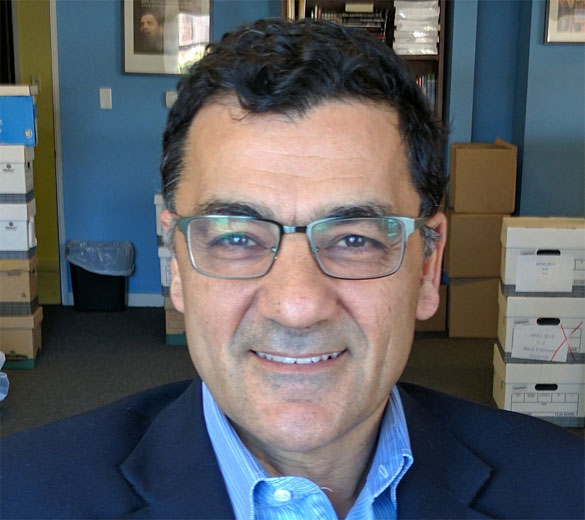
Muslims in the United States need to develop an American Muslim sensibility, but mosques have been a hindrance in the process, says Salam Al-Marayati, President of the Los Angeles-based Muslim Public Affairs Council (MPAC). The organisation works with American Muslims and represents their interests to decision-makers in government agencies, media outlets, interfaith circles and Hollywood studios. In an interview with Saif Shahin of NewAgeIslam.com, Al-Marayati says Muslims in the country and worldwide need “a theology of pluralism and inclusion, not a theology of exclusion and confrontation”. Edited excerpts:
By Saif Shahin, NewAgeIslam.com
How well are Muslims in the United States integrated with the rest of the population?
In general, Muslims are highly integrated, especially in the workforce. They are present in all sectors of the industry. Whether it is professional work—like medicine, legal work or engineering—or blue collar work, you find Muslims everywhere. You find more Muslims now in academia and even in the media. I think that’s an indication of a highly integrated community.
The real challenge is in terms of identity, and the role that the mosques are playing. Many of the mosques in America are struggling with the issue of integration in their own community and the American society at large. They, as a result, sow confusion among young people in terms of what it means to be an American Muslim.
In terms of national conversation, there is an absence of the Muslim voice. Or if there is a Muslim voice in the media, it is fixated on an extremist fringe usually emanating from South Asia, the Middle East or the Horn of Africa. So there is still a problem in terms of the image of Muslims—among the American public, and among Muslims themselves in terms of who they are and how they are defining themselves. And then in terms of political integration I would also think it is a major challenge because there is no voice of Muslims in the policymaking discussions.
Are you saying mosques are hindering the process of integration?
They are not equipped to deal with the issue of integration. I don’t think there is an idea of integration that is organic within the mosques of the United States. They are dictating the national discourse, and it’s usually negative. It becomes very reactionary in terms of engaging others in American society, in terms of providing an identity for young Muslims.
I think mosques in general are still playing catch up. There needs to be a theology of pluralism and inclusion, not a theology of exclusion and confrontation. And I think the global ummah (Muslim community) has the same challenge.
Is this because of the influence of Wahabi Islam?
I don’t think it is Wahabi Islam they are influenced by. I think it’s more the apprehension of applying Islam to a different culture. It’s the same problem with the Shias. The Shias have a similar problem in not being very in tune with American culture. So it’s not Wahabi Islam that is the issue, it’s not necessarily extremism that is the issue. It’s more an issue of stagnation of Islamic thinking in terms of identity, in terms of engagement.
So it’s more of a social than an ideological problem?
I think so. Now, there is a need for an ideology that is progressive, that is connected with culture and is authentically Islam. There is definitely a need for that. But it doesn’t matter whether it is coming from a Wahabi point of view or a Shia point of view. That is secondary. It should come from an authentic Islamic point of view, based on the Quran and the authenticated, non-controversial sunnah (sayings) of the Prophet, but is within the American context. In other words, it has to be releavant to our young American Muslims growing up and our fellow Americans.
The problem is that in many mosques, Islam is Arabised or Pakistanised. It has that foreign aspect. And we need to be comfortable with an American understanding of Islam.
Can you explain how mosques are hindering integration?
You go to a mosque and the khutba (sermon) is about stories of the sahaba (companions of the Prophet). We love the sahaba but using them as the only source of education is very limiting. Or, the khutba is about the rules and regulations for making wudu (ablution), i.e. trivial matters that do not deal with the social realities of our community. Or you go to a conference and they spend six hours on what women can and cannot do during their menstrual cycle. If this is going to be the corpus of religious education in our community, then it is completely irrelevant to the issues that are challenging us today.
Is something being done about it?
There are now more trainings for imams (prayer leaders), there are now more discussions about these issues. For instance, we have a lot of Muslim women in their 20s and 30s who cannot find Muslim husbands because the (prospective) Muslim husbands are marrying non-Muslims. Now we are getting to discuss these issues, talk about identity issues.
You are saying extremism is not an issue, but we still hear of incidents such as the Fort Hood attack or the failed Times Square bombing?
There is certainly extremism, but that’s separate from identity formation. And when you look at identity formation within the framework of radicalisation, that already puts you in a handicap. That’s why I want to separate the two. But are there individuals who become radicalised? Absolutely. And is there an absence of a strong Muslim identity? Absolutely. But the extremists are the exceptions, not the rule.
To what extent did 9/11 induce self-criticism within the community?
It did for a while, but I think much of the mosque leadership went back to the old way. There are only a few exceptions where the mosques are really engaged in identity formulation, engaged with others in a healthy way—based on human equality, which is an essential aspect of tawhid (monotheism)—and in terms of reforming the understanding of Islam so that it is relevant and applicable to young people and to American society.
Are there TV channels or other media in the United States that preach Islamist exclusivism, as there are in the Middle East and South Asia?
They are not that widely viewed. What you find is Iraqis watching Iraqi channels, Syrians watching Syrian channels, Egyptians watching Egyptian channels and Pakistanis watching Pakistani channels.
How are Shia-Sunni relations in the US?
They are cordial at best. But still, there are many problems in terms of relating to one another and I would say it’s the same problem among Sunnis and among Shias as well. There is a lack of good and effective dialogue.
What sort of recommendations does an organisation such as yours offer to the government?
We offer recommendations on policy matters, be it health and welfare of our community, young leaders’ development, identity or other public policy matters like national security, global relations between the United States and Muslim-majority countries.
Where does Islamophobia stand today compared to, say, just after 9/11?
It’s much more intense now. It’s more concentrated and [better] financed than it was immediately after 9/11. So it’s a much more vicious attack against Islam than ever before. And it’s being used in the 2012 elections more than it has been. I believe 23 states launched an anti-Sharia ballot initiative, and that is only so that the right wing can bring voters to the polling booth.
Are there Islamophobic tendencies in the ongoing Republican primaries?
Oh yeah. But I am glad that Mitt Romney came out and said that he did not approve of Islamophobia in the Republican debate.
Saif Shahin is a research scholar at the University of Texas at Austin.
URL: https://newageislam.com/interview/mosques-hindering-muslim-integration-us/d/6584
